
The success of the immortality trials was met with global jubilation, a collective sigh of relief that lasted a happy year or two. Finally, we could all be immortal — not metaphorically, but literally, biologically. Here was infinite durability, the dream of Kings, Pharaohs, Khans, and Conquerors, now available in the form of a routine out-patient operation. It was surprisingly affordable and only took about three hours.
Governments and media declared that death was finished. One less thing to worry about. It was surreal, almost anticlimactic. We were like a cat that finally catches her own tail after a long chase — what would we do with this thing now that we had it?
As the shock and elation wore off, killjoy reality set in. People were still being born but they weren’t dying. The workforce couldn’t absorb the shock of the modern miracle — pensions and retirement funds couldn’t support millenia-long retirements. People were quitting at age seventy and then stubbornly living on forever. The miracle of the Telomere Reinforcement operation had created an unprecedented labor shortage. We learned that even immortals can starve. Death, as it turns out, wasn’t completely finished.
There were awful times — dark decades of general strife and privation. No matter how rough the sledding, no one seriously considered trying to reverse the operation. The genie couldn’t be put back into the bottle, so to speak — miracles can’t be undone.
Today we give thanks to the Eternal State, which led us out of those troubled times. The State’s first decree was that Telomere Reinforcement was a Human Right and in fact mandatory. Fortunately the effects of the Reinforcement are passed down genetically, so only one generation was compelled to queue up. It’s not as bad as it sounds when you consider the gain, really.
The State also decreed that everyone must carry their own weight as long as they wanted to eat — no one lives for free. The universe isn’t designed this way. Every living thing, immortal or not, must find a way to scrounge up three meals a day. The universe doesn’t hand out meals– not even to its most cherished children. So we set to our long work.
In the early days, one might’ve been proud of working non-stop at the factories for a millenium. But even without taking a sick day, what was a millenium? Next to immortality, a millennium was a mote. Yet we had to keep on eating thrice a day so we blindly worked for millenia beyond counting, worked and worked, looked ahead and reckoned only work, work that would last until the heat-death of the universe, work that would outlast the lifetimes of the stars and yet still not enough work to fill our hungering mouths. We forgot the faces of our parents and their parents. Memory doesn’t work very well at certain timescales.
Staring down the barrel of labor without end, you’ll understand why some of us try for an early exit. Only crude methods can be used. We live beyond the reach of time but not beyond the blunt force nor the choke of water nor the singe of flame. Thank God we still burn, drown, bleed, and break. We can’t amputate our congenital agelessness but we’ve figured out how to break ourselves the old-fashioned way. It’s our collective fascination — we polished statues, marmoreal and sullen. We sleep in the corners of factory offices, we lie between cogs and flywheels and daydream about high ledges.
I know one or two who have actually done it, you know. Taken themselves out of the workforce. An acquaintance of mine made it up to the roof of the factory two blocks over and swan-dived through a hole in one of the prevention nets. There aren’t supposed to be holes in the nets but she’d spotted it from the street. Somehow she’d gotten onto the roof and leaped down through with the precision of a starving falcon at hunt. She sang beautifully as she came down to her retirement.
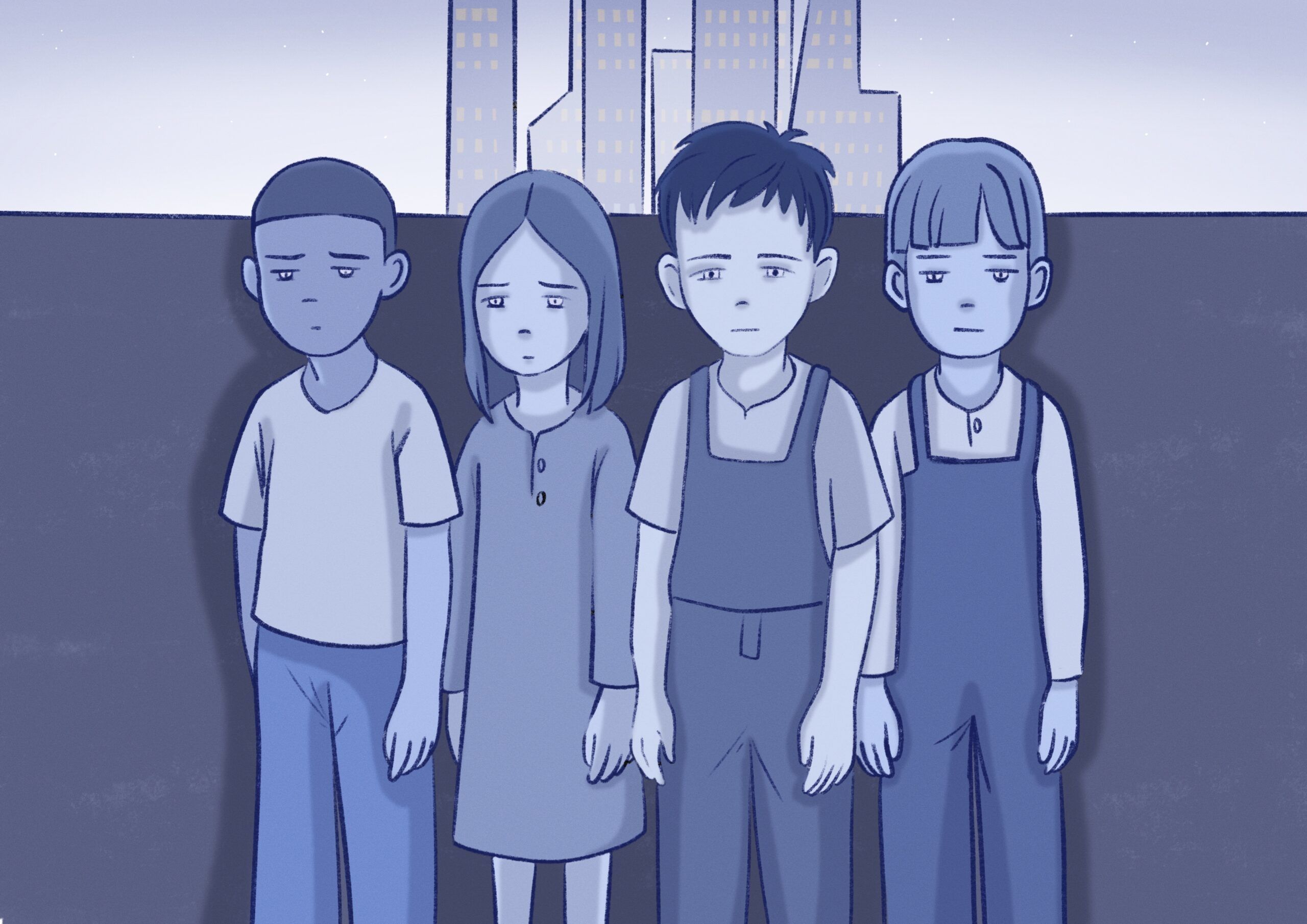
We rushed from our places in the lines and gathered around her viscera on the sidewalk. State Agents arrived swiftly. They had to push through a mob of us but we are small and easily moved. Many of us are still children. The miracle freezes you at a certain random point in your physical development and many of us wear the bodies of children, only children older than mountain ranges and comet tails.
We briefly came off of billion-year shifts to wail like children around that splattered body on the sidewalk — “Take us with you,” “I’m right behind you,” “I’ll see you soon,” things like that. We love raising a fuss. That might’ve been yesterday or it might’ve been last century — memory doesn’t function well on a certain timescales, it must be admitted. Memory didn’t evolve with the miracle operation in mind.
Some time ago, the Eternal State, in its wisdom, gave us our Allotments. Myself and all the other children in my Unit each have an Allotment. Allotments keep us off of rooftops, keep us from cutting holes in the nets for swan-diving, keep our fingers out of electrical sockets. The Eternal State developed the Allottment Program as protection against mass suicide, as a workforce motivator. It’s our great efficiency catalyst. It’s been proven that an Allottment written on your arm is actually more effective at preventing suicide than a hundred roving State Agents.
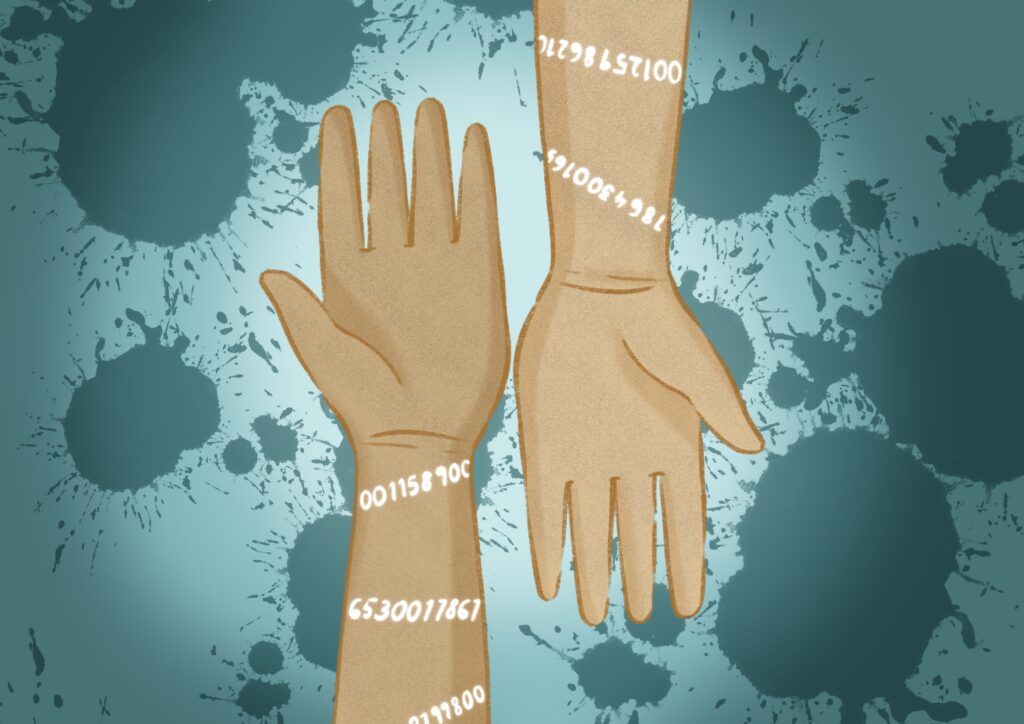
It works like this: at the inception of the Program, everyone alive was given an Allotment number. The number shows the remaining time that the bearer must spend working. The numbers are generally high — my number is still given in scientific notation. I’m not sure if there’s an “-illion” word for it. I try not to check my balance too often, but it’s displayed on our forearms and it’s tough to miss. Newborns also get a number. The State is very encouraging of our breeding, by the way — we play a game where we guess at how high the Allotment will be for baby.
It’s strangely comforting to watch the seconds tick away, to watch the milliseconds dance over the veins of your forearm, to stay up until midnight to watch the bigger digits drop. The digits at the end — seconds, minutes, hours, days — those jog along well enough, but the overall pace is glacial. Still, watching your Allotment tick away is a pastime. It keeps us busy for hours. We love watching the numbers on our forearms or the forearms of our babies.
When you get to zero, you get the right to retire. The State offers a choice of a few sanctioned methods to effect the retirement. The singing swan-dive isn’t on the menu. The State-sanctioned retirements are cleaner and done in private. It must be done immediately — we’re not set up to support someone living off the fat of the land. Plus, after a certain amount of time, there’s only one thing left that anyone wants to do anyways.
People — not me, certainly, but many that I know — still try to skirt the system. People are always trying but the State doesn’t make it easy. Rooftops are closely monitored, although most buildings aren’t high enough for the jump to kill anyways. We have no guns, no strong ropes, no belts, no knives, no live wires. Ours is a society without sharp edges, without poisonous things in the mouse traps or cabinets, without fire or water. People still try using whatever method they can — we get creative. We’re always on the lookout for opportunities or ideas but rarely does anyone take action or do anything illegal. The epochs of our factory Allotments have made us pretty docile.
There was a man in my Unit who’d gotten a tip about the ruins of a bridge in one of the abandoned districts. At such-and-such a time of night it wasn’t well patrolled, wasn’t well-lit, and you could get there easily enough if you were willing to crawl on your belly for fifteen or sixteen hours. What of it? That’s a mote.
So he bravely made the crawl, gained the bridge, and stepped out onto the edge. There were trillions of hours left in his Allotment. The tale of those years was written right there on his forearm with millisecond precision in a font small enough to accomodate the many digits. The man on this bridge had decided that this wasn’t a life at all, it was a waiting room. There are plenty of things to do, see, eat, smell, hear, and touch, but after enough time it’s just work for the sake of putting calories into your belly and the belly is never, ever full. The State holds that no one was entitled to life while their Allotment still had a balance and yet no one was here by consent. How couldn’t he jump?
None of this is how I feel, by the way. The man on the bridge felt that way, not me.
So this man had resolved to jump and see what was at the bottom. It certainly wasn’t a net. He took a running start and ran towards the edge — towards his illegally early reward — and at the last minute, a State Agent tackled him and pinned his arms behind his back.
“Please,” the jumper sobbed into the pavement, “I didn’t ask to be here. I didn’t ask to have my Telomeres fixed or regenerated or whatever. I want to be like the trout in the old streams or the rabbits in the old glens or the flies that only live for one day. I think God accidentally put an animal’s brain in my head instead of a human’s brain. This is all a mistake — His mistake — let me put it right.” The State Agent sighed and carried him back to his squad car. The jumper bawled in the back seat — not crying the way adults do but the way a little child might, with total abandon, using his entire body, punching the seat and convulsing and spitting.
After he calmed down the State Agent took him out for coffee. “I’m not going to arrest or even arraign you,” the Agent explained. “I like you. In fact, because I like you so much, I’m going to let you in on a State secret.” He leaned in and whispered to the man in despair: “The truth is, we don’t really care if you kill yourself. We budget for quite a few suicides in our labor projections. Plus, if people didn’t try, there’d be quite a few of us Prevention Agents out of work!” The Agent chuckled and tore open a sugar packet. “Sure it’s a risk for morale, but we’ll get the work hours either way.”
He poured the sugar into his cup of steam where it dissolved and he went on explaining. “One thing they used to say of suicides, back in the darker ages — ‘think of your children.’ Well — think of them now! I know you have a few — there’s no one alive who hasn’t welcomed a few dozen into the world. When someone slips through the net and makes it away, we just take their remaining hours and disburse it to their next-of-kin. Why do you think the Allotments are so high? Think — what do you think happened to your Grandfather? What about your Great-Grandfather? How do you think they met their end? What of their hours? Have you ever rolled a snowball down a mountain? Do you know that no one’s ever made it to the end of an Allotment?”
The jumper started crying again — not loudly this time, just a quiet sob into his coffee. Day was breaking. His shift started soon. The State Agent took a sip and glanced outside.
“On a long enough timescale, everyone eventually finds their bridge. Where’s your Great-Great-Grandfather? Hm? Your Great-Great-Great-Grandfather? And what about his Father? I can keep going, we have time.”