
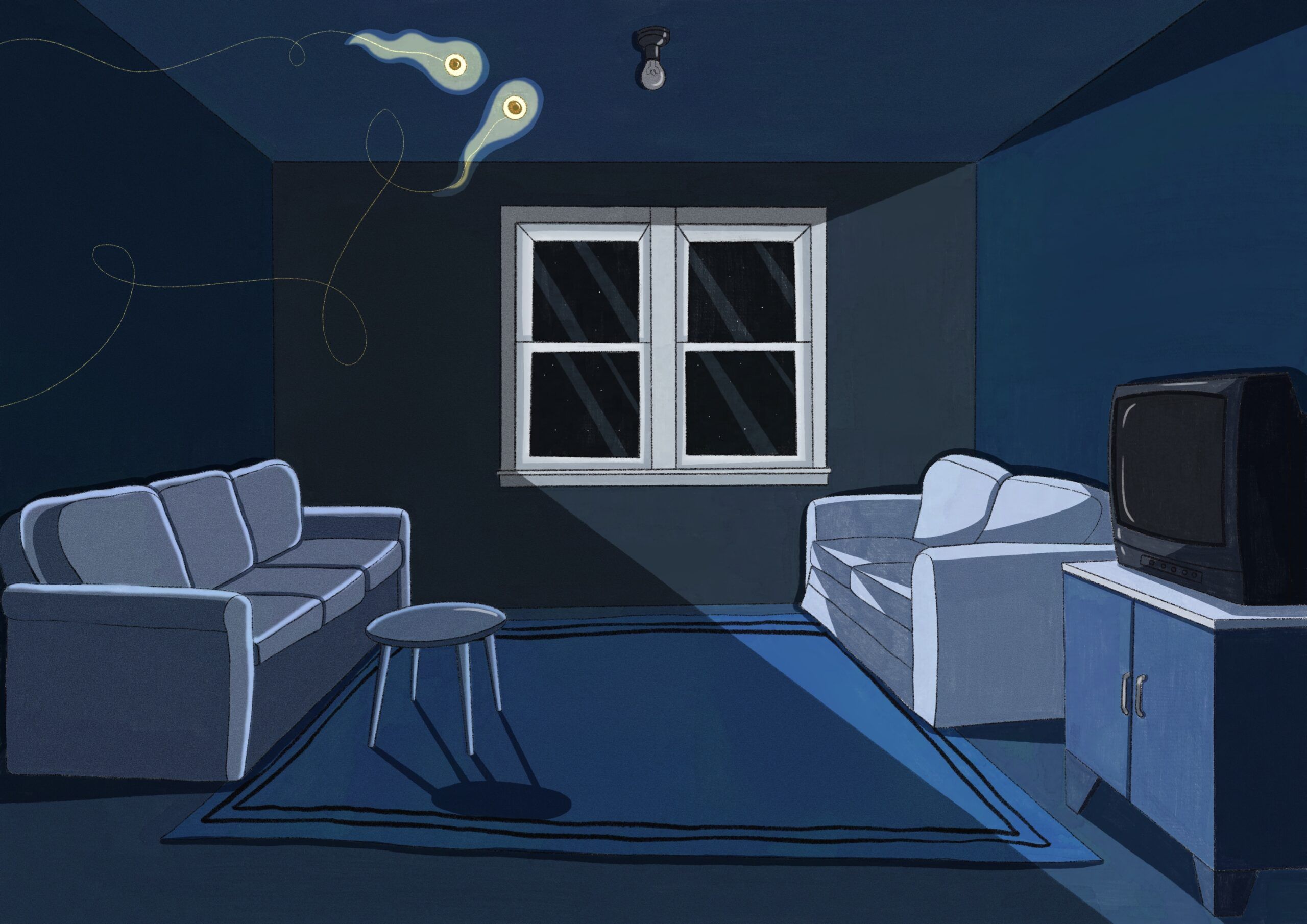
Ten men clad in navy blue moved like centipedes through the first floor of the three-story tenement. Their pale skin poked from under Balaclava masks, showing the scars from recent eye-replacement surgeries. A semi-automatic rifle pressed to each man’s chest, and a handgun strapped to each thigh.
The three o’clock freight train clattered down Old Dixie Highway, muffling the men’s boot steps. Three men separated from the group to inspect the next landing, peering around the corners. They signaled for forward movement. Agamas scampered under variegated crotons and hibiscus shrubs bordering the stairwell. Three more men took the lead to the second floor. They rounded the corner as the lime green door to apartment seven opened. Four gloved hands grabbed the man existing the apartment.
“Solin Isidor Marshoot, You’re under arrest for money laundering. You have the right to remain silent. Anything—”
“You mean Marchaud.” Solin said. “My last name is pronounced Mar-show.” The bag of garbage he held sank to the ground beside him. He bent his knees to the ground, complying with the instructions barked at him. He noticed the words “police” and “ICE inscribed on the back of his captors’ jackets.
Solin’s eyes popped out of their sockets and floated above his head. An agent with a crusader tattoo under his dislodged sleeve twisted Solin’s arm, swatting the eyeballs away with his free hand. The eyes moved closer to the ceiling away from the agent’s reach. Solin’s bones creaked under the pressure of the agent’s knee. The folded skin on Solin’s forehead unpleated; his mouth and hollowed eye sockets widened. Pain shot from his crushed chest. Two gloved hands zip-tied Solin’s brown wrists behind his back. The gold rings on his pinkies tightened. He trembled and whimpered like a wounded dog. One agent booted him in the chest. Solin did not want another chest-breaking kick, so he wriggled his bound wrists, finding the small tattoo of a red, pierced heart in the space between his thumb and index finger. Pinching that Tattoo took his mind off the other fires in his body and thoughts about his capture. Laundry? They are arresting him for laundry; he repeated in his mind.
Another agent whose biceps looked like the hindquarters of a steed had Solin in a headlock. Solin’s black and pepper locks cascaded over the agent’s arm, giving the look of a horse’s arse and tail. The trash bag Solin had been carrying out of his apartment now a wedge. Soft sunlight shimmered through. Solin’s dispatched his shaking eyes until they narrowed on the agents scurrying like cockroaches around the apartment.
Thousands of creeping figs, pothos and philodendron vines crept out of floral water tubes attached to the walls. Several tendrils of English Ivy hung over a small radio whose red wires fed four speakers emitting low rumbling drums and intermittent shouts of “Ayi-bobo!” in an unbroken loop. Open tubes of paint and worn brushes laid on a makeshift easel. A woman, naked of clothes, covered with eyes, hung on the canvas. On the purple settee, the life-sized doll faced the painting with legs crossed, showing the coffee toned, sheer stockings and designer patten leather pumps. The doll’s pearls had eyes painted on them, and they gleamed against the sunlight suffusing through the open door. Her tweed jacket hugged her generous curves.
The tallest agent climbed on top of her, gyrating. The others laughed. Sol wanted to dock his eyes in their sockets to shield himself from seeing this harassment of his long-time companion, but he feared they would tie his eyes down or put a hood over his head to prevent any future dispatch.
The mop leaning against the wall dripped brown water emitting the intense, clean scent of Fabuloso. The agents’ footprints created a crisscross pattern of mud prints over the glistening floor. Dishes and silverware clattered from the emptying cabinets above the small stove; agents threw everything down. They opened the refrigerator and dumped the four apples onto the floor. They broke twelve eggs. One agent used a knife to poke the tray of chicken thighs thawing on the second shelf. They dumped the mayonnaise in the sink. Solin watched the destruction of his food. Twenty-nine dollars down the drain, he thought. He wanted to scream at them but feared they would bludgeon him. He folded his lips in so that he would not make sounds as the dead faces of others ICE had captured in the neighborhood surfaced to mind.
Solin now on his stomach on the floor, agent Horse-arms bent to look under Solin’s bed, a single cot in the corner. Solin’s floating eyes whirred and trembled. Not there. Anywhere but there.
“Can you put those fucking things back in your head?” Horse-arms said, pulling boxes from under the bed. Before Solin could reply, Horse-arms said, “Looka here looka here looka here.”
Horse-arms mouth hung open, staring at the box full of cash. One by one the other agents peaked in, raising their eyebrows.
“Let’s go pendejo,” the tallest agent said, lifting Solin by the bound wrists.
They carried Solin like a duffle bag. They carried Solin by his tied arms. They carried Solin by his tied ankles. They carried his floating eyes in a net the way one would transport trapped butterflies.
********
At about three in the afternoon, shadows approached apartment seven. I positioned myself by the window, mounting my cell phone between the slats of my blinds. At about three thirty I caught them carrying Mr. Solin, Sol, as we, residents of the Dixie Land apartments, call him.
“My arms hurt” Sol said. They dropped him. Sol winced. One stocky agent kicked him in the face so hard I swear I could feel it. I wanted to cry out, but I remained hidden.
“Shut the fuck up, you filthy dog.” The agent spat on his face, the splatter coating Sol’s cheek.
I caught that five second footage and sent it to Eyewitness News. While I hid under my kitchen table, I texted and emailed the video. I told the news crew to hurry. ICE had come to the building before. Two weeks ago, when they came, Sol had not been home. Instead, they had taken Jesula from apartment three. I did not get any footage then; I hid under my bed at that time. I did not open the door. Jesula had opened her door. They banged for a few minutes, and I thought they would break the door down. A sigh escaped my mouth. This time, I found the courage to get a record, to face those shadows or else I would see them in my dream, chasing me.
Next, I sent the same text to my cousin Gypsie.
Why would they take a seventy-five-year-old man? Gypsie typed back.
IDK. Please help him.
I pondered the question, and I could not think of any reason; Sol being the most trustworthy, honest, peace-maker I knew. He would give anyone his eyes.
A few months ago, when the men in civilian clothing started picking up women off the street and taking them away in unmarked vans, fear like construction foam expanded at the base of my feet, freezing me in place. I rarely left the apartment. I painted the verse Joshua chapter 6 verse 7 above my door. Be courageous.
“You’re being such a case,” Gypsie said, folding her manicured hands while she leaned against my door. After a month of my voluntary lockdown, she came for proof of life a week ago.
“I’m being a case? You should have heard Jesula’s screams, and the trail of blood left on the steps after they took her.”
“Cicelie, nothing is going to happen to you,” Gypsie said. “You’re an American.” She pocketed her fancy phone that vibrated every ten seconds. “Clients. ICE is keeping me busy.”
“It must be nice.”
“Oh, yeah? How do you really feel?”
I averted my eyes. A voice in my head reminded me about Gypsie being my only known and living relative. At twelve years old, twice my age, she came looking for me; satisfying a promise to her mother. “Find your little cousin,” her mom told her as her mom lay bleeding on 79th street. Her mother never had a chance against the stray bullet. Gypsie had looked out for me—even when she worked two jobs and attended law school at night.
Looking at Gypsie, I took a deep breath. I wondered where I would fall if I were captured. Being born right here at Jackson South Hospital may not matter much. I grew up in foster care. Two years emancipated and trying my best to do something with my wages from my two jobs—security guard at the library during the day and at Fed Aid Credit Union at night. If I had the money to get eye surgery, I might have a chance to evade ICE. Deep down inside, I know I am an American nothing.
********
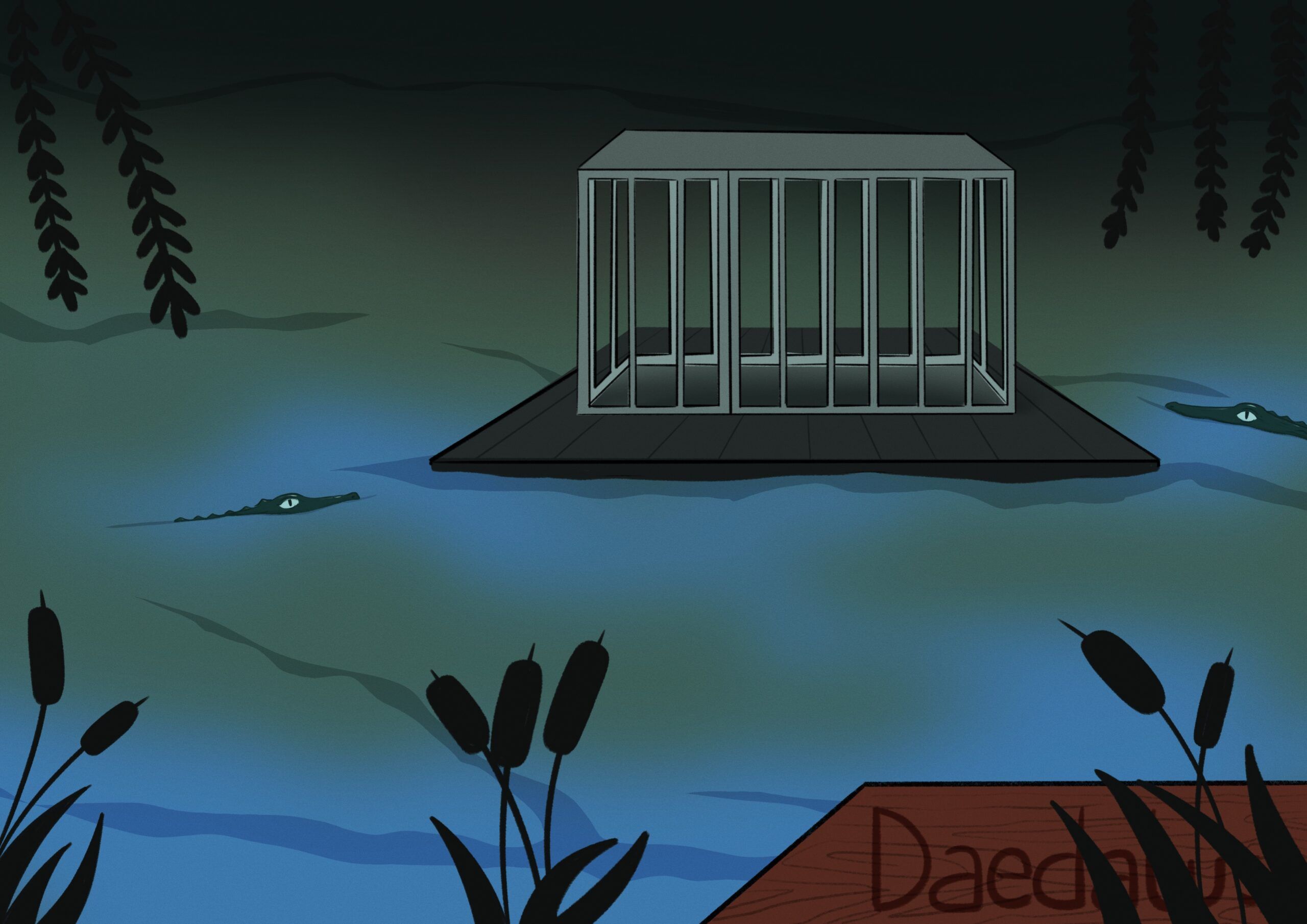
“Six PM. Wake up. Time for work,” the alarm repeated in a sultry voice. It surprised Sol that the agents allowed a prisoner to have a phone. A red-faced man whose arms were bound above his head and who sat across from Sol wiggled his hip and the phone fell. A prisoner to the left of Sol managed to grab the slipped phone and silenced it. The other prisoner’s head bobbed with each bump the van hit. Sweat rained down from their greasy heads. Sol knew they were like him; they didn’t have the energy to cry. The van took countless winding roads. Sol stopped counting after the fiftieth right turns. Each time, the sudden jerks shoved him away from the other prisoners for a brief, clean breath. The heat in the van abated momentarily when the wind came through the window as the van accelerated. Several times, the van stopped and had to back up and take a left or make a U-turn. That’s when the heavy heat had them wheezing. On one road, alligators sun-bathed on both sides. They lifted their snouts at the noise of the van, and a couple slid back into the swampy depths. A few followed the van and then stopped after twenty feet or so.
The faded entrance sign leaning at the bottom announced their arrival to Daedalus Detention center. Coral stone squatted into an arch. Chains at Sol’s waist linked him to thirty-two other men. They descended the van and lined up in front of a row of armed guards.
“Pod sixty-three, put your shoes, clothes and everything on you in this clear bag.” Sol recognized Horse-arms voice. The chains clanged when the thirty-two men bent and twisted their bodies into compliance. “Take a marker and write your name and the ID on the plastic bag,” Horse-arms said.
A barge pulled up. Sol wondered who had built the cage. If it had been his construction crew, there’s no way there would be soldering gunk at the base of the cage’s posts. He stared at remnant of lead smeared at the base of each post. This pointed to the cage’s precipitous assemblage. Sol spotted a tarp above the floating cage.
“Don’t put your feet outside. Don’t lean on these bars. Some had to find out the hard way,” an agent about four feet tall said, the name “Rubio” was inscribed on the back of his orange vest.
“Come’on Little Marko, where’s the fun in telling them? Let the fuckers find out on their own,” Horse-arms said.
Rubio grinned. “If it is raining or the sun is too high, untie this rope and four people can maneuver the tarp to cover your cell.”
Sol’s floating eyes climbed to the top of the cage to inspect the tarp, and found it to be thin and missing many gromets.
“There are thirty-two sleeping bags for you to do whatever you want to.” Horse-arms said. “We suggest you sleep in them. There will be no fucking around in the cell.”
Once all the men were on the barge, Little Marko removed the chains, and the men could move around the twenty-by-twenty floating cell. Horse-arms closed the cell door with a humungous padlock, and the floating cage pulled away.
That night, Solin stared into the darkness of Daedalus Detention Center, his two eyeballs floating out of his head again. Sol’s eyes were two bright orbs navigating the convoluted space, leaving behind a thin gold string that his body could not follow.
The men smacked mosquitoes, creating a concerto that the warden loved to close his eyes to hear. Sixty-five pods, each filled with thirty-two men in just two days. Small hands played the solo in three movements. The rest were moving orchestras clapping away. Their piercing yelps a punctuating climatic crescendo. Mash Kumar turned down the sound of his favorite show, MASH. He loved it so much that when he became an American citizen along with ten members of his family, he changed his birth name from Mashudu to just Mash. Now, he watched the new recruits. Small hidden cameras in the cells fed hundreds of screens. He saw the floating eyes. He picked up the walkie talkie, “Kumar to Base.”
“Base clear for go.”
“Bring me the floating eyes of the recruit from Pod sixty-three after dinner. President Führer arrives tomorrow at fourteen hundred hours.” Mash didn’t need to explain how this would be an issue for the Fuhrer, a man who wanted loyalty and normalcy above all else.
“Roger that. I’ll bring them in two hours. Stet.”
It baffled Mash when his eyes popped out of their sockets a few years back. How and why, had he gotten that bug? He could not find the words to thank a long-time family friend, Dr. Shah, who burned them. Dr. Shah replaced them with glass eyes so that he could better serve President Führer. The first executive order President Führer enacted decreed the imprisonment of anyone who could not look upon his nakedness. Those waiting for the procedure could wear special glasses. Those who joined ICE or the police force received the operation immediately. Dr. Shah performed forty to fifty eye replacement surgeries a week, he boasted to Mash.
Often Mash’s glass eyes didn’t work in synchronization. They looked in opposite directions. Sometimes they met at the sclera and remained stuck like automatons out of battery power.
********
Gypsie Cola pushed the cellphone into Horse-arm’s face. “That’s your ugly head in this video. You’re holding my client in this fucking concentration camp,” Gypsie said. Horse-Arm’s glass eyes moved slowly from her lips. His tongue stuck out a bit to taste the air. She almost expected to see a forked tongue. His eyes moved like a camera tilting down from her throat to her cleavage.
“I thought you had a wife?” She gave a pointed look at the crusader cross on his left arm and the 1488 tattooed on the right arm.
He held his arms behind his back, trying to hide the tattoos.
Gypsie laughed, shaking her head, “That hate never stopped your grand-pappies on the plantation,” she said, showing him both middle fingers.
“I would like a private room to speak with my client now.”
“I’ll open the interrogation room, but all conversations on premise are recorded,” Horse-arm said.
Three texts and two email messages later, Gypsie watched Solin Marchaud trudge behind agent Rubio.
“Mr. Marchaud, I’m Gypsie,” she said, extending her hand. “We’ll speak Kreyol to discourage the eavesdroppers here.” She pointed to the light fixtures at each corner of the room. Sol’s face looked like a piece of laundry that had been forgotten on the line. Gypsie unscrewed the top of her tall metal water bottle and gave it over. He gulped down the lemon-infused water. His floating eyes lost their red tint. “
“Are they giving you water?”
“The same water that goes to the one toilet is the same the water we must drink. It smells like human shit and fish.”
“I’m sorry,” she said, covering his wrinkled hand. He smiled at the first real human touch since his capture. She recognized the question in his eyes. “My cousin, Cicelie, from your building, sent me the video of your arrest. I’m going to get sanctions taken against the two officers who kicked you and manhandled you.”
Sol waved his hand listlessly in the air, shaking his head.
“It might not do anything, but we have to try. So, they accused you of money laundering, do you know what that means?”
“Does it mean that I took money from the laundromat? I always put all the coins in.”
“No,” Gypsie said, exhaling. “It is a crime where people accept monies from drug dealers or other illegal dealings, and they try to put them into legitimate businesses. They call it washing dirty money.”
“I don’t know anything about that.” He twisted his hands together in his lap.
“They claim they found twenty thousand dollars in your apartment, and your bank gave them a list of large deposits you have been making for two years now. You know, your temporary Protected Status, TPS, ended the day after you were arrested. Armed with what they are calling evidence, they feel like they have a good case to deport you back to Haiti,” Gypsie said, watching the way Sol’s eyes returned to dock in their sockets.
He looked at her squarely and said, “I’m not guilty of this crime.”
In Sol’s eyes, Gypsie could see what Cicelie described as disarmed honesty. Then. Sol’s floating eyes approached her, and like a television screen, they projected an image of Cicelie holding a 1-gallon plastic bucket—a recycled butter receptacle. Cicelie opened it. She had a paintbrush. She put on a face mask. She started to smear the content of the bucket onto a door. The name on the door is Rachelle Bovin.
“Oh, that’s the infamous shit smearing,” Gypsie said, recalling her cousin’s version of this incident, which included tales of Rachelle dodging her and standing her up when it came time to Cicelie to get her money.
“This stunt got Cicelie banned from the community,” Gypsie said.
“After Rachelle came home to find her door covered in shit, she panicked and left with nearly fifteen thousand dollars from the community. Everyone in the tenement were furious because Rachelle ran away with their money. That’s when I took over the sol. What could I have done?” Sol said.
“You did nothing wrong. This is our ancestral banking system. It’s ironic that your real name is Sol and you manage a sol. It’s like destiny,” Gypsie said, laughing harder when Sol laughed also.
“Tontine, sol, or sousou has been our way of banking way back from the motherland. That money they found under my bed is not my money,” Sol said.
“So, this money they took from your apartment is the tontine, sol money?”
“Each person has a share or hand. Specifically, this week is Gerard’s hand. He should receive that money tomorrow so he can take it to his lawyer. His wife and four children are being held in a detention center probably quite like this in Mexico,” Sol said.
The eyes twirled twice. Through them, Gypsie could see a woman pinned down by several drunken men in uniforms ramming into her as if the space between her leg an abandoned cave. Gypsie closed her eyes; tears escaped the sides of her closed lids. When she regained her composure she said, “I will go tonight to the building and get an affidavit from each person who’s part of this sol. I will make a motion before the judge so that we can get you released.”
“Don’t worry about me. Get the money to Gerard to get his wife out of that place. Please.”
“Can you tell me each person’s name and how much each person has put in the pot? I can get the affidavits done tonight. I will file an emergency hearing to get you out immediately. It might be delayed because the president is coming here,” Gypsie said.
********
Sol lay in his sleeping bag. The water licked the side of the barge. He coveted the plop-plop summersaults of restless fish. He wanted to be like the rustling leaves cooled by the light wind. The heat hovered over them the way a hen would ready eggs. Their bodies looked ready to hatch. The strangled screams of prey didn’t alarm him. The men laid on top of their sleeping bags.
His floating eyeballs twirled above the cage. He projected images of snow and a cascading waterfall, and he could hear sighs of relief. Some men moved closer to the spot under where he projected visions and images. They did not care what they watched. Sol’s eyes shifted from showing snowy banks.
Nets came over his eyes. They were dragged away from Sol. The golden vein detached and coiled back into each socket. A few minutes later, his eyes trembled when they stared at the glassy ocular cemetery of Mash Kumar.
********
I thought about telling stories when Gypsie told me the news.
“Cicelie, undocumented and even those with TPS status are not sending their kids to school. I’m trying to organize some activities for those kids.”
“You know we had classes online or over the phone during Covid, why can’t we do the same now?”
“Cicelie. That’s a great idea. The parents have phones. You could get books from the library and read to the kids. You can even get the kids to copy down the books.”
The next day, I perused the shelves in the children’s section at the library. The book called me. Hans Christian Andersen’s name loomed above the title, The Emperor’s New Clothes. I began, “Many years ago in a country far waw, there lived an emperor who spent all his country’s wealth on clothes. He wore a different outfit every hour. He never wore the same thing twice. He did not care about poor people, the arts, the military, or visitors to his country.” I paused and asked the children to read back the story. Over two hundred hands went up. I scrolled and chose a child who looked like she was about five years old. She didn’t miss a thing. Over twenty thousand children tune-in at various times for story-hour. They always asked for that story. When I asked them why, they tell me they have seen the emperor on the television.
********
After a twenty-one-gun salute, round, freckled faces appeared on the wall-sized projector. Flaming red hairs in neat tresses that fell over one shoulder and blonde hair neatly parted in the middle, sang, “Jesus by your precious blood, I surrender. Wash me and make me whiter than snow.”
When the singing stopped, the cameras panned to President Führer clapping. His face oozed orange gladness. He stood at the podium in the lobby of Daedalus Detention Center. Ceramic planters with exotic plants line every corner of the lobby. Cold air blasted above. Those in the audience with new eyes or special glasses saw that he and the governor, Norm Diaboli, wore the same blue suit. Mash Kumar stood to the side, trying not to sweat through his long-sleeved army SWAT jacket.
“Amazing job. Thank you to the Heritage Children’s choir. What angels. Folks, this is what’s at stake here. The future of these American angels. Governor, you’ve done an excellent job with this facility.”
Two rows of reporters faced the podium. The reporters with glass eyes sat in the front rows. Those without glass eyes had to wear special glasses.
“President Führer, what advice would you have for governors harboring illegal immigrants. Should they follow this model?” a reporter asked, fanning her face streaked with running sweat. The air conditioner above the president and his entourage didn’t extend to the press or their camera crew.
“Absolutely. Most of the Democratic states are a mess. They need to follow Norm Diaboli here,” the president patted Norm Diaboli on the shoulder. “He gets it right every time. He’s even built a high-speed road for half the expected cost.”
“Tamiche with Visionary News here. Can you explain the process for prisoner release here?”
“Self-deportation is the first step. If a person self-deports, they can apply to return to the United States later, and they may be approved. If they don’t self-deport, they can never come back.”
“How will they afford that?” Tamiche said.
“We’ll pay for it. That’s how good we are. They broke the law, and we are the ones paying for it.”
“Cindy with Coyote News. Mr. President, we are so lucky for the direction you are taking our country. How will this impact farms?”
“Well, farms are exempt. It’s called ‘farmer’s responsibility.’ The farmers need those people. ICE will not be going to farms. The farmers are responsible to hire the good ones,” the president said, holding his big thumbs up.
“For the people who didn’t self-deport and are taken here, how can they leave?” Cindy said.
“If someone wants to go home, we’ll send them home immediately, on our own dime. Remember, these are the worst of the worst. Hardcore criminals. We’ll keep them here in maximum security. We’re trying our best to fix this broken system we inherited from the previous president. He allowed twenty-six gazillion immigrants to come in from shithole countries to poison the blood of good American people. We counted them. This radical leftist lunatic communist. He tried his best to put me in a place like this but—”
“But, nobody puts baby in a cage,” MAGA-Vixen said, thankful for a moment to finally be able to say something. All the men laughed, and the president smacked her buttocks.
Vixen, the only woman on the team of four accompanying the president, wore a gold necklace that proclaimed MAGA-VIXEN. The president looked at her neck to verify her identify. He could not tell quadruplets apart. Though she colored her hair black and had blonde highlights, he struggled to tell the sisters apart.
It amused him to see the four together. How can one guy be so lucky, he said to himself. He made the blonde one his press secretary. The smartest one and easiest one to identify wore a stetson hat and practiced real estate law, so he made her his attorney general. MAGA-VIXEN had a gun collection, and she carried two pieces at all times. That’s why he made her his secretary of state. The last sister, the one the other sisters like to call the runt, kept him informed as to the happenings on the senate floor.
These four women serviced his every need so well he almost forgot the cold corpse he called wife.
Thirty minutes after the president left the detention center, all prisoners were stuffed back into the floating cages. The agents had moved half of them out of each cell and taken them off the premise in the vans. They sat in the hot vans for almost two hours. Sol’s eyes were in their sockets and bandaged. His arms tied behind his back. The men breathed like fish out of water.
********
Every time Sol’s floating cage rotated to agent Horse-arm’s post, Sol’s eyes twirled, and Horse-Arms could see his wife’s sad face. Once he saw her shooting up heroine. He punched Sol in the gut, but the eyes twirled and whizzed so high they could not catch them. Then, the eyes followed Horse-arms and showed his son on the playground with the nanny. The little boy grabbed at the little girls around him. He kicked another little boy in the face. The eyes followed so many agents, showing them events at home. Several agents felt relieved by Sol’s eyes; others felt tormented and could not wait for him to go to the court and be deported.
Seven days after Sol’s capture, he had his day in court. There were only bones under Sol’s skin. What would happen next? How can an old man with no family go back home survive? He has lived in that tenement for decades, going to his job, paying his bills and taxes, and helping his neighbors, Gypsie wondered as the bailiff helped Sol take a seat next to her. Gypsie stood to present her position and each affidavit. Sol’s eyes twirled and projected images of each named person. He showed how each person had paid into the sol.
Judge Leon Philan stood, and then he sat. He took a deep breath and sighed.
“This is a travesty. Never in my thirty years on the bench have I seen this much incompetence.” He tapped his fingers. “I find that the ICE agents knew that Mr. Marchaud still had his TPS protection. They picked him up the day before it expired. You should have waited for the expiration. Perhaps he had planned to self-deport since your administration claims to be within his purview. However, we will never know. You took that choice away from him. Then, there is the buffoonery of this so-called money laundering. Your lack of cultural understanding and sensitivity has led to gross negligence.”
Sweat pooled between Gypsie and Sol’s clasped hands, but Gypsie fixed her eyes on the judge.
“I am ordering for the defendant to be released. He will be given sixty days of protection to reapply for the TPS extension or self-deport. All charges are wiped without prejudice. Attorney Cola, I hope your client brings a fierce suit against these human rights violators.”
Gypsie turned to Sol to hug him, but for the first time she saw his slumped body. Blood pooled out of the corner of his mouth. She screamed. “Help, please. Someone please help!”
A bailiff lifted Solin onto the desk. “No pulse.” He ripped Sol’s shirt apart and began compressions. Sol’s chest appeared to be a concaved valley of bones. His skin black and blue, his eyes blank and still.