
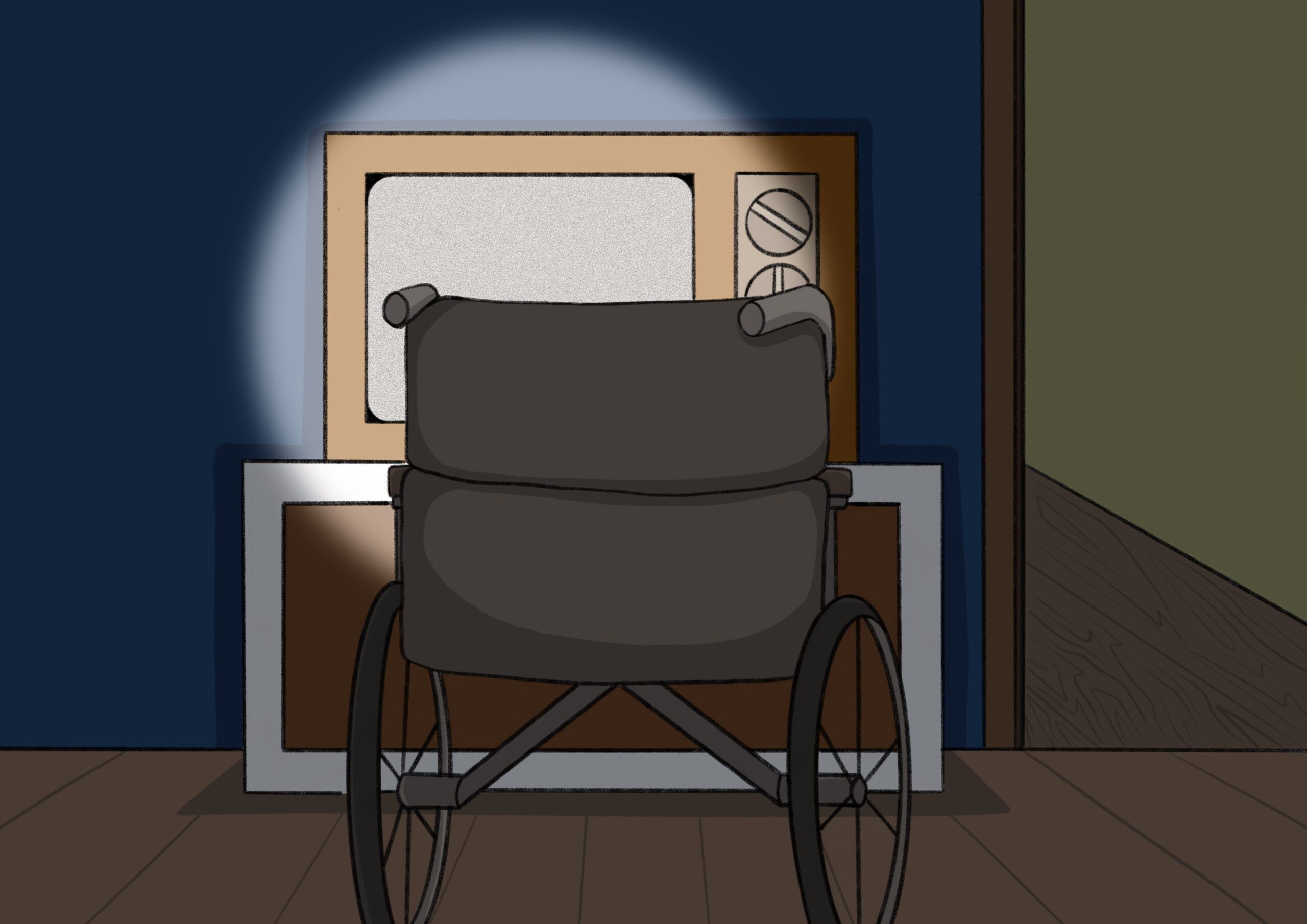
On the black and white screen, cowboys drawled their declarations and horses neighed in solidarity as I lay on the living room sofa, in the dark, trying to find sleep. Abuelo and LaLa were unconscious, in their bedroom, with their ancient, tiny TV blaring conviction at them. It gave them comfort.
Morning came and I rose quietly. I aroused my two elders and fed them their simple breakfasts and their pills, of which there were many. After this daily ritual, my mother switched on the living room TV and was soon bathed in the glow of televised Mass, which she listened to every morning intently, her lips forming vowel shapes as her voice quavered softly in concert with the sonorous words of the video vicar.
My father sat on the sofa behind her, with his view of the TV blocked by LaLa’s wheelchair, in which she lived during her waking hours, and he stared at the back of it, vacantly. Eventually, he would fall back into unconsciousness. He slept most of the time these days. He was, once upon a time, a self-made man of the streets. Now he was catastrophically bored into slumbering surrender.
My sister, Myriam, was my only sibling. She bore the brunt of our shared responsibility. She lived a mere 6 minutes from “Century Gardens”, where our parents resided. My home was New York City, 8 states away. As a result, our parents’ slow burning health care crisis was inexorably wearing Myriam down to the gristle.
Keys jangled in the door and in walked Augustina. She visited on Saturdays to clean the apartment and prepare traditional Ecuadorian meals for LaLa and Abuelo. She also attended to their pill regime, which was byzantine. In addition, there were daily blood samples to take, Abuelo’s insulin to inject, blood pressure and sugar level readings to write down and LaLa’s lactulose to give orally (to control the runaway ammonia in her body from her liver disease).
Myriam had run me through the paces but I was glad to have Augustina there to help. She was congenial and kind and of all the caregivers that came and went, she alone was consistent.
We had a lot of trouble with caregivers, which Myriam found by way of the Latino grapevine. She had been unable to recruit someone to replace our latest caregiver, Nora, who had abruptly quit in reaction to our mother’s rudeness.
Myriam had booked a weekend cruise with her husband, Tomas, to get away from it all. Nora quitting had jeopardized her plans. I volunteered to come down for a couple of weeks to give Myriam the respite she badly needed.
The caregivers we hired were undocumented and in varying degrees of desperate straits, all of them wanting payment off the books. There was no talk of insurance or background checks. The price was right and it was all we could do.
All the people we hired started off more or less pleasant and reliable but sooner or later something would change in their circumstances, or they would tire of LaLa’s delusions and vindictiveness, or Abuelo’s tendency to leave the apartment and wander off onto 8 lane roadways, or they would simply disappear. It kept Myriam on her toes.
* * *
One day they will die.
That thought led me to write a draft of my father’s eulogy but I ended up telling his life story, and so it was too long.
My mother’s will be harder. A eulogy should tout the deceased’s best qualities and the values they held dear but if I do that by the book, I’m leaving out so much. A person is defined by both the good and the bad, and if there is a story there, how they overcame the bad. I’m not sure either one of them got there. I remind myself that a eulogy is not for the speaker. It’s for the audience.
This led me to think about epitaphs. What shall we etch upon their urns or gravestones?
THOUGH YOU ARE GONE, YOU ARE NOT FORGOTTEN
That might be right for Abuelo and, anyway, it’s already true.
SHE DIED AS SHE LIVED
This appeals to me for LaLa because others can read what they want into it.
My mother suddenly cries out, declaring she can see her long dead mother, Doña Julia, in her bedroom. Augustina and I hurry over to comfort her and can’t help peeking into her room.
Doña Julia looms large in my mind. She raised Myriam and me. Our mother worked as a beautician and did not have much time for us. When Doña Julia died, I was given the box containing her ashes. We never got around to buying an urn or a niche at the cemetery so she lives, so to speak, in my closet in New York. When my children were little, I would sometimes take it out and shake it in front of them, to give them the willies. It rattled because there were bone bits in the box. It spooked me too, to be honest. Doña Julia shows up in my dreams from time to time, always surprised to learn she is dead, when I reveal it to her.
Sunday was difficult. Augustina visited on Saturdays only. The day began with my mother insisting she has cancer and that her medications are fake and are making her condition worse. The doctors are corrupt. The scientists have changed all the clocks. She begged me to do something about it.
“You’re my son! If anyone should believe me it should be you!” she cried, her eyes dancing around the room, then locking on me, pleading.
My father suddenly snored loudly from his position on the sofa, causing us both to look at him. He was asleep but fully dressed, shoes and all. I give him credit for dressing himself neatly every day, as if he is going into town, even though he rarely gets farther than the sofa and spends the day sleeping on it in a sitting position.
I went to him and patted his head, feeling his plight. He awoke and stared at me in bewilderment until recognition dawned. “Dario!”
Dario is Myriam’s son.
“No, Papi. Soy Marco,” I replied.
He blinked, and then, “Oh! My son! How are you,’chacho? What are you doing here?”
“I’m here for a couple of weeks to help Myriam.”
“Myriam? What happened to Myriam?”
“She’s on a cruise. She needed a little break from the routine.”
“A cruise? You kidding me!” He always said that.
I nodded. “Can I get you anything, Papi?”
Abuelo contemplated that, then waved me away, “No I’m fine. What are you doing here?”
We went into a loop of him asking and me answering the same questions. I let it happen three times before changing the topic.
Evening came and I prepared them a meal. Whatever I made for them had to be simple, to keep them as healthy as possible, but also had to appeal. They preferred ordering take out because it was salty and greasy, but it usually arrived cold and was expensive. I decided on grilled chicken with rice and beans. LaLa complained – “This chicken is dry.” – but she ate it. Abuelo always ate anything you put in front of him.
I sat with LaLa, while she had her meal at the TV table I had positioned in front of her wheelchair. Abuelo always ate by himself in the kitchen.
“Why don’t you move down here?” she asked, alternating her attention between the food, the Western on the television set, and me.
“I don’t want to.”
She frowned. “Why not? Your whole family is down here. Dario moved back down after spending a year in Virginia. Don’t you love us?”
“I’m here right now, aren’t I?”
“You’re here because you have to be.”
“Mamá, my life is in New York. I like it there. And it’s too damn hot down here.”
“We have air conditioning. Why don’t you call more often?”
I was very guilty of never calling. I considered it a minor form of torture.
“I’m super busy, you know that. I’ll try to call more.”
“You always say that.”
I didn’t respond. For a few minutes we both became absorbed in the movie on the TV. John Wayne was explaining to an Arizona judge that he wasn’t going to break a promise he made to a dying woman.
“I never thought my life would turn out this way,” said LaLa, choosing a moment of quiet to declare herself.
I reflected that how one’s life turns out depends on the choices we make. But outside events can have a hand in fate as well. LaLa had had breast cancer and survived, with only a lumpectomy to show for it. She had been lucky. But after that she became a hypochondriac and, as if in response, her health took a nose dive, beginning with knee surgery and rapid weight gain as a result of her giving up on walking in the aftermath of the surgery. That had been her choice. Her sour outlook on life was also her choice.
“I think you and Myriam should send Abuelo to a home. He’s useless,” she rasped.
“So you think it’s a good idea to live here by yourself?” I asked, fighting a moment of ire.
She stared at me, then declared, “Yes, I do. I can do it.”
“Don’t you love him? Won’t you miss him?”
“No.”
Abuelo had had an affair during my teen years, which bankrupted our family – he had maxed out all his credit cards and even purchased a car for the other woman. When my mother discovered all this, it broke her heart and also broke my faith in him. I began to see him in a new light. I had looked up to him all my young life, but as I grew up, certain evidences and patterns began to coalesce. He was a liar. He was impetuous, impulsive, prideful. He wasn’t careful about things. He was easily deceived. It worried me that I had half of his DNA. I had lived most of my adult life trying not to become him. But sitting in front of my mother feeling anger and resentment, I wondered if I had anyway.
I suddenly envisioned the perfect epitaph for his gravestone.
HE PLAYED A GREAT GAME
Abuelo did play us for a long time. I like it because others could infer what they want.
“Your sister works so hard,” declared LaLa, snapping me out of my reverie.
I nodded in agreement. “She needed a break. Between managing you and Dad and running her business, she’s under a lot of pressure.”
“A lot of pleasure? Then why is she so mean to me? Why didn’t you have a son?”
I had to hand it to her. LaLa could pack a punch with just a few choice words.
“I’m happy having daughters, Mom. I don’t need a son.”
“Our family line will die out because you didn’t have a son.”
Maybe that’s for the better, I thought, but I didn’t say it, as much as I wanted to.
* * *
I met Mercedes for the first time on Monday morning. She rang the doorbell, though she surely had keys, and I let her in. She was loudly delighted to meet me and we exchanged pleasantries in Spanish. She was a vivacious, tall and hefty Guatemalan, dressed in hospital blues, proclaiming herself a professional caregiver.
After our introductions, she put her purse down on the kitchen table and glided over to LaLa and Abuelo who were in their usual positions in the living room.
“Hola, Milagro,” she said to my mother, calling her by her first name. LaLa appeared not to hear and didn’t look away from the TV.
“How are you feeling today, Napo?” she asked my father, using his old-world nickname, which surprised me. Abuelo nodded and smiled, in response to Mercedes’s gleeful delivery. “Are you feeling handsome or sexy?”
He thought about that and tentatively answered, “Handsome.”
Mercedes laughed, “Well then, I think I should help you take a shower, so you’ll be nice and clean for the ladies, no?”
Abuelo nodded again, eyes twinkling. I was pleased to see this level of indulgence from Mercedes. Abuelo had always been a people person and any interaction with the outside world always brought him back a little.
After Mercedes finished performing Abuelo’s ablutions, she tended to LaLa, providing pills, toast and tea. Abuelo dutifully swallowed his pills and ate his breakfast at the kitchen table.
I learned Mercedes was married and somewhat established, with a resume of past assignments, and a doting husband who dropped her off and picked her up in his SUV every day. She was smart and also intentional. I could feel the calculation behind her eyes.
This was all fine so long as she fulfilled her responsibilities, and she did that well. She would hum to herself as she prepared meals and made a conscious effort to engage both of my parents in conversation; a noble effort, given LaLa’s taciturn nature and Abuelo’s, at best, tenuous stream of consciousness.
Despite LaLa’s standoffishness, Mercedes was attentive, helping her bind her swollen legs in compression tape and chiding her for sneaking sweets, which she found stashed in the creases of the wheelchair.
“You know this is bad for your diabetes, Milagro! Don’t you want to live forever, so you can watch your grandchildren grow?”
“No,” answered LaLa, eyeing the candies in Mercedes’s hand.
Mercedes slowly closed her fist over the candies and wagged a scolding finger at my mother with her other hand.
“You can’t tell me want to do,” finished my mother, resentfully.
Mercedes looked in my direction and raised her eyebrows in a gesture of amused frustration. I could only offer a polite smile in return.
Seeing that Mercedes was in full command of Abuelo and LaLa, I set up my laptop at the dining room table and prepared to do some work. I had barely begun when Mercedes approached.
“Your mother wants to talk to you.”
Suppressing a sigh, I went to the wheelchair. “Yes, Mamá?”
“When are you going back to New York?” LaLa asked. I could see what was coming. No answer, except perhaps ‘never’, would be a good answer.
“In about two weeks, after Myriam gets back.”
LaLa gasped. “Myriam is gone?”
“She’s on a cruise to take a breather.”
“Why does she want a breeder?”
Mercedes laughed, then quickly apologized. LaLa glowered.
* * *
One night, LaLa had had to be taken to Memorial Hospital after an outburst of violent incoherence, which had required Myriam to leave a party abruptly and rush to the apartment to meet the EMTs. Whenever LaLa failed to take her lactulose, her damaged liver would release excessive amounts of ammonia into her bloodstream. This went directly to her brain and spiked her confusion and dementia to Olympic levels.
I debated with Myriam about resisting the advice of the doctors at the hospital. Our mother did not enjoy being alive. And Myriam and LaLa were vicious to each other. Over the years, in lockstep with our mother’s steady deterioration, their relationship had devolved into hair trigger choleric exchanges where our mother would spout resentments and confabulations, and my sister would excoriate and lecture her in a loud authoritarian voice. LaLa would absorb Myriam’s vitriolic remonstrations quietly, wringing her hands and meekly muttering denials. It was difficult to watch.
I wondered how Myriam could treat our mother so cruelly while also fighting with doctors for her survival tooth and nail. It didn’t make sense. I ascribed it to her Catholic sensibilities. Myriam is a big believer.
Myriam also lectured Abuelo, actually more like shouted at him due to his deafness, but not as vindictively. Kinder shouting. Perhaps because he had always rushed to her defense whenever she and I would fight as children.
* * *
The two weeks transpired and Myriam returned. She came by the apartment the morning of the day I was leaving for the airport. Mercedes wasn’t due for another hour.
“Hello brother,” she said, cool and casual, as she breezed past me to inspect the parents.
“How was the cruise?” I asked, trying to assess her mood.
“Perfect. Badly needed. I wish it had been longer,” she replied, returning to where I stood beside my luggage, having confirmed that no damage had been done. She took a moment to assess me, like I was an interesting object, then flashed a smile.
“So, did you have fun taking care of them? Anything I need to know?”
“It’s difficult to see them like this,” I confessed.
“I see it every day. You have no idea.”
“But Mercedes is a pretty good attendant. Even if Mom doesn’t like her.”
“Our mother doesn’t like anyone.”
“She wasn’t always like that.”
Myriam squinted at me and replied, “Well, now she is.”
“And Dad is just… gone. He’s a ghost of the guy that used to live in that body.”
“I know,” she answered, pivoting to solemn. “I miss him.”
I tried to lighten the mood. “He puts on deodorant and combs his hair in the bathroom like ten times a day.”
Myriam burst into laughter. “I know! He doesn’t remember what he did an hour ago!”
I looked at her and felt the urge to hug her. She welcomed it and we held each other in silence for a few minutes.
Finally, I said, “Other than that, I think things went pretty much as expected.”
“Did you try to talk to LaLa?” she asked me, tacitly acknowledging my conflicted feelings.
“I did. It was a disaster every time. But I did.”
Myriam grunted, glancing at our mother’s back. She was intently watching her TV Western. Abuelo snored peacefully on the sofa.
Looking at my watch, I declared, “I’ve got to go. Airport time.”
She nodded. “Yeah, I know. Ships in the night, brother.”
Suddenly, I blurted, “Myriam, I really appreciate what you do for them. The burden is enormous. I’m glad I could help in some small way. Besides sending money.”
“Just keep sending it, bro,” she replied.
And with that, after kissing each parent goodbye, and hugging Myriam one last time, I left Century Gardens and flew back to New York City.
* * *
A few weeks later, I phoned Myriam for our regular check-in.
“I fired Mercedes,” she announced.
“Why? She was actually pretty competent, I thought.”
“So you know I have cameras in every room,” said Myriam.
“Yeah.”
“Unfortunately, or perhaps fortunately, our caregivers sometimes forget about the cameras.”
I felt a spike of concern. “What did she do?”
Myriam took a breath and said, “She slapped LaLa.”
I felt my anger rise. Despite my conflicted feelings about our mother, the thought of anyone being cruel to her struck a nerve. “Why?”
“She was refusing to take her meds. I guess it had been a trying day.”
“That’s no excuse, Myriam. What did LaLa say?”
Myriam answered slowly, “She never mentioned it until I saw the discoloration on her face.”
“That’s strange. You would think she would have raised the roof.”
“I think she’s given up, Marco,” said Myriam.
Myriam’s words washed over me and left me with a conflicted cocktail of feelings: anger, sadness, and regret.
Myriam continued, “As soon as I heard that I played back the cam’s event history and there it was, plain as day. I fired her as soon as I could get there in person.”
I tried to sound calm. “Good idea to not do it remotely. She could have done anything in response.”
“Exactly.”
We both listened to each other breath over the line for a few moments, sensing each other’s emotions.
“So now what?” I asked.
Myriam replied, “I’m sleeping there until I can hire someone.”
“Oh, Myriam.”
“The good news is I found someone via the grapevine and I’m interviewing her tomorrow. Her name is Beneficia.
Myriam hired Beneficia. She was a heavyset, Mexican evangelical who believed in eating natural foods and insisted on feeding our parents food of this predilection. LaLa absolutely hated it and loudly complained to Myriam that the new caregiver gave them nothing to eat and that there was no food in the house. LaLa resorted to sneaking Lays potato chips, which she had surreptitiously ordered from Amazon.
* * *
On the day LaLa died, she was complaining of pain all over her body and she refused to eat anything. She could not hold her weight up and was in danger of collapsing if anyone tried to move her. Beneficia called Myriam at the factory in a panic telling her to come over immediately because LaLa was clearly not well.
Myriam dropped what she was doing and came as quickly as she could. She called Memorial on the way and an ambulance with three EMTs was already on the scene when she arrived. She burst into the apartment to find the three EMTs struggling with a wholly uncooperative LaLa, who moaned and complained of imminent death as they manhandled her like a side of beef and laid her on the wheeled gurney. They rolled her out of the apartment into the ambulance and drove off to the hospital with Myriam in close pursuit.
All of this happened, very loudly, in a matter of minutes. Beneficia was in tears. Myriam was angry and barked orders at poor Beneficia to stay with Abuelo. And through all of it, Abuelo slept soundly on the sofa, completely unaware of the chaos broiling all around him.
Soon thereafter, Myriam called me from the hospital.
“Her ammonia is fine. But she has a severe UTI. They’re starting antibiotics which will cover other issues as well. They’re also checking for sepsis.”
“Sepsis?” I asked, thinking the worse. Sepsis happens when an infection someone already has, like a UTI, triggers a chain reaction throughout their body. Organ failure rapidly follows.
“Yes, she might be done, brother,” said Myriam, reading my mind and sounding very tired.
“They’re also doing brain and abdominal cat scans.”
“The full program,” I said, “You’re right, this could be it.”
“Yes, brother,” I heard her sigh.
“Should I come down?”
“They’re admitting her. I’ll let you know.”
Three hours later, Myriam called again, this time to tell me I should fly down ASAP. I didn’t argue and immediately dropped out of a meeting I had been attending. I headed directly to the airport, never mind luggage, and hopped on the first plane to Miami.
Myriam called again while I was in the cab. “She’s on the brink. Stage 4 congestive heart failure. They couldn’t reverse the effects of the sepsis. All of her organs are failing. The Doctor says she’s going to pass imminently.”
“You mean any minute,” I echoed dumbly, realizing with crystalline clarity that my mother was about to cease to exist. My face became hot while my hands became cold.
“She’s barely conscious but she wants to speak to you.”
The cab pulled up to the Departures terminal. I hurriedly paid the fare and stepped onto the curb, phone at my ear.
“My son,” croaked LaLa, very weakly, gurgling phlegm.
“Mamá,” I said, becoming the little boy I had long since not been.
“I love you, ‘chacho.”
Something opened up inside me and I sobbed, “I love you too, Mami.”
“Remember me, mijíto. I tried to give you the best life I could,” she whispered.
“You did, Mami,” I gasped between lungfuls of air. “I’m sorry for…”
“Goodbye, my son.”
I heard the phone drop and the long beeeeep of the heart rate monitor in the background. I couldn’t move. I didn’t know where to go. So I folded my knees and sat on the curb. People swirled past me on their way to their destinations. Myriam came back on the line. She was also crying.
“Dios mío, Marco. She’s dead.”
“She’s dead,” I numbly repeated. How strange to hear the words come out of my mouth and enter the atmosphere, only to be floated away by the indifferent wind.
Myriam kept talking between sobs, “It was so hard to watch, Marco. She really suffered on her way out.”
Hearing that was like a body blow but I calmed myself down, trying to be strong for Myriam.
“I’m coming down. I’ll meet you at your place. Not the hospital.”
“OK.”
On the plane I thought about my childhood and the role LaLa had played. She had said she tried to give me the best life she could and I had agreed. In reality, Doña Julia had raised Myriam and I, for the most part. Our parents were always at work, or traveling, or at a party, and when they were home they were too tired to even read us a bedtime story. LaLa never cooked us a meal. Abuelo never played a game of catch with me. Still, I remembered weekends with them at amusement parks, or at the beach. There were also group gatherings of their circle of friends at public parks with barbecue grills going and Latin music playing. I remembered Abuelo’s raucous poker games in our suburban home’s basement that went on all night. I remembered getting caught with girlie magazines by LaLa and her trying to scratch my eyes out, she was so angry. I remembered being driven to college by Abuelo and LaLa and seeing my mother cry as they drove away from the campus, leaving me to my four years of discovering the world beyond our colloquial lives.
It was complicated but my parents really had tried to give me and Myriam the best lives they could muster. But they did not plan for their old age. The costly burden of caring for them had fallen upon Myriam and me, to the point that our own retirement plans were compromised. I had wished for their deaths. What kind of son did that make me? And what kind of parents were they, assuming we would give our all, to the point of bankruptcy, to keep them alive? Was it selfish? Was it stupid? Traditional Latin American families did not worry about these things, I supposed. It left me lost at sea.
I pondered what would come next. The funeral arrangements, the cremation, the eulogy, and yes, the epitaph.
* * *
Myriam’s house was an enormous Spanish tiled and stucco’ed mansion in a gated community. Tomas opened the door and waved me in, giving me a brief hug and patting my back heartily.
“Long time, bro,” he said. “You want a drink?”
I shook my head. I did want one but that would have to wait. “Good to see you, Tomas.”
“I’m sorry about your Moms,” he began. “Did you get to see her?”
“No. I didn’t want to. I don’t want to remember her that way.”
Tomas nodded, patting my shoulder. “I get it, bro.”
“You’ve been a good brother-in-law,” I said. “You were kind to her. You and Myriam both put up with a lot and I want you to know how much I appreciate that.”
Just then, Myriam emerged from her bedroom. I noticed that she was wearing heavy foundation, no doubt to hide the blotches of red on her face from all the crying and trauma she had gone through. She sailed towards me cheerily and gave me a heavily perfumed hug.
“Brother.”
“Myriam.”
We sat at their dining room table, with paperwork spread in front of us. Myriam was in administrator mode now, which was one of her strengths. It was time to get things done, wrap things up. She was about to start walking me through forms when I interrupted.
“What’s going on with Abuelo? Does he know?”
This gave Myriam pause. “I haven’t told him,” she said.
“He wouldn’t remember you told him by the next day, anyway,” added Tomas.
I was inclined to agree, but it was murky. If we didn’t talk about it, he would eventually notice LaLa was gone, especially if we were to move him out of their apartment into an assisted living facility. He would connect the dots and realize we had hidden the truth from him. Perhaps a greater cruelty than telling him outright.
“Let’s look at the will and talk about final arrangements,” declared Myriam, determined to get on with it.
We decided to stage a post-cremation memorial service. I lobbied to have both Doña Julia’s and LaLa’s ashes poured into a pair of Maracas so we could break them out and shake them to music whenever we wanted to remember them. Of course, that was roundly rejected by Myriam, who was dead set on buying an expensively priced alcove at a mausoleum (though my idea hugely amused Tomas). And it fell upon me to write the eulogy. I am struggling mightily with that. And yet, to me, the most important thing I can do is pick LaLa’s epitaph. What would be the final words that would define the life and the mind of the great Milagro “LaLa” Mendoza?
I sat in my hotel room that night, nursing a bourbon and writing down ideas.
RELEASED FROM ALL HER EARTHLY CARES
This appealed because it was true. But it was also generic. Cold.
Searching the internet, I came across a Neil Gaiman quote, which I rather liked:
A LIFE, LIKE ANY OTHER, COMPLETELY UNLIKE ANY OTHER.
This too appealed and was positive in flavor. A contender.
The wise guy in me considered,
ONE WAY, DO NOT ENTER
but that was more a testament to myself, not to LaLa.
I obsessed about this for hours until I finally settled on one that felt the most real to me and, I had to admit, conveyed what I felt too. And so, for all perpetuity, those who will stroll the mausoleum where LaLa’s ashes lie will see, upon stopping at her alcove:
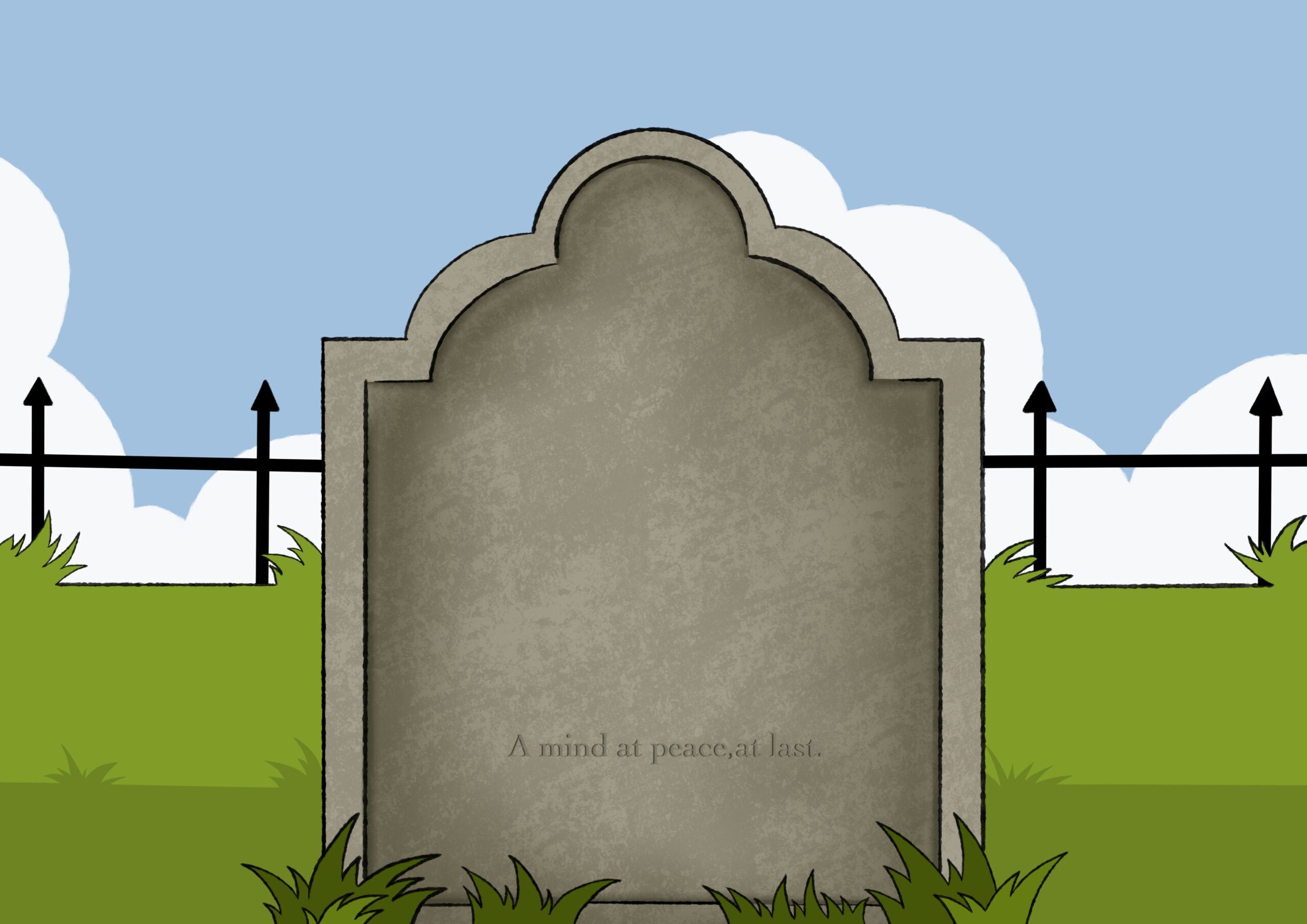
A MIND AT PEACE, AT LAST
THE END