
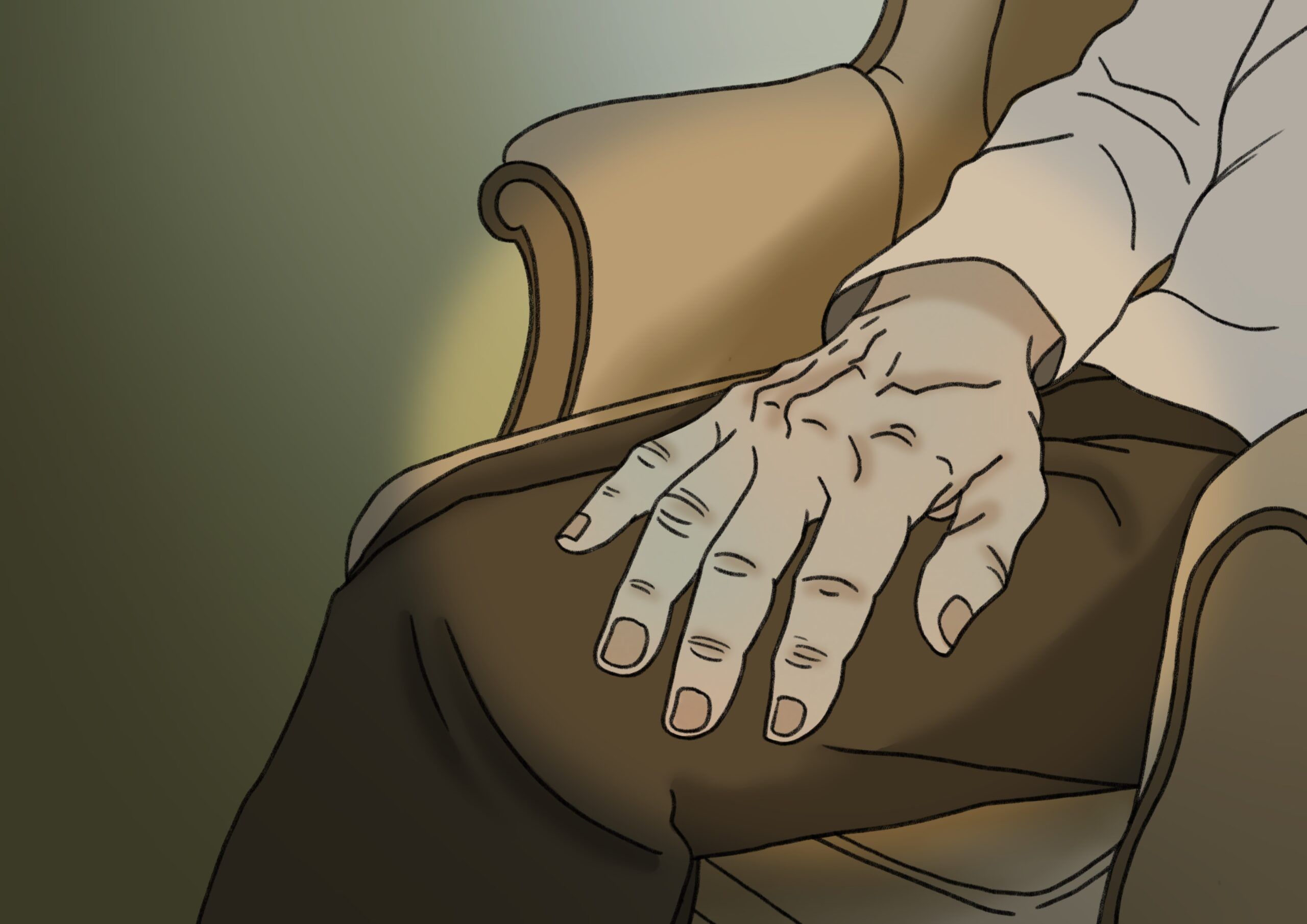
The afternoon light, filtered through the dust that always seemed to hang suspended in the Nebraska air, shrouded the room in a timeless glow. It claimed the corners; it settled heavy and golden on the arm of the wingback chair where the grandfather sat, or rather, was placed, like a heavy ceramic vessel that might break if shifted too suddenly. He did not live here. He was on loan. Thomas had driven to the facility on the edge of town—the brick building with the manicured, indifferent lawn and the heavy security doors—and signed him out for the evening. It was a retrieval, a temporary reclaiming of a father from the bureaucracy of forgetting. Ella, sitting on the bottom step of the stairs, holding her knees, watched the light and watched the men. She was eleven. It was an age, she felt, of being mostly invisible, a state of being that suited her purposes, for she was a spy in the country of the ill.
He was disappearing. That was the truth of it, though her mother called it “declining” and the doctor, wiping his glasses with a white handkerchief, spoke of “stages.” But Ella knew it was a disappearance from the way his body became more and more see-through with every season and his words slowed and lessened, until they vanished altogether. It was as if the wind, which never ceased its rushing sound against the clapboard siding of the house—a sound like the ocean, though the ocean was a thousand miles away—was eroding him grain by grain. He was a man of the plains, but more than that, he was a man of numbers. He had taught Algebra at the county high school for forty years. He was a man of axioms, of proofs, of answers that could be circled in red ink. Now, he is an unsolvable variable.
Ella remembered Grandpa’s house in Kansas, before the move, before the facility in Hebron became his address. The mornings there had smelled of bacon frying in a cast-iron skillet and the sweet, wet scent of fresh cantaloupe. He woke his grandchildren up not with a shout, but with that smell, whistling as he sliced the melons into perfect, geometric crescents on the counter. He was a man of vibrant, specific life then. He loved birds, especially cardinals. He had feeders lined up along the back porch like sentries, and he would sit for hours, naming them, distinguishing the males from the females by the shade of their red. And the garden. The garden was a portal to the fairy kingdoms Ella read about in children’s novellas. He had flourishing hydrangeas and roses and that defied the fickle Kansas climate. There were begonias and lamb’s ear and baby’s breath and tomatoes and cucumbers and banana peppers and squash—all so abundant that one could hardly see a bit of grass in the whole yard, save for the blades sticking up between the stepping stones winding a path through the foliage. Ella remembered her mother, Sarah, calling him on the phone in the summers, asking about soil pH and rain meters. “Dad, the leaves are turning yellow,” she would say, and he would give the cure, a doctor of petals and roots. Now, his hands, which used to be stained with soil and tomato vines, were white and smooth as wax paper, resting uselessly on his knees.
Ella’s father, Thomas, sat at the card table next to the grandfather’s chair. Here was the tension that pulled the room tight as a bowstring. She watched her father’s back. It was a broad back, a back that bent over desks to explain the quadratic formula to farm boys who only cared about harvest prices. Thomas was a math teacher, just like his father had been. He believed in order. He believed that if you worked the steps correctly, the solution would present itself. At first, he had approached his father’s illness as if it were a complex equation on the blackboard that simply required more time, more chalk, more rigorous application of the rules to solve. It took years for him to fully accept his father’s fate—to see what little good his meticulousness offered a senseless disease. He was glad his mother wasn’t alive to know her husband like this, but he missed her intensely, with the tenderness and desperation reserved only for a mother.
Now, he cared for his father, the way he hoped beyond hope his children might care when Alzheimer’s came for him. He hoped euthanasia was legal, by then, and that they would love him enough to let him die with dignity. It was the most terrifying thing in the world—the thought that he would be forced to remember his dad this way, and as he aged, the memory would become more of a prophecy, until he forgot his father entirely, like his father had forgotten him. Thomas felt he was trapped in an infinity loop of holding on and being torn apart. His back was slumped over a bowl of vanilla ice cream with extra sugar sprinkled on top. He was feeding his father, one half-spoonful at a time, and wiping his chin of the cream that dribbled out before each swallow. The grandfather could not speak, or hold a spoon, or choose his dessert, but his contentment was evident by the deep moans uttered throughout his feeding. Every so often, his feet shuffled quickly in his chair, which the family had also come to recognize as an indication of excitement.
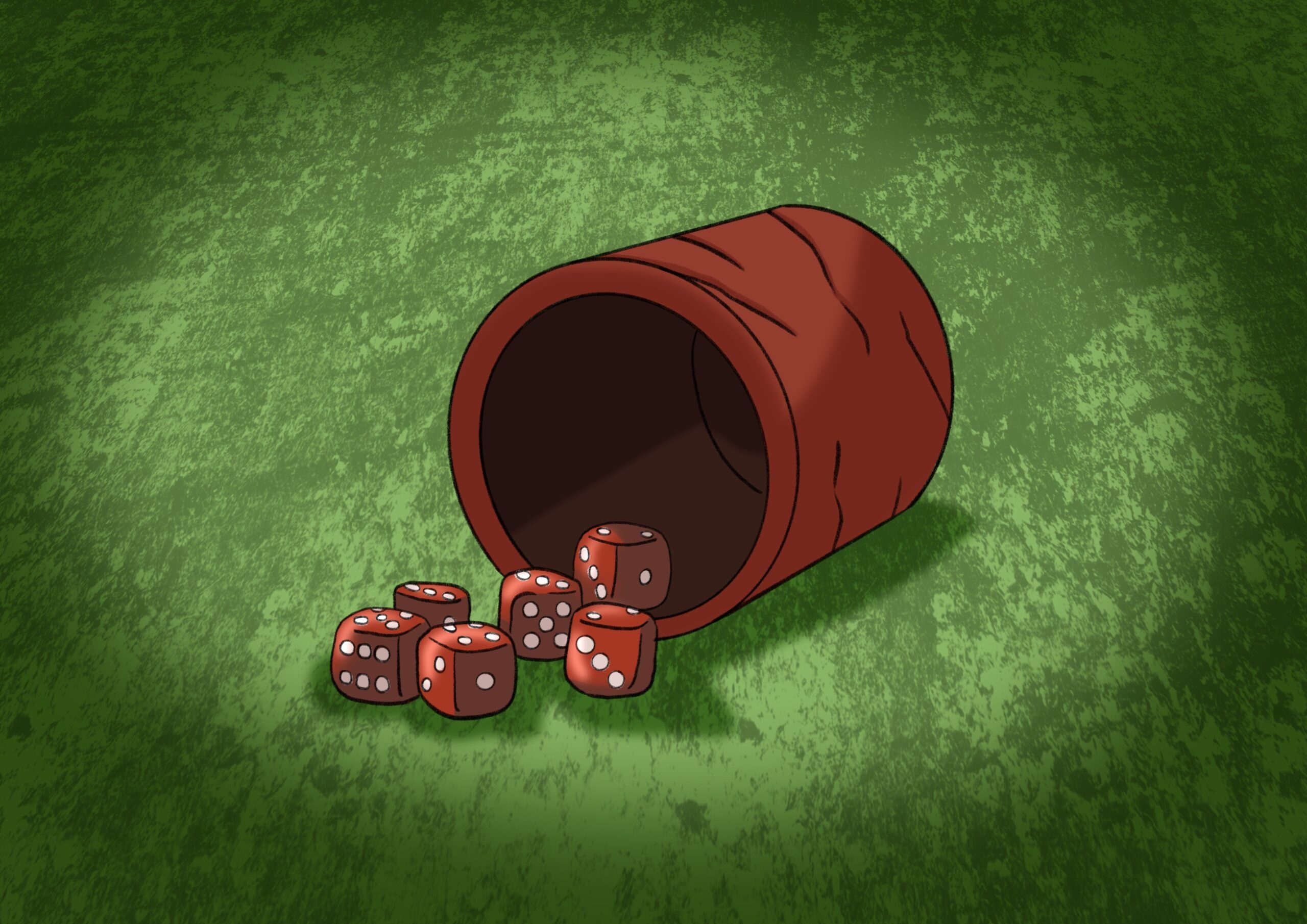
Beyond them, the card table was set for Yahtzee, an old family-favorite pastime. Scorecards with their neat grids, the five dice, the red plastic cup which was known to produce a delightful clatter with each shake of the dice. The lip of the cup was worn smooth, a testament to thousands of games played on this green felt mat, games played when the grandfather’s mind was a steel trap, calculating probabilities before the dice even settled.
“Dad,” Thomas said. It was a question asked to a room that had no answer. “The bowl is empty. Are you full?”
The grandfather’s eyes were open, but they were not looking at Thomas. They were looking at a point in the middle distance, perhaps at the pattern of the wallpaper (faint yellow roses, trellises) or perhaps at a cardinal he saw in 1972. His mouth opened, not to speak, but to let out a breath that rattled in his chest like dry leaves in a gutter.
From the kitchen, Sarah entered carrying a tray of iced tea. The ice cubes clinked against the glass, a musical, domestic sound that felt out of place in the solemnity of the room. She was an English teacher, a woman who lived in the fluidity of stories rather than the rigidity of numbers. She understood that some narratives drifted, that some sentences ended without periods. She moved with a quiet grace, placing the tray on the sideboard. She caught Ella’s eye and offered a tight, brave smile, but Ella looked away quickly, embarrassed by the attention. Sarah placed her hand on her husband’s shoulder, which he immediately reached across to touch with his opposite hand, grateful for her presence. She squeezed Thomas, then offered to her father-in-law, “You just give us a sign if you want some more ice cream later on.” She picked up his bowl and dirty napkin from the table.
“Boys,” Sarah called up the stairs, her voice soft but projecting, the voice of a woman used to commanding a room. “It’s almost time to play.”
The heavy footsteps of the brothers, Caleb and Michael, thudded above. Thump. Thump. Thump. They were older; they had escaped into the noise of adolescence, leaving Ella on the stairs to keep watch. They came down reluctantly, smelling of body spray and indifference, sliding into their chairs at the card table. They were creatures of sudden growth and loud energy, their limbs too long for their bodies, their voices cracking between octaves. In the presence of the grandfather, they seemed to shrink, overwhelmed by the proximity of decay. They sat with their shoulders hunched, terrified that the silence might touch them, might infect them with its slowness. Caleb kicked the leg of the table, a nervous tic, vibrating the dice and tea glasses. Thomas shot him a look—sharp, though an unconscious reflex. A demand for stillness. Caleb froze.
“I’m going to walk, first,” Ella said suddenly. The scene was too sad for her; she thought she might die. She needed to be a separate thing before the game began. She needed to verify that she was solid.
“Hurry back, Ella,” Thomas said, not turning around. He was arranging the dice in a straight line, equidistant, parallel. He was building a small fortification of order against the chaos. Ella grabbed her puffy yellow coat from the rack by the door, then moved quickly to the side of her grandfather and planted a fat kiss on his stubbly cheek before she left, swinging the storm door closed, the scent of the old man’s flaky scalp and dandruff still lingering in her nose.
Outside, the town of Hebron—though she rarely thought of it by name, it was simply Town, the center of the universe—lay under the immense, crushing blue of the sky. The brick streets, laid down by men dead a hundred years, rattled beneath the wheels of passing trucks. It was a Tuesday. The flatness of the world was absolute. To the south, the river; to the north, the highway. In between, the grid of houses, white and grey, standing like stubborn teeth against the wind. Grain elevators rose in the distance, white cathedrals of concrete, storing the harvest, holding the wealth of the earth in dark, dry silos.
She walked with her hands deep in her coat pockets. She walked past the theater with its peeling marquee, past the majestic courthouse that rose up like a castle, incongruous and grand. She walked away from the forced liveliness of the living room, but she carried the image of her father’s hands with her. Hands that usually held a protractor or a piece of chalk, now hovering uselessly over the green felt of the card table. She felt the vastness of the plains pressing in on the smallness of the town.
In Hebron, one could see the weather coming from fifty miles away. One could watch the storm clouds gather, bruising the horizon, long before the rain fell. Her father noticed the storm from the living room, but he refused to board up the windows until Ella returned. At the sight of the gray rolling in, he remembered the little ceramic music box with a twirling green parrot his mother used to wind and let play for her grandchildren many years ago, and while he was no songbird, he began to hum, so Sarah and Caleb and Michael could remember too: You are my sunshine, my only sunshine, you make me happy when skies are gray….
Ella found herself pushing open the door to The Keepsake, a narrow, long shop that smelled of cinnamon candles and paper glue. A bell chimed—a bright, insistent daring sound. This was the domain of Mrs. Gable, a retired librarian and a musician who’d taught Michael guitar through 8th grade. Ella was familiar with her, from church and from her frequent visits to this shop—a sanctuary of the minute, the specific, and the preserved. Walls lined with paper of every texture: cardstock, vellum, parchment. Bins of ribbons and buttons sorted by the rainbow. And beads. Rows and rows of glass vials filled with beads. Mrs. Gable was behind the counter, cutting a length of gold ribbon. She was a woman of soft edges and bright sweaters, a woman who believed that life could be categorized, cropped, and pasted onto acid-free paper.
“Ella,” Mrs. Gable said, smiling. Her glasses hung on a chain of turquoise beads around her neck. “Escaping the brothers?”
“Yes,” Ella lied. She drifted toward the aisle of beads.
She plunged her hand into a bowl of mixed glass beads. They were cool, hard, unyielding. They made a satisfying shhh-clack sound as she let them run through her fingers. This was what she wanted. Things that did not forget their own names. A blue bead was a blue bead. It would be a blue bead in a thousand years. It did not wake up one morning and forget how to be blue.
“Working on a project?” Mrs. Gable asked, coming around the counter. She moved with a bustling energy that made Ella feel tired.
“No. Just looking.”
Mrs. Gable picked up a packet of scrapbooking stickers—little clocks and calendars. “I got these in new. For ‘timeless memories’ pages. People like to put them on pictures of graduations. Or weddings. Things you always want to remember.”
Ella looked at the little adhesive clocks. They were frozen at ten past ten.
“Those are nice.” Ella said, and pursed her lips like she’d seen her mother do in department stores when pausing to admire a sweater, as if she were considering the purchase, though she knew she could not afford them with the two crumpled dollar bills in her pocket. “I don’t think so, today,” she said politely, but ambled over to the wall of stickers, her eyes raking over cartoon images of birthday cakes and woodland animals, lipstick prints and American flags, smiley faces and swaddled babies and alphabets.
“Do you have anything for mistakes?” She was feeling very mature.
Mrs. Gable paused. She tilted her head, bird-like. “Mistakes. You mean like…correction tape?”
“No,” Ella said. She looked down at a bowl of beads on a table below the stickers. “Some stickers for when you start making mistakes all the time. Maybe I want a scrapbook page for that. Or for when you can’t tell what’s right or wrong anymore.”
Mrs. Gable’s face softened, collapsing slightly into a look of pity that Ella found unbearable. “Oh, honey. How is he doing? Your grandfather?”
The town knew. Of course the town knew. In a place this flat, there was nowhere to hide a shadow.
“He can’t count,” Ella said. It was the most accurate word she had. “My dad is setting up Yahtzee right now. Have you played that before?”
The older woman nodded and leaned sideways on the counter to show that she was listening, that Ella was safe to speak.
“We’ve always played it as a family. That’s why I’m so good at math. I get first in all of the multiplication table races at school.”
“Wow, that’s very impressive,” Mrs. Gable indulged. Ella’s ears turned hot. She hadn’t meant to brag.
“But Grandpa doesn’t know what a straight is anymore. He used to teach calculus.”
“It’s very hard, dear,” Mrs. Gable sighed, and she stepped forward to touch Ella’s shoulder. Her hand was warm, fleshy, alive. “It’s the hardest thing. Watching the sharpest minds you know become dull. My own father… well. It takes a piece of you.”
Ella nodded and pulled away, ostensibly to look at a string of pearls. “My dad has to feed him. His hands shake.” She felt a prickling behind her eyes. She hated it. She hated crying. It made her feel young.
“It’s because he loves him,” Mrs. Gable said quietly. “Grief is just love with nowhere to go.”
Ella stared at the pearls. They were fake, plastic, coated in iridescence. Grief is just love with nowhere to go. It sounded like something from a greeting card, the kind Mrs. Gable sold on the spinning rack by the door. And yet, it made sense of the trembling spoon, the hung head. Her father was full of love—a massive, dammed-up river of it—and the grandfather was a closed door. The love hit the door and sloshed back, shaking the father’s frame.
“I want these, please,” Ella said, grabbing a two-inch tube of seed beads. They were black. Like punctuation marks. Tiny holes in the fabric of the day. She held them up to Mrs. Gable and moved to the register, avoiding eye contact as much as possible.
“Just those?”
“Yes. Thank you.”
She paid with a dollar bill. She needed to leave. The smell of cinnamon was suddenly cloying; the optimism of the scrapbooks, with their blank pages waiting for “Happy Memories,” felt like a lie. You couldn’t paste a man down. You couldn’t crop the edges of the fear in her father’s eyes and frame it with decorative tape.
Her walk back home was more of a jog—she knew she’d spent too long away from the living room, and the rain clouds were nearly overhead by the time she reached her block, sheltered by honey locusts and Siberian elms. The light outside had faded to a bruised purple with an orange rim. She walked inside and peeled off her coat, greeted shortly by her parents, who had waited for her to start the game. Caleb was relaying a story about some teammate who’d mouthed off and earned them all a sprinting punishment at football practice. The lamp in the corner cast a pool of yellow illumination over the table. The wind picked up, rattling the sash of the big bay window, a reminder that the house was just a wooden box on a sea of grass.
When Ella took a seat on the ottoman pulled up to the edge of the table between her parents—her makeshift seat—the game could begin. A glass of tea sat sweating in front of her, the ice cubes now pebbles in the brown. She didn’t care much for tea, but took a drink anyway, feeling guilty. Sarah sat next to her father-in-law. She spoke to him in a low voice, reading the categories of the scorecard as if it were poetry, reminding him of the possibilities. The brothers sat opposite, silent, their large teenage bodies folded awkwardly. They looked like trapped birds, eyes darting to the television playing the nightly news in the other room, then back to the table, bound by duty and the obtrusive weight of their father’s sorrow.
But it was Thomas that Ella watched. She tried to sync her breathing with the pulse of his. She wanted to know what it felt like, to be him. The game took off: three-of-a-kind, chance, two sixes, a small straight. Then the grandfather’s turn came. The plastic cup sat on the table in front of him. The five dice lay scattered on the green felt like jagged teeth.
“Dad,” Thomas said gently. “Can you pick them up? Into the cup.”
The grandfather stared at the dice with a vague, polite interest, as if they were artifacts from a foreign culture, his hand twitching on the armrest. Thomas stood and reached across the table. He picked up the dice, one by one—clack, clack, clack, clack, clack—and dropped them into the cup. He placed the cup in his father’s hand. The grandfather’s fingers were loose, uncomprehending.
“Shake it, Dad,” Thomas whispered.
Nothing happened. The grandfather held the cup like a glass of water he had forgotten how to drink. Thomas moved around the table. He knelt beside the chair, just as he might kneel to help a student who had dropped their books. He placed his large, capable hand over his father’s withered one. He wrapped his fingers around the plastic cup, enclosing the older man’s fist entirely.
“Like this,” Thomas said. His voice cracked.
Together, the two hands—the son’s and the father’s—shook the cup. The sound was aggressive, a rattle of bones, a chaotic noise in the quiet room. Ella saw the tendons in her father’s wrist stand out. He was forcing the probability. He was trying to generate a result from the void.
They slammed the cup down onto the felt. Thomas lifted it away. Three sixes. Two fours. A full house.
“Look at that, Dad,” Thomas said, his voice thick with a desperate, manufactured cheer. “Full house. That’s twenty-five points. Good roll.”
The grandfather didn’t look at the dice. Instead, he turned his head slowly, agonizingly, toward Sarah. The movement was geological, a shifting of tectonic plates. Sarah was writing the score down, her pen scratching softly. She felt his gaze and looked up. The grandfather smiled. It was a beatific, heartbreaking smile of teeth turning beige, full of a sudden, terrible recognition.
“Linda,” he whispered.
The room froze. Her name sucked the air out of the space.
Linda was the daughter who had left. The daughter who had taken a bus to California in 1978 and never came back. The daughter for whom the grandfather had written a letter on the first of every month for twenty years. Ella knew where the letters were; they were stacked in a shoebox in the attic, under the eaves where the heat gathered in the summer. She had found them once, looking for Christmas ornaments. Envelopes yellowed at the edges, stamps with airplanes on them, and the red ink of the post office stamp: Return to Sender. They were a stack of paper grief, a narrative without an ending, a theorem that had never been proven.
“Linda,” he said again, louder this time, and his breath carried at the end of the word, Lindaahh, like a summoning, reaching out a trembling hand to touch Sarah’s sleeve.
Sarah froze for a second, her pen hovering over the paper. She looked at Thomas. Thomas was staring at the dice, his face ashen. He knew. He knew that in his father’s decaying mind, the variables had shifted. The timeline had folded in on itself. Sarah—the English teacher, the daughter-in-law, the constant presence—had been replaced by the ghost of the girl who left. Michael shifted in his chair, a squeak of wood on wood, his eyes wide with a mixture of disbelief and fear. This was the breaking of the world, the adults losing their names. A mistake. A miscalculation Sarah could not bring herself correct. She reached out and took the old man’s hand. She understood fiction; she knew that sometimes the metaphor was more important than the literal truth.
“I’m here,” Sarah said softly. “I’m here, Dad.”
The grandfather let out a long, shuddering sigh, his eyes filling with tears. For the first time in months, the man he used to be felt present in the room—right below the surface of his unaware body. He spoke once more, “L-l-luh…luh…”
“I know. I know you do. I love you, too,” Sarah struggled to speak through her choking tears. “So much. We all do. Thomas, too. Thomas is here.”
“Dad?” Thomas pleaded, hopefully. It had been over a year since his father had addressed him with words. But the grandfather was done speaking. He just sat there grasping Sarah’s hand, with his crusty yellow fingernails and his skin so waxy it turned slick, with his eyes squeezed shut and tears frozen halfway down his wrinkled cheeks, no doubt immersed in memory of some faraway time everyone had forgotten, but him.
Thomas sat back on his heels. He looked in awe at his wife, and then to his father. He was the pragmatist; he dealt in precision. He graded papers on right and wrong. And here was his wife, lying, and his father, hallucinating, and the only thing that was real was the full house on the table that the old man didn’t even know he had rolled. Behind the defeat he felt, there was a light in him, burning with the flame of the miracle he had just witnessed in his living room. His father was still alive.
Ella saw her father’s shoulders shake. He was the one who had physically moved the cup, who had forced the mechanics of the game, but it was Sarah who had solved the equation. It was Sarah who had accepted that X could equal Y if it meant peace. This, Ella noted, was grief. A breath you could not catch, a word you could not pronounce, a father who did not know you. The young girl stood from her perch on the footrest and walked around the table to where her father knelt. She hugged him from behind, around his neck, like she was mounting him for a piggy back ride. She didn’t squeeze tightly, or offer any words (there were none), but she stood over him for quite some time, proving that her love had somewhere to go. She felt a wetness on her sleeve and knew her father was crying. He kissed the inside of her elbow. “Thank you, baby.” This, she knew, was her cue to let go. She unhooked her arms and took two steps back from the scene at the table.
“Your turn, Caleb,” Thomas said, his voice barely a whisper. He didn’t get up from the floor. He stayed kneeling beside his father, slowly rubbing his hand across the old man’s shoulders, while Sarah held his hand, playing the part of the ghost. The dice rattled again. The game continued. The probability of numbers, the stories told to survive them. The brothers rolled quickly, eager to be done, eager to escape the suffocating intimacy of the moment. Caleb’s eyes were red and wet, too. He sniffled.
The rest of the game passed solemnly. Michael won, inching ahead of Thomas with a four-of-a-kind in the final round. Not a single Yahtzee rolled the entire game. What are the odds? When the game was packed away and the table was cleared, and wiped, and folded to rest against the wall until next week, Thomas retrieved his father’s coat and wheelchair from the mud room. He and Sarah carefully leaned his body forward to slide on the old brown leather sleeves. Michael and Thomas each hooked an arm under his shoulders, counted to three, and hoisted the man’s body up to a sort of standing position, then gently back down into his wheelchair. They would have to perform the same routine to get him into Thomas’s car, then out of the car, then into the recliner in his little dormitory, where staff would eventually shuffle or carry him to bed. Ella, Caleb, and Sarah said their goodbyes at the doorway, each taking a turn to lean close and awkwardly drape an arm across the grandfather’s unresponsive body, murmuring forms of goodbyes and I love yous. The storm door rattled its farewell.
Then he was gone. Ella went upstairs, past the heavy silence of the smiling picture-framed hallway, into her room. She sat on her bed. She pulled the tube of black beads from her pants pocket and poured them out onto the quilt her mom had dug up from some chest in her childhood farmhouse last spring. The beads scattered, tiny black planets against the checkered patchwork. She began to line them up, one by one, a long, wavering line of darkness. She counted them. One, two, three, four. She wanted to reach a number that was high enough to make sense of it all. She imagined there was some magic array of beaded lines in secret numbers she could unlock—a code that would turn back time or cause a genie to appear or a passage to open from her bedroom floor and lead her to a cure for Grandpa or a spell to overcome the tearing sensation she felt in her heart. She lined them up in formations, over and over, until it was too dark to see, until the only light was the strip of yellow from the hallway, until Thomas returned home, and he and Sarah came up to kiss her goodnight and tell her to brush her teeth. She would try again tomorrow. The sound of the dice rattling in the cup echoed like a dry, rhythmic rain in her mind, falling on a roof that could no longer keep out the weather.