
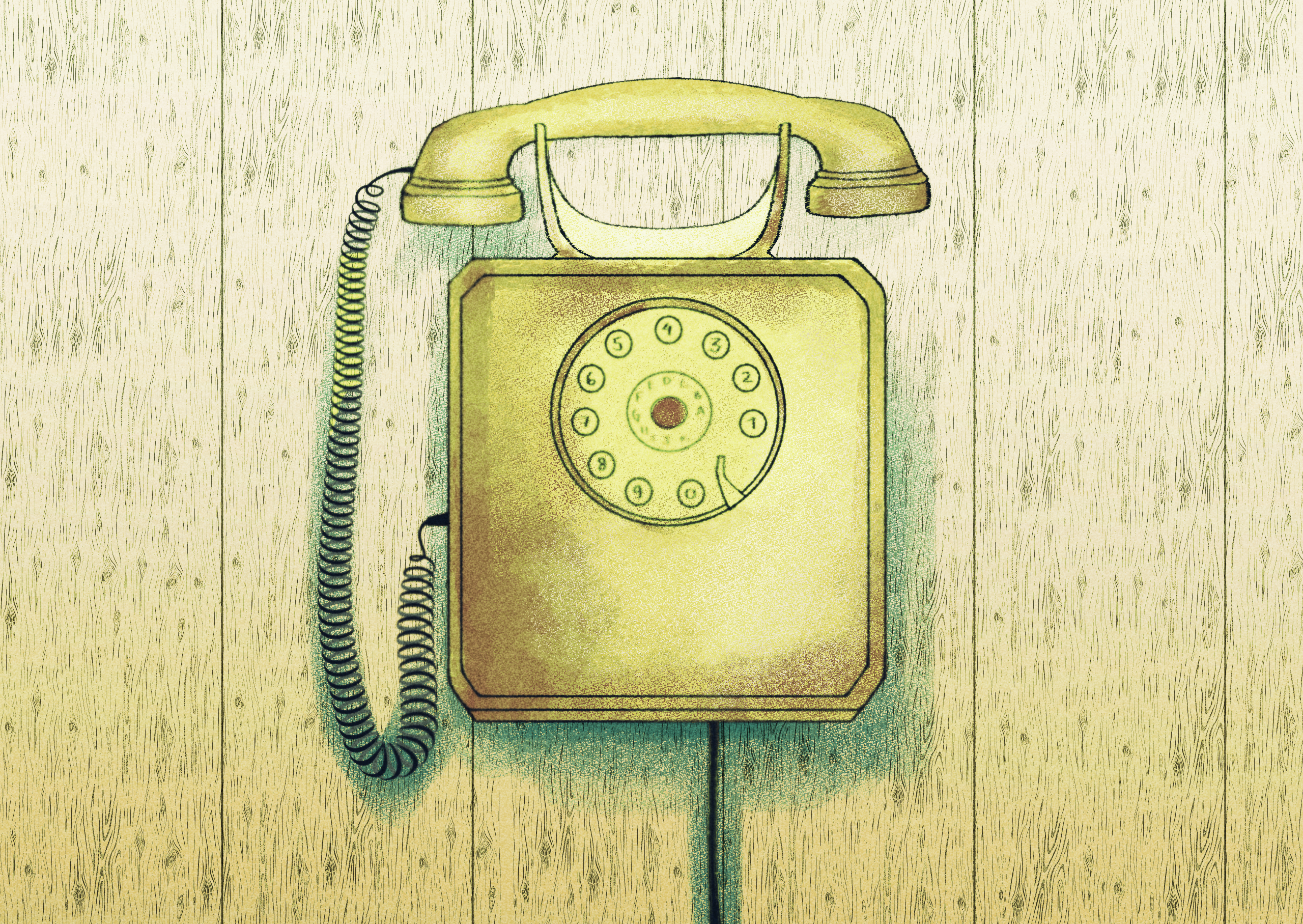
Graham never intended to eavesdrop on his neighbors. It was an accident the first time. He lifted the receiver one night, delirious from another migraine, planning to call his manager when he heard the familiar iambic chirping of his next-door neighbor, Honey Lou Ginger, on the other end of the line.
“She could be in a devil cult. Did you read the Courier yesterday? It’s more common than you think,” Honey said. “Or something worse! Something we haven’t even read about yet!”
“Oh, I doubt that, Honey. I’m already as worried as I possibly can be. I don’t need to imagine devil cults or whatever could be worse.” Graham knew she was talking to Dorothy, “Dotty”, another neighbor.
“Well, all I know is she was happy and acting normal when she was with my Arthur,” Honey Lou said.
Neither Graham nor his mom used the phone often. No one ever called for him. Ever since his father passed away two years ago, his mom would just let it ring. “Stop!” she once shouted at him when he moved toward the front hall. She figured it was either Honey Lou hoping to poke her nose further into their business or someone trying to sell them something.
“Beware of kindness,” she said.
Now, the light from the streetlamp squeezes through a thin sliver of glass on their front door and spotlights the telephone. Tonight, like many others, he tiptoes through the kitchen and pulls a small step ladder from the front hall closet. He sits on the top step, a sketchbook on his lap, and gently separates the receiver from its base, placing his hand over the mouthpiece.
“It wasn’t for Caramel, I don’t know where I’d be. And that’s the god’s honest truth.” Honey Lou again. Caramel is Honey Lou’s horse. Lately most of the nightly chatter details Caramel’s many qualities and needs.
“And I’ll tell you something else, Dotty, you wouldn’t be the same without Caramel either.”
“Now that’s just nonsense, Honey Lou. Caramel is a fine horse, but I was doing just fine before he came along.” It is difficult to tell if Dotty likes Honey Lou or has resigned herself to tolerate Honey Lou out of sheer loneliness.
Honey Lou gabbles on about Caramel for another five minutes. Squeezing the receiver between his head and shoulder, Graham begins a sketch of an exalted horse-like Jesus figure rising from a cloud, hooves outstretched. Below he writes the words: “Caramel has died, Caramel has risen, Caramel will come again. Neigh-men.”
He tells himself he only listens for inspiration for these sketches. Last week it was Honey Lou’s mistrust of the new milk boy with a facial scar shaped like a candy cane. Before that, she suspected the Kennard’s new dog might be part wolf and “it was only a matter of time before, well, I don’t really want to say, but that new family, you know the ones from New Jersey or is it New Hampshire? the ones always letting their little girls play unsupervised. I just hate to think if that dog got loose. Of course, that might teach them to keep better mind . . .” Honey Lou caught herself before her verbal dominoes led to openly endorsing harm to a child. “Well, God forbid. I’m just saying that someone should say something.” Graham envisions a comic strip: The Imagined Adventures of Honey Lou and Caramel the Superhorse. He’ll have to change the names, of course.
“After Clifton passed and Arthur moved out,” Honey Lou continued. “Caramel has been my rock. I wouldn’t be able to support you through this time with Sadie without him. I’m your Caramel!”
Graham holds his breath. Dotty gets silent after hearing her daughter’s name. The topic soon shifts to the mundane details of the next day’s church potluck, and Graham returns the receiver to its base.
***
The first time Graham noticed Sadie, she had crammed a red wagon full of dolls and wheeled them to the edge of her front lawn. She was bent over, struggling to prop up a brunette with faded brown eyes when he wheeled his cruiser past his new neighbor’s house.
“How come you’re getting rid of them?” he asked, a drawing pad tucked under his right arm. Sadie didn’t reply. Having safely seated the slouching brunette, she turned her attention to centering a cardboard placard reading “25 cents” in front of the wagon.
“I can help you with your sign,” he said.
“What makes you say that?” She turned and glared at him through squinted eyes. Graham could feel the heat on his neck. Sadie glanced at her sign and frowned at the pencil script barely visible in the mid-morning sun.
“I’ll be right back.” He planted his whole foot on the cement and whizzed back to his house to get his paints and brushes.
“No one is going to want these stupid dolls anyways,” Sadie said when he returned. Graham shook the bottle of red paint then grabbed his biggest brush to trace over the 2 and the 5.
“I can do some flowers around the edges,” he said. “Purple and yellow?”
“No flowers,” she said.
***
Caramel is not the first dimwitted beast Honey Lou has deified. Her son Arthur has always been “destined for greatness.”
“Those classrooms are too drab for my Arthur’s active mind,” she proclaimed during one of her unwanted visits. For a while after the unexpected death of his father, she made daily calls upon the house. Knocking and yelling “Christine!”, she assumed his mother was deaf with grief. When Graham was home and feeling up to it, he would answer the door and politely tell Honey Lou that his mother was napping and not feeling her best. But that particular white lie only fueled more visits.
“If I have to hear that woman chirp about Arthur the Almighty Asshole one more time, I’m going to strangle her neighborly neck,” his mom once said after closing the door on Honey Lou’s backside. That was the first real laugh they shared together since his father collapsed while mowing the lawn. That night he began sketching a new prematurely balding superhero: Arthur the Almighty Asshole – AAA in white lettering stretched across his chest.
Now Caramel is the new Arthur and the original Arthur, from what Graham has gleaned from the phone conversations, got a girl from Kentucky pregnant and moved down there to work in a tobacco warehouse. Honey Lou is uncharacteristically short on details whenever the subject comes up.
Lying in bed that night, Graham fixates on one phrase: “that time with Sadie.” They only mention her name with vague terms like “that time,” “the whole situation,” and “whatever’s going on.” He hangs on the line hoping they elaborate, but they never do. Dotty goes quiet, and Honey Lou changes the subject.
***
During their freshman year, Graham and Sadie sat next to each other in Mr. Smith’s composition class. Mr. Smith was the oldest person Graham had ever known. He had taught through two world wars and a depression. “I had him first thing in the morning,” Graham remembered his dad saying after the first day of school. “He would come to school already covered in chalk. We never figured out the story behind that.” Memories of his dad always led to memories of Sadie. And vice versa.
“Oh my gosh, that looks just like him!” Sadie said in a much too audible whisper the first time Graham showed her a sketch of Mr. Smith during class. “What’s he doing?”
Graham scribbled on the bottom of the page and handed the notebook to Sadie. “Mr. Smith vs. The Chalk Monster.” Sadie smiled and wrote her reply.
“Or he’s having an affair with a Chalk Mistress. She can’t keep her chalky hands off him. Now draw that.” Graham curled his toes and clinched his fists, a knee-jerk response to quell the electricity shooting through his body. He spent more time than he would ever admit thinking of notes and sketches he could pass.
***
Graham walks the same path home from Safeway every evening. Two blocks south, cut through the parking lot of the Big Apple Diner, through a thicket of trees and down the slope leading into the vacant lot across from his house. The lot is overgrown with weeds except where generations of neighborhood boys kicked dirt spots with the toes of their shoes to make permanent bases for pickup baseball games. He passes the oak where he remembers pouting, arms crossed, after another swing and miss. He remembers the day his dad told him it was okay if he never again picked up a baseball bat. He steps into the street and sees the curtains drawn over their kitchen window, a sign his mom has been sitting in her late husband’s chair sipping from a bottle of Champagne Velvet beer, his dad’s favorite afterwork drink.
“You know I can’t stand that stuff. And don’t even think about kissing me,” his mom would say each time he offered her a sip, knowing he would spring out of his chair, wrap her in his arms and kiss, sending shrieks of pretend horror through the house. A group of those pea green-labeled beer bottles huddled near the back of the refrigerator for months after he died. Then, one by one, they slowly disappeared.
The empty bottle lies on the counter. He picks up the note next to it. “Gone to bed early. Plate in the refrigerator. Sorry about the lima beans. – Mom.” Graham curls his nose at the mention of lima beans. He will eat them – “no one wastes food in this house” was the most common refrain of his childhood – but he won’t like it. He feels guilty that his mom still cooks for him.
He scrapes the remaining lima beans and streaks of creamed potatoes into the trash can and washes his plate in the sink. He finds his notebook next to his bed, lies down, and makes a list of everything he knows about Sadie.
Sadie?
not married
not in Indiana
last heard from six months ago
not right
sick?
hiding? (from what?)
He has listened to dozens of conversations, and this is all he knows. He sits up on his bed and pauses for a moment to listen to the squeak from the mattress springs. Another memory.
***
Sadie knocked on his bedroom door two days after his dad passed. He spent most of those weeks in his room not knowing what to do with himself. He was too young to help with funeral arrangements and too old to be easily distracted. Sadie didn’t say hi or ask him how he was doing.
“He was always nice to me,” she said. “I remember wishing we were brother and sister, but now I don’t know. Seems like having good parents just means more pain.” She sat next to him on the edge of his bed. The hem of her skirt touched his knee. It was so quiet they could hear the bed springs squeak when he nodded his head in agreement.
Even now, years later, that noise never fails to trigger a memory of that moment. He feels guilty knowing it’s a moment he longs for and it wouldn’t have happened without his dad dying.He and Sadie had never been closer. And they never would be again.
The memory morphs to one he desperately wants to forget – the first time he lifted the telephone and heard Sadie talking to Arthur.
They were sophomores, he and Sadie, and no longer had class together. They remained friendly, a wave in the hall, a knowing eye roll, but her attention was constantly in demand – from far more confident boys, from a swarm of girlfriends, from teachers wanting her to join their club. She fit in everywhere. He fit in nowhere. But the new distance between them did not prepare him for learning of her coupling with Arthur. They were making plans for the weekend. He hung up immediately, devastated.
It didn’t take long for his misery to lessen. The conversations between Arthur and Sadie, like their short-lived romance, were decidedly one-sided.
“Get this, Derek says he’s seen a wild boar out in the woods behind his yard. He says it was there when he went looking for the baseball that Jimmy threw over his head.” Arthur inherited his mother’s inability to gauge the interest of his audience. “So I says to him, ‘You sure that wasn’t your sister’s boyfriend hanging around hoping to get a little lovin’?” Arthur laughed long and hard at his own joke, completely missing the dead quiet from Sadie’s end of the line.
“Get this —” Arthur said.
“Got it,” said Sadie.
“I ain’t said nothing yet,” Arthur said.
“Oh, sorry. Must have had one of my moments.” She wasn’t sorry. He could picture her biting the inside of her cheek the way she did when someone said something stupid, and she had to stop herself from cracking up.
Arthur and Sadie were fussed over like royalty at school and around town. People saw what they wanted to see.
“Can’t you just imagine those gorgeous grandchildren?” Honey Lou said to anyone within earshot.
“She’s got just the right amount of sass to handle that ego of his,” said an over-involved art teacher.
“Those two aren’t long for this town,” said his manager at Safeway who bragged so often about Arthur’s powerful throwing arm on the baseball field you’d have thought Arthur was his son.
***
“Christine!” Honey Lou yells and slaps the front door with an open palm. Graham sits at the kitchen table. He knows his mom can hear from the bedroom.
“Christine!”
Graham slides quickly past the doorway, just in case Honey Lou is standing on her tiptoes to peer through the window slats. His mom folds laundry on her bed.
“I’m coming,” she says before Graham says anything. She grabs another T-shirt.
“I can answer the door and tell her you’re not here,” he says. “She doesn’t like to talk to me.”
His mom looks at him and smiles. “No use. She saw me come back from the grocery this morning.” She moves past Graham. He remains seated on the side of the bed. He can hear Honey Lou practically fall into the foyer when his mom opens the door.
“Oh Christine! Thank goodness. I thought I missed you.”
“Here I am. Would you like to sit down?” his mom asks.
“Oh no, no, no. I’m asking everyone if they’ve checked their milk delivery this week.” She proceeds to swear that her milk bottle is half an inch emptier than it was last week. “I think he’s swigging straight from the bottle! I’m going to make sure I get a good look at him next week. I suggest you do the same.”
“My milk seemed fine,” his mom says. “He’s probably too full after swigging yours.”
“Not funny, Christine!” Graham hears her pause before pushing on. He makes a mental note for a new villain to sketch later – “The Milk Swigger.”
“Oh and here,” Honey Lou says. “Arthur’s old jockstraps. I thought your boy might find some use for them. Arthur says he’s done with baseball which is such a shame. You remember how good he was. Everyone said so. Coach Blum used to say he’d play pro some day. They might even come scoop him up out of high school, that’s how good he was.” Graham can remember Honey Lou standing in that same spot, saying those exact same words only a few months ago. “Do you remember that game against Lincoln? They wrote it up in the paper. They put Arthur at third base for the first time because the Reynolds boy had a weak arm. Probably because he was starting to plump out like his father. Anyways, what was I saying?”
“Thank you very much, Honey Lou,” Mom says.
“Oh Christine, it’s nothing really. And please forgive me for not staying longer. I’m just so busy I haven’t had a moment to think straight. Caramel hasn’t been eating and Arthur needs me to drive down so I can look after the baby. You know he’s starting his own business again?” She pauses like she’s waiting for a reaction.
“Tractor repair,” she continues. “He was in line for a promotion at the mill down there. Manager training and all that, of course. But he has too much creative spark. You can’t bottle that up. It’s not good for your heart.
Graham is thankful he can’t see his mother’s face
“Oh Christine. I’m so sorry. It was just an expression. You know how my mouth gets away from me.”
“It’s quite alright, Honey Lou. I’m thrilled Arthur has found a creative field like tractor repair for all that energy of his.” Graham suppresses a laugh. He imagines sketching a jock-strapped Arthur the Almighty Asshole rescuing citizens stranded on broken tractors.
Honey Lou’s sing-song voice begins to fade. He assumes his mom is standing gripping the front door, waiting for that moment when she can close it without seeming rude. Graham walks from the bedroom to see his Mom opening the tote bag on the kitchen counter.
“I’m nineteen,” he says. “I haven’t played baseball in nine years.”
His mom holds up a frayed jockstrap with a pair of wooden tongs. “She knows,” his mom says. “You want to have a bonfire later?”
***
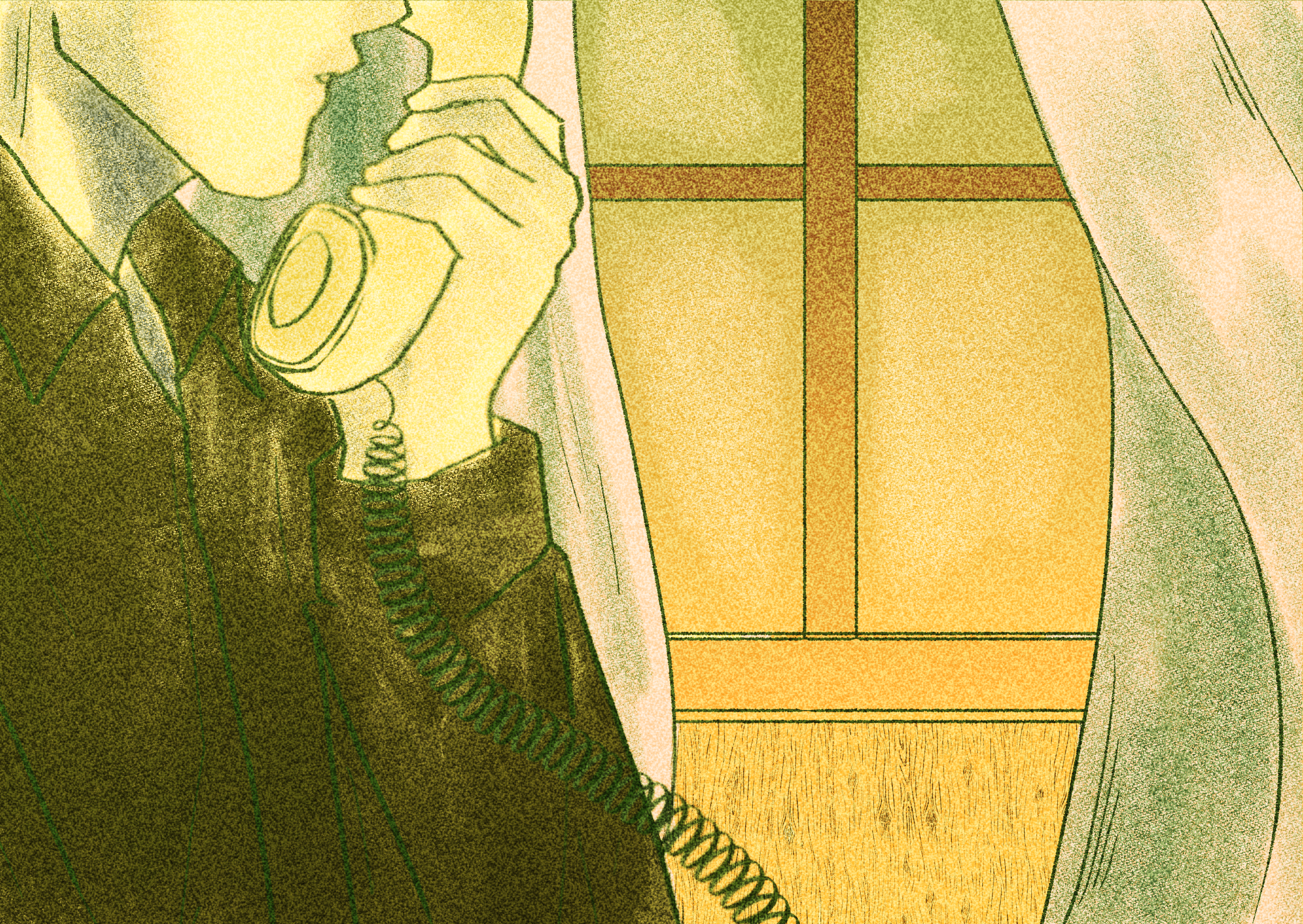
Sadie broke up with Arthur the day before high school graduation. Graham found out later that night from a younger boy who worked at Safeway. It happened in the parking lot after school. Arthur looked like he might have started crying before denting the front hood of his family’s Buick with his fist. Graham asked how this boy knew all these details, and the boy shrugged his shoulders and said everybody knew.
After the graduation ceremony, Graham noticed the two stayed separate despite their families being years-long friends and neighbors. He thought Arthur was trying too hard to be happy, laughing and slapping his friends on the back, while Honey Lou called to him from a few feet away. He glimpsed Sadie briefly, while she posed for a yearbook picture with her best friend Diane. Graham was too far away to read the expression on her face. His mom, who had become increasingly agitated by school events, stood feet away to avoid small talk. And Graham knew it didn’t help that he had made no plans for his postgrad life. She had nothing to talk about.
“We can go,” he said, gown already off and slung over his forearm.
“Are you sure?”
A week or two after the ceremony, Graham wrote Sadie a three-page letter detailing all his feelings, folded it in fourths, taped it shut, and walked out the door with every intention of putting it in her mailbox. He made it less than halfway before shredding the note and dropping the pieces down the storm drain. Finally, he decided to ask her to join him for dessert at the Big Apple Diner. Surely her raging sweet tooth hadn’t abated since graduation.
It took another week to work up the nerve to approach her front door. Most families finished dinner by 7:00, so to be safe he left his house at 7:20. Sadie’s mother answered the door. He had expected this. He had planned for some small talk before asking about Sadie. But her mother didn’t even say “hello.” She stood and glared like he was a salesman who needed to get through his pitch. Graham persisted.
“Good evening, Mrs. Starkey. It’s a lovely evening, isn’t it?” It was a nice evening, but the falseness of his tone lingered between them. Sadie’s mom nodded her head.
“The ceremony was very nice, don’t you think?” He was slipping. He had expected her to reply by now. Her mother was always pleasant to him. Not nosy or condescending like Honey Lou Fader. She always asked how his mother was getting along, how he enjoyed his job, and then left it at that. Now she stared at him and frowned.
“I’m sorry, Graham. I don’t feel myself. What is it you want?” Graham’s mouth went completely dry.
“Oh. I, uh, um Sadie. Can I speak to her?”
“Sadie is not here.” Her mom answered in a robotic tone. She closed the door before Graham could ask when her daughter would be home.
***
“Can you believe her nerve telling me how to hold my own grandson? I’ve been biting my lip for months about the way she scoops him up each time he cries. Boys need tough love. I mean, look at my Arthur –” Honey Lou is raving tonight. Graham holds the earpiece two inches from his ear to not be tickled by the vibration.
“Oh Honey Lou, you know every generation thinks they know best,” Dotty says. “I should know.” Another reference to Sadie? Graham can’t be sure. “Now, when is Arthur bringing that baby to your house? I can’t wait to get a peek at him.”
“Don’t get me started,” Honey Lou says. “Arthur’s here right now.” Her voice lowered to a whisper. “No baby though. Showed up an hour ago. Said he needed a few days to cool off. I can’t say I blame him! I’ll try to ask him about making a visit with the baby tomorrow when he’s in a better mood. The whole neighborhood is just dying to meet him!”
“Well, I sure hope so,” Dotty says. “How is the business coming along?”
“He’s working so hard, that’s all I know and I know next to nothing and a mile from something about starting a business. I don’t know how he can tie his shoes in that house with that –” She pauses. “I can’t help but think how it would have been different if he and Sadie –” This is not the first time that Graham has listened to Honey Lou stop just short of implying Sadie’s fault in Arthur’s failings. He’s happy, as always, for the conversation to turn to his missing friend.
“We just don’t —”
“Graham! What are you doing?” Graham drops the receiver on the table, and in fumbling to recover it before it makes more noise, snags the cord and pulls the base crashing onto the linoleum. High-pitched squawking emanates from the receiver lying a few feet away. He grabs it and slams it back on the base.
“Graham?” He hadn’t heard his mom slide out of bed, open her door and pad down the hall. But there she stood in the family room only a few feet away.
“I, uh, I was talking to a friend,” he says, clumsily. He had never held a telephone conversation in his life for more than thirty seconds.
“I’ve been standing here for three minutes. You haven’t said a word. What friend?”
“Nothing. It’s nothing,” he says standing up. “I’m tired.” His mom doesn’t move to let him easily pass by. He has to brush the wall with his shoulder to avoid a collision.
***
Graham’s walk home from work has gotten noticeably darker this week. He is well into the second month of the second school year since he left high school. He can no longer say he just graduated. He can’t be still figuring out his next step. Life is figuring it out for him. Weeds sprout through the cracks in the Big Apple Diner parking lot. He pauses to kick loose a clump of crabgrass with the toe of his shoe. The stems fly forward, but the roots remain. He glances into the diner to see an empty booth. What would Sadie say if she was sitting in that booth watching him from the window? What would she say if he was sitting across from her? A familiar, casual evening. Coffee and pie after dinner. A long walk at dusk past the construction of a new subdivision, one of many in town. They pause to argue which layout they like best but agree the corner lot is ideal. A dream within a dream.
Sadie’s face morphs into his mother’s as he keeps walking. Her disappointed look from a few nights ago. They haven’t spoken since. He doesn’t have a coherent explanation, so he hopes she will forget, and they can return to their routines.
He places a hand on the broken fence at the edge of the parking lot and glimpses a shadow in the periphery. The side of his face is soon smashed against the wood panel. There is ringing in his ears that muffles all the noise around him. Someone shouts at him, but he can’t tell who or what they’re saying. He can’t tell if he is standing up or not. He might be floating. He finally regains enough focus to see that Arthur has grabbed the lapels of his jacket and hoisted him against the fence.
“I always thought you were a little creep,” Arthur growls before planting a fist in his sternum. Graham pitches forward on the blacktop and tastes the Grandma’s apple pie he ate near the end of his shift. He can’t find the breath needed to call out. A tangle of images pieces together in his mind while loose gravel digs into his palms. He remembers Arthur screaming at his own mother throughout his teen years, a quietly shared secret on their block, for being “stupid,” “dramatic,” “dull,” and “dense.” Yet, here he was, defending her privacy by kicking Graham in the ribs. He imagines Sadie is there to tend to his wounds and comfort him like she did when his dad passed. Arthur is gone. Graham waits for a long time before lifting himself off the ground.
The house is dark and quiet. His mom is awake and calls to him from the pantry on the other side of the kitchen. She turns around when he doesn’t answer, and then seeing his face, rushes over and grips his cheeks with her hands. He falls apart in her arms.
***
“How long have I been asleep?” Graham asks. His mother sits at the kitchen table. It’s light outside but there are no sunbeams coming through the east-facing picture window.
“Almost a full day. Do you remember Dr. Garrison visiting?” Graham shakes his head and touches the bandage taped to his right temple. “Sit down. You need to eat.” She brings him a plate of meatloaf and scalloped potatoes before returning to the kitchen to dry dishes. Graham wolfs down the food and begins gulping a glass of milk. He sets the dishes on the counter and turns to go back to his room.
“Hold on.” Graham turns toward his mother. “That girl is fine. You know that, right?”
“Jesus, Mom. What are you talking about?”
“Sadie. She’s okay. You don’t need to worry about her.”
“Right, well. I’m not. So, okay.”
“Arthur is dumber than horse manure and filled to the brim with resentment – a dangerous combination. But he may have done you a huge favor.”
“Mom, I don’t need this right now. What are you even getting at?”
“Yes, you do. This is exactly what you need. And I’ve been too miserable to realize I’m the only one who can give it to you.”
Graham stood stone still. His socked feet straddled where the carpet met the kitchen’s linoleum.
“Sit down.” She gestures over to the chair he has just left. Graham scoots forward, not wanting any part of this but not seeing any way out.
“Something’s wrong with her,” he says. “She’s missing. Her own mother doesn’t know where she is.”
“That’s not true. Dotty knows exactly where she is. She just doesn’t like it. I’m guessing.”
Graham stares at the beer can in disbelief. His mom barely leaves the house. How could she possibly know this?
“Where is she?”
“I don’t know. But it’s none of my business. I saw her. It was late, and I was out for a walk when I saw Sadie hurrying into a car I didn’t recognize. Dotty called after her from the porch but hurried inside when she saw me. Sadie looked different. Her hair was short. She looked stressed but not distraught.”
“But it doesn’t make any sense. Why the secrecy? Why pretend?”
“I don’t know that either. I could guess but it doesn’t really matter. You’re the one I’m worried about.” Graham doesn’t answer. His bruised face flushes.
“I know what hopeless love looks like. I know even more what lost love looks like. But her dreams are not your dreams.” This is so much worse than getting pummeled by Arthur, Graham thinks. “She’s not coming back. At least not any time soon.”
“My head is pounding.” It’s true, but he can’t tell what’s causing it. He can’t distinguish between all the hurt. He needs to leave. Now.
Graham gets up, heads past the telephone table and grabs his shoes from under the bench in the foyer. He doesn’t bother slipping them on before leaving through the front. Steam from a recent rain rises from the empty street.
“Graham, I love you.” She doesn’t try to stop him. He stands on the stoop and lets the wet seep through his socks.