
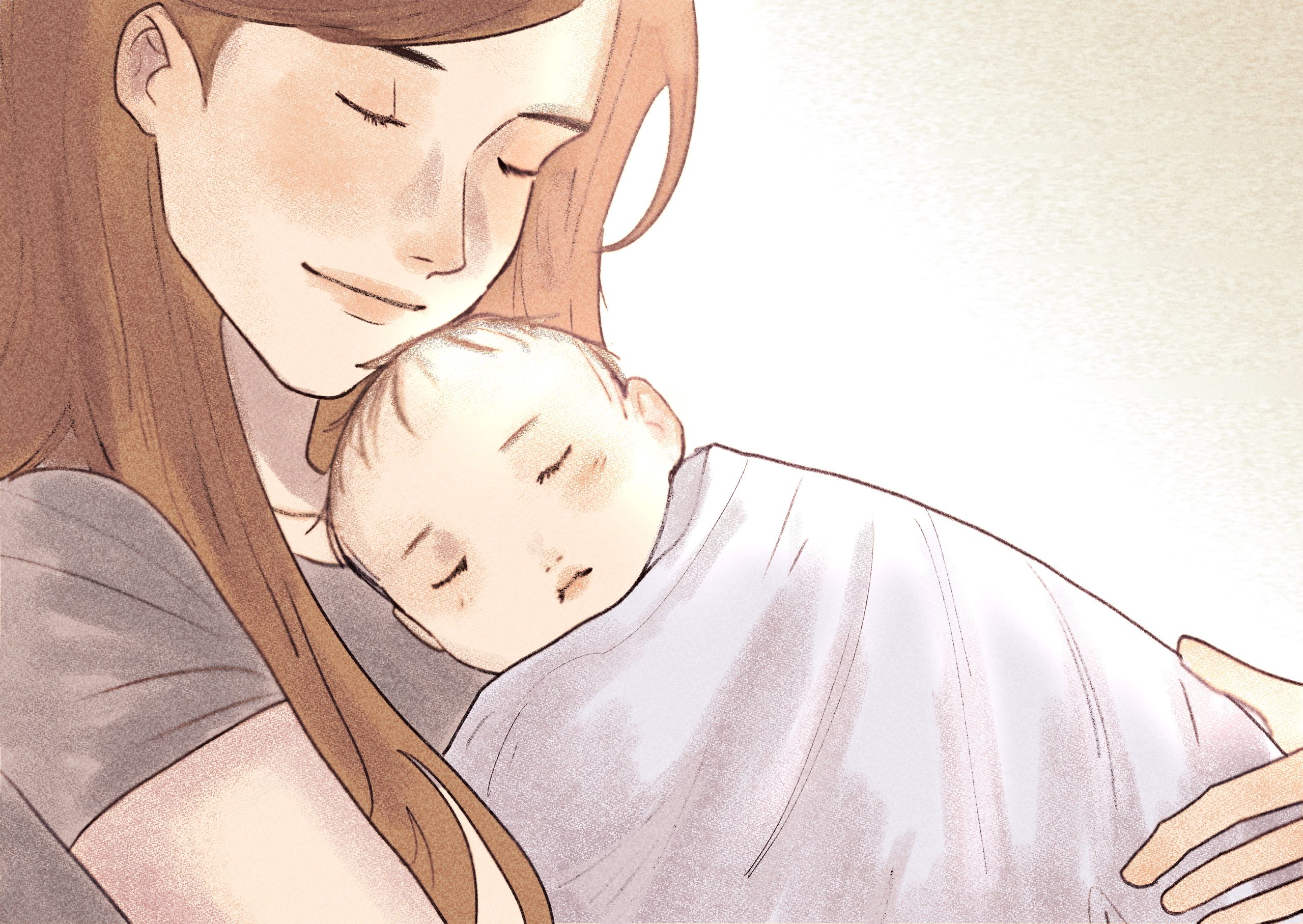
Everything is swimming a little. The fluorescent lights and ceiling tiles blur as brightly as rippling water. The last contraction loosens its teeth, leaving me floating above the bed, mildly unhooked from gravity. The monitor beside me keeps up its steady beeping, completely unmuffled.
Thomas squeezes my hand. I wish he’d stop doing that. Or I wish he’d do it harder. Or maybe I wish he would just harpoon me like a whale. “That was a really good push, Marie,” he says again, like he’s cheering for a child, but I know he means well. I nod, surfacing and sinking again.
Someone adjusts the blankets around my legs. A nurse. The doctor says something to her, but I don’t hear a thing. I fall back and the impression above me crashes in waves. I close my eyes slowly. I close my eyes slowly to keep from slipping away.
This morning: the cereal bowl I held against my chest as I sat up in bed. The way I tried to eat but then put it down because of my stomach. The phone Thomas forgot on the bedside table, facedown and silent. The brisk air when I swung my legs off the bed. The cramp when my feet hit the floor, though I knew the real labor had not begun. Tugging on a pair of pajama bottoms. Looking in the mirror. Smoothing my hair back. Blinking at my reflection, as if there would be any meaning to the concept of vanity today. Opening the front door, November air tucking itself down the neck of my gown. Holding my belly in both hands. Tripping over the doorframe. Flattening my rotund shape on the wooden planks, my face flush to the boards, dampening with dew.
Before too long: rolling on my side. Hollering something to the effect of “[Help!].” Hearing my own pitiful annunciation and worrying, but my neighbor did see me. My desperate horizontal orientation. Him helping me up with an apologetic smile, not unlike his usual grin. His kids at their front door: watching two adults huddle together like they’d seen in Dad’s movies about war. Wearing nothing like what they should’ve been wearing, their hair sticking to their blankets. Running to us like they run circles around their mother, their arms are rotors. The girl’s gap-toothed grin waning at the sight of my pain. Remembering the boy once gave up while putting on shoes and ran down the street after his friends. The mother standing in the doorway with a hose, spraying his feet before letting him back inside. Oh, how the pair tracked mud through their house constantly. I can remember that image clearly, the way she held the hose.
Standing stiff, watching the kids from my window: sunburning and yelling and childish certainty. Wet summer heat dripping like honeycombs. Their laughter rippling across lawns. Practicing arpeggios on my violin. The bow falling into the tempo of their running feet. The metronome ticking incessantly beside me, indifferent to the notion. The boy climbing my fence, slipping down and scraping his shin. The princess giving him a dandelion. His refusal to treat it like a gift from royalty. The sun in perfect position, pouring most everything in gold. The tree trunks as narrow and dark as ledger lines on sheet music. The metronome ticking beside me, indifferent to the notion.
Tine goes the metronome. I can hear it now: tine and tine and— No. The hospital room where I am very much in my body: the beeping the tempo of my arpeggios. Coincidence. Humor. Irony. Dying to give birth. Isn’t that funny?
Never. Mind.
________
I’m leaning against the paneling of the front porch checking the time and looking at photos because there’s no service. I shift my weight, and the leaves dusting the steps beside me skate away. A single Jack-o-lantern rests on the stoop, his head caved in on one side. A birdbath in the yard holds a wide pool of rain and a drifting mass of whirligigs. The air has a nip. I wish I were in bed. Instead, I’m here, at my HR manager’s “engagement tea” because my instinct for self-preservation is embarrassingly strong and, in my experience, HR remembers everything. So, I drag myself up the stairs, pass the deformed Mr. Lantern, and knock lightly.
Warm air spills out immediately, followed by waves of cinnamon and vanilla. I sidestep a mountain of coats piled on a single overburdened chair and place mine carefully on top, praying it doesn’t cause an avalanche. Soft-spoken laughter drifts through the rooms and, somewhere, a classical guitar is being played—gentle, precise, improvisatory music that makes even silence sound expressive. In various places—on credenzas and bookshelves—mason jars sit holding cinnamon sticks wrapped in twine. The backs of most chairs are covered with crocheted blankets or hand-stitched quilts.
Wandering further through the seemingly endless rooms of ungiving small talk, I finally find the guitarist sitting by the bay window, like part of the décor. Beside him I spot two people I know want to say hi to me, but I slip away to another crowded room, full of people I don’t know. I pick up the book off the coffee table. It’s about New England lighthouses.
“Hey, Thomas!” someone shouts.
Unfortunately, I lose my place while reading the entry on Portland Head Light, which was commissioned by George Washington in 1787 and which was first lit in 1791, making it the oldest lighthouse in Maine. Before me, Guy from accounting is standing over twelve inches too close to me.
He claps me on the shoulder and immediately launches into a monologue about refinance rates. I nod like a bobblehead, my eyes tracking the many other goings on: the guitarist has switched to a minor key, jamming an intrusively energetic vamp, the people I wanted to avoid dig their way through the coat pile and say their goodbyes, the host couple turn from them and greet more guests with the same, rehearsed hug, the newcomers approach the corner cabinet and carefully choose their teacups.
Somehow, I must have missed Marie because, now that Guy has shifted from one leg to the other, I see her pouring tea into hand thrown clay etched with a peace sign, holding her peacoat over her arm. Where did she come from? She’s so funny, always just appearing.
She finishes pouring and looks around with polite concern, a gentle pink still present in her cheeks. She must be alone. I brush past Guy and walk over, refusing to give my anxiety a chance to grow.
“Hello, Thomas” she says. “I didn’t expect to see you here.”
“I didn’t expect to see myself here either. You came out of obligation too?” I ask.
“Yeah, well, if I didn’t come, she’d bring it up in the office for the next three months.”
I nod. “Very true.”
The hostess’ dog stumbles upon us and claws at my leg. “Hi Norman!” I say, petting him instead of talking to Marie. And then through the window beside us I see a cluster of kids wearing light jackets, begging their parents for the opportunity to run around and get frost bite.
In the main room, the newly engaged couple steps before the fireplace, hand-in-hand, and the wife taps her teacup with a teaspoon. Everyone slowly ends their conversations, something I had already accomplished, and make a herd facing the mantle. People clap at each remark politely while the hosts make their announcement—about love, partnership, next steps, the whole script. I look at Marie standing beside me, her hands in her pockets, nodding through the speech. I think she’s really listening.
As soon as it’s over, the hum of conversation resumes. Norman leaves me to find another suitor. A couple asks the guitarist if he takes requests. And Marie leans toward me, lowering her voice so the words could truly only be for me.
“Why don’t we slip away?” she asks.
“Wouldn’t that be better?”
_______
“Marie, we’re going to help things along,” the doctor says. “A small incision. It will make room.”
Small. Make room. Help things along. Everything he says is obviously euphemistic, but I do not speak or protest. I only nod and watch as he begins to clink various metal instruments onto a tray.
Thomas, I finally notice, is squeezing my hand painfully tight. He turns to the doctor. “She fell on her stomach hard this morning. Please be careful with her,” he says. He looks pale. I wonder if he might faint, and I almost hope he does. It seems unfair for the both of us to stay conscious during this. The nurse lays a wet cloth on my shoulder, but I am uncertain this simple pleasure alone can sustain me. And although I’m trying really hard to hold onto the room, everything is decreasing.
Our living room: sudden and whole and warm, like flopping onto a sunlit dock. Covered head to toe in a crocheted blanket. Sleeping on the rocker in the corner. Brilliant moonlight across the floor, drawing rectangles on the hardwood.
Thomas: cradles a tiny bundle in his arms and, despite his wrinkling eyes, looks young. Hands her to me reverently, like I am the altar and she the body. Holds her against my chest and she fits there perfectly, as if I were made with a hollow just for her. Leans in but doesn’t kiss me, and, for the first time in years, I am anxious for him to do so.
Our baby’s tiny fingers: thrust out of the swaddle and curl around mine. Grip and grip. Mine grow red and redder. They grip harder still and mine explode and I’m screaming and gripping and gripping the railing until it’s there. The hospital bed railing is here.
The nurse: telling me to breathe but I am gasping. Really gasping.
The monitor: making an endless tone. Without break or understanding.
The doctor: “Stay with me, okay?”
Trying to swallow: my throat full of sand. My husband down by the waves. My daughter wading in the water. She is daring and darling at only five years old, and, when he looks away, she falls into the jagged rocks.
I love: him. How he looks so absolutely useless and so absolutely determined to console her. Our daughter, so I take her by the hand, and we sit down on our front stoop. Her feet, how they don’t reach the ground yet. Her cheeks, still red from crying.
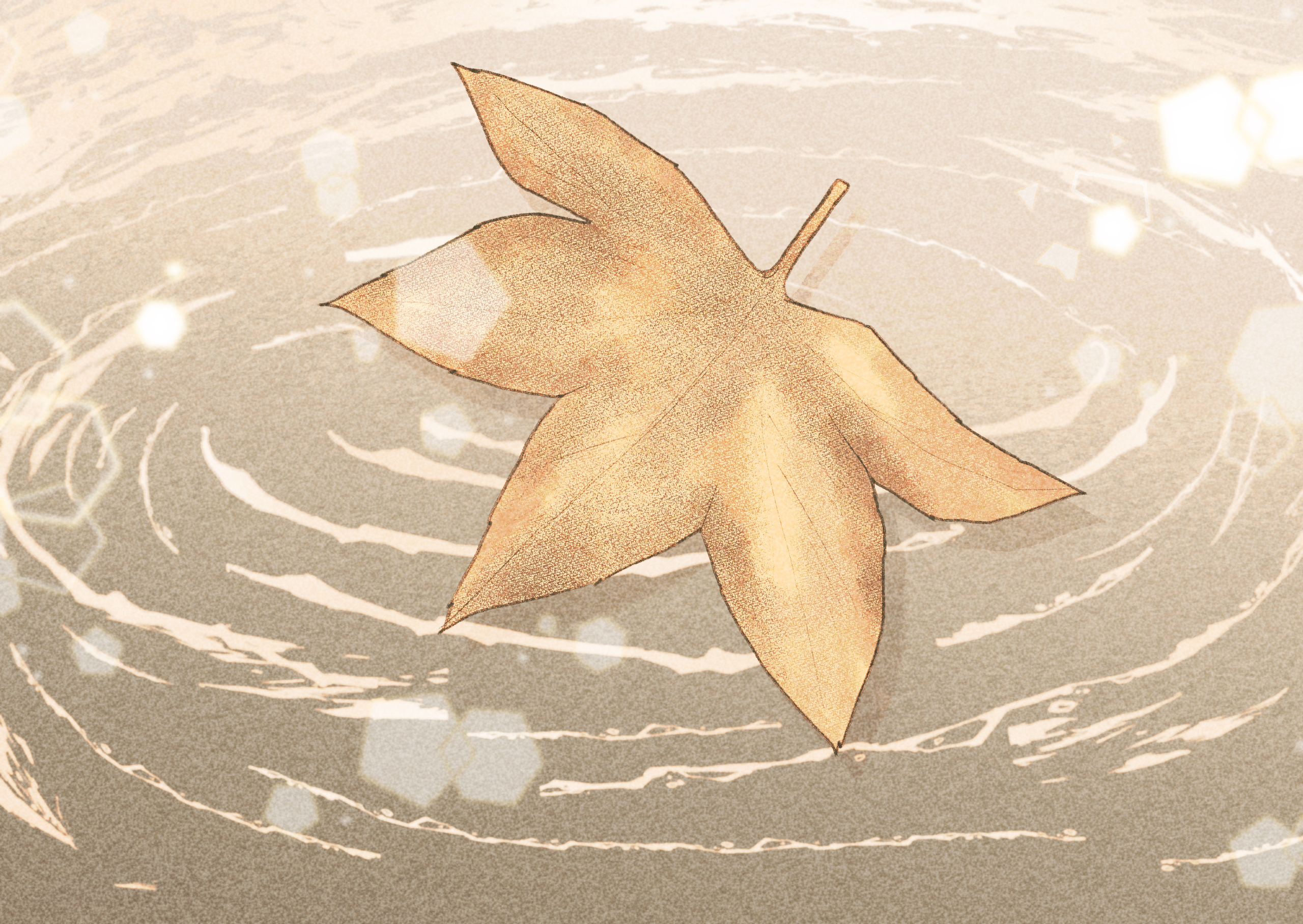
We: sit in silence for a while. Discuss why leaves change color. Lose momentum when I start mentioning chlorophyll and carotenoids.
She: nods, even though she got more than she asked for. Stands up, taller than me now. Is wearing a backpack. A large hiking backpack. Grins while wiping a tear from my eye.
A small ache: beneath my ribs. Below my stomach. Wants to tell her not to go, but she is waning out of sight.
A stinging ache: diagnosed as an awareness for the necessity of pain.
A constant ache: wishes I had told her to stay for as long as she likes.
_______
Outside, the air is colder than before now that dusk is approaching. It takes away my breath at first, not that I had anything to say anyway. Marie zips her coat halfway and tucks her hair inside the collar.
“There, we did our part,” she says, her breath turning to fog. “We were seen. We were pleasant. We contributed to the coat pile.”
“Actually, you didn’t,” I say. “You held your coat the whole time.”
We pass the birdbath in the front yard; the same one I noticed on the way in. Up close now, I see it is not filled with floating whirligigs, but with small, dead moths, their wings spread wide from shock. I decide not to mention that.
“So,” I say, shoving my hands into my pockets, “where are we going?”
She shrugs. “Around,” she says. “Away. Just walking. Why—do you need a goal?”
“I like goals,” I say. “I’m very goal-oriented when it comes to not disappointing someone—especially HR.”
“Well, we’ve accomplished that one. Now we’re working on not disappointing ourselves.”
I’m not sure what to say to that, so I don’t say anything, but the intermittent silence between us doesn’t feel awkward. It feels fragile, like a porcelain creature we’re trying not to startle.
We reach the end of the driveway and turn left. The neighborhood spreads out in quiet rows of well-kept houses, each one with its own minute variation on respectable comfort. Exposed wood. Crisp siding. Square windows where families move in silhouettes. A few houses have porch lights already on; the others must be waiting until it’s truly dark.
We pass a garage with four rusty bicycles leaning against the side, their front wheels turned in toward each other. Some little boy’s forgotten plastic wagon lies on its side in the grass, half-filled with damp leaves. A birdfeeder hangs low from a nearby branch. It’s empty. Overhead, the last orange light before dusk is fading, smeared low along the tops of the houses. I am in awe at the fact that the sky does this for free.
“It’s pretty,” I say, almost involuntarily.
“It’s something,” she says. “These suburbs always seem to look like someone’s idea of what a neighborhood should be, not what it ever actually is.”
“And what’s the giveaway?”
“In the imagined version, everyone knocks on each other’s doors with pies and casseroles. In the real version, my mom waves me over from inside her mini-van and forgets my friends’ names.”
“That’s unforgiving,” I say. “I don’t know anyone’s kids’ names.”
“Maybe not, but you knew our HR’s dog’s name.”
“That’s because I get a lot of emails from HR, and she mentions his name in every email signature.”
She laughs, and I feel proud of myself, like I’ve finally answered a very small exam question.
Up ahead, the same kids I spotted earlier appear at the end of the street, walking with their hands stuffed in their pockets. They’re bundled in coats that clearly aren’t quite warm enough. I can tell because their shoulders are hunched. The cold is sneaking in through their zippers and the collars. The kids, ignoring this naturally, turn the corner, determined.
“It’s nice when you just do it,” Marie says. “When it’s too cold to be out but you go anyway. It feels like you’re getting away with something.”
When we reach the corner where the kids went by, where a chain-link fence runs along, separating the yard from the sidewalk, she slows and then stops, leaning against one of the posts. I lean back too, a step away.
“I like it here,” she says.
“On this corner?”
“Yes.” She looks up at the sky, now fading into a dark blue. “We’re just here.”
“I’m good at being ‘just here’. I’ve had a lot of practice,” I say, shifting against the fence. “I’m always ‘just here’.”
“You’re not always ‘just here’,” she says. “You’re reserved.”
I shrug. “People rarely notice the difference.”
At this she turns to me, getting closer, and I let her. Her nose wrinkles as she leans into me. Her face falls on mine, and her body pins me into the top of the metal fence. It stabs me ruthlessly.
“Shit,” I jump forward, pulling us both down to the pavement.
“I notice the difference,” she says sheepishly.
_______
Running to catch up with her: the porch boards beneath me never ending. Her boots tapping lightly up ahead. I run until I see her backpack slip from her shoulders and unravel into a long train.
Sitting down to catch my breath: beside an aged Thomas. Beside a great many pepper-haired people I do not know. All dressed in formal black. All watching my daughter, dressed in white, kiss a man for the whole room.
“Okay,” someone says beside me, their voice close. “Right here. Right now.”
Pain ripping up my spine: an apocalypse threatening to break me open. All the weight descending and pulling me with it.
“Just one!” the doctor says. “Just one more!”
Pushing: because I have no choice. Because I have narrowed to a single point.
Pushing: something out of me with a sudden silence. An unheard moan.
A sharp cry: fierce, outraged, living, screaming, lifting to the light. A boy!
It’s: a boy.
The decree lands first on Thomas and is then passed back and forth effusively between his mouth and the nurse’s. For me, it only rests on my lips, where I still feel her kissing me goodbye.
They place him on my bare chest. His cheek is hot against my own. His limbs, his everything is so tiny. He is heavy and slippery and here. His cry rises and then breaks, hitching to my skin, and my own weeping answers his.
A son, how strange.
“Hi,” I whisper, the word both an apology and a promise. “Hello, my son.”
His face startles at my voice, and then loosens, as if he is deciding whether to forgive me. I tuck him closer, his fists unfurling and curling around my breast as if he were taking ahold of the whole world.