
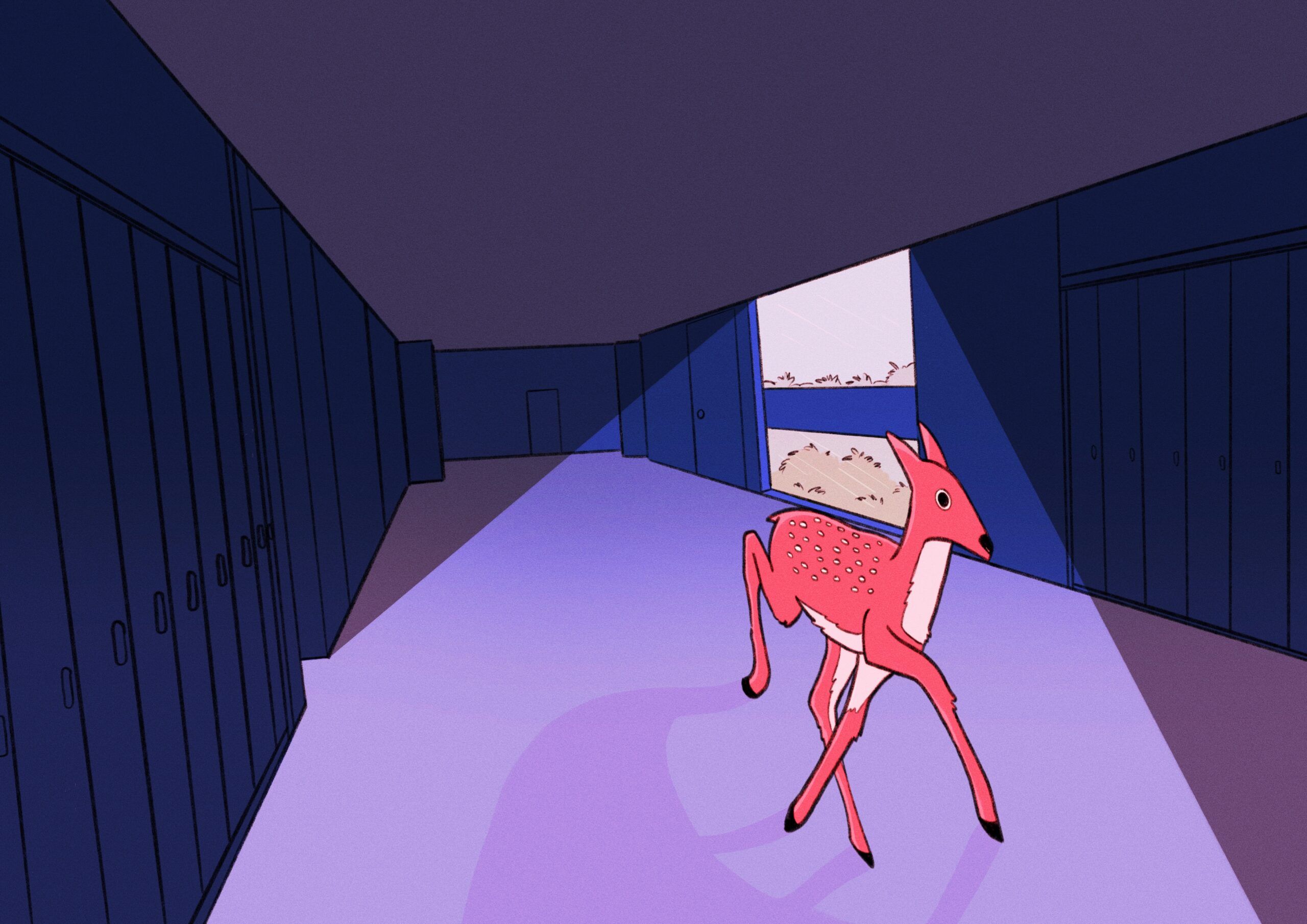
Joy and I hardly met throughout the years, and we weren’t exactly close. The few times we spoke in our high school days were the sort of mild and uninteresting exchanges common between peers, but something about her demeanor took hold of my interest and even impressed me. She seemed somehow more sure of herself, of others, of the world. Her brown hair swayed elegantly as she subtly gestured, and her slim figure and fluid walk often brought to my mind the image of an agile deer.
When I discovered that she had, by some odd chance, ended up at the same faraway, smalltown college as me, I found my gaze drifting toward her again. She had grown up to become an especially solitary girl – or rather, young woman – but always seemed to carry the lightness of a free, liberated spirit. She had never been one to mingle with others in high school, and it didn’t surprise me that she remained pleasantly alone throughout many years of college. We were similar that way. But she floated, in the same confident, content way she always had. She seemed unchanged, untouchable. She never once looked back in my direction. She had no interest in the lives of others, even of someone like me, who she’d once known.
Like that, our paths never crossed, even though they’d run through the same spaces. As strangers, we’d carry on living our separate lives. But she called me one night of our junior year, and that changed.
I can’t say what compelled me to answer. I sat there, in the bedroom of my apartment with my books sprawled open, staring at the name of a person whose number I never realized I’d saved. And in an instant, I was taken aback by the arbitrary pieces of Joy I had collected over many years. Maybe I was curious about what she wanted, what she sounded like, where she was, and I couldn’t help myself from grasping at any answer. Or maybe I’d derived an unusual satisfaction from the idea that she hadn’t forgotten me, that perhaps she’d paid attention to me all these years later too. Either way, I answered, bringing up the phone to my ear with a breath caught uncomfortably in my throat.
Her voice was quiet and a little sultry. I found myself imagining the shape of her thin lips and neat teeth as she spoke. “Sorry,” she said. “Will you take me home? I’m out alone at night.”
I asked her where she was, and she said she’d met someone at the fried chicken shop downtown. I slipped on my jacket, took my keys, and shut the door.
I had no idea why she’d asked me, of all people. I didn’t even have a car. I ran all the way to the place, feeling reinvigorated for a reason I didn’t understand. I found her squatting in front of the floor-to-ceiling windows of the shop, just beside the door. The white lights bleeding from the interior gave her curved back a slight glow. Her hair – now straighter and longer – hung around her head, concealing her face. She was wearing some kind of thin cardigan over a light green sundress, arms crossed over her knees.
I slowed as I approached. When I said her name, she looked up at me and smiled. I caught sight of her eyes head-on for the first time in years. Round and tapering to points at their ends, they struck me, as they had in the past, as very pleasing to look at.
I offered my hand. “Are you alright?”
“Yes,” she answered as she took it and stood. “Thank you.” She brushed off the loose gravel on her dress. I took off my jacket, and without a word, she accepted it, draping it over her thin shoulders. We stared at each other for a while. I couldn’t read her eyes, could only see the sharp focus they had.
“You know,” she said slowly, “I never thought you were good-looking back then. But I see it now, a bit. The more I look at you, the more I think you really are quite handsome.”
I wasn’t sure what to say to that. I also didn’t know what kind of game I’d unknowingly walked into. It didn’t feel like she was flirting despite her words, and this conversation certainly didn’t feel ordinary. Rather shortly, I asked, “Why did you call me?”
“Well,” she murmured, “why did you answer?”
I was a bit stunned by the question, though I should’ve expected it. I had no good answer for her, I realized, and so I conceded with a short, “Fair enough.” Then she chuckled, amused, waving a feathery hand through the air dismissively. She already knew I had no answer.
She walked slowly, lolling side to side on account of her pointed heels. Our shoulders nearly brushed as we walked. She was silent for a while, but eventually, inhaled sharply. My ears perked up.
“I had a dream,” she said, her words lifting off as lightly from her lips as the fabric of her dress in the breeze. Then she stopped, and I turned back suddenly as if she were something that might disappear. Her eyes flicked up to meet mine, and I noticed how her grasp on the flaps of my jacket exuded a subtle desperation that was undetectable to the passing eye. When I narrowed my own eyes at her, she held my gaze with a startling, strong spark of conviction. “I want to marry you,” she said.
#
When she said it, I found I wasn’t at all surprised. I was not charmed by her assertion either, which frankly, I believed to be a little uncouth. I asked, “Are you drunk?”
Everything I’d seen in her eyes and face leading up to that moment faded away. She returned to her carefree self, a little cold and very distant. “No,” she said. Her voice was flat again. “I drank some beer, yes, but I’m still sober.” She began walking again, and I stood for a moment longer before catching up.
“What do you mean, then?” I asked. The breeze at night made me shiver. “‘Married’? We’re hardly in our twenties. I mean-” I paused to offer her a chance to interject, but she remained silent. “I just don’t know what to say.”
She smiled without looking at me, tugging tightly on my jacket. It drove me a little crazy not knowing what she was smiling at, like I was on the outside of a joke she was sharing with someone else.
“You don’t really have to say anything,” she said. “It was just a dream, you know.”
I was bewildered. She said that – and said it in a certain way – like she was trying to single me out as the one who was strange, when it was her who had confessed something bizarre. Still, I dipped my head and kept walking. Then it occurred to me that I didn’t know where we were walking to. But Joy, in the same, purposeful and rhythmic way I’d often seen in the past, walked on, with the soft click of her heels echoing behind her, and echoing the low drum of my heartbeat.
“Do you live alone?” she asked.
“Yes,” I replied. I felt, once again, that I was lowering myself into some unpredictable trap.
“I really hate to ask, but do you think I could sleep over? I told my roommate I’d be out tonight and she definitely has her boyfriend over.”
“Sure,” I said. “That’s fine.”
She smiled at that, sighing and dropping her head so her hair slipped forward over her shoulder in slow, rolling waves. I wasn’t sure what she found amusing this time either, but I didn’t feel so foolish, at least. Then she shook her head a little, side to side, the light rumble of a laugh escaping her lips. She lifted her head back up to look at me, and she said, “You really haven’t changed at all, Reagan.” I noticed the way her eyes morphed with her smile.
I led her up to my small apartment and flicked on the lights. Slipping off my shoes, I remembered that the only person that had ever come to my apartment was my mom, and even that was a long time ago. I wasn’t ashamed of anything, though, not even of my solitude or bleak walls and carpet, not even in the presence of Joy. I might’ve even hoped for her to bring some color to it, and to me. She kicked off her heels, plodded to my bed across the room, and threw herself upon it. It reminded me almost of the way a fish would flop, just much less violently and only once. I went over and picked up my jacket, which she had tossed beside her, and draped it over the back of my chair. She didn’t move for a few moments, so I sat down on the bed beside her, a safe distance away. “Do you do this often?” I asked. “It’s not safe, you know. Walking into a guy’s room and laying in his bed like that. Or even staying out so late in the first place.”
“Please.” Her voice was far away since she faced away from me. “I’m not stupid. I know what kind of guy you are.”
I don’t know if she was calling me respectful as a compliment or easy as an insult, but by now I was more used to her way of speaking. “Is that why you called me?” I asked.
“Mm-hm,” she agreed lazily. “And I had that dream, so I guess you were on my mind.”
“You must have a lot of faith in me, then,” I said.
She flopped back over onto her side so I was able to see her face. She stared at me for a while. It felt like she could see through my head, straight through to my thoughts. “Are you going to hurt me?” she asked after a moment.
She said it lightly, like she was making small talk. She really didn’t care, I realized, what I was going to say or do, because she had somehow already figured me out. “Of course not,” I replied anyway because it was true.
She blinked lethargically. When she was silent, it felt almost like something was suspended in the air, dangling precariously between us. Then she opened her mouth. “You remember that thing they made us do on the last day of school our senior year? Where we had to write a letter of gratitude to someone we never had the chance to thank?”
I nodded. I remembered it vaguely – I wrote to one of my teachers, and I received a large pile of neat envelopes on my desk. A few of them were from classmates or friends thanking me for a memory or a favor. Many others were from some form or other of admirers.
Joy shifted her weight to dig through a pocket of her cardigan. Her thin fingers emerged with a small, folded note. “I wrote one,” she said, “but I never gave it to you. I dug it out of one of my boxes this morning after my dream.” She held it out to me, sitting up so she could reach. As I took it, she folded her knees up against her chest. It rattled between my fingers like a fluttering dove.
quiet eyes far away
charmed and forever charming
those who live to
endlessly revolve.
center of another eye,
not mine,
you pass, chasing
something unseen.
smile carrying the
gentle notes of a guitar,
a rising melody
bringing dazzling illusions
that fail to fool you
as they fail to fool me.
a mirror
and a mystery, you’re
a figure in my memory
I hope to extinguish
yet maintain.
when we meet again,
I hope I understand you more
and hate you less.
#
I started playing hockey when I was four, and I played up to state championships in high school. And perhaps because I’d transferred mid-way through my junior year, I ended up catching the attention of my peers. I think some of that had to do with my name, which was especially hard to forget because it didn’t really suit my face or my demeanor. I recall sharing this suspicion with Joy once after we reconnected, and she laughed airily at my naivety, brushing her hand across my shoulder with a glint in her eye. “That’s cute,” she’d said.
Outside of hockey, I never did anything notable, but I’d somehow been adopted into a group of popular kids. I didn’t particularly mind the company, but I never cared for it either. I thought that was what Joy meant in her poem, though, about those “illusions.” When I looked back on it, it seemed like only the two of us were privy to the way I didn’t fit exactly into that crowd the way everyone else thought I did. I never dated or partied or did whatever else those kids thought they could get away with. Yet all the same, I spent most of my time with them, smiling in the same sly ways and laughing at the same dry jokes. Living life as it came to me.
I did not know until reading her letter that Joy did not approve of this ruse, which at the time, I had not known was a ruse at all.
#
In the twenty-or-so meager years of my life, I’d been called a lot of things. Most of my peers in high school knew me only as “a good hockey player” or “the new guy.” I overheard a girl once describe me as having an “overly serious but boyish charm”; a teacher here and there would note an “unexpected tendency for reclusivity at times” in their reports; even my older sister would refer to me – fondly, I’d like to believe – as “hopeless” and an “oddball” to her friends.
Over the years I came to understand that what other people remembered about me was that I could act strangely and against expectation. Undoubtedly, I’ve remained an “oddball” after high school, after college, and for every new phase of my life. But I still remember very acutely how for each jutting edge and corner I carried, Joy seemed to morph around and embrace me. Never once had she called me overly serious or strange or hopeless. She’d say that I was a good person, someone with a good heart. She’d say that I had a beautiful way of believing the best of people, that I too often neglected to see it in myself.
In high school, there was only one time where we spoke at length. I met her at the public library where we were to work on some unimportant group project with a few other classmates. She had booked a study room, and even though I arrived fifteen minutes early, she had already settled in. I thought it might be in order for me to introduce myself to her since we hadn’t spoken before then, but the “I’m-” barely left my lips before she finished for me.
“Reagan,” she said levelly. “I know.” Then her eyes softened as I dipped my head in resignation and slight embarrassment, and she hesitated for a moment before beginning, “I’m-”
“Joy,” I interrupted this time, and copying her playfully, added, “I know.” I saw something pass through her expression that I didn’t recognize. We both shared a smile, and it was then that I first realized how pleasing her eyes were.
So for fifteen minutes, we spoke, though nothing we said was of particular value. It was the existence of the conversation itself that satisfied me; it was the glorious and rare promise of understanding someone who seemed to understand so much about everything and everyone else. Years later, it would be this same, brilliant promise that urged me to receive her despite my bemusement.
The words she and I had said were promptly drowned out as the others in the group arrived, boisterous and reckless. At the time, I found their entrance and animated gossip entertaining. I laughed and leaned in, momentarily forgetting Joy’s presence altogether. But remembering just as quickly, I saw her eyes were disgruntled, even contemptuous. She turned away. The slow, silent acquiescence from just a minute ago flickered away like the weak flame of a candle, and that was itself a signal I was not smart enough to understand.
#
We slept together on my bed, which she insisted was okay, since I didn’t have an extra mattress or futon, and certainly didn’t have a couch of any sort. It was a double bed, anyway, so there was enough space for the two of us so long as we didn’t spread out our limbs too much. I let her change into a spare long sleeve and a pair of linen pants I’d outgrown a few years ago. Her dress and cardigan hung limply over my jacket on the back of my chair. I was struck by their lifelessness without her.
Her note lay unfolded on my desk, exposing its naked candor to the still air of my room. “It’s awful, isn’t it?” she exclaimed with a light laugh after I’d read it. I understood that it wasn’t really a note of gratitude at all – perhaps that was why she never delivered it to me – but more like a fragment of her young mind. I noticed her face grow soft and somber when I shook my head. “I don’t know,” I told her. “I guess I kind of like it.”
I decided to stop confusing myself with everything she said and did; the only way everything sorted itself out was when I stopped thinking at all. Whether she really hated me or liked me, whether she was trying to tell me something more or not – I set everything aside, as if this whole night were a dream in and of itself, one that I would eventually wake up from and find myself deeply disturbed.
Sleepless, I looked over to where she laid. I could feel how close we were, and I could feel the gentle warmth radiating off her body. Moonlight streamed through cracks of the window blinds, illuminating stray streaks of her hair and floating over the blanket in little slivers. Then I realized she had begun to tremble, almost indiscernibly. Crying.
Her sobs began to grow louder, into something she could no longer muffle with her hands. I turned toward her after a second, leaning closer. I placed a gentle hand on her shoulder as if it could channel all my compassion and comfort to her. Silently, she placed her hand over mine, holding it still.
#
She’d tell me a few weeks later that her boyfriend broke up with her over fried chicken the same night she called me. We talked often over the months that followed. Our meetings were dictated only by her spontaneity, and were often over cold beers at the balcony of my dingy apartment. She liked the air up there, she said, and I certainly didn’t mind a refreshing break from the oppressive summer heat here and there. After her third visit, I gave her the spare copy of my key.
That day, we tapped our bottles together with a sharp clink and drank. I leaned out against the flimsy rail, sticking my head far out in hopes of catching an occasional breeze. I could feel my shirt slick with sweat, my hands slick with condensation. It was maybe our fourth or fifth time speaking like this.I watched her chug half the bottle at once.
“I really had to sit down and think about my life after that,” she said, crossing her arms on top of the rail. “About every moment in my life that led up to me amounting to nothing.” She sighed, like it was all some insignificant but bothersome ordeal from the past. All that had happened that day, she said, felt like a series of signs from a higher power. Signs that, for some mysterious reason, directed her toward me.
“So I guess you’re pretty superstitious,” I noted.
She shrugged. Her slim fingers traveled up to her collarbone, fidgeting with the delicate gold chain hanging from her neck. “I always thought that the universe had its reasons for things. I thought that if I let it steer me, I’d eventually end up where I’m meant to be. Now I’m not so sure.” She looked at me for a long moment. “I guess that means I’m finally growing up.”
I’d think about that moment for a long time, even after she’d left. Could that be the reason she’d gravitated toward me? I never imagined her as someone without ambition and direction, but the truth was that she’d found me while she was very much aimless. She’d shown me she’d never taken anything too seriously, never done things with a true sense of permanence. And maybe that was the reason she’d sought me out, saying she wanted to marry me – because I was someone who was so grounded and unchanging, and more importantly, someone real and tangible from her past. I was a simple person who lived a simple, one-directional life. That was something she knew for sure, something she’d confirmed with her own two eyes after she called me. She believed I had something she didn’t, and something she feared she would never obtain.
In the moment, though, I didn’t say much or think much. Eventually, I asked her, “Do you think you loved him?”
She let out a long breath. “I don’t know,” she admitted. “I was sad about him leaving. There were times when I missed him, too, and other times when I felt relieved. But I wonder about it a lot. Like, is love really something you can fall out of so easily?”
I didn’t have an answer for her. I drank instead.
“I used to think I knew all the answers,” she said. “When I was seventeen and eighteen and nineteen. Now, I can see that I don’t know anything at all.” She took another swig from her bottle and stood, wiping her hand on the fabric of her denim shorts. “I don’t think I understand what exactly love is anymore.”
I saw a different side of her then, one that was not indifferent and not exactly vulnerable, but defeated – stained ugly with hopelessness. She might’ve wanted me to teach her that too – what love was like, what love could mean for people. But it was something I didn’t know either, so I said, “I don’t think anyone ever does.”
#
On the warmest and brightest summer day of the year, we kept the balcony door closed, and instead, stared up into the blue sky from a woven bamboo mat beside a slow, rotating fan. I was feeling faint and tired, so I laid down. Joy, worried about my emerging fever, rested a cold towel on my forehead and dutifully resoaked it every fifteen minutes despite my protests.
She told me about her dream that day. We were much older, she said, and we were married and lived in a lovely house with three lovelier kids. It was nonsensical, the way all dreams are, but her words spun an earnest novel that fluttered up and around the room like a butterfly. Then, she recalled, we were alone somewhere mellow and comforting and hazy, where I held her hand and she leaned her head on my shoulder. I spoke then, too. She couldn’t remember what I said, or if she could even understand what I was saying at all, but she knew it was something out of fondness because a profound warmth began to spread through her chest. She described it as the touch of sunlight on a spring day.
“I know it’s childish,” she said, “but it made me so happy that when I woke up, I felt so sad. I realized I wasn’t happy in my life. That my life wasn’t even leading up to anything. I was in a push-and-pull relationship, alone with no close friends, and without a single thing that let me enjoy life. I was miserable.” She became solemn. “Do you think you’re happy?”
My eyes were closed. We were silent for a long time. I heard her start to rise to refresh the towel, but the sound of my voice pulled her back. “I’d say I’m happy right now. I don’t think being happy should be so difficult or so unattainable the way other people make it seem… My life isn’t all that great, but I’m still okay with it. I’m pretty content with where I am most of the time.” I opened my eyes and found that my smile came very naturally. “I guess you could say that I have pretty ordinary expectations, so it’s not too hard to please me.”
It was then that she let it drift out from her lips, that silvery reassurance that made me feel like a blissfully ignorant child. “You are such a good person, Reagan,” she said like a sigh, swiping my sweaty face and neck with the towel. It was almost as if she’d been caressing my face directly with her fingers.
#
Joy was the only one who ever told me I was a good person.
I think about that a lot these days too, about what it means to be a good person. I’ve never come to an answer, and I know somehow that no amount of pondering or reflection will guide me to anything definitive. All I’ve come to realize now – and far too late – is that Joy was someone with an extraordinary capacity for tenderness and trust, which I took for granted back when we spoke. I couldn’t understand what she’d seen in me, but she approved of me. And in her own way, she cared very deeply about me.
I suppose that in the same way her dream felt so real and important that she sought me out, these memories urge me to search for her again in my past.
#
“Do you still play?” she asked me once. It was early winter, then, and perhaps the cold weather made her think of the ice and the rink. We no longer drank cold beers on my balcony. I’d usually sit on my desk chair with some hot water. She’d lay or sit on my bed, folded up in my blankets, sometimes asking me to brew her a coffee or make some tea.
I was silent for a moment, as if it was something I needed a moment to think about. Without realizing it, my fingers began to drum softly against my desk. “No,” I answered, “I haven’t even touched the ice.”
“Did you try out for a team here? Like, intramural or something?”
I shook my head.
“Hm.” She tilted her head back thoughtfully. I thought I saw something sympathetic in her eyes. “I didn’t think you’d be someone to let that go.”
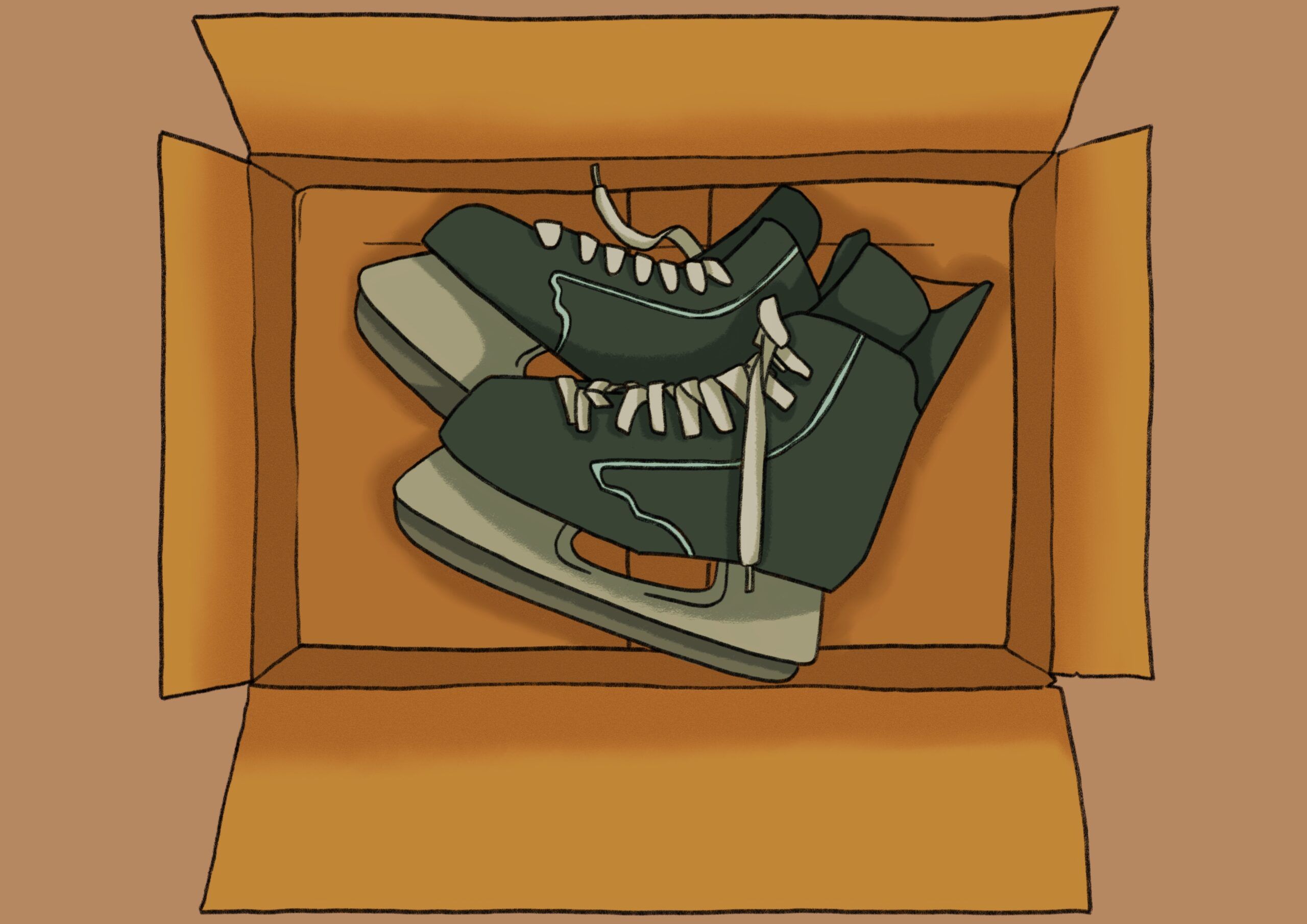
To be honest, I didn’t think I’d be someone to let it go, either. I took those skates with me when I moved to college, thinking I’d at least put them on once in a while to let myself glide away from my new and intimidating adult life back toward something I knew. To let myself reconnect with something that used to make up so much of my life. Something I depended on, something I loved so fiercely it’d driven me to exhilarating heights. But the skates sat in my closet for years, untouched and useless.
That made me feel heavy, even a little sad. Maybe I used to be someone great – at one thing, at least. Maybe I used to be someone who was passionate, someone who was hungry for success, someone who loved something they had no obligation to love. Those days seemed so long ago. It even seemed to be in another lifetime.
“I guess I’ve become a different person,” I said. “And anyway, my mom threw my skates away a long time ago.”
#
A few weeks after that, Joy told me she was leaving. She wanted to study abroad in some Scandinavian country – I can’t recall which one anymore – for her last semester. I understood that this was her way of taking a step in her life, but whether that step was in an established, thought-through direction or one of blind faith, I didn’t know. I had a feeling that when she left, she’d spread her magnificent wings and never look back. I imagined her moving high up into some other realm that was far out of my reach, leaving me behind in my pathetic spot in the world. And quite suddenly, I felt like we were returning to the way we had been in high school: me, standing still, eyes catching her every now and then with curiosity and even something along the lines of envy, and her, floating past gracefully. I didn’t say any of that out loud, of course, and simply nodded along as she spoke.
She handed me back my spare key. “You’ve been lovely,” she told me. Her smile was new. There was something sharp and refreshing about it, like the faint hint of lemon, and it seemed to light up her beautiful eyes.
I took it from her uncertainly. I felt as though I should say something – maybe something bittersweet, something warm or appreciative, maybe even something congratulatory. But I failed to find a way to put anything into words, and I failed to even recognize exactly all that I wished to convey. I stared at the key in my palm for a moment. It seemed to hum quietly.
“I’m sure we’ll see each other again,” she said, but I knew it to be a lie. By then I’d learned quite a bit about the way she spoke and the things she meant when she said certain things in certain ways. I knew that this was all part of her definite decision to begin again, to begin as a new version of herself. But it was nice of her to say this to me, and I willingly played along.
“I’ll marry you,” I said, “when you return.”
She laughed delightfully at this, and I felt my face soften. She reached up gently and kissed me on the cheek, and then she left. For hours after that, I could still feel the buzz of her presence, the lingering sweet aroma of her perfume in the air and on my clothes. I never saw her again.