
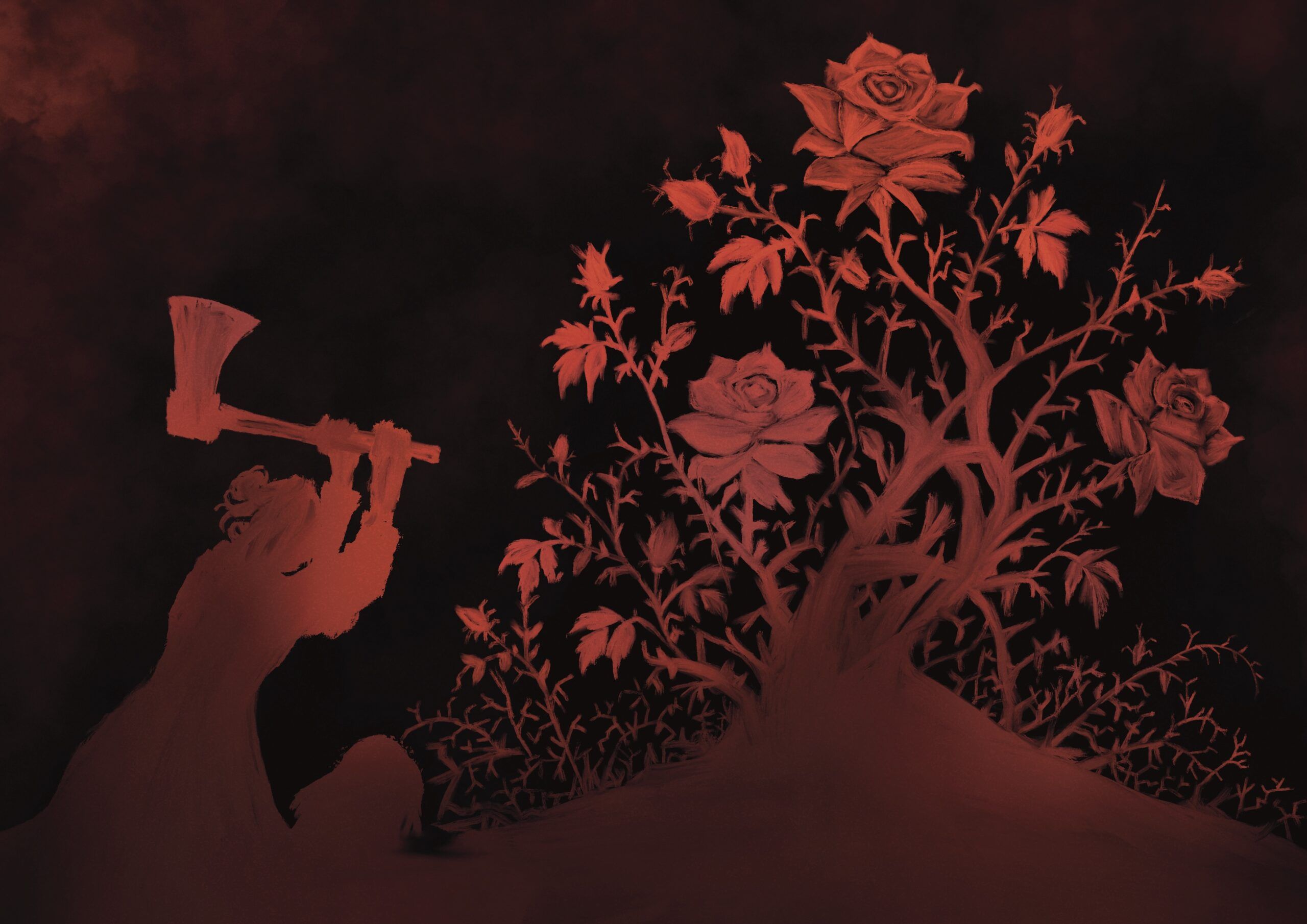
“Boogers !” nine-year-old Rebecca Hathorne blurted out, dropping the rose she had just cut, and blotting the blood already beading on her arm and leg. She glared accusingly at her assailant, the majestic rose bush that towered over the garden shed, and saw her blood glistening on its sharp, thick thorns. It was the closest she came to swearing, but it was a harsh reprimand to the swaying branches, as if she could shame them for hurting her.
This particular plant seemed eternal, existing long before the first human inhabitants had discovered this property and claimed it for themselves. But the land was never theirs, and there was a price to be paid by those living on it.
Rebecca’s earliest memories of her family’s ancestral home were chronicled in images that captured the splendor of the sprawling rose bush. It dominated the garden, almost as if standing guard. It crept into the background of many family photographs, a visual history of the generations before her, recorded in the faded portraits resting on the fireplace mantle.
Her great-great-great-grandmother Samantha Hughes had discovered it when she and her husband Nelson had purchased the house from Bertram White, agent for Angelo Bellini, the sole surviving son and heir of the Rappaccini family, immortalized in a short story by nineteenth century author, Nathaniel Hawthorne.
From snatches of conversations she had overheard, she learned that family lore hinted at a distant relationship between her own family and Hawthorne’s, despite the different spellings of their surnames. It was common knowledge that in order to distance himself from the notoriety of his great-great grandfather, Judge John Hathorne, the author Nathaniel had added the W to his name. Rebecca didn’t know if the stories were true or not but she was intrigued by the possibility that she might be related to someone famous. When she asked her grandmother about it, her questions went unanswered or were discouraged.
“Never you mind about that,” her grandmother said. “Those people grappled with their own demons because of that judge. Not one of them ever contributed anything good to the world, not even that writer.”
She thought for a moment and looked at Rebecca. “Some say that before she died, one of the women he convicted of witchcraft cursed him and all his kin.”
She shook her head sadly, looking first out into the garden and then at the photos on the mantle.
“We may share their blood, but we carve our own path, child. We aren’t responsible for the sins of the past, their sins, not ours.”
Although Rebecca had always been given free rein to explore the garden, from the time she began to toddle along the cobbled path that circled the fountain that was the centerpiece of the garden, she had heard the catechism of warning: “You must never stray from the path, and you must never go near the rose bush by the shed.”
She had promised, but her eyes were always drawn in that direction. She admired the spectacular beauty of the scarlet blossoms. She watched it from a distance, enchanted by the way it swayed in the breeze, almost as if a fairy princess was hidden in its branches, imprisoned by an evil sorcerer. Sometimes, she imagined she heard a sweet voice calling her name, and she would turn toward the shed. But each time she was tempted to venture toward it, she remembered that she had been warned repeatedly, gently by her mother and emphatically by her grandmother, to keep a respectful distance from it. So, she busied herself by the fountain.
The fountain looked as if it belonged in the courtyard of a Roman villa rather than in the yard of a New England farmhouse, but here it was. Marble dolphins breached marble waves, some swimming downward amid the fountain’s cascading waters. Those waters glistened along their sleek contours giving the impression that they were about to leap onto the path. Neptune stood above them, surveying his surroundings, his outstretched trident seeming both a warning against interlopers and a means of protection.
Rebecca would sit there for hours, letting her imagination spin stories of Neptune striding the waves, sending tempests to sink ships. She loved the sound of the delicate, sparkling streams that spilled softly into the pool that at one time had held koi fish. Sometimes, she would sit on the rim of the fountain dangling her feet in the water, imagining herself a sea nymph, swimming alongside the dolphins.
At other times, she would turn her gaze outward, taking in the profusion of color that made the garden feel like an Impressionist painting, delicate and exquisite.
There were bluebells and daisies and roses, the heirlooms planted with loving care by family members, some whom she knew only by their photographs. Her grandmother referred to each flower by the name of the person who had planted it: Mama’s pink-tinged yellow Peace Rose, Great Aunt Harriet’s pink and white columbine, Grandmother’s Shasta daisies, and the white angel roses Great Grandma Dorothea had planted the year Great Uncle William had gone to war.
Beauty stretched across every inch of the colorful landscape, but to Rebecca’s young eyes, nothing was as beautiful as the deep scarlet blossoms of the forbidden plant by the shed. It eclipsed every other flower, towering high above their heads, like a Greek goddess on Olympus, tolerating the less significant inhabitants in her realm. Its branches were intertwined in an intricate, untamed helix. It took Rebecca’s breath away.
It had withstood the deep snows of harsh winters and the unrelenting sun of drought-filled summers, never failing to provide that breathtaking display spreading across the horizon, a wall of blood red clusters. And today, she had decided that she would cut a single rose and take it to her room.
As she blotted her wound, Rebecca was filled with anxiety. She knew she was in a boatload of trouble. She shouldn’t have come here, but she’d done it. Now, she had blood beading across her arm and a thorn embedded in the soft flesh somewhere behind her knee, and it stung. A lot. Worse than a bee sting. She’d have to sit down to twist her leg around enough so she could pull it out.
Rebecca had made her way to the rose bush carefully, the same way she had watched her grandmother do it on the few occasions she went to prune its blossoms. But her grandmother wasn’t nine years old and she had worn heavy gloves and covered her arms and legs in thick protective clothes, her hair secured in a bun. Rebecca was wearing shorts and a short-sleeved shirt, her hair unbound.
As she squatted to get the thorn out of her leg, her hair caught in the branches. She began to cry in frustration as she tried to untangle her stray locks. She could hear her mother calling her to come in for lunch, but she was afraid to answer. She had disobeyed. She was where she had been told never to go. She stopped sniffling, and stayed quiet, hoping her mother would stop calling. As soon as she untangled her hair, she thought, she could slip unnoticed into the house and find a Band-Aid or two before going into the kitchen. So, she would wait.
But the longer she waited, the heavier her arms and legs felt. And she was drowsy. She rubbed her eyes and stared at the spot where she had dropped the single rose she had cut. It seemed to be moving, the severed stalk trying to burrow into the earth. It couldn’t be! But somehow it was.
Rebecca shivered and her eyes grew wide. The roots of the rose bush were rippling beneath the ground, reaching out for her. She held her breath and crab-walked backward. Or she tried to. But the thorn behind her knee pulsed and throbbed. It seemed to have grown larger and become swollen, gorged on her blood.
Rebecca was no longer afraid of her mother’s anger. She was afraid of an angry, looming plant, reaching for her. She didn’t know how she knew it, but she was sure that if she didn’t move now, those roots would burst from the ground, engulf her and entomb her within itself.
She tried to call out. “Mama! I’m here! Please help me! Help me, Grandma! I’m trapped! I’m trapped by the rose bush!”
She struggled to her knees, and pushed her hands against the ground to get her footing. Every movement seemed to play out in hazy slow motion. She could barely move. Her foot was rooted to the ground, dotted with small red pulsating bumps that ruptured and were reaching for the soil.
“You’ve got to move! You’ve got to move!” a voice told her and she struggled, unable to pull her foot free.
She heard her grandmother calling her name, telling her to stay calm, and hurrying forward, her face grim and determined. She carried an ax.
“Close your eyes, child and be brave.”
Her grandmother raised the ax high above her frail shoulders.
“You’ll not take this one! D’ya hear me? You’ve taken all you’ll ever take from me and mine and you’ll take no more! I’ll not have it! Enough! You’ll let her go or I’ll hack you to pieces even if it means the death of me! I say enough!”
The ax came down on the side of Rebecca’s left foot, and hot waves of pain shot up her leg. She felt nauseous and lightheaded. Her grandmother reached behind her, still holding the ax in one hand, not taking her eyes off her adversary, an antique rose bush.
“Take my hand now, child, quickly.”
Rebecca clung to her grandmother as they backed away. A breeze caught the ancient leaves and rushed through them, giving the bush a momentary voice that seemed to wail as the branches moved back and forth in agitated protest.
“That’s all of her you’ll get.”
They moved slowly backwards until Rebecca felt her feet against the cobblestones. Once they were safely there, Rebecca’s grandmother hoisted her up and thrust Rebecca into the fountain, directly under the dolphins, whispering in a language Rebecca didn’t understand. It seemed as if the dolphins slid close to her injured foot as her grandmother reached in to remove the thorn from Rebecca’s leg. She broke it into several pieces, and watched as they disintegrated in a bubbling froth. She continued chanting as she plunged the ax into the water, touching Neptune’s trident as she washed the blade clean. The pulsating pain in Rebecca’s foot ebbed and then was gone.
“Climb down, child, under your own power.”
Rebecca did, and looked down at her foot. It was no longer bleeding. She saw a scar, as if her wound had healed a long time ago. She looked up at her grandmother, expecting to be gathered up in a comforting embrace, but she wasn’t. Her grandmother looked relieved, but stern as Rebecca found her footing.
“I heard a voice,” Rebecca said, “telling me to move.”
Her grandmother nodded.
“That was my sister, Rebecca. You’re named after her. She was just like you, not heeding the warnings. She wasn’t as lucky as you are.”
Her grandmother placed her hands on Rebecca’s shoulders, turning her toward the rose bush, no longer beautiful in Rebecca’s eyes.
“Look at it child. Look at it and remember and count your blessings.”
Rebecca stared at the rose bush and thought that within each blossom, she could see a young, tear-stained face, one of which bore a striking resemblance to a young woman she had seen in a photograph on the fireplace mantle.