
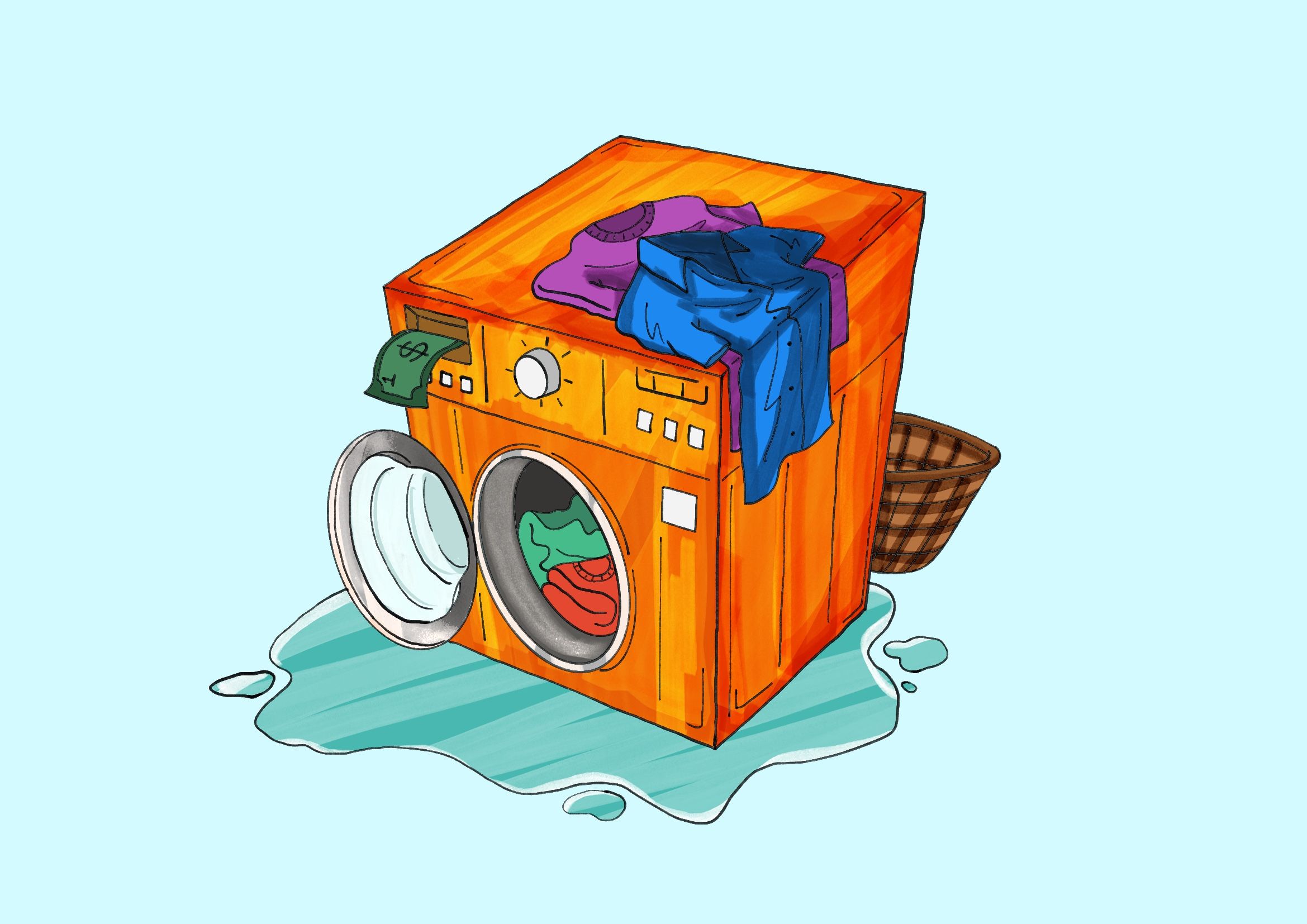
All I had was bills. You need four quarters to run the machines. This would not usually have been a problem. But the change device wasn’t working with the bills I had and the only eyes watching the store were those of a half-a-dozen or so random cameras. I piled my stuff into the machine and added the liquid detergent then went to make change. I put a bill in the device; it spat it out. I pulled it taught, I ironed it with my palm, I blew on it—what the hell, right?—like it was dirty mirror. The mindless hunk of last century technology returned it every time. Spat it out. Stuck its tongue in my face.
It did not remind me, in the moment, of all the times Sandy had refused to go out with me. At least Sandy had been polite.
The only other patron of Staccato Laundromat was a trimly bearded guy with a roll of quarters and a half-filled basket of dirty laundry. I’m not much for talking to strangers but I asked him if he’d mind.
“Four quarters for a dollar?” I said in response to his incredulous look. “Machine won’t take it.”
He looked down at the bill, up at my face. His expression did not change.
“Maybe you’ve got a bill it will take?” Dollars to doughnuts he didn’t need all those quarters for one scant load of laundry, but what the hell? I held my floppy bill stiff as I could and pointed it at him. He glanced at it, pulled his basket a couple inches closer to the machine.
I wondered if he spoke English. But you wouldn’t have to speak English to puzzle this one out. I pointed the longitudinally folded bill toward his ample supply of quarters. He just stared at me like I was one of those visual puzzles you have to squint to solve.
“If it’s not a problem,” I said.
By then his back was fully turned to me, like I was a sound he’d thought he’d heard but decided was just his imagination. He pulled open the beautifully engineered round glass door of the washing machine and begin to load his soiled shirts, underwear and towels, a few items at a time, as though he was folding eggs into a recipe to keep the perfect mixture of air in the batter. He hadn’t said a word. I hasten to add that the vibe he gave off was not unfriendly, not exactly. Indifferent maybe. Oblivious, I guess. He seemed to have decided what he’d thought was a ghost was really just wood snapping in the cold.
I resisted the temptation to blurt out just what you’re thinking: “what the hell is wrong with you? A dollar for a dollar. If you don’t want to help, you could at least be polite. I don’t even need an explanation, just common human decency.”
Stuff like that.
To tell you the truth, I wasn’t really tempted to say those things. Just like I hadn’t been tempted to say anything to Sandy when she replied, “I’m sorry. I just, I have to—I have an appointment to get my hair cut.” The more trivial the reason for turning you down the more obvious it is that she just doesn’t want to go out with you. I’m more obtuse than most people, but even I catch on eventually.
With this guy, I got the sense that he held onto his words, as though words were currency and, though he didn’t have to hoard them exactly, he couldn’t afford to spend them frivolously.
What I said to his back was, “I’ve already put the detergent in. And it’s a long walk home, and there’s no place open at this hour where I could go. If you don’t might? Even exchange.”
The role of quarters was just sitting there, paper torn open, like the carcass of fresh kill. Guts spilling out on the buff white paint.
While I was staring at the quarters, imagining just dropping the bill down and picking up four, knowing I wouldn’t do that, even though his back was turned, even though he hadn’t told me not to, even though it was just possible that the exchange itself was so simple, so obvious, so normal that his turned back might have been meant as “help yourself”—which I half thought it did. Like I said, I’m kind of obtuse sometimes. But I know small physical gestures often carry the meaning of whole paragraphs, even between strangers. Anyway, while I was thinking of that and before I said the last thing I’d said, about the detergent, which was true, another guy walked into the laundromat. He’d heard what I’d said. Before I could ask him if he had any quarters (at the risk of insulting the first guy if he had indeed implicitly offered me his, which, I’ll tell you now, he hadn’t), he said to me, “And that’s the problem, isn’t it.”
He walked up to the first guy and put a hand on his shoulder as though to say, “here I am. Sorry I’m late,” or whatever. I’m figuring they’re lovers or brothers or just good enough friends to communicate that way, so only they know exactly what the hand on the shoulder means.
“I’m sorry,” I said.
He looked at the bill in my hand. He gestured to the roll of quarters. He knew at a glance everything that had transpired.
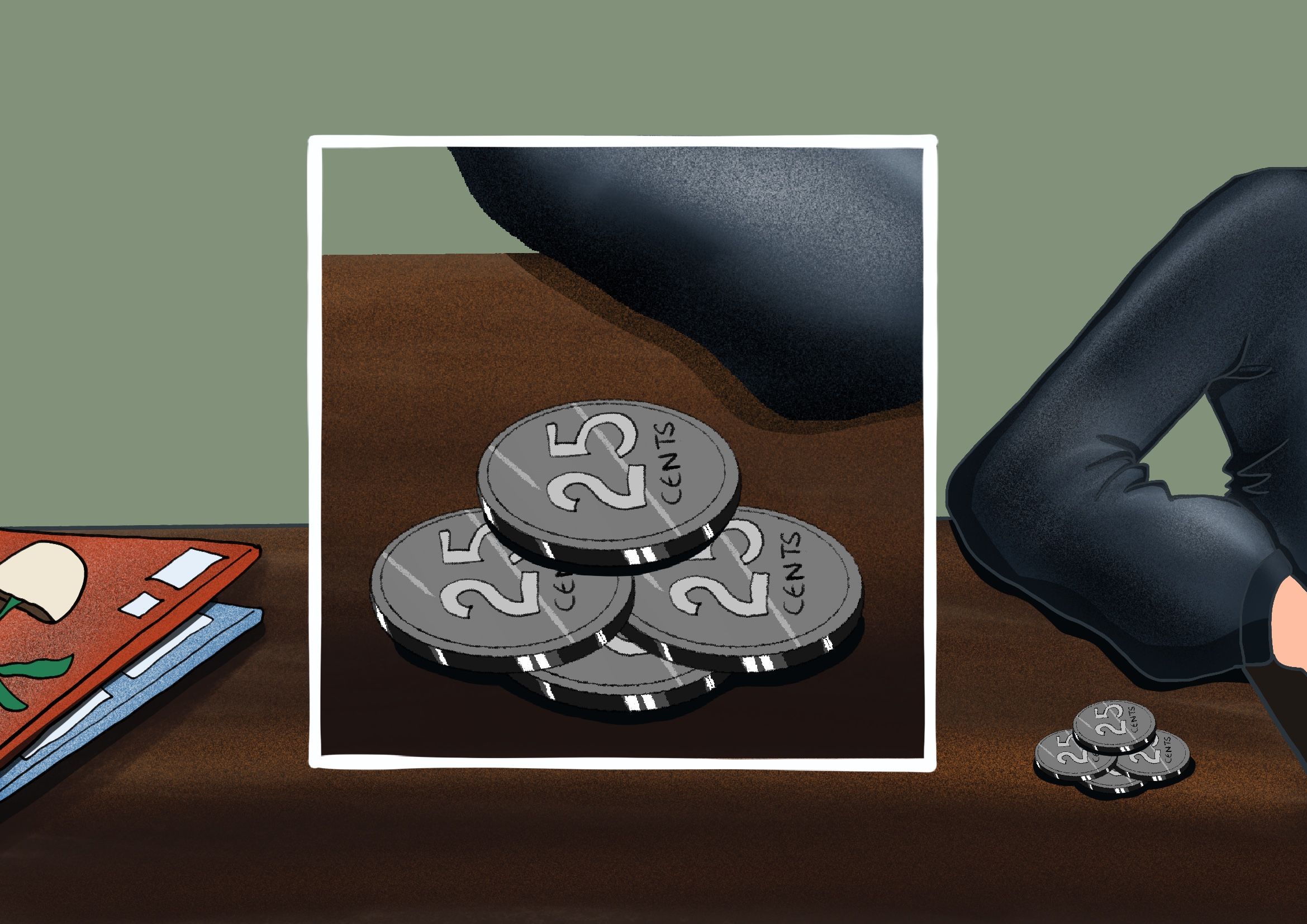
“You have a dollar bill. You would like to use it to buy four quarters from Bill.” (Yes, his name was Bill. I’d rather it had been anything else, but that’s what it was. The universe doesn’t exist for the neat composition of narrative.) “If it were an even exchange,” his friend went on, “you wouldn’t do it. Are you going to give me your teaspoon of salt in exchange for my teaspoon of salt? No, you’re not. Bill’s four quarters have to be worth more to you than your bank note, or you wouldn’t spend it to buy them.”
I must have looked incredulous.
“A dollar is worth more than a dollar,” he said. “Also less.”
“OK,” I said, uninterested in metaphysics. Bill closed the beautiful glass door of his machine. Four quarters rasped down the throat in quick succession and plunked audibly in the empty coinbox. He set the cycle going.
“I’m going to sit,” he said. First clue I had that he had ears and spoke English.
The friend said, “If the machine required three quarters to run, would you not be willing to buy three quarters from Bill here for a dollar?”
“At this point, I’d give you a dollar per fucking quarter if it would save me the trouble of tramping home with gloppy laundry.”
“He wouldn’t take advantage of you, like that.” The guy nodded at Bill, who was seating himself on a plastic chair by the plate glass window with the backwards name of the laundromat stenciled on.
His friend leaned against the agitating machine. “I suppose that’s all you have.” Glancing again at the bill in my hand.
“Excuse me?” Brows furrowed.
“Your bill is worth less than a dollar’s worth of quarters to you. But it’s worth exactly one dollar to Bill. So there’s literally nothing in this transaction for him.”
I opened the door to my machine—there being just one machine between mine and Bill’s (like men at urinals we had left the one between us free). I pulled a gloppy white shirt from the pile. “I need to wear this tomorrow.”
Tight lipped, he smiled as his eyebrows shot up. “Not information I need.”
The silence, on my side, grew quickly awkward.
Beside Bill on the little table at the front of the store was a stack—well, not really a stack, a former stack, at present just a mess—of magazines. He didn’t take one. He didn’t look at them. He didn’t stir the pot in search of a noodle. He sat like a shut-down robot and stared across the room.
The carcass of quarters was still right there, open on the drier.
What would happen if I dropped the bill beside the roll and helped myself to the quarters? I glanced up at a surveillance camera.
“He’s really not going to help?” I said.
“I didn’t invent the laws of economics,” Bill said blankly, without moving even his mouth.
The last time I saw Sandy, she had the same expression. It had been maybe a year since we’d left high school and I hadn’t seen her since. This was a long time ago. I was in a bookstore getting a jump on the reading list for next semester: Kafka, Kundera. (It must have been a survey of Famous K. Novelists.) She was running her finger down the volumes on the remainder table. She looked up as though some part of her distracted eye had sensed something in the room unlikely but familiar. She’d said no to me so many times—so politely, so carefully, so cautious of my feelings; it took that many times for me to realize what she was saying wasn’t what she was saying. No. Always no.
That day at the bookstore she had no idea she was carrying inside her the weight of all the times she’d turned me down. She caught my eye. So briefly, like a fly that brushes one fiber of a spider’s web, makes it sing, feels a tug, but doesn’t get caught. Whatever expression she’d had or prepared for looking up drained away. She turned slowly; it wasn’t, said her turn, that I was there that spurred her. There was just nothing on the discount table to spark her interest. She adjusted her shirt. She left the store.
Bill sat there blank. As consciously unaware of the economic universe, in which was too overinvested to change, as he could compel himself to be.
“You wouldn’t happen to have four quarters?” I said to the friend.
“He’s always been like that,” he said. “I think that’s why I stay with him,” he whispered, but not so quietly Bill couldn’t have heard if he was listening. He even glanced that way.
I had to work out what he meant. Was he born that way? Had he survived some trauma? Before this guy had met him was Bill the most selfless, generous soul on earth and was he a victim of betrayed goodness? Did this guy stay with him out of curiosity?
“Oh, I don’t have any money,” he continued. “Probably wouldn’t give it to you anyway, with him watching. No, really. I don’t give a shit. I’d give you the whole roll without taking the bill. But I couldn’t explain to him what I’d done. Do you understand that? There aren’t any words that could buy that information.”
I was as incredulous as you are, believe me. I had—I mean I couldn’t count—the number of things it occurred to me to say at that moment. It’s very unlikely whatever your incredulity or smugness suggests to you parked itself in my brain, stared down at all the ways this could go, found none more likely than any other, like fucking Frost in the yellow woods. I stood there stupefied. No doubt he saw it.
“I don’t want to go through that again,” he said.
“Again?” Forlorn. What had he gone through already and how often? Like if he gave me four quarters right now his fissured love would fail. I didn’t want to be responsible for that.
I did, however, want to wash my clothes.
I fought the impulse to argue. What good would it have done? I don’t know what trauma Bill has suffered; I’ve suffered enough to know only a crazy person shops for sense in a nuthouse. I wasn’t going to get anything out of these guys. I closed the door on my dirty clothes. I took a seat across the table from Bill. He didn’t react. I picked up a magazine without looking at the cover, and waited. It was late. Maybe no one I could trade for quarters with would enter before sunup. But I’d give it a little while. I’d invest another hour in hope. I had nothing else to do.