
The house breathed when she did. When the spring left dew on the grass, she liked to fling open all the windows and let the air inflate the rooms like a pair of lungs. This very morning had the perfect weather for such a thing. Though she avoided the window right near the front door because she knew what was out there on the porch. Waiting for her.
The warmth of the sunshine put her in the mood for poppyseed muffins, as it always did, so she tied her apron with yellow frills around her waist and cracked open her copy of The Happy Mother’s Guide to Keeping House. Spots of dried flour dotted the recipe. She flattened out the creases in the page.
She never felt more connected to her mother than when she cooked. It was the best quality time they had when she was a kid, when she stood on a stool to reach above the counter as her mother explained how to sift the flour and mix the dry ingredients separate from the wet ingredients. Everything she taught her was information passed down from her mother, who got it from her mother, who got it from her mother. She liked to imagine one original mother at the beginning of time who bestowed upon her daughters the vast mythical knowledge of motherhood. Her own mother died young, about the age that she was now. Because of this, she had trouble remembering all the rules of mothers, the rules that other girls could practice alongside their mothers late into their teen years. This was the root of her gratitude for the Guide.
The muffins turned out mostly perfect. One had a lopsided top. There was always one. She tossed it in the trash, though the sugar she had remaining in her cupboard needed precious conservation. The rest of the muffins she displayed on an oak stand with pink flowers painted in a ring around the base. She placed a curved glass cloche over the top.
The phone rang. She ignored it as she had every morning since she woke up knowing in her gut what had happened. She did not want to hear someone say it. The folded flag delivered to her doorstep, which still sat undisturbed on the wraparound porch, confirmed all the fears that had kept her up at night. Whatever overburdened, emotionally-detached general had been assigned the task of delivering the news did not need to be audience to the impolite performance of grief that would surely erupt from her had she been forced to hear the words aloud.
She went about her day with the typical chores. The dusting, the sweeping, the laundry. She no longer thought of her actions as individual choices. They were continuations, each duty carrying the next like a pearl-strung necklace. She found it best to keep busy because she would not, in fact, know what to do had there been any emptiness. Any time for herself. It would likely consume her. But she did not fear that because something always needed done.
Once the floor was clean and the clothes had been hung up to dry, she sat listening to the radio as she did her needlework. Stitch one, stitch two. A refugee camp in Poland had been bombed and they found no survivors. Over and under. The president planned to crack down on evasion of the newly enacted draft. A basting stitch to hold the pleat. Signs of a heavy storm incoming from the west. This caught her attention. She put down her work and grabbed the Guide. It had an entire section on storm preparation.
It shocked her how quickly the grey clouds gathered on the horizon. The rain hadn’t yet begun to fall but she knew better than to take the heavens at face value. She pulled the windows closed. The radio reminded her of the Civilian Defense advice. “Remember to find shelter.” Her home was her shelter, and she trusted in its strength to protect her. If the storm swept it away in the waters, then she would go along with it just as God intended. She checked through her preparedness kit, comparing it to the list in her Guide. Water, blankets, flashlights, batteries, cans of food, can opener, first-aid supplies. She would be okay.
Before she went to bed that night, she read over the last letter she had written to her husband. The one that had been returned to sender in the mail. She had talked about all the things that occupied her life at the moment. The showy milkweed blooming in the backyard, the dress that was difficult to hem, and the creative recipes that stretched less into more. Exclamation points sprinkled throughout the letter with the strategy of communicating happiness. She also told him how much she missed him. How much she couldn’t wait for him to come back. She set the letter behind the picture of the two of them sharing a strawberry milkshake that she kept on her nightstand and thought about everything that needed to be done the next day until sleep finally took over.
***
When the front door opened, it didn’t make a sound. Not even the hinges creaked, despite their need for a good oiling. What came through wore the silence like a traveling cloak. But the air still changed, as though the house had taken a breath but forgot how to let it go.
It lingered at the threshold for a moment. The hulking mass blended in with the night around it but became more sharply defined as it stepped into the small space of the living room. The smell of damp fur followed it. It crept down the hallway toward the half-closed bedroom door. The woman sleeping inside did not wake right away, but her heartbeat quickened in pace to match the thumping of the new living presence in the room. Her body sensed that whatever nightmare lived in her head had shifted into the space around her and she sprang up, gasping for air.
There it stood. The yellow eyes rested on the foot of her bed. The body framing them had the large, unnatural silhouette of something wild. She cursed herself for not checking the door. Her oversight had invited it in. She wanted to scream but could not make a sound, so she only held its gaze. The panted air from its jagged mouth rolled in waves to settle onto the skin of her hands. It stared at her like it knew her. Something passed between them, something she could not explain, but it made her feel small. Her hand found the cross around her neck and she whispered a prayer. The creature turned and left as silently as it had appeared. The darkness accepted it the way that water folds over a stone lodged deep into a riverbed.
***
The morning did not bring her comfort. The woman chalked everything up to a bad dream. She had only imagined the thing in her room, though the door still remained ajar, shifting with the breeze. She moved to close it, blaming the unsteadiness of the morning air and the old lock on the door that she knew needed to be replaced. Before she did, she picked up the newspaper that rested beside the weather-worn packages at her doorstep, not even taking a second glance at the latter.
Had she not known every inch of the kitchen as well as she did, the change would have been hard to notice. But she saw it immediately. Beneath the glass cloche, which was still centered and intact, several muffins were missing, leaving behind only crumbs and empty wrappers. She knew she had not eaten any the day before because the appropriate number of daily calories for a woman of her height, according to the Guide, did not allow for even a quarter of a muffin let alone a full one. For a fleeting moment, she imagined her husband had returned in the night just as he used to after a long shift at the Rogue River Cannery, smelling like sockeye salmon and steelhead. Sometimes, he would come home with a wild-caught Coho salmon that one of the native fishers had given him. These were her favorite. She loved the way their silver scales shimmered in the light, and the firm texture made it so easy to cook with. The fridge had no fish now, though, not since he had left. And so she knew it was not him who ate the muffins.
She just needed coffee. The grounds in the glass jar on her counter amounted to only one cup’s worth. The stamps of her War Ration book provided no more allowances. She added some chicory to the basket in order to improve what would likely be very watery Roosevelt coffee. The aluminium percolator on the stovetop made popping noises as the hot water began trickling down through the filter. The bitter smell reminded her of her father.
He was a stern man. Sometimes, when he came into the kitchen to grab the prepared coffee set out just for him, he would catch her mother leaning against the counter and staring at the trees outside the window. He would point to the framed stitching of Proverbs 31 that hung above the sink and remind her that noble women did not “eat the bread of idleness.” She would laugh in a way that sounded just like a cry and pat him on the shoulder, hands fluttering to straighten the collar of his suit jacket. The woman, only a child then, sat on the couch, brushing the hair of her Madame Alexander doll that smelled of sawdust and glue. The plastic eyes above its rosy cheeks bulged out of its head in a way that used to terrify her.
The sound of the coffee had reduced to a gurgle, so she removed it from the stovetop and poured herself a cup. She spread open the newspaper on the table, skimming through for anything interesting as she drank. Most of it revolved around the war. Things her husband used to explain to her stood out to her like the wage-profit curb and income tax fraud. The names of evil men, and the friends of evil men, were peppered throughout the headlines. She flipped past most of it.
In the center of the paper, she found an advertisement featuring a woman named Rosie working as a riveter. She wore a blue jumpsuit and a red bandana and pressed a heavy tool into a set of steel beams. Below her, a question read, “Can you use an electric mixer? If so, you can learn to operate a drill.” The woman thought about her electric mixer and couldn’t imagine it worked anything like a drill. She traced her fingers along the muscles of the woman in the picture. The jaw set in defiance. The look of pride in her eyes. The woman leaned closer to where she could almost see the pupils of Rosie’s eyes. She wondered what it would be like. She imagined the raw, coarse power of the iron and steel turning and tightening and yielding under her fingertips. The grease under her fingernails. The soreness of her muscles and the sweat that forms along her hairline when she has worked hard enough to heat her body to an almost immutable degree. She could see the sturdy construction before her that her own two hands had pressed into submission. The longer she looked, the less certainty she had that the image was just a picture. But it didn’t do her any good to linger. She folded the paper, pressing her palm flat against the creases. She scrubbed her coffee cup in the sink, water ran and ran, clouding at first then clearing as the cup became clean.
This day carried itself out nearly the same as the last. The dusting, the laundry, the needlework. The only change came when the sun dipped below the horizon and a trickle of fear reminded her of the thing that must have been a dream. She checked The Happy Mother’s Guide to Keeping House for tips on securing her house against intruders.
She began with the door. Locking it and then unlocking it, only to lock it once more, just to be sure she felt the bolt slide into place. She pressed the wood with both hands to feel it firm inside of its frame. The Guide recommended pushing something heavy against the door. And so she did. The kitchen table scraped across the linoleum floor as it resisted her weight. Next came the windows. Each had a brass mechanism that clicked into place, keeping it from sliding open. The Guide recommended putting wooden dowels into the frames so that they could not be opened from the outside. And so she did. When she reached the window in the bedroom, the one that was a bit smaller and higher off of the ground than the others around the house, she noticed the sheets still twisted and tangled from her restless sleep the night before. She straightened the bedding and pulled the corners tight until the wide white moonlight spread out undisturbed by any wrinkles.
With everything locked, she felt contained. Safe from the world outside. She kneeled onto the wooden floor and rested her elbows on top of the bed, bending her body into the posture of prayer. The name of the Lord felt fragile in her mouth. The last time she had prayed like this was when she and her husband tried for a baby for over a year with no luck. At the time, she recalled the story of Samson’s mother, known only as the wife of Manoah. Though Manoah and his wife argued over whose sterility caused the issue of their infertility, an angel arrived and revealed her to be the barren one. The angel blessed her with a son but required that mother and child must abstain from all things unclean. These rules, the angel said, would ensure that the child had a happy life. The woman thought of this story often as she struggled with her own barrenness. She wondered whether the rules she followed were not enough. When she spoke in prayer now, it was hard not to remember that her prayers over the years seemed to have fallen on deaf ears. Even so, she begged for safety from whatever lurked in the night.
The house let the creature in once more. It had betrayed the woman who worked with such diligence to secure it. The creature stalked her from the hallway outside of her bedroom, watching her knelt in such a vulnerable position. But it did not move. It only waited.
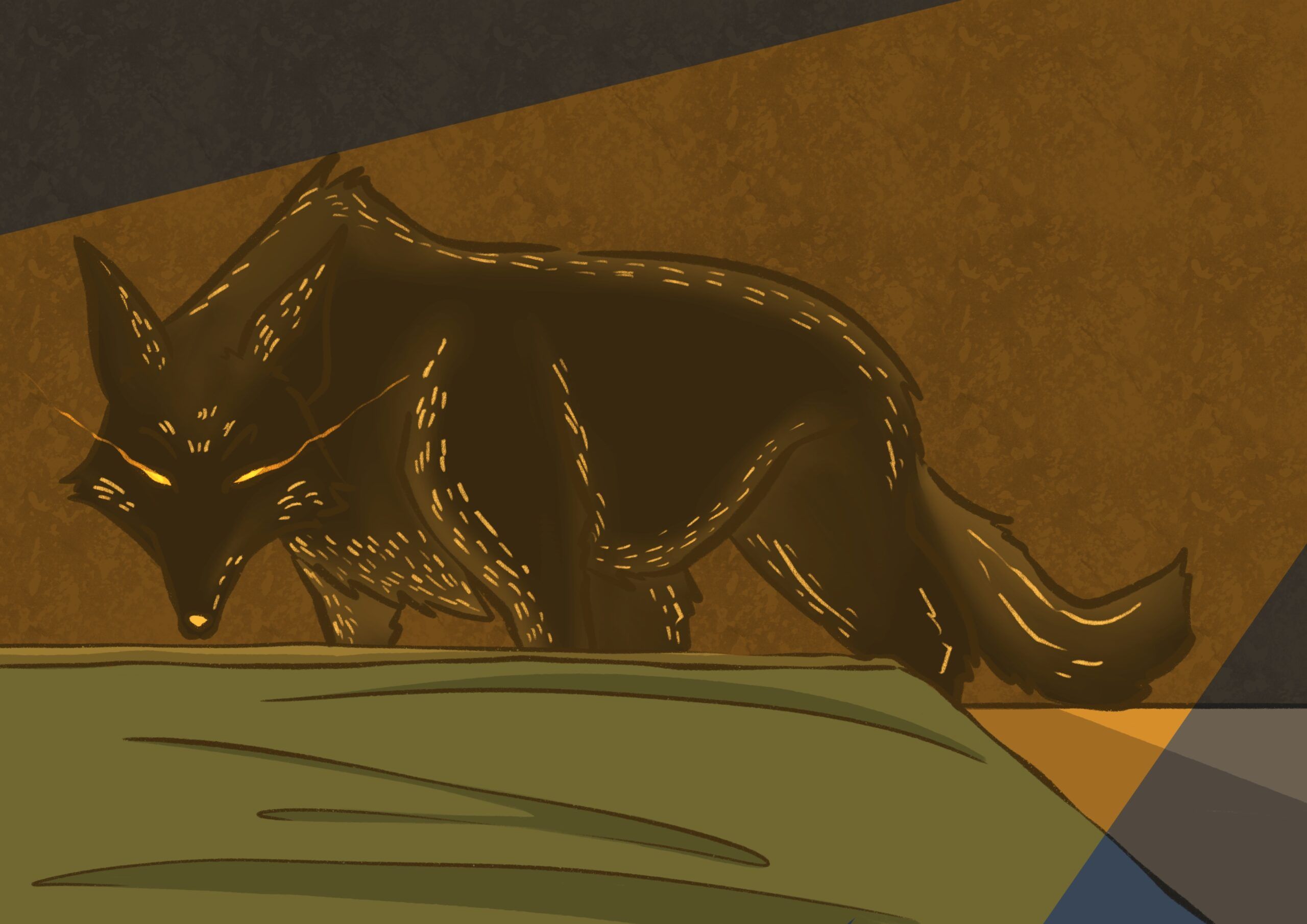
When the woman stood to get into bed, she turned to see the yellow eyes in the darkness behind her. The back of her neck felt ice cold and the center of her chest constricted, catching her breath and holding it near her heart. The creature stepped into the blueish white light from the moon and the woman recognized features similar to the wolves from her childhood storybooks. The sharp curve of its back rose a few inches above its massive canine head. Matted fur the color of soot covered its entire body. Blood-red gums lined its open mouth and sprouted white teeth wet with saliva, far sharper than any weapon a human could design. The Wolf could overcome any prey it wanted. This she knew. But it did not lunge at her.
“Tell me what you want,” she said.
It walked around her, lifting each paw slowly as if trying not to startle her. It lifted itself up on the bed, the frame creaking under its weight, and it lowered itself onto the blankets where her husband used to sleep. Stretched out legs spilled over the edge of the mattress.
Maybe it was because it reminded her so much of a dog laid out there on the bed or maybe it was because she had slept alone for so long, but she was overcome with the desire to bury herself deep into the fur of the animal. And so she did.
Her dreams twisted into rushing wind. She ran across the landscapes of the countryside. Across the Rocky Mountains, skirting around protected parks west of Calgary, over the flowing rapids of Bow River and through the woods. She felt the strength in her legs, pushing against the earth, every stone, every fallen branch, broken under her feet. The world unravelled into a blur of motion.
Before she opened her eyes the next morning, she felt the strangeness of her body. Damp with sweat. Thin limbs tangled into discoordination. The cold air brushed up against her skin in patches. She stirred and ribbons of fabric fell around her body, some onto the floor, some piled up in the empty space next to her.
The room was a mess. The mirror above her dresser had shattered into pieces now dusted across the floor, reflecting the sunlight coming in from the windows. A chair in the corner lay overturned and a deep gash in the fabric burst with cotton. Something that looked like claw marks decorated the floorboards and bed posts. Her feet met splinters when she rose from the bed. But she carried no injuries.
The front door once again stood wide open. However, the pin-tumbler lock showed no signs of forced entry. The bolt retracted clean into the cylinder just as if she herself had unlocked it. There were only two keys to that lock. One used to dangle on a silver chain around her husband’s neck, but when he left last year, he tucked it away with his father’s watch in a wooden box in their closet. Whoever had come in the night, she would be a fool to believe it was him. The other key was hers. She kept hers on a brass hook near the door, hanging on a pink thread. But it wasn’t there. The muscle memory of her hesitation at the door kicked in and she patted the pockets of her yellow polyester dress. Something small and rigid rested at the bottom of the lining. The key. She must have forgotten to put it back in its place the last time she went out. Fog crept into her mind making it difficult to think. Coffee would make it better.
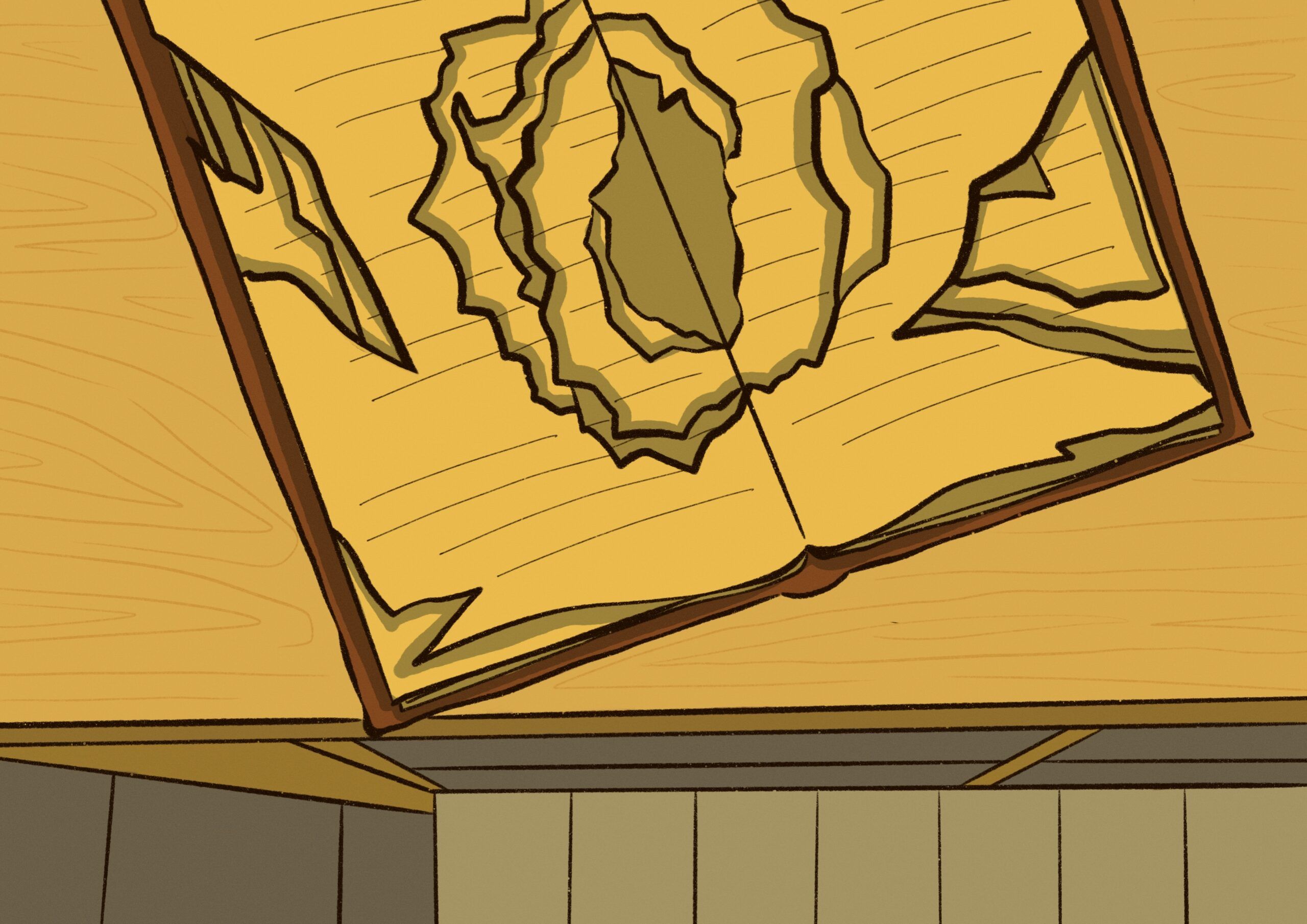
Ceramic pieces of broken dishes littered the kitchen floor. The bottom of her apron split into frayed strips where something jagged had ripped through it again and again. The table leaned to the side, one leg fractured like a bone. Something wet pooled around the woman’s feet as she walked on the cold linoleum. Milk from a broken glass bottle. None of this mattered more to her than the colorful shreds of paper spread out across the counter. The jumbled bits and pieces displayed fractions of letters. She knew that, had she put them all back together, they would spell out The Happy Mother’s Guide to Keeping House.
The Guide had been with her since they laid her mother to rest. Her old spelling tutor had gifted it to her.
“You’ll need this now,” she had said. “Maybe it will teach you to be happier than your poor mother.”
She had tried to picture her mother smiling like the woman in the picture on the cover. Something to block out the image of her with a rope around her neck. Over time, when she tried to remember her mother’s face, her memory stamped this other mother’s face in its place. The happy mother.
She cried over the shreds of paper on the counter longer than she had cried at her actual mother’s funeral. But she knew she should not idle for long as there was work to be done. She cleaned up the milk and glass from the floor and swept the shards of dishware. She mended the fabric on her apron, trying to turn the stitchwork into something pretty like a flower. If she could do all this, if she could put the house back together piece by piece, then surely she did not need the Guide any longer. She would be okay.
***
But she wasn’t.
The refrigerator was the first thing to break. Then the sink. The copper pipes beneath the cabinet whined and then burst open, gushing water all over the food she had just pulled out of the warm fridge. As she wound duct tape around the gaping wound in her plumbing, the phone rang. She ignored it. It rang again. Something split open inside of her. Something she could not tape up.
She picked up the receiver.
“Hello?”
“Hello ma’am.” The voice paused for a moment and she heard the sound of shuffling papers. “I’m calling about your husband.”
“I know,” she shouted. “How could I not know?” She slammed the phone down. The rotary dial teetered back and forth from the force.
Lightning cracked and the lights flickered. Once. Twice. Then they went out completely. The rain outside grew so loud that it masked the sound of running water still coming from under the sink. In the darkness, nothing looked broken or unclean. She closed her eyes. Nothing needed to be done. There is a secret bliss that can be found in sorrow.
***
The Wolf took its time that night. It knew she would be waiting. A trail of water lay in the wake of its steps, dripping off of its wet fur. Thunder rumbled outside and the door banged hard against the wall as gusts of wind ripped through the house.
She sat upright in bed, dressed in a clean white gown, hands folded in her lap, clasped together as if in prayer. Her eyes did not open when the Wolf entered. She did not ask why it came tonight.
She could feel the warm body move closer to hers. When she finally did open her eyes, the ceiling had disappeared and the Wolf hung above her, staring down into her. She could not look away. She felt every inch of her mortality. Her brittle bones, her thin and accessible veins that carried her lifeblood. The Wolf pressed its paws onto her chest and she felt the air escape her body. The house shuttered. The mouth of sharp teeth opened and the hot breath spread across her face. Her mind left the room and instead rested upon the image of heaven her grandmother tried to sell her and that she had spent most of her life trying to buy.
She did not scream when it happened. Or maybe she did and the Wolf was simply louder. As it ripped her flesh into strips, saturating her gown in blooms of blood, her ribs opened up to welcome it. It burrowed itself deeper until the line between what was human and what was not became unclear. The creature had entered her as a root enters the earth. Everything narrowed into muscle and fur and the pounding of a human heart learning the rhythm of something new. The wild beasts of earth could not access the heavens and her body was more wild than it had ever been.