It was the morning the accident happened.
Not an accident like you might think.
Not one involving a car.
Nothing in my life was usual like that. I was nineteen, and I still lived at home with my parents, and I did not have a car because I did not know how to drive. I was getting closer to finishing homeschool and earning a high school diploma that would be mailed to me from the school in Chicago, the same way my coursework was mailed, somehow finding me here, lost in the wrinkles of the Ozarks.
The accident was with an ink pen.
I was walking from my room at the back of the house holding a notebook, but not in my hands, holding it more like a baby. Though I hadn’t finished school, I loved school, not math, but literature and anything that wasn’t math, immersing myself in it, dreaming myself into the stories I was reading, and that morning, as I walked out of my room, holding my notebook like a baby, I must have been doing just that.
That part isn’t true.
I was not doing homework. I was writing a letter.
I should have been doing homework but I was writing a letter instead.
The letter was to my favorite pen-pal, Teresa Cecilia, in Mexico City. She was my age and was in her first year at Universidad Panamericana where she studied history, art, and poetry. I thought her life couldn’t be more different than mine. She was brilliant, bound to be a professor, and I was in awe of her. I wrote her all my letters in English because she wanted to improve her English and she wrote me all her letters in Spanish because I was taking Spanish through homeschool and I asked her to please write me everything, absolutely every word, in Spanish. I would then spend hours at my desk, translating her letters with the aid of a used bookstore Spanish-English dictionary, one with wildflowers pressed in the creases and falling out on my desk as I turned the pages. No one else in my house knew Spanish, so while the lock on my diary could be broken, each page hungrily consumed, Teresa Cecilia’s letters to me were mine all mine.
The ink pen was stuck in the aluminum spiral coil of the notebook where I had started a letter to Teresa Cecilia when I walked into the wall.
Or rather, the jutting corner of the wall – I don’t really know how to describe architecture, which I think of as a kind of math. It was the same jutting corner we had all walked into at different times, so often, that my mother called this jutting corner of the wall “bad fen shui” because she didn’t know how to describe architecture either. She would simply say, “Watch out for the bad fen shui in the hallway!” Which, like an inside joke, my father and I understood to mean the jutting corner. However, on the rare occasion someone came to visit, they did not understand what she meant – bad fen shui? – and they would freeze, looking all around the hallway in great alarm, as if for a menacing spirit.
Yes.
I ran into the “bad fen shui” that morning and was stabbed by my ink pen.
That was the accident.
My mother was on the phone with my grandmother. She was being very loud. That’s because she was fighting with my grandmother. They only talked once a week and every time, the conversation began with red birds and recipes, and ended with a screaming match. Yet every week, my mother felt guilty, blamed herself, and called my grandmother, starting the circle again.
It is no small thing to be stabbed by an ink pen. It is no trifling affair. It is a shock, particularly for one who has adored ink pens their whole life, wandering near and far with them, into cornfields and up trees, always with an ink pen, my mother griped, always, always that girl with an ink pen! This is because she was perpetually fighting ink stains on my clothing that would never come out in the wash and I had heard many times, so many times I had heard, Sophia Magella, stop walking around with an ink pen because you are wasting your father’s hard-earned money and my time!
So I knew I was in trouble.
Because this, the blood oozing from an ink pen stab wound, was far worse a transgression than ink stains on my shorts.
I was not mistaken.
My mother’s lips tore away from her teeth, a snarl that turned her into the big bad wolf, and never failed to send my knees knocking. She grabbed my arm and screamed, “Sophia Magella, why! Why did you do this to yourself!”
Why had I done this to myself?
I frantically searched my mind for an answer.
It was like staring at a math problem for which no solutions arose, only the sense of drowning into blank space, quietly, slowly, irrevocably.
Finally, I spoke the words I thought might save me. “Bad feng shui,” I said, and pointed to the jutting corner.
My mother shrieked, clutching her head: “Who walks into a wall! Who walks into a wall with an ink pen! Who stabs themselves with an ink pen!”
I had done this to myself. Why?
As with a math problem, the question persisted. I labored and sweat in my mind. I retraced my steps. I had ambled out of my room this morning feeling fine. I was doing homework – no – I was writing a letter to my pen pal in Mexico City.
My dearest Teresa Cecilia, I had started the letter.
I wrote to five other pen pals in five different countries but Teresa Cecilia was my favorite. We wrote every little thing about where we lived, the history and such. I told her that to complete my homeschool PE credit I had signed up to take Irish and Scottish dance lessons because the Ozark mountain region was rich with Celtic tradition. I sent her photos of me performing onstage with my dance troupe, Celtic Fire, in my skorts and Irish jig shoes, my dark hair covered by a wig of springy platinum curls when we performed at churches, schools, and craft festivals. I told her that Irish jig shoes use fiberglass on the tips and heels, rather than the metal of tap shoes, so the dancers make an extra sharp sound when they dance across the floor. In return, Teresa Cecilia sent me postcards of Chapultepec Castle and Catedral Metropolitana and hand copied poetry on the back like Bernardo de Balbuena’s La Grandeza Mexicana published in 1604. Her letters to me were written on thin air mail paper that crinkled like rose petals that had dried out in the Mexican sun years before.
Where was I?
I had been writing her in my notebook and what had I been writing to her?
Oh yes! I was responding to something she had written me. She had written me something about her mother. Her mother, she said, had grabbed her by the hair and pulled. It wasn’t the first time. There had also, once, been a biting incident. She had never told about these things, she wrote. Well, one time she had, and the person had responded that mothers and daughters sometimes fight and she needed to understand that her mother was a human being with troubles of her own and she, the daughter, must be the bigger person and show grace, mercy, and forgiveness. Teresa Cecilia wanted to ask me, her American friend, for consejo…was this true about mothers and daughters? Was this normal? What kind of relationship did I have with my mother?
I was walking down the hall and thinking on this very, very hard.
On the phone, my mother’s voice was escalating.
I had stopped to write something, then kept walking, shocked by the true thing I had written. The very, very true thing. The truest thing I’d ever written.
Was this why I had stabbed myself with an ink pen?
While I worked at this problem, standing there in the hallway, the blood making a glistening trail from my bicep to my inner elbow, pooling there like red silk, my mother stalked to the bathroom where she yanked open cupboards and drawers, riffling through them with an aggressive clatter. On and on she went – who walks into a wall? Who walks into a wall with an ink pen? Who stabs themselves with an ink pen?
I do, I do, I do, my mind answered like an excellent student, and went on to answer the question that was really there, beneath the others, sending up its invisible black smoke. I do because I am bad.
She returned to the hallway and sputtering, swiped my arm and patted down my wound with a hydrogen peroxide soaked cotton ball and then, the wound being cleared for viewing, she gaped at it, let out a scream. “What did you do!” Her eyes wide and afraid. “You made a perfect hole in your arm!”
It was not like receiving an A.
She screamed again, let my arm drop. “I’m going to have to call your father!”
The doorbell rang. The diiiiiiing a long cry between us, soft and broken.
“Who is that?” my mother hissed, staring deep into my eyes, because after stabbing myself with a pen, who now, this intruder I had summoned to our door?
“It must be Bryan,” I said. “Bryan – to tutor me.”
Her face changed and like a princess she swept to the door, flung it open, and pulled him in. “Bryan!” she cried. “Bryan!” taking him in her arms like he was her own. “You will never believe…what a morning!” She was nearly sobbing, and he was patting her back, always so good to my mother, not having one of his own. His own had died. He believed he had lost something holy. He believed that everyone with a mother had access to a kind of god, that mother love was the closest thing to divine love on this earth.
His eyes found me, standing there in the hallway with a cotton ball pressed to the bleeding hole in my arm. His eyebrows drew together.
“Come here, come here,” my mother led him by the hand, “take a look, Bryan, you will never believe…” she pushed my hand from the wound and held my arm up. “Sophia Magella stabbed herself with an ink pen!”
Bryan glanced from the wound to my face, holding my eyes. He turned to my mother. “She stabbed herself?”
“Because she’s a ditz.”
“Because she’s…what?”
My mother read his face and made calculations faster than any machine could ever do. “Well, what I mean to say is, it was bad fen shui,” rapping the jutting corner with her fist. “It’s what we always say around here, Sophia Magella, isn’t it? Now excuse me, I’m going to have to call her father.”
She hurried off toward the study and soon we heard her say it again, this time to my father, over the phone, “Bad fen shui!”
Bryan ducked into the bathroom, soaked another cotton ball with peroxide, came back out, and wiped away the blood, earnestly, like it mattered. “Wow,” he said, inspecting the wound, “that’s really something.”
For the first time, I looked. I looked at it myself. It was breathtaking, yes – a perfect circle. “I could never make such a precise circle using the compass and protractor,” I told him.
Bryan laughed, holding my arm up, like a champ. “A+ in Geometry!”
When Bryan laughed, I could never laugh, only gaze, because I was captivated by the way his unruly auburn curls fell across his forehead. It was beautiful art, the way his curls fell when he laughed, or when he danced. I had met him at dance lessons. I had only been allowed to see him because I had to see him, since he was my dance partner in Celtic Fire, and dance was my PE credit.
There were only a few things that had found me out here in the Ozarks:
1. My homeschool courses
2. My pen pal’s letters
3. Bryan Kelly
Oh, Bryan, first boy to touch me, one strong hand gently clasping the curve of my waist, he in his reel shoes, me in my ghillies, dancing each other to the pipes, a boy made of poetry. And numbers. He liked math. He saw that math could be lyrical and when he tutored me he sometimes played a penny whistle trying to capture the equation’s fragile notes. It was the only time math made sense to me, when he turned it into music and made the numbers sing.
Bryan covered my perfect circle ink pen stab wound with a Scooby Doo band aid.
Then my mother came back and ripped it off, peering at the wound with her reading glasses perched low on her nose, so she could describe it to my father, phone clenched between her face and shoulder. “Well, it looks pretty damn deep to me. Like it goes a long way down. Like she could fall down inside it and meet some real characters, a cheshire cat and a mad hatter.” She smirked, sighed, shook her head. “Yep, that’s what I’m thinking, too.” She hung up and palmed her forehead, then said, “You need to get to the Emergency Room. Your dad and I agree. And what am I supposed to do? I’ve got bread in the oven and dinner to make and I should call back your grandmother or I’ll have hell to pay…”
“I can take her,” Bryan said.
My mother glared at me as though I had said it, or perhaps, said it in Bryan’s voice, like I was a ventriloquist and he was the dummy that sat upon my knee.
“Bryan,” she said, still looking at me, “we are not going to drag you into this.”
“I want to take her.”
“What about her math?”
“I can tutor her in the waiting room.”
My mother said, “She needs a tetanus shot.”
Then, shouting at us from the door as Bryan led me to his car. “You make sure those doctors give her that tetanus shot! You hear me? Otherwise, she’ll get the lockjaw!”
“It was an accident,” I told Dr. Patel.
“You must be a committed writer,” she said. Her hair was in a braid reaching all the way past her hips, and when she bent to examine the wound, the braid fell across her shoulder, the rich black color in stunning contrast to the white coat. I grew fixated on the braid, the glossiness, the thick strands, the purple hues inside the strands, like her braid was a different creature, separate from her. She peered up at me, “I’ve seen a lot of stressed students from the university, yet I’ve never seen an ink pen stab wound.”
“Until today.” I smiled.
She smiled back. “How did it happen?”
I told her about the walk, the wall, the notebook, the pen, and ended with, “Bad fen shui.”
She straightened, made a note on her clipboard, pushed her glasses up on her nose. “Unless you are in unbearable pain, which I can see you are not, due to the jokes about fen shui, I can clean and bandage the wound, and send you on your way.”
In the corner, Bryan cleared his throat.
The doctor and I swiveled simultaneously to look at him, having forgotten his presence. He was so calm and quiet, sitting in the chair where I imagined mothers sat, fretting, kneading their worn purses. Bryan, I felt sure, would have kneaded his purse, had he had one.
Bryan said, “Her mother wants her to have a tetanus shot.”
I couldn’t believe he remembered, and was being so diligent. That’s not true. I could believe. That’s who he was. I was dumb to hope that he might forget. I should have said to him, in the car on the way there, I don’t want a tetanus shot. I had a phobia of shots, from the time I was a little girl. It took a doctor and two nurses holding me down to administer shots. It was not a small fear, easily reckoned with. This fear had roots that reached so deep, I couldn’t begin to find their origin. I could probably fall down that hole and meet characters there, a queen yelling off with her head! You would think someone had attacked me with a needle, early in my life. It didn’t matter. I would not have been able to tell Bryan I didn’t want the shot. I had relied on the hope he might forget.
Dr. Patel pushed her glasses up on her nose again. She wore a tiny nose ring that glinted, arresting my eye. I stared at it, trying to mind meld with the sharp sparkle, trying to become it, instead of me. She said, “I don’t believe that is necessary in this case. However,” she turned to me, “when was your last booster?”
“I don’t know.”
Dr. Patel nodded. “All right then. It is no problem. Who knows where that ink pen has been?” Her nose ring winked at me. “I will be back.” She walked briskly from the room, her black braid swaying on her back like a decadent, dancing snake.
I began to shake all over. This is not hyperbole. I was rattling, like my mother’s old car on bumpy Ozark backroads.
Bryan came over, sat beside me on the exam room table. “Hey, hey, hey,” he said softly, taking my hands between his. “Your hands are like little refrigerators.”
“I don’t like shots,” I said.
“I don’t know who does.” He rubbed my hands between his. “You already kind of gave yourself a shot…an ink shot. Maybe you’ll become a famous writer. Maybe famous writers get ink shots.”
I barked a laugh, through chattering teeth. “Can we do math?”
“You want to do math?”
“I told Mom I would.”
“Did you bring your geometry book?”
I closed my eyes. “No.” She would be so mad. “Can we still do math? Please,” I said, “it will help me to do math.”
He stared at me because, as my tutor, the one who had borne witness to my breakdowns over equations, those were not words that he had ever predicted coming from my mouth.
“Okay, sure.” Bryan lightly touched each of my fingers, and counted. “Von, two, three – ah, ah, ah!”
I laughed so hard. “Count von Count?”
“It’s important to review the basics.”
He kept counting, pressing the pads of my fingertips, with so much tenderness, a new round of goosebumps broke out on my skin, but these were a different sort, and not unwelcome.
Ah, ah, ah!
This was when I knew.
I would marry him, if she let me.
This man whose curls tumbling over his eyes when he laughed was a form of art. This man who danced me up and down the stage, our shoes clicking in time, this man who played the penny whistle to translate cold numbers into golden music I could feel, who touched each of my fingertips with reverence like they were flowers from heaven while counting in the voice of Count Von Count in a cold hospital room displacing fear.
Dr. Patel’s eyes opened wide when she walked back in and found the two of us, heads bent close, laughing together, giddy. She said, “Oh! I do hate to be the death of the party.” Her nose ring winked at the same time she flashed the largest needle I had ever seen. I thought she had to be kidding. It was more like a Civil War rapier.
No one said, this won’t hurt.
Anyone faced with that needle knew better.
Still, that wasn’t the reason I suddenly howled.
I had, what is known in fiction, as a flashback.
That needle, plunging at me, made me remember.
After, I was what the poets call inconsolable.
The same word Teresa Cecilia would write.
The word was the same, in English and Spanish.
Separated by so much, she and I shared that word.
I cried for a long time in Bryan’s car.
I cried my body into a circle, as though made by a compass and protractor, with shaky hands, my knees pressed into the passenger door, I cried with a force to break things. I was good, and so could not break things with my fists, yet if I cried hard enough I could break things with my sadness instead, and still be good.
Bryan did not chastise me or worse, pep talk me. He didn’t attempt to close the space between us. He let me be. I thought about when we danced Ceili, when we sank into the flow of steps, like into a river, the way we dripped with music, the way he knew with some gorgeous instinct when to spin me closer and when to whirl me away. He sometimes said, after a show, “Good dancing is all about generosity.” He was dancing with me all the time, I thought. He was dancing with me now. There was space between us, and still a heartbeat.
Finally I fell quiet and he said, “Sophia Magella.”
I unfolded myself, shifted to face him.
He held out two rectangular pink pieces of paper.
“What are they?” My voice sounded like it wasn’t done crying.
“Fair tickets. The plan was, after tutoring today, I was going to take you to the fair. Well, we’ve done the tutoring…ah, ah, ah,” he smiled.
Two weeks previous I had told him that I’d never been to a fair, yet I had a recurring dream of riding a Ferris wheel. I can feel the ride in my body even though I’m asleep and dreaming. I can feel it in my body, the motion of a circle – maybe it’s a geometry dream? The circle feels beautiful though, in my body, like the moon, a flower, a shell, a pearl, all combined, with lights, a feast of lights strung through me, twinkling from cell to cell as the circle spins, I want to cry out but I can’t make a sound, the circle and the cry are both inside me, and I can’t move my mouth.
“I can’t go to the fair.”
“Why not?”
“I haven’t asked my mother.”
“I can ask her. I can ask her right now.” He climbed out of the car and off he jogged across the parking lot, back into the building, to use the phone there, I surmised. If there was a dark side to Bryan it was that he was far too decisive and efficient. He thought life was like numbers. He thought he knew the answers.
When he returned he was smiling. “She said yes but she wants to talk to you first.” He saw my face. “What? Why do you look like that? It’s your mother, Sophia Magella. She wants to make sure you’re okay.” His eyes, the longing there. His beloved narrative that mothers are gods, and he had been robbed of this form of worship. People don’t want to lose their favorite stories. And it is not kind to take them.
So I found myself going back into the building from where I had fled, and picking up the phone that was laying on its side like a dead man, on the receptionist’s desk, and saying, in a tiny voice, “Hello?”
“Did you get that shot?”
“Yes.”
“Did it hurt?”
“Yes.”
“Good! After all that chaos you caused. Justice is served. An eye for an eye.”
“Yes.” I stared at the receptionist, briskly organizing a stack of paperwork on her desk. Her hairstyle was immaculate and sprayed into place. It looked like certainty. I wanted to fall into it, become it.
“If it was too late and you get the lockjaw, don’t blame me,” my mother said, and then, sweetly, “Bryan is such a good guy. What did you do to deserve him? He wants to take you to the fair. Go have fun now!”
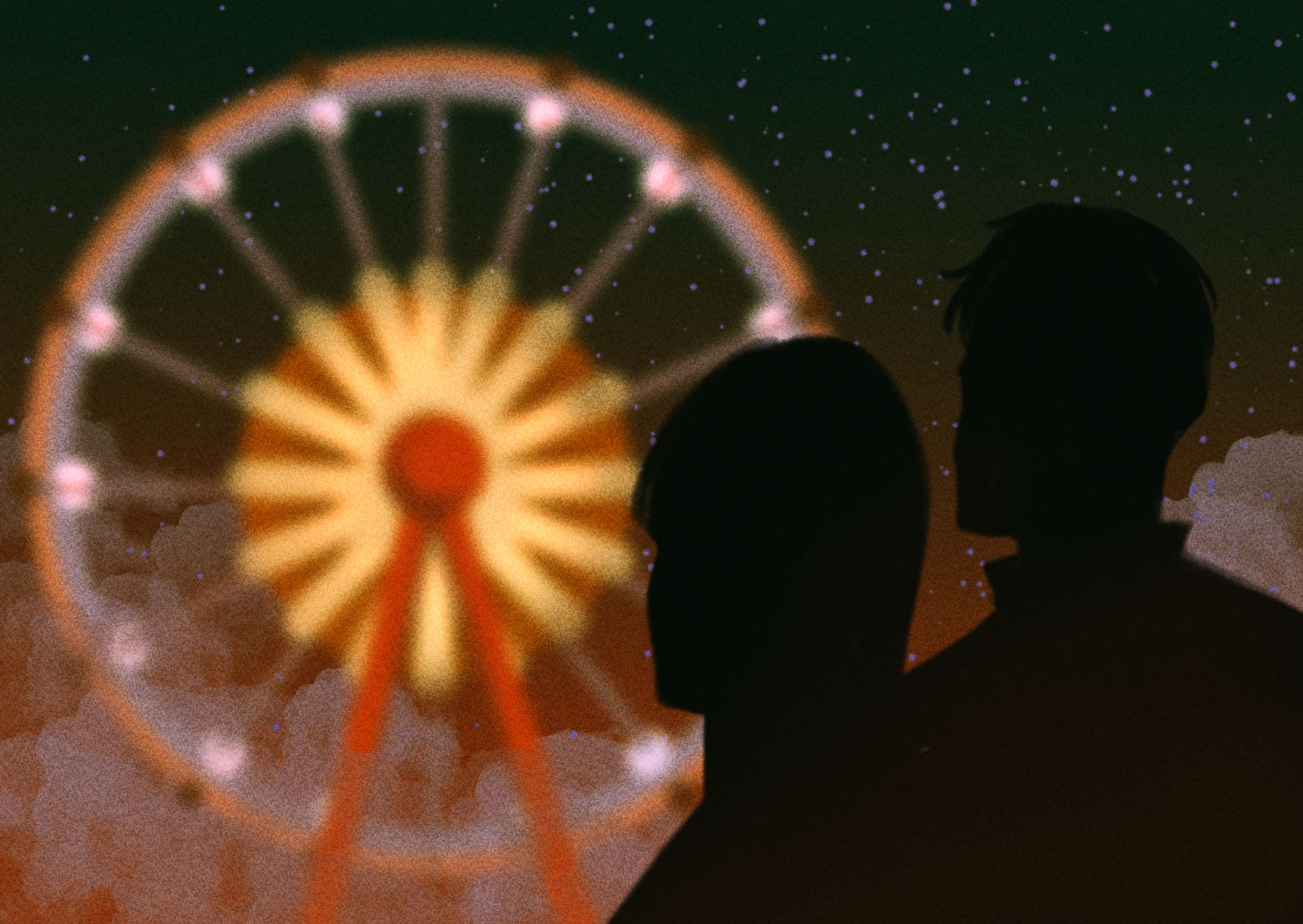
The Ferris wheel rose above the fairgrounds.
Spinning fast, a circle of fire.
Standing in line, I could not look up at it.
Why would I ever want to ride such a thing.
I said to Bryan, “What is lockjaw?”
It was astounding that, being in danger of it, I didn’t know.
Over the shouts and laughter, the Ferris wheel riders kicking their legs in the carts, waving their arms, twisting this way and that, a mass of writhing and shouting snakes – I listened to Bryan describe the way a jaw could stiffen, tighten. “It gets worse and worse,” he said, “until you can’t talk at all.”
The line moved, our tickets were taken, we squeezed through a turnstile, and then into a little swinging cart.
“I’m frightened,” I said.
Bryan swung an arm around me. “I’ve got you.”
How could that be when he didn’t know the truth?
Ah, ah, ah!
The cart began to lift and lift and lift. It was twilight now, the sky a deepening, darkening blue, a vile shade of blue, yet painted here and there with pink cloud wisps.
That was the problem with everyone.
They wanted pink clouds.
That morning, there had been a moment, standing in the hallway with me and my mother, the wound crying blood, a moment when – he almost saw. The truth had grazed the corner of his vision, and went no further. Look deeper into the sky, past the pink clouds, through the skimpy veil of stars, and you find black holes. You fall into them. No one wants to fall into a black hole.
At the top, Bryan pointed to the sky, not to the black holes, to the stars, like puncture wounds, last gasp light, seeping through.
Bryan never asked why I was nineteen and still living at home. He didn’t wonder why I didn’t have a driver’s license, why I wasn’t finished with homeschool, why I only had pen pals for friends. He said, your mother cares for you so much, and you are lucky.
It was not good to tell on people.
It was not good to push people into black holes.
The ride moved swiftly then, shoving us backward, our hair blowing forward, then up, a circle circling, a geometry of mothers, how far back does the circle go, round and round, locked in, she can’t help it, my father saying, it’s the way her mother treated her. We were helpless then, slaves to the circle on fire.
She is shouting on the phone with my grandmother, then smashing it down.
Faster and faster the circle goes, climbing up.
She is storming down the hall, ripping away my notebook, flipping through my notebook. She is reading the letter, something I had written to Teresa Cecilia, something, finally, true. Spit gathers and boils at the corners of her lips – how dare you write that!
Back down the circle goes, and around.
She is plunging the pen into my arm.
You believed her.
You thought it was me.
Did you wonder?
Well?
Were you going to say anything?
I turn to Bryan. “It was not bad fen shui.”
He presses my hand to his lips, kisses it.
The ride is too loud, the gears, the festivity.
I have to shout to get him to hear.
“It was not an accident!”
He smiles, his eyes full of Ferris wheel lights.
Panic rushes me, a black shadow.
God, no. God, help.
I touch my jaw.
Frozen over, like a pond in January.
Ice, sealing in the contents below.
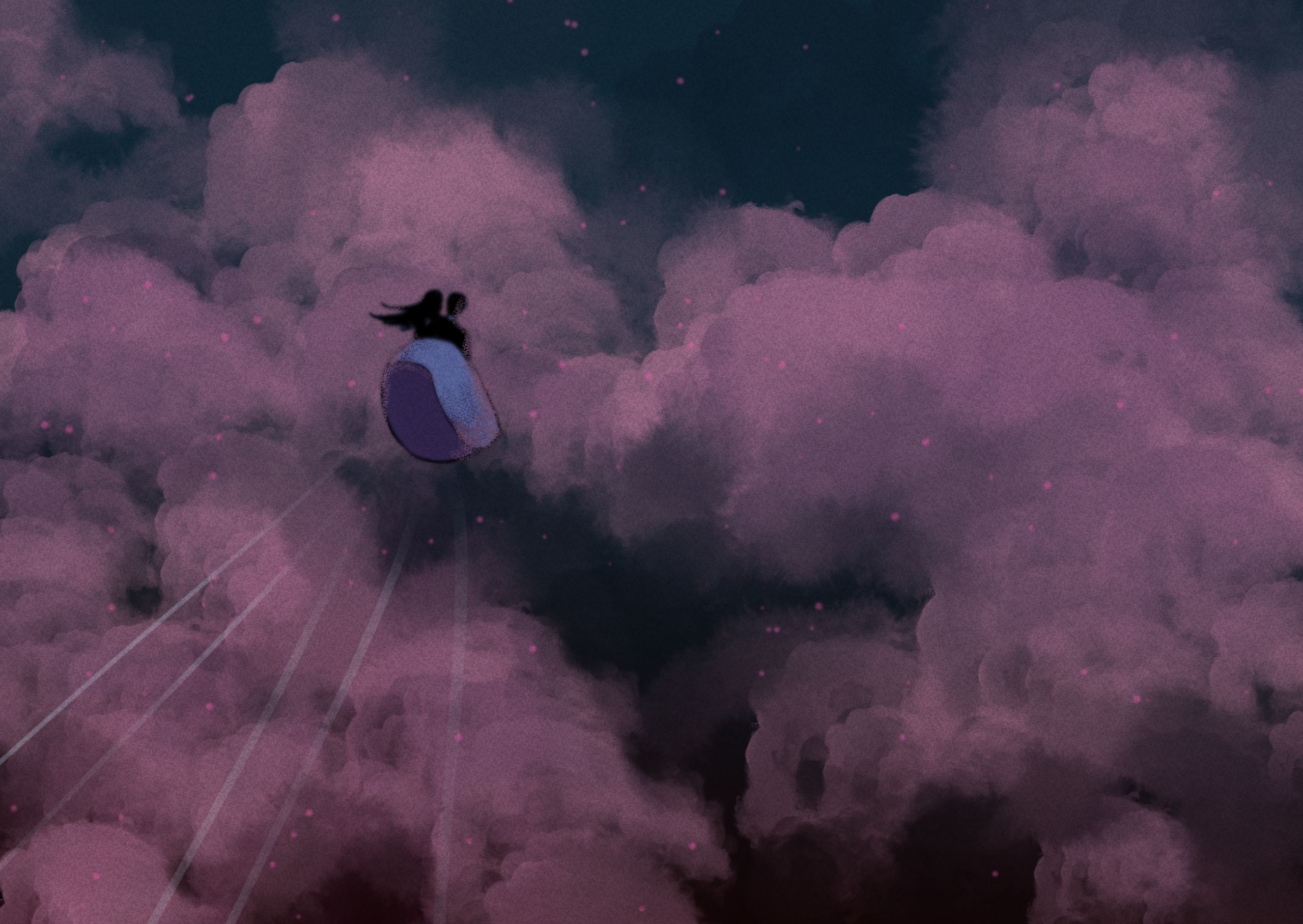
We catapult into the pink clouds.
I can’t even scream.
I lay my head on his shoulder.
I will die up here.
Counting circles.
Ah, ah, ah.