
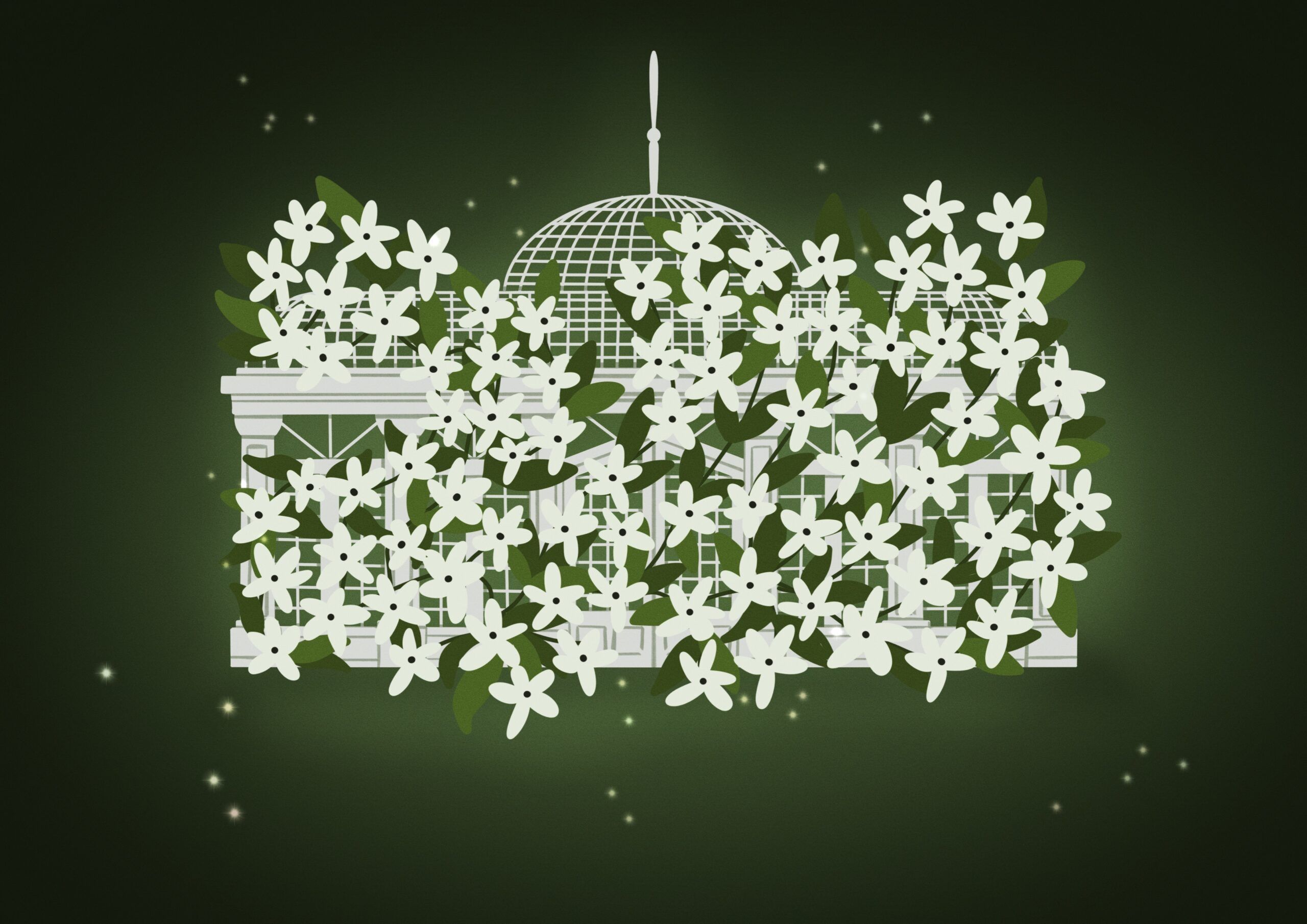
The air at the back of the conservatory clung heavily, a damp blanket against my throat. The Jasminum radiated a prickly heat. I struggled to draw in the wet thickness, my lungs fighting for the same nutrients I gave the plants, a systemic lethargy pulsing in my marrow.
“Hollis? You’ve got the misters on a loop again.”
Amara’s fingers moved with analytical precision, her eyes tracking the digital readout of the hygrometer. A heavy lethargy in the stems signaled the soil turning sour long before the sensors registered the shift. She looped wire around the Jasminum polyanthum, but the imagined squeeze of the metal tightened against my ribs, mirroring the constriction I felt whenever the greenhouse air grew stagnant.
The children’s raincoats were a primary-colored invasion, but the scent triggered the shift: not salt air, but the sudden, sharp smell of chalk dust and pulverized concrete.
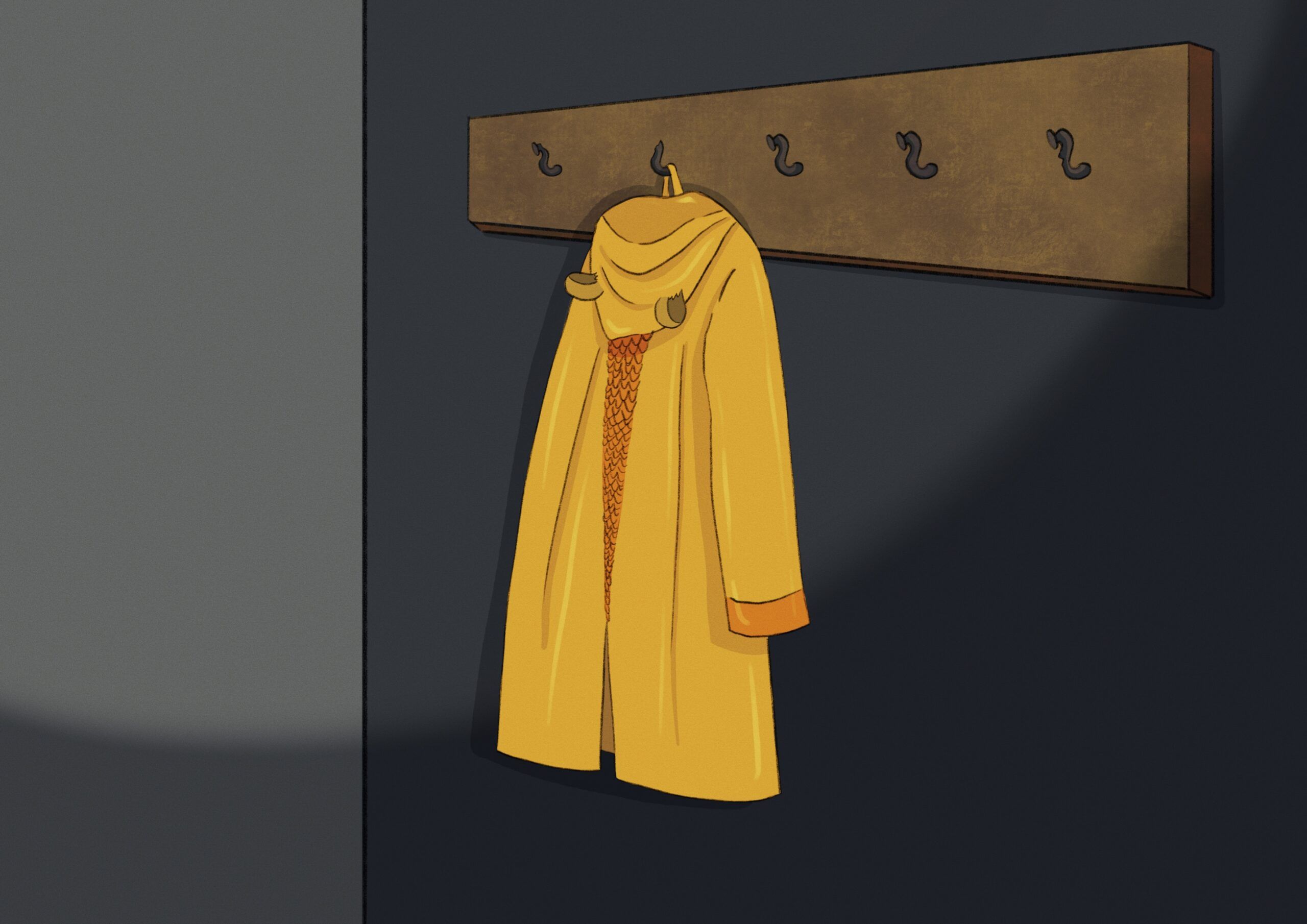
The children moved through the humid aisles like a school of bright, tropical fish, but my eyes snagged on a single yellow hood. It wasn’t just yellow; it had the felt ears of a lion stitched to the top and jagged, orange dragon-scales running down the spine.
My thumb twitched, tracing the air where a small, warm palm used to rest. I could still feel the phantom sensation of that last tug, the way Leo’s hand had slipped from mine with the practiced ease of a child who knew he was loved enough to be allowed a moment of rebellion. He hadn’t been running away; he had been reaching for something.
In the conservatory, the air inhaled in a slow, humid respiration. But the memory of the school remained bone-dry. I mourned the teacher who saw the world in primary colors and chalk dust, a version of myself now buried under layers of moss and silence.
First came the sound: a structural groan, the wrenching of bone, and the staccato crackle of glass. Then, silence. Not the expectant silence of the moss, but a vacuum, a hollow, gray void thick with the taste of gypsum and disturbed insulation.
A reinforced iron beam pinned me down, a cold, rusted weight that didn’t pulse. My inhalation became a shallow, whistling sibilance against the grit. Drips from a broken pipe echoed in the dark: tap, tap, scrape. A mechanical meter that offered no comfort.
My scar, more than a mark from the wire that bit into my neck, maps that sterility. It holds the memory of being trapped in a world made of dead things – steel, brick, and dust.
Now, as the Jasminum curls toward my throat, the contrast provides a physical mercy. I feel the slow, steady pulse of its sap, a deep, wet hum that silences the dry, whistling echo of the hallway. The vine offers its supple tissue, the counterpoint to the cold steel that once bit my neck. This place rose as a cathedral built of rising sap, not a structure of brick and dust.
They brought with them the scent of salt air and grape juice, cutting through the heavy musk of the damp earth. One boy stopped by the Jasminum, reaching out a sticky hand toward a tender, questing leaf. I didn’t yell. I couldn’t. But the air around the vine seemed to curdle, thickening with a sudden, protective humidity until the boy pulled his hand back, wiping it on his coat as if he’d touched something hot.
“Hollis, the misters,” Amara prompted, her voice a sharp, measured anchor.
The grow-lights reflected in the children’s eyes, too bright, too much like the sun through a collapsing skylight. I turned for the brass valve, my movements convulsive and urgent. The mist needed to rise, to turn the room into a grey blur where their small, desperate shapes would finally dissolve into the greenery. I needed to be back in the silence of the roots before they could see the hollow in me.
Silence rushed back into the room like a physical weight, but it wasn’t the clean silence of an empty space. It was the heavy, expectant quiet of the moss. Amara stood by the humidity control, her brow furrowed as she tapped the screen of her tablet.
“The levels are spiking in the east quadrant,” she said, her voice dropping back into its systematic rhythm. “The sensors are showing a heat variance, maybe a localized fungal bloom.”
She tapped the screen again, but the text began to fractalize into green vines and mossy filigree. The numbers dissolved into an emerald haze, and the systematic rhythm of her voice finally broke. She stared at the tablet, true shock replacing the analytical calm, before she slowly lowered her hand, letting the machine go slack.
The fever simmered. My palm held a residual heat, a sour, metallic tang at the back of my tongue signaling an infection in the roots. My skin tingled with an inexplicable sympathy. My fingers hovered above the soil, sensing the serrated pulse of the mold before the digital readout finished its sweep.
“The Ghost Orchids are swimming,” she said. “The wet offends them.”
I moved to the Ghost Orchids, my hand stayed suspended above the moss. I skipped the PH check and waited for the coolness. When the plants thrived, the air around them felt like a suspended animation, a perfect silence. Today, an abrasiveness remained. I adjusted the spray nozzle by a fraction of a millimeter, waiting for that internal gear to click into place. As the mist settled, the tension in my jaw finally eased. We surged in sync again.
I lingered there, my shadow overlapping with the bone-white roots. I liked the Ghost Orchids best because they specialized in withholding, a strategy of survival through stillness I recognized in my own bones. While other plants reached with noisy ambition, these stayed root-heavy and translucent, content to exist as a quiet heartbeat.
I didn’t answer. The words waited there, a dense, fibrous tickle behind my teeth, but I let them stay buried beneath the low-frequency hush of the soil.
I reached for the brass control valve. The metal sweated, a cold, slick skin that resisted my grip. I braced my boots against the damp concrete and pulled. The valve didn’t just turn; it shrieked. This shattering sound vibrated upward through the pipe and settled directly into the numb center of my scar.
I didn’t feel my knuckles hit the iron. I only saw the bloom of red against the grey pipe – a sudden, bright intrusion of heat in the humid green.
“Careful,” Amara said. She set the shears on the zinc tabletop with a clack and began to move, her gait steady and unhurried. “That pipe has been acting up since the storm. My abuelo used to say the plumbing in this town held grudges. Here, let me…”
I didn’t look up. I fixed my gaze on the floor, watching a single bead of red fall. It landed on a patch of Cladonia rangiferina, a grey, dormant lichen that had clung to the base of the pipe for months, a shriveled ghost of the tundra.
Where the blood hit the grey, the color ignited.
A violent, rebellious eruption of orange and green burst from the lichen. A sudden, sharp hunger started in my stomach and moved quickly up toward the silvered line of my scar. It felt predatory, a buzzing sensation that made the hair on the back of my neck stand up. The lichen didn’t just grow; it reached, and the cold iron beam shifted and strained under its microscopic weight.
I scrambled back. My boots slid on the wet film of the concrete, and I hit a tiered display of terracotta. The pots went down in a sequence of heavy, earthen thuds, sending shattered red shards skittering across the aisle.
“Hollis!” Amara stopped. She didn’t reach for me. She stood perfectly still, her eyes tracking the floor where the lichen now pulsed a vibrant virid. It moved with an unnatural, predatory speed toward the drainage grate.
“What the hell,” she whispered. Her tone shifted—no longer the gardener, but something more primal. Her words dropped into a low register that felt like a warning.
Amara didn’t reach for me; she stood back, her shadow long and distorted against the glass. “Hollis, stay back. If that’s a chemical reaction from the pipes…”
I pressed my palm over the scar at my throat. The skin there didn’t just feel hot; it screamed with a white-noise scorch searing beneath the surface. I pointed toward the moss, my finger trembling, tracing the serrated line of the virid eruption.
Amara knelt, her hand hovering just inches above the growth. She didn’t touch it. “It feels warm,” she whispered, her voice losing its instructional calm for the first time. “Hollis, the air in here… it oscillates. Go. Get out of the humidity. I’ll call the lead, tell him the old pipes vent something they shouldn’t.”
I didn’t wait. I grabbed my canvas bag, the strap digging into my shoulder. As I moved, the Ghost Orchids, Dendrophylax lindenii, seemed to pivot. These leafless, bone-white things lived on light, yet now their stems shivered. No breeze caused this; instead, a silent, collective contraction surged, as if the room coiled, waiting for me to leave.
The drive home blurred into a haze of salt-spray. When I pulled in, the tires crunched over the gravel. My cottage sat huddled against the Oregon mist, but the Hedera helix, the English Ivy I’d spent years trying to tame, had staged a coup. A thick, woody vine had snaked across the porch, tangling around the heavy oak. It didn’t move for me, offering only a skeletal scratching against the wood as I shoved it aside.
Inside, the air tasted damp and rebellious. I reached for the kitchen faucet to wash the red from my knuckles, but as my fingers gripped the cold metal, a fibrous tickle bloomed in the back of my throat. I coughed, a dry, racking sound like tearing paper, and spat into the porcelain basin.
There was no blood.
A single sycamore seed, the winged “helicopter” of a Platanus occidentalis, hit the porcelain with a distinct, metallic clink. I froze. The sound vibrated through my marrow. The clink became the frantic, rhythmic squeak of sneakers on linoleum.
The seed shuddered against the white basin, its vibration rising into the harmonic whine of a structural beam under too much pressure. I gripped the edge of the sink until my knuckles went white. The scent of damp earth vanished, replaced instantly by the sharp, medicinal sting of floor wax and the dry recollection of pencil shavings. The white-noise scream of rising dust filled my lungs. I no longer stood at the sink; I returned to the hallway as the air began to scream.
The sound of the seed became the roar of the ceiling coming down, a shattering that seemed to happen in slow motion. I could see the scurrying feet of my students, their sneakers squeaking on the linoleum in a panicked rhythm. As a teacher, my first instinct had been to shield them, but I froze, my throat locking, unable to scream or warn them as the structure failed, taking the future I’d planned with it.
A skeletal scratching against the kitchen window snapped my vision. The ivy didn’t just tangle the door; it scraped against the glass, a rhythmic, demanding sound, the insistent knock of a child’s knuckles.
I looked down at my hands. The thin line of red on my knuckle had stopped bleeding. In its place, a tiny, soft, wet pop occurred. A microscopic sprout, no thicker than a human hair and pulsing with that same emerald light I’d seen in the conservatory, pushed its way out from beneath my skin. It didn’t hurt; it felt like an unfolding.
I reached for the kitchen shears, my breath coming in convulsive, paper-thin hitches. I didn’t think; I just snipped. The sprout fell into the sink with a small splash against the porcelain.
Relief lasted only a heartbeat. Outside, the house groaned as the ivy gave a violent, coordinated heave against the siding. A thick, woody arm of the vine punched through the screen of the side window, scattering a spray of dirt and salt-mist across my floor.
A hot, prickling heat rose from my chest to my jaw, a pressure with no outlet but my own limbs. I threw the shears at the invading vine. They clattered uselessly, the metal ringing against the floorboards, but the ivy recoiled as if I’d drawn blood. The leaves shivered with a dry, metallic rustle that sounded like a warning.
I needed the car. I needed the sterile, unmoving skin of the Subaru, away from the house’s grasping green fingers. I stumbled out the door, my boots kicking through a thick mat of vines that sought the hooks of my laces, lacing around my ankles: living tripwires. I slammed the car door shut, the frantic click of the lock providing the only clean sound left in the world. Here, I found only plastic, fabric, and the scent of stale air.
I reached for the ignition. My hand stopped an inch from the key.
A subtle purr vibrated through the dashboard. From the depths of the center vents, a plush, vibrant carpet of Bryophyta came weeping outward. No dusty, desiccated moss of the woods, this; it displayed the vibrant emerald from the conservatory, wet and thick, its velvet tongues curling around the radio knobs. As I watched, a single sycamore “helicopter” spun slowly out of the vent, drifting onto my lap with that same, hollow clink.
The growth didn’t just claim the house. It claimed the machine. It claimed the oxygen around me.
I didn’t turn the key. I couldn’t. My exhalation created a hushed sibilance against the windshield, fogging the glass until the Oregon mist and the reaching ivy became a smear of charcoal and green. The tremor from the vents pulsed in my teeth, a rhythmic and mechanical drone that matched the harmonic whine of the school’s structural beams in the second before they gave way.
I looked down at the sycamore seed on my lap. Its translucent wing was pinned against my denim, but it wasn’t still. It was shivering, a frenetic frequency that pulsed against my thigh. The memory didn’t come in a flood; it came in the staccato crackle of settling concrete.
The tickle in my throat flared into a dry-rot heat. My fingers found the scar at my collarbone. The skin felt puckered, tight as a drumhead. As I pressed down, I felt it: a soft, wet pop beneath the surface, like a seed casing splitting. I tilted the rearview mirror. In the grey light, a thin, verdant line stitched itself into my pores, following the fractured map of the silvered skin, a biological grafting that ignored the boundaries of my anatomy.
“Miss Hollis, look!” Leo had knelt on the gray linoleum, his lion-dragon hood flopping forward to obscure his face. Between the industrial grit and the scuff marks of a hundred sneakers, he had found a ladybug. A tiny, domed miracle of red and black. He didn’t pick it up by the wings; he waited for it to climb onto his thumb, his face radiating the kind of focus usually reserved for prayer. “A gift for you,” he’d whispered.
A hot, prickling pressure surged from my chest to my jaw—the anger of a sanctuary betrayed. Years spent maintaining a soundless conduit ended as my own skin turned liquid and green.
I clawed at the hem of my shirt and scrubbed at the scar, rubbing until the flesh burned raw, but the verdure held. It throbbed, responding to the friction by thickening into a lush, velvet carpet that crept toward my jawline. I slammed my fist against the steering wheel. The sound made a dull, wet slap. Instantly, the vents hissed. A thick plume of earthy air hit my face, smelling of deep woods and a cellar left closed too long.
I had reached for him then, not for the ladybug, but for him. My fingers brushed the felt ear of his hood just as the first structural groan vibrated through the floorboards. The sound didn’t come from the ceiling; it came from the bones of the world. Then the air turned to chalk dust. The yellow of his coat was the last light I saw before the gray tide extinguished it. I had been his teacher, his guardian, and I let his hand go for a ladybug.
I lunged into the glove box, my fingers fumbling past the manual until they closed around the bypass pruners. The metal delivered a cold, aseptic shock against the heat radiating from my neck. I didn’t need the mirror anymore. I used my touch. I felt the lichen—not as an intruder, but as a beating extension of my own nerves.
I didn’t hesitate. With a sharp snip, I sheared the first cluster of green growth from my collarbone.
A sound escaped me, a wet, tearing gasp. The moss I’d sheared didn’t fall; it dissolved into a verdant mist that the car’s vents greedily inhaled. Where the metal cut, I didn’t bleed red. I wept a clear, sticky sap that smelled of crushed pine needles. I snipped again, but the growth staged a violent surge racing toward my chin.
I threw the car door open, letting the cold Oregon mist blast into the car. I didn’t head for the cottage.
The ignition was a harsh cough in the driveway. I gripped the wheel, but my fingers didn’t feel like bone and skin; they felt like thick channels of sap. The leather steering wheel felt dead and suffocating.
I didn’t drive back because I chose to. I drove because the hum in the soil at the conservatory had become a localized gravity. Every mile closer, the “white-noise scream” in my head—the one that had played on a loop since the school collapse—began to tune itself to the frequency of the glasshouse.
I watched my reflection. I didn’t look for the scar anymore, but at the malachite sheen beneath my collarbone. My hands rested loose on the wheel, the frequency from the sycamore seed absorbed into a steady tremor. The car felt too small, a tin box rattling through a world finally starting to breathe with me. By the time the glass dome rose out of the mist, I wasn’t an employee returning to a shift. I was a tributary reaching the river. I wasn’t fighting the tide of green; I was finally letting it pull me under.
The conservatory glowed in the twilight. I pushed through the heavy doors into an expectant vigil. Amara stood there, a dark anchor against the luminescent green. She turned, her eyes tracking the malachite stitching up my neck and the sap weeping from my collarbone. The air around us oscillated with a low-frequency thrum.
“I didn’t call maintenance,” she said. Her voice held steady, even as the static in the room rose. “I knew it wasn’t the pipes. My mother used to tell stories about the soil, how it remembers what we try to forget. The garden answers you, Hollis.”
I walked toward the Dendrophylax lindenii. As I approached, they didn’t just lean; they bloomed. Dozens of them, white and ethereal, unfurled in an ethereal silence.
“It’s okay,” Amara whispered, stepping back to give the growth room to breathe. “You don’t have to hold the ceiling up anymore. Let the roots take it.”
The pressure in my chest reached a breaking point. I reached out and pressed my palm against the main support beam, the same iron that had failed me years ago. I didn’t freeze. I let the green surge take over. This was the penance. Every root that lanced through my muscle was a debt paid. I wasn’t just becoming a part of the conservatory; I was becoming the structural integrity I had lacked in that classroom. As the iron beam pressed against my new, bark-thick ribs, I pushed back, offering my body as the bracing, a biological graft to ensure that this roof would never groan, would never settle, would never take another light. I was no longer the woman who let a hand slip away. I was the architect of the silence, a living monument to a boy in a lion-dragon hood.
I felt the pulse of the exchange: the copper in my blood meeting the chlorophyll of the rising sap, my circulatory system merging with the conservatory’s living architecture. From my throat, through the moss and the silvered scar, came a song of roots, a language that needed no words. I watched as the vines I carried inside me poured out, lacing the old iron in a protective, living web, trading the brittle beam of the past for a new, breathing anchor, the structure that holds the cathedral of green aloft.
I didn’t pull my hand back. The biological grafting was more permanent than mortar.
She didn’t look afraid; she looked at the sea of white, luminescent blooms pulsating with life. She had tracked the data, watching the spikes and variances, but I saw the moment she let the tablet go. It clattered to the floor. She finally stopped looking for the “why” and started seeing the “is.” She took a step forward, her boots crunching softly on the emerald carpet, moving like a parishioner toward an altar.
“Hollis,” she whispered. The clinical sharp edge of her voice was gone, replaced by a soft, unburdened wonder. She reached out, her fingers stopping just short of the vines now pulsing under my skin. “I was looking at the sensors. I was listening for the equipment. But you, you were listening to the hunger.”
A small, knowing smile touched her face as she looked from the reinforced iron beam to the flower unfurling at my throat. She raised her hand again, this time with the careful, hovering distance she reserved for the Ghost Orchids, acknowledging the flower as something specialized and rare. “You’re finally speaking.”
The white-noise scream in my head dissolved into the soil. A flower opened from the center of my scar, and as a low, rustling sound rose in my throat, Amara’s jaw developed a rhythmic tremor. She didn’t reach for me; she adjusted the gain on her tablet, her pupils dilating as she recorded the biological anomaly. The bloom exhaled an emerald mist of spores. I saw the realization hit her: she finally heard me, but the sound was a biological barrier, a frequency she could only observe from the other side of the glass.
The Oregon mist pressed against the glass, but I no longer belonged to the world of human breath. I had traded the woman crushed by a failing school for the entity that held the cathedral aloft. A sycamore seed fell from my sleeve, hitting the concrete with a metallic clink. It wasn’t the sound of wood, but of a structural change. My new body was as cold as the iron that once broke me, but this time, I was the one doing the bracing.
Beyond the glass, the flash of a primary-colored raincoat moved through the bone-dry world. I watched it with the cold precision of a lens. There was no poetry in the shift, only the hard, industrial reality of the sap. I was no longer the teacher in the chalk dust; I was the architect of the silence, my roots lacing the old iron in a grip that would never again fail.