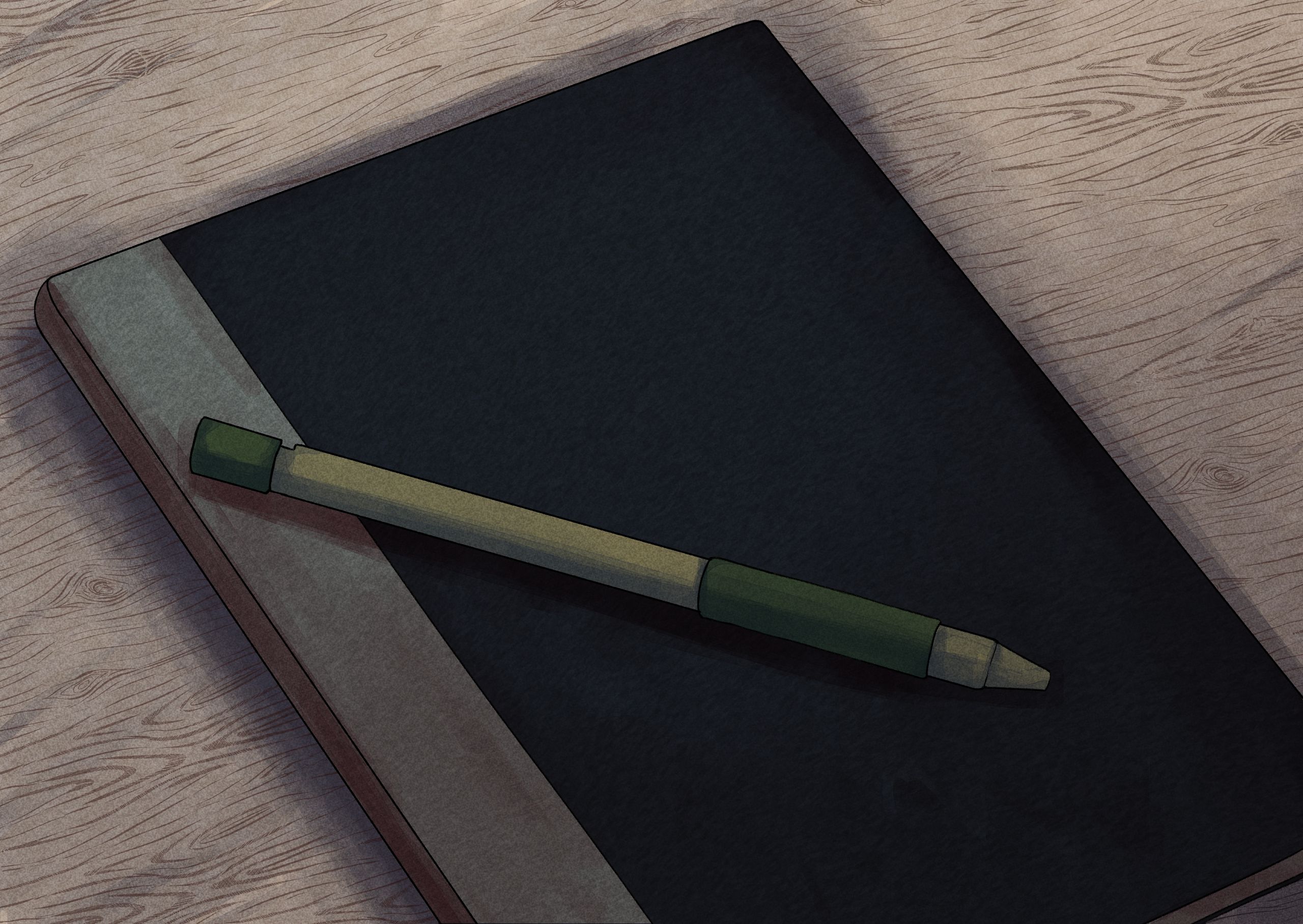
Paul opened his rucksack and fished out a new composite notebook and an old mechanical pencil he’d found off 18th and Commerce during his morning walk. Humidity made his fingers stick to the pages as he flipped to the dog ear and his pencil grip slipped when he pushed the 0.9mm point to paper.
Paul wrote.
Concrete pillars rise from the earth and carry the highways far above that carry the traffic that surges north and south in and out of the city. A cacophonous roar of engines and short tempered horns bellow above and descend below into bowels that divide one city from another of the same name. Both sides house, although differently, people who traverse the highway underbelly only when necessary. Though there are sidewalks and stoplights and bike lanes and small patches of green where perhaps a park may one day be raised, it is vacant of all save those who belong to no city.
These international waters of concrete, dust, and gravel are patrolled and swept and enforced sporadically; but from the highway above and the either-side alleyways, debris continually collects and buoys here again. The tide is always churning, and with each new rotation more is gathered and drawn out from the shores into those deep waters that bridge worlds.
There is life among the debris that is often mistaken for flotsam and jetsam. It rides currents and unseen slipstreams and experiences something unique to this ecosystem connected over countless miles and congregated in finite liminal spaces that are open to all and reversely exclusive.
Paul drew on his surroundings but did not write Dallas or I-35 or Main Street. These names he inhabited were only real until he entered the notebook, where they dissipated into something truer than any one place could be. A name in the real world was too defined, too contained, too known to embody the truths that Paul invoked.
The only city name he ever put to paper was Tokyo, but that was because he liked Tokyo and because it was the only city he knew that was bigger than itself. And once, while in Paris, he wrote of Paris.
Time passed slowly beneath I-35 as Paul built his world of words and graphite. This suited him. Writing was an art — it was his passion — and he took his time to make sure each word was placed where it belonged. For Paul, writing was an act of discovery more than creation.
Part of his writing process was meditation. If he didn’t know where the story was going or what the next word need be, he would rest his tools gently to the side, tuck his legs and sit on his heels, close his eyes, and breathe deliberately with open palmed hands resting on his thighs.
He would sit like this for as long as needed to continue with his paper bound discoveries. In a past life, Paul was a military man. When he meditated, his back was straight as an arrow and his focus was hard earned.
During the hot summer months, he wore his greying, shoulder length hair in a tight man bun. His clothes were slightly oversized but clean — cargo shorts and a plain white tee cut into an open-side tank. Though his body retained a disciplined cut, he was also vagabond-thin and his ribs showed taut through his sun-thick skin.
When Craig Michaels saw Paul for the first time, he nearly lost control of his lime green pay-by-minute scooter as he zipped under the highway. He saw a passive man defying his surroundings, something simple and completely unexpected. He saw reverence that would be out of place most anywhere but especially there. He saw a homeless knight, a samurai kneeling, holy focused in a concrete temple. He saw a ronin, a man of honor in an honorless place.
Craig Michaels was a photographer who made a sizable living searching America’s urban jungles for what he called the sublime poetry of marginalized truth. He had nearly two million followers across his socials and was in Dallas hosting one of six pop-up exhibits scheduled that year. When he saw Paul, he’d been heading back to his downtown hotel from a photo shoot with the infamous crowds of Deep Ellum crawling from one grunge-chic bar to the next. Craig Michaels was fascinated by the juxtaposition of desire and indulgence, of facades and bones.
When he saw Paul meditating against a pillar supporting I-35 roaring several stories above them, Craig Michaels skidded to a halt, took out his phone and quick punched an end to his ride. He scoped a spot that was discrete with a view to take unseen shots of the singular figure. He unslung the camera bag from his back and was soon adding hundreds of rapid-fire shots to his SD card. He would discard the unwanted ones later.
It took Craig Michaels several minutes to do all of this, during which the meditating man never moved. So Craig Michaels halved his distance to Paul and took a few more shots. He waited and watched, sure that the meditating man — the series already titled The American Ronin in his mind — was an instant success moment. Paul remained steadfast in his stillness, so Craig Michaels soon replaced his digital camera with an old Nikon FE2 that he saved for rare intimate moments.
Craig Michaels halved the distance again, now only twenty feet from Paul, and he took photos with a camera that audibly shuttered and reeled with each manual pull and click of lever and button.
Paul’s hearing, honed from experience and need, like most of his faculties, was good. Despite the highway echoing from above and the ambient buzz of a nearby drinking district on a summer afternoon, he heard the camera. He took a few final deep breaths, looked up, and quickly took in the young man. He greeted him in an even, gravel-smooth voice, “I’ve not heard that sound in a long time. I didn’t know those things were still around. What is it — an old Canon? An Olympus?
Craig Michaels was startled and slightly frustrated to be found out but collected himself and answered, “Oh. Hello. Close. It’s…um…a Nikon, actually. An FE2. Good ear, umm…”
“My name is Paul. And yours?”
“I’m Craig Michaels, a photographer…obviously,” he said, jiggling the camera as if it were a press pass, proof of his right to take the photos.
“Yes, I can see that. But why are you here?”
“I think you’re a very interesting subject. Shit, I mean, sorry. I don’t mean to be insensitive or anything. But, yes, you are worth shooting. I mean… I was passing by on a scooter, the one just over there, and saw you kneeling. That caught my eye and I just had to…well…I guess I just let myself get carried away. I’m sorry if I’ve offended you. I…umm…I didn’t mean to.”
“Not at all, Craig. Don’t give it another thought. I live a life in the open and can hardly get angry every time someone takes notice of me.”
Craig Michaels stood there and nodded with his camera still raised limply toward Paul. He was not accustomed to talking with his subjects. He was an observer who saw himself as a curator of unseen moments, not a participant — that would ruin the truth he captured and shared with the world.
Paul was good at conversation — he was good with people — so he continued when Craig Michaels stood silent. “You may use the photos you took, if they turn out; though I can’t imagine anyone wanting to look at me and…” he gestured to a nearby sleeping bag, a small pile of clothing, and other orderly possessions stacked amongst the dirt and gravel. “…all of this.”
“I…I think you’d be surprised,” Craig Michaels said. He then began another awkward pause but caught himself. “And, umm, I suppose I should say thank you…umm…”
“Paul,” he said, answering the unasked question with a kind smile. “My name is Paul. Feel free to say so if you caption your work.”
“Thank you, Paul.” Craig Michaels took out his phone and thumbed at it for a moment. “I’m just writing it down so I don’t forget. Bad with names,” he laughed awkwardly.
“I understand. Pardon if it’s rude of me to ask, but you don’t talk to the people you photograph often, do you?
“Umm…no. I suppose I don’t.”
“That’s fair. I think I understand. Well, let me know if there’s anything else I can offer. You can take more photos, if you want, or perhaps you’d like to know a little more about all of this” he said, motioning once more to his surroundings.
“I mean, yeah, that would be great.”
“The photos or the story?”
“Umm…both. I mean, if that’s alright with you.”
“Of course, Craig. You’ve got it.”
They spent the next fifteen minutes working the camera. Craig Michaels, who felt the posed shots would give weight to the unscripted moment of meditation, had to pause three times to swap film. He shot two rolls in color and two in black and white. The first unseen shots were — thankfully, he thought — captured black and white. Color was an aesthetic, the lack of it was a truth.
“You’ve got your photos,” said Paul, once they’d finished. “Do you still want the story?”
“I do,” said Craig Michaels. He was already imagining this as a feature in Harper’s or The New Yorker.
“Well, in truth, it’s not much of a story,” Paul began. “It won’t take long. Would you like to record this?”
“Oh, yeah,” Craig Michaels said and fumbled with his phone to open the voice recorder. “Thanks. Okay, we’re good.”
“Alright. Here, take a seat,” Paul said as he positioned an old red Kroger’s milk crate next to the photographer.
“Would you…” Craig Michaels spoke and then hesitated before continuing, unsure what to say or how to be. “Would you want to come with me for some food? Maybe a drink? We could grab a bite and do this over a beer. We don’t have to go far.”
“That’s very kind of you, Craig. But if you don’t mind, I’d prefer to stay here. I need to keep an eye on my stuff, and I swore off restaurants and bars long ago.”
“Oh. Of course. Umm…sorry.”
“No apologies needed. Do you mind staying here for the story?”
“Yeah, we can do that,” Craig Michaels said as he accepted the milk carton seat. “Okay. I’m recording. Ready when you are.”
“Thanks, Craig,” Paul said. He was good with words, and he knew his story well — many highway-side travelers had asked about his life. He told it to Craig Michaels as he’d told it to them.
He spoke of his childhood in Wichita and the hardships his mom experienced after his father passed when he was young; his older brother, who was now somewhere in Milwaukee living a good life with a husband and kids; his time in the Marines; his honorable discharge after earning a Purple Heart in Iraq; how most of his squad hadn’t been so lucky and that they were with him always.
He explained the difficulty of finding work when he returned home and how each job, no matter how different, felt similar and unnecessary. After his mother passed, he’d had enough and chose to live life on his own terms. He’d packed a small bag of clothes, a handful of books, and a journal and pencil, and began his life as a wanderer.
For many years he booked travel by train and plane and stayed in hotels and rented out local homes for days, weeks, months at a time. He traveled on money saved during his time in the service and renewed his funds as a freelance writer. He had always enjoyed writing and found after everything that he was good at it. Eventually, despite enough time and money to continue that life, he gave it up for the one he now lived.
“I’ve lived unhoused for over a decade — not homeless, mind you — and I’ve had time to reflect,” he said as he rounded out his tale. “I am the product of two truths. I am out here because I have to be, in a sense; but I am also out here because I choose to be. And that is an incredible privilege.
“I traveled the world with the Marines, then I traveled it again after my mother passed. I thought about staying over there. Paris. Morocco. Istanbul. Lima. Bali. Seoul. Tokyo. Tokyo is the only place I’ve been where I felt at once both lost and found. But I came back here, to the states, because I cannot yet afford to feel insignificant — at peace. There is something unspoken here that I need to understand, and there is something about myself that I’ve not yet found.
“I gave a part of my life to this country, and I still don’t know why. I need to know, and I believe — I am confident — that the only way I’ll find an answer is out here.
“So here I am. I live under bridges, travel highways, eat light, read what I can find, write every day, and view this world from the outside in, or perhaps, sometimes, the inside out. When you saw me meditating under the bridge, I had been writing and was waiting for the next words to find me. They come to me always, in time.”
Craig Michaels didn’t know what to say, so he didn’t. The two men looked at each other from their milk carton seats and let time settle between them. It became clear that Paul would be content to spend more time sitting in silence, so Craig Michaels eventually shifted and spoke.
“Thanks for the story.”
“Of course. My pleasure.”
“And you don’t mind I share it?”
“It’s yours to share. All I ask is that you keep the truth of it. You don’t have to keep to the facts, but I would appreciate it if you keep the truth.”
“I…umm. I’ll probably stick to what you told me.”
“And that is just fine.”
“Well, I should probably get going. Thank you again. Paul.”
“Truly, Craig, it was my pleasure. I’ll likely be here for a few more days. Stop by if you have any questions that would help tell your story.”
Craig Michaels slung his camera bag over his back and started toward the scooter that was still parked where he left it. After a few steps away from Paul’s encampment, he turned around to ask a question.
“What do you mean, tell my story? It’s your story, no?”
Paul studied the young photographer for a moment before answering. “Since beginning this life,” he said gesturing around himself once more, “I have written every day. I have published six novels, three short story collections, four screenplays, and a book of poetry. None of the stories were about me, although many of them deal with the things I’ve lived. They’ve been about people I’ve met, relationships I’ve known, moments I’ve witnessed, vistas I’ve studied, and stories I’ve been told. It would be wrong of me, I think, to tell my own story. It’s mine to live, but I’d rather see what you have to say about it.”
“Is that what you mean about keeping the truth but not the facts?”
“Yes.”
“I…what’s the truth of it, though?”
“An excellent question, Craig. Unfortunately, I don’t have the answer. Truths are tricky things — I find they present themselves best if you just give them time. Hang onto that recording for a while before you look through the photos or create anything from it all — it will come to you.”
Craig Michaels nodded uncertainly and took a few more steps toward the scooter before asking another question. “You said you’ve published many stories. If I go to a book store, will I find them?”
Paul nodded his head.
“Do you, umm, do you make money from the books?”
Again, Paul nodded his head.
“So…why are you out here?”
“As I said, my friend, I could have travelled abroad for the rest of my life if I wished. But none of this is about money — especially the stories. The money goes to people who actually need it.”
“I’d like to read one of your stories. What’s your last name? Or…umm….perhaps, what name do you publish under?”
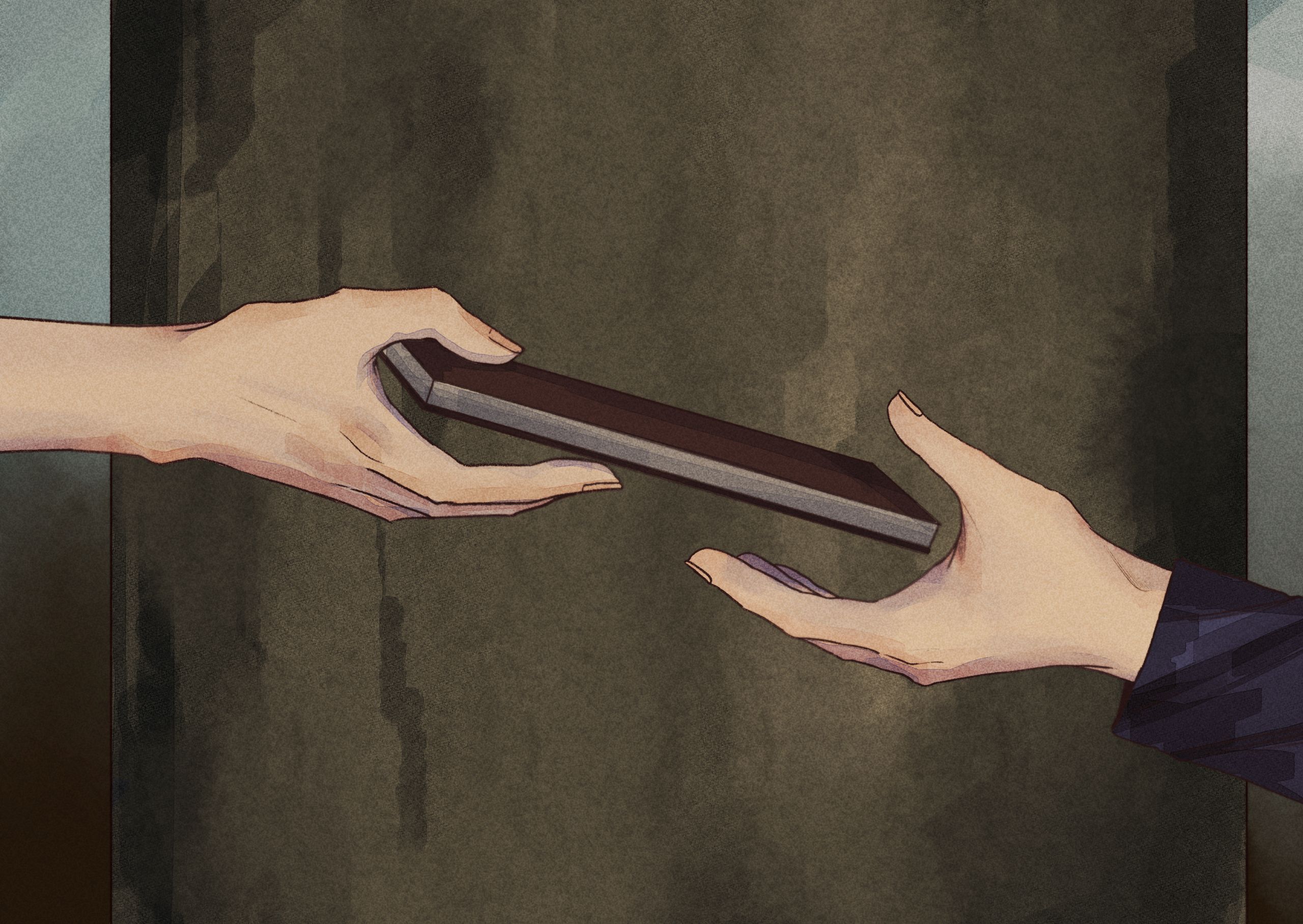
“I am sorry, Craig, but that one is just for me. If you want to read one of my books, all I can recommend is that you read and perhaps eventually you will have read one. Although, actually…here.” Paul sat up from his milk crate, walked over to Craig Michaels and handed him a composite notebook. “Take this.”
Craig Michaels thumbed through the pages. The notebook was nearly two-thirds full. “Is this…”
“It’s my latest collection of short stories. Not quite complete, but it’ll give you a sense of what I write. You can use a story or two, if you want, although I’d prefer if you kept most of it for yourself.”
“Paul. I can’t take —“
“Sure you can. I will write more. Please accept it.”
“I…thank you.”
“You are most welcome, Craig. It has been a pleasure.”
The two men shook hands and parted. Paul returned to his small encampment next to the concrete pillar holding up the highway above and Craig Michaels returned to his hotel, where he sat at the bar late into the night thinking over his day and the time spent with Paul. Summer was all but over by the time he looked at the photos from that day.
Years later, as he meandered the streets of downtown LA, Paul read a sign and recognized a name. He entered into a busy studio and wandered from wall to wall, taking his time with each framed photo. They were all portraits, varied in style and subject, and most were accompanied by a long-form description. They each contained a story — sometimes profound, often insignificant, but always intimate.
And then Paul found himself staring at a photograph he’d never seen but already knew. He studied the meditating figure and the concrete that framed him. Then he read the description, which began in quotes, Concrete pillars rise from the earth and carry the highways far above that carry the traffic that surges north and south in and out of the city. He continued reading until he felt a tap on his shoulder and heard someone say, “Hello, Paul.”
Paul turned around, smiled, and greeted an old friend.