
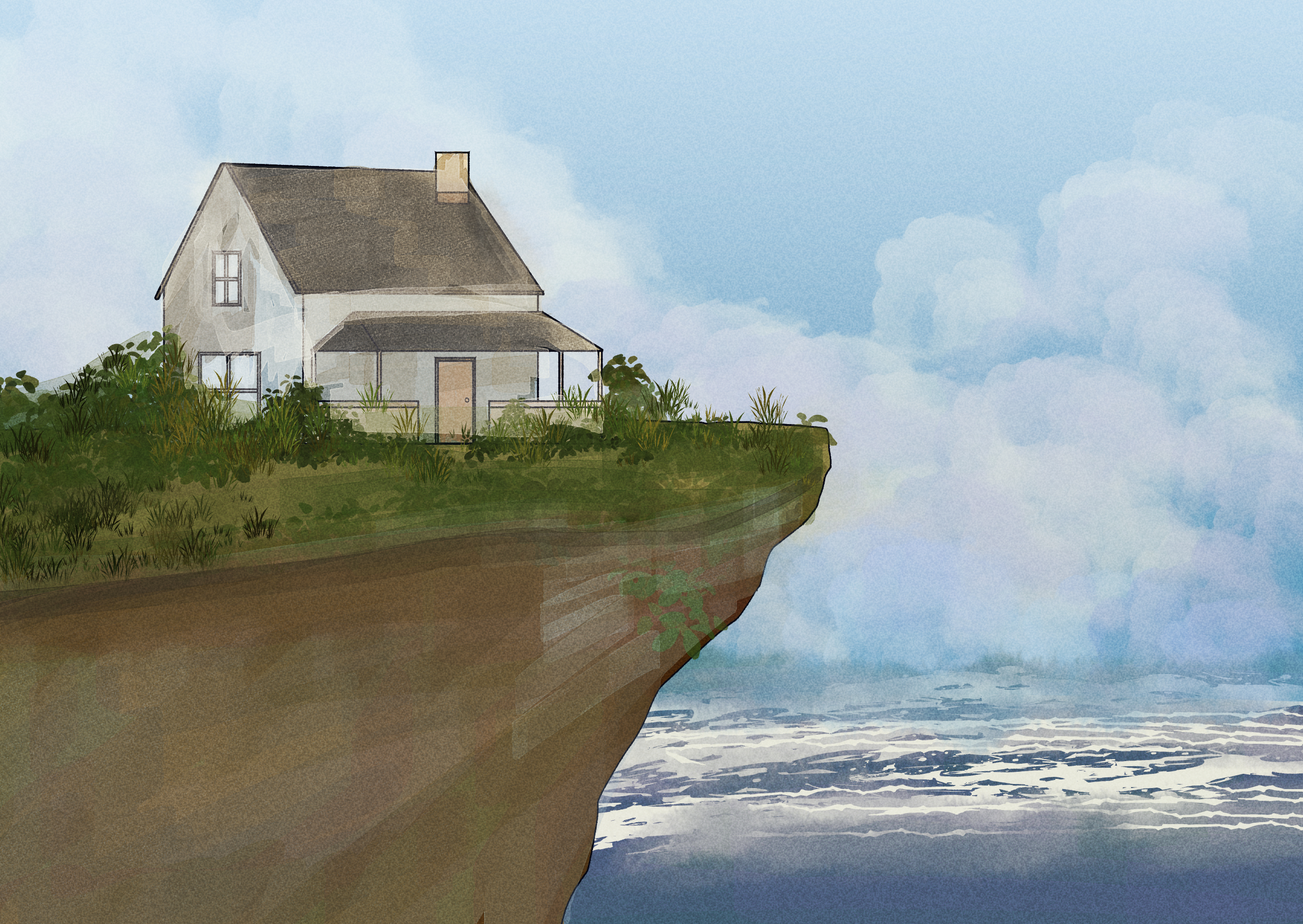
On an island in Maine, there sits a house. It’s an old house, one weathered by storms and salt air. Still standing in spite of the waves battering the cliffs it sits atop. The cliffs are just tall enough to hold back the waters as they surge, protecting the house from flooding and the foundation from crumbling.
Driving to the island is a chore. You need a car with four-wheel drive and impeccable timing. When the tides rise, the sand bar connecting the small island to its neighbor is submerged. There’s no dock for a boat and the currents make swimming dangerous. Whoever lives on the island wants to be left alone. Or wants to believe they do.
On the porch there’s a rocking chair. Handmade by the looks of it. The breeze moves it lightly, creaking on the wooden deck as it swings. Along the edge of the deck are overgrown boxwood bushes. In the bushes lies another rocking chair, one of its legs broken. When the boxwoods fill out over the summer, the chair disappears under the foliage.
It’s been like that for years. The couple who lived in the house would watch the sunset every evening from the porch during the summer, and from the window by the fireplace in the winter. Robert and Shirley were married in 1949 just a few miles north of where the house stood at the Oakland House Resort. Resort was a strong word for what the place was back then. It was just a big old house with 6 rooms where families could spend their summers. But it was beautiful.
Robert was a traveling insurance salesman, which back in those days made pretty good money. Shirley was meant to be a stay at home mother. But no matter how much they tried, a child never came. They didn’t have reliable access to doctors back then anywhere close to the island, so they prayed to god hoping he would help them be the parents they yearned to be. But no child ever came.
She made the house her baby.
Besides weekly trips to the store nearly an hour away in Blue Hill, Shirley barely left the island. Shirley knew every noise the house made. How the wooden beams creaked when the winds gusted, how the tin roof pattered under heavy rains, and how the light hit every piece of furniture in the house at every hour of the day. When she couldn’t sleep, she walked its perimeter in the dark, one hand grazing the walls as if checking for a fever.
She tried filling the house with art, books, and music. But still, even after she spent an afternoon rearranging the bookshelves for the fourteenth time, the quiet would settle back over her by dusk. The house absorbed her efforts without gratitude. She couldn’t fill the hole with children. The one thing she and Robert had been so excited to do together.
Whenever Robert was home, she played the role of the dutiful housewife, doting on him and spending as much time together as they could. But on nights Robert wasn’t home, Shirley would talk to the house as she rocked in her chair. Not aloud, at least most of the time. The house was the only thing that stayed in her life. But it couldn’t talk back.
Robert worked long hours and drove long distances for his work. He was successful, but his wife’s infertility made him feel ashamed. At church, Robert avoided the eyes of the men whose sons fidgeted beside them in the pews. He imagined what they must think of him. He was a man with no heir in a house too large for two.
That wasn’t the only reason he couldn’t meet their eyes. Robert had a secret. While he traveled, he would hire women for sex, desperate to imagine a life in which he could have a son. He needed to fill that house he’d built.
Shirley began to suspect Robert’s infidelity only a few years into their marriage. After one of his trips, he came home smelling of perfume that wasn’t hers. A few years later, while cleaning out his car, she found a pair of lace panties in the backseat. The signs grew more frequent, harder to dismiss. Still, Shirley never confronted him. She didn’t know how to leave, and she didn’t know anyone beyond Robert. She was stuck.
Robert worked well into his fifties, although he could have retired earlier. In his later years he spent as much time as he could away from home. When he was on the island, he grew sharp and demanding. Eventually, he stopped watching the sunset with Shirley altogether. It had been the thing they loved most.
One day, as Robert was returning home from a work trip, he stopped off at the store to pick up dinner for himself and Shirley. As he checked out, a young man with a familiar nose stared at him from down the aisle. Robert dismissed it. But then, the young man followed him out of the store. Then to his car.
Robert turned around to give the young man a talking-to. But the young man broke down crying. He explained that Robert was his father, and that his mother had only been a woman Robert had known for a single night over 17 years ago. The young man’s nose was his nose. The same sharp ridge, the same wide nostrils. Robert stiffened at the realization. For years he’d only been able to imagine a son. Now the real thing was standing in front of him.
Shirley sat on the porch in her rocking chair, Robert’s sitting empty beside her. She waved as his car pulled up to the house, but noticed that the car door stayed open after her husband emerged. Then the sound of footsteps that weren’t Robert’s. Her hand fell from its wave, and in that moment she understood something was ending, though she didn’t yet know what. Robert was the happiest she’d seen him in years, bounding up to her, proclaiming that they could finally have a son to call their own. A son to fill the big, empty house.
But Shirley recoiled in shock. The perfume, the panties, the late returns from work trips. She has swallowed her questions like pills for years. The house had never protected her. It had kept her tied here, hiding from the truth.
The young man stood silent at the foot of the steps, watching as Shirley sobbed and shoved Robert back, screaming as the devotion she had given him for decades collapsed all at once.
But Robert wasn’t interested in her feelings. He saw that she would never accept the boy. He had built a life that refused to bear fruit. He would not let it be taken from him now. It was his house and he would do with it what he wanted. Shirley lunged at him, her grief sharpening into rage. Robert grabbed a rocking chair and raised it, forcing her backward toward the stairs. She teetered, caught herself, and stood trembling.
Shirley met his eyes. She saw not guilt, but resolve. Robert had what he wanted now. But Shirley’s loneliness and pain roiled in her body, steaming her skin in the cool night air. She screamed and surged forward again.
This time Robert threw the chair. Shirley tumbled down the stairs as the young man jumped out of the way of the falling body, and the chair that followed. One of the legs of the chair broke as it hit the ground, falling into the bushes. Shirley’s body didn’t break. It rolled until she was just on the edge of the cliff. The waves crashed below in the darkening night, reaching up the cliff as if reaching for Shirley.
As she tried to scramble to her feet, Robert rushed down the stairs. The young man tried to move in front of him to spare Shirley his wrath, but Robert pushed the boy out of the way.
He ran up to Shirley struggling to stand and kicked. As she slipped over the edge, Shirley understood that the house had never been hers. She had only been allowed to keep it warm. She screamed as she fell, but there was nobody around to hear her besides Robert and the young man. Robert heard a thud down below and the screaming ceased.
Then, he ran into the house, his son in tow, and packed up everything he could run away with. He told his son, scared and appalled by his father’s behavior, that he’d done it all for him. The boy didn’t know what to say, and was too afraid his father might do the same to him that he’d done to Shirley.
Her body was found years later, after the bank reclaimed the house. The house is on the market now. The listing praises its privacy and ocean views. It doesn’t mention Shirley.