
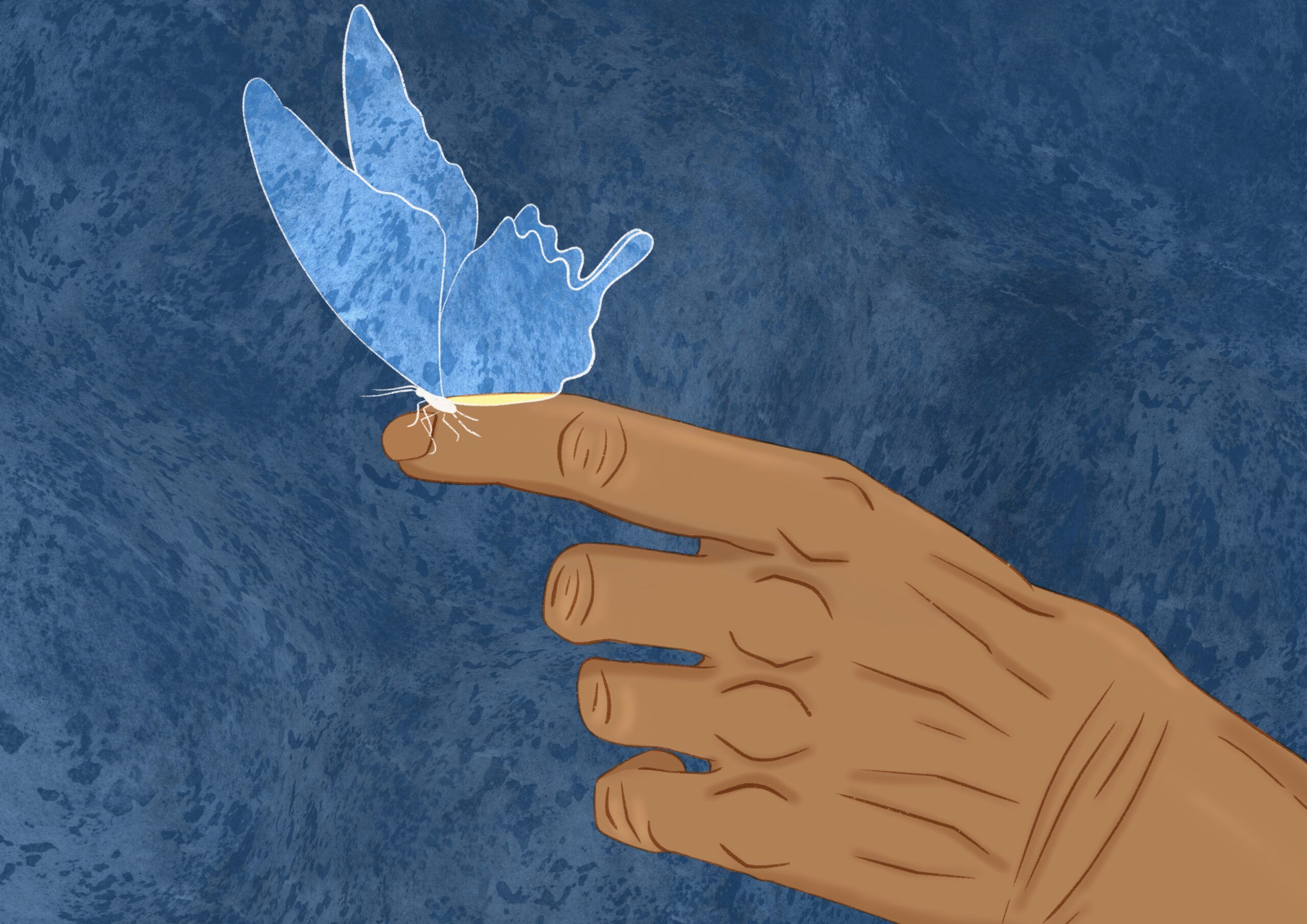
Cyril was coughing again. It was a morning ritual. He sat up in bed, breathed deep, and exhaled long. His wife Maria Amália, mending a pair of pants with a sewing kit, got up to pour a cup of water for him. Then she went downstairs to the kitchen to check on a Portuguese cod stew. Maria Amália Pita Pestana Reis came from the town of Ponta do Sol on the Portuguese island of Madeira—the hometown of Cyril’s ancestors.
Cyril finished his water. All his old joints needed oil, he thought, but at least he didn’t have dry mouth. His coughing stopped. He was ready to begin the day.
Cyril looked out the window. The sun was up and the English springer spaniels, Babette and Crockett, were stirring in their outdoor kennels. He had trained them not to bark at the chipmunks on the grounds, but they still pawed and whimpered, excited by the quarry.
He washed his face and dressed in his uniform of slacks, dark collared shirt, and tie. Then he put on his glasses and glanced at the headlines in The Wall Street Journal and The New York Times, which Maria Amália had laid out on the bed. CNN, Ted Turner’s new 24-hour news channel, was launching, but it was no great milestone in this home. Cyril did not believe in television. He preferred the radio.
Maria Amália was coming up the stairs with coffee and a chocolate croissant as Cyril sat at the foot of the bed reading.
“Happy birthday,” she said.
“It’s been a week. No need to stand on ceremony,” he said.
“When you’re ninety-three, you have privileges.”
“Ninety-three years old,” said Cyril, with a touch of wonder. “Papa never got to see this season of life. He wouldn’t believe this world. God rest his soul.” He paused. “You know, I feel like getting my butterfly net.”
“Why don’t you?”
“I would just want to catalogue them,” he said wistfully.
It had been a month since he donated his entire butterfly collection, 1,250 boxes and 65,000 specimens, to the American Museum of Natural History—what the curator called “the single largest and most complete one of North American butterflies ever made by one individual.” It was the product of fifty years of amateur science practiced with uncompromising standards. Aside from this son and grandchildren, his collection was his most precious legacy.
Cyril Franklin dos Passos (his mother had encouraged him to retain the Portuguese lowercase “d”) was a paragon of intellectualism. Since retiring from the legal profession in 1928, he had roamed every desert, mountain, and field in natural history. His journey had taken him through ornithology, geology, paleontology, and archaeology. Nearly all self-guided and self-taught. And he took an additional excursion through philately. He had postage stamps from the United States, Nepal, Tibet, Heligoland, the British Commonwealth, and France.
But the study of butterflies was his métier. His light and his truth. He was a charter and honorary life member of the Lepidopterists’ Society. He had collaborated on research and corresponded with writer and amateur lepidopterist Vladimir Nabokov. “Thanks for your interesting paper,” Nabokov wrote dos Passos in 1947. “I wish I could write with such lucidity. My own style gets constantly entangled in subordinate clauses and brackets.”
Cyril’s massive library of butterfly books included a volume given to him by financier J.P. Morgan. Morgan had written his name in the book in fine gold print. Wittenberg University had awarded Cyril an honorary Doctor of Science degree in 1965, and Canadian entomologist James McDunnough had named a butterfly after him in 1940, Tharsalea dospassosi.
For decades, Cyril had kept an iron routine: a morning butterfly expedition, lunch, a brief nap, a half-hour walk with the dogs, a snack of ginger ale and ginger snaps, then the news and dinner. Every summer, he traveled to Europe with his wife. He loved France. His routine offered a long, sure path of contentment. No spikes, no extremes.
Now, his butterfly vault was nearly empty of treasures. So were the cabinets where his first wife Viola had kept her moths. When she died of heart disease in 1944, Cyril donated her 12,000-specimen collection to the American Museum of Natural History.
For a moment, Cyril felt a tinge of doubt. Like the day he had to quit driving. His three-story, six-bedroom French chateau-style brick home, built to accommodate the naturalist’s life, seemed futile and forlorn. He sipped his coffee and waited for the moment to pass.
“Why don’t you study the birds?” Maria Amália asked. A northern cardinal was singing in the oak trees surrounding the chateau. “Bird-ie, bird-ie, bird-ie,” it chirped in loud, ebullient tones.
“Ornithology? It would take years for an amateur to enter the field. To do it properly. To get published.”
“Maybe you have years.”
“I do enjoy crows. Remarkably intelligent. There are a couple of crows—I’m certain they know my face. Maybe the field has room for an amateur naturalist. Another Audubon. Maybe.”
Cyril finished his croissant, wiped his mouth, and neatly folded his newspaper. He got up to retrieve one of the remaining boxes of butterflies—his sentimental relics. At his desk, he studied a male summer azure butterfly he caught in Maine. He took utmost care with the specimen, as if he were examining detail from the Book of Kells or the Bayeux Tapestry. He banished any non-entomological cares from his mind.
He was finding his cadence. He had seen colleagues chase butterflies and jump after them. Cyril caught the most butterflies because he slowed down. Slowed to a serene stillness. He figured he would take notes on the summer azure all morning.
The butterfly, however, was taking hold of his fancy. For once, he drifted and daydreamed. The subtle colors, the powder blue and fine white crystals with a flash of blue iridescence, were incantations. They were calling forth a carousel of cherished memories…
Daicey Pond, Maine in the summer of 1929 offered the kind of wilderness that inspired Henry David Thoreau’s The Maine Woods. Forests of red spruce, balsam fir, and hemlock, dense and dappled with moss. Potent balsam aroma flowing through the woods, bogs, marshes, and meadows. Abundant shadows and crevices for furry, pitiable critters like fishers, hares, martens, and lemmings. Kaleidoscopes of butterflies fluttering in the meadows and alighting on milkweed flowers to swill nectar. Breeding pairs of monarchs—the classic orange burst, black veins, and white spots—in pas de deux. Little evidence of man except a few logging camps and Indian trails.
In the morning mist on Daicey Pond, Mama loons with eyes like dark cranberries wailed warnings to predators while their chicks rode on their backs. The wail sounded like a despondent, high-pitched French horn. Now and then, a trout-mad fisherman let out a triumphant whoop, but solitude always returned, faithful and encompassing. In the evening, a still life painting reflected on the pond: the sage visage of Mount Katahdin and its sleepy cloud companions, brushed with orange and blue light.
Cyril and Viola dos Passos, newlyweds with an appetite for adventure, were hiking the environs of the pond that summer. At age forty-one, Cyril had just retired from his legal career, having made a fortune. He and Viola were eager to begin a new life close to nature, using their cabin in Rangeley Lakes as a staging area.
The stock market was soaring and Fats Waller’s jazz tune, “Ain’t Misbehavin,’” was the toast of Harlem. Life was sizzling. Even the savage Maine mosquitoes were on holiday.
“Don’t you want to paint this? All of this?” said Cyril.
“Don’t you want to just fill the house with modern art? How about a Picasso in the foyer?” said Viola.
“Modern?”
“I’m teasing, dear. I want to write, paint, everything!” she said. “Tomorrow to fresh woods, and pastures new.”
“Who said that?”
“Milton.”
“My uncle loved Milton. He said Paradise Lost was as good as going to church.”
“He must have been quite a man.”
“He was a brilliant man. Brilliant lawyer. Lavish spender. He could gab. Sign a dozen new clients over supper at Delmonico’s. I could never do that.”
“Tell me you don’t miss speaking French at Del’s with your railroad men?”
“If any of the railroad men spoke French, I would have been thoroughly impressed.”
“Making deals, making deals in the palm garden. Where do they get all those palms? Palms…in Manhattan?”
“Can we stop a minute?”
“We do well for city slickers.”
They stopped in a clearing where the grass was mushed down. A large moose had slept there the night before. Through the trees, they peered at fragments of Mount Katahdin.
They carried backpacks with a picnic lunch, molasses, and notebooks for poetry and field observations. They were planning to have lunch on the mountain then look for the arctic Katahdin butterfly, Oeneis polixenes Katahdin. The molasses was for “sugaring” a tree to attract lepidoptera. They also packed a gun should they need to signal their location.
“Papa lived to be forty-three,” said Cyril, after he caught his breath. “We don’t know how much time we have and I don’t wanna spend it all in court.”
Thanksgiving 1916, twenty-nine-year-old Cyril was dining at Delmonico’s, the most luxurious restaurant in Manhattan, with John Randolph Dos Passos, his seventy-two-year-old uncle and senior partner at the Dos Passos Brothers law firm. His uncle, who had moved to New York at twenty-three, became the chief lawyer, landlord, financier, and patriarch of the Dos Passos family when he amassed great wealth attending to the details of corporate mergers and trusts of the Gilded Age.
When Cyril’s father Benjamin, also an attorney, died in 1898, “John R.” became Cyril’s mentor. Cyril was close with his mother Isabel and the two often spent summers and Christmases together at various New England resorts: Rangeley Lake and Poland Spring, Maine; Pittsfield, Massachusetts in the Berkshires; Lakewood, New Jersey; Jefferson, New Hampshire in the White Mountains; and Warwick, New York. These upper-class enclaves had facilities for golf, tennis, horseback riding, hunting, and dancing, and gentlemen dressing up in top hats and swallowtails, twittering “jolly good.”
This Thanksgiving, however, was John R.’s. His wife Lucy had died the year before. His son Jack, a writer, was traveling in Spain. His other son Louis, a stockbroker, was working. John R. rejoiced to play king and treat his beloved nephew to an indulgent repast at Delmonico’s, which served turkey but also snipe, pigeon, plover, and four different species of duck.
John R. was presently in negotiations with the maître d’, working him like a pliant courtroom witness, procuring a sweetheart deal: a roast to perfection of the last canvasback duck in stock. It was once the most expensive item on the menu and, along with oysters and Maryland terrapin, an emblem of Delmonico’s American haute cuisine. Now, “King Can” lived off-menu due to overconsumption and its password was known only to the oldest and dearest restaurant patrons.
John R. adjusted his herringbone waistcoat to contain his excitement. The duck was won. He was flying full sail, mainsail to mizzen.
“As a duck for life that dives,” he said. “So up and down the poor ship drives!”
“Is that from one of Shakespeare’s forgotten plays?” asked Cyril. Over a decade, he had warmed to his uncle’s intellectual fancies, but sometimes they mystified him.
“Pericles? Forgotten? It’s not forgotten if I remember it! I may have forgotten it once but I remember it now! The mind is an old trunk in the attic. Eventually, everything rises. Rises from oblivion.”
“Rises from oblivion, that’s good. Who said that?”
“Oh, that’s not Shakespeare. That’s a Dos Passos original…direct from Madeira.” John R. was trailing off; his sparring partner at the New York County Bar Association, the attorney Samuel Untermeyer, was approaching. They had debated the 8-hour workday, where John R. argued against.
John R. stood up out of respect for his visitor. Of late he felt lost at Delmonico’s. He would scan the tables for old friends and then remember this one was bedridden or that one had died. Although Mr. Untermeyer practiced liberal politics, John R. considered him a first-rate jurist of the old school. Untermeyer had become an office boy at a firm at fifteen, gained admission to the bar at twenty-one, then launched an extraordinary legal career. He had a large art collection and loved gardens and flowers, especially orchids. He was a many-splendored, kindred spirit.
Instinctively, Cyril corrected his posture and wiped his mouth with a napkin, so he looked his best in such company.
“Lynx-eyed! In all my time in court, I have never been called lynx-eyed. Mr. Dos Passos, you can certainly fence with words,” said Untermeyer.
“Better to have the perceptive eyes of the lynx than to be just another cunning scamp of an attorney,” said John R.
“You may be a little behind the times, but you are no scamp. I hope very much to see you again.”
“Rest easy, next time I may send Mr. Cyril to debate in my stead. There is no finer man in the bar,” said John R.
“Your apprentice? Well, I look forward to that. Enjoy your dinner, Mr. Dos Passos,” said Untermeyer, before slipping away.
“When will these Progressives learn? What I insist on is this: no restriction should be placed upon anyone’s action, so long as he did not commit a breach of the peace. Certainly not a restriction on the working day construed by the government,” John R. told his nephew.
“I agree,” said Cyril.
“I know that, and that’s why I’m giving you the firm.”
“Sir?”
“Life grants attorneys few privileges like writing his own will. Mind you, I feel strong as wrought iron. I have no plans to die. But I do tire of the city. Jack knows all about this. I’d rather be talking to the quail. At the farm.”
“I will never be equal to the task of succeeding you.”
“Atlas had not a greater burden on his shoulders, than the responsibilities of the lawyer. You have the precise measurements of a common-law lawyer—all that I advocate to whomever will listen and whomever will pretend to listen. Thank the Lord we had such a long apprenticeship together.”
There was a song of his uncle’s pronouncements, spoken in court and written in books, playing in Cyril’s mind. Sometimes, it drummed all day like a woodpecker and Cyril became insensate.
Then John R. changed his demeanor, slowing his delivery and speaking with touches of melancholy and self-doubt. Cyril could scarcely believe it. “Thank you,” said John R., “for this dinner. I have no one to read Voltaire to.”
Cyril searched for something tender to say in return. Something just right for the man who had become his surrogate father. Something that would not border on sentimentality.
While Cyril pondered, the waiter arrived with the roast duck and John R. regained his former speed and intensity.
“Splendid! From the north Chesapeake?” John R. asked the waiter. “Wild celery still going strong down there? I haven’t been to Baltimore in a dog’s age. God help Delmonico’s if the celery ever fails. God help us all!”
He was giving the waiter no chance to respond, and Cyril felt bad for the young man. Yet, it was grand to see the old master at play once more.
“Do you know the name of the Englishman who first described the delicacy of roast canvasback? George William Featherstonhaugh! The audacity! Featherstonhaugh! A name like that deserves a knighthood.”
In January 1917, John R. died of pneumonia. Cyril and Louis were at his bedside. John R. bequeathed to Cyril “the good will, name, and business of Dos Passos Brothers” and his law library.
For Cyril, Featherstonhaugh was the first memory that flowered in his mind.
“God help me,” thought Cyril, counsel for the plaintiff. The World War I armistice had been signed the day before, but for him it was not time to celebrate. The gallery was full of New York press still anxious from Woodrow Wilson’s crackdown on newspapers during the war and angling for a better view of the witness entering the courtroom. The man approaching was pale, frazzled, and unshaven. He had taxed every part of his constitution producing more than a thousand patented inventions.
Thomas Alva Edison, the Wizard of Menlo Park, was taking the stand. The plaintiff, Archibald Ostrom, was suing him for about $6,000, alleging non-payment for the sale of toluol, an industrial solvent manufactured in one of Edison’s plants, to the British government.
Cyril remembered one of his uncle’s many aphorisms: “In jury trials, professional success is attained before the addresses are made. The skill of the lawyer in handling witnesses, his capacity to twist and magnify facts, the placing of all the circumstances in a dramatic light—these are means which tell upon the jury. The great mise-en-scène effects are what bring results.”
By the time Edison raised his right hand and took his oath, Cyril was ready. This wasn’t Marbury v. Madison, but this was a case involving Edison and it demanded something special. His father was gone. His uncle was gone. Cyril alone was carrying the Dos Passos name in the legal world, but he was prepared.
“Is that your signature?” asked Cyril, holding a letter of Edison’s.
“It looks very much like mine,” said Edison.
Mise-en-scène, thought Cyril. “Don’t you even know your own signature?” he barked.
“I can only say that it looks very much like my signature. If you will let me see the letter I can tell you.” Edison was not impressed with lawyers. They did not produce anything. They were just men who sometimes worked for him and did not produce anything.
Cyril handed the letter to Edison, who replied, “Sure, that’s my signature.”
“Did you guarantee the delivery of the toluol?” asked Cyril.
Then Edison launched into a long harangue against making empty promises in business—against inexactitude. “I have too much experience to promise to deliver a certain amount without knowing how much I can deliver,” he pressed.
“Mr. Edison, I wish you would answer yes or no and not make speeches,” affirmed Cyril.
The next day, Cyril exulted in the publicity for the Edison case. This would elevate the Dos Passos Brothers firm and bring in new business.
The laurels, however, withered on Cryil’s brow. He started thinking about the future. If he was the master now, who was his apprentice? He had no heirs. Few law students these days wanted apprenticeships or tutorials in English common law. None cared for Shakespeare or Cicero. The next generation, he thought, did not want what he had to give.
The phone rang, removing Cyril from his reverie. It was the American Museum of Natural History, asking if he would come up to New York to meet some lepidopterists visiting from England.
He could find a driver but was it worth the effort? Did he really want to see New York? Delmonico’s survived, offering power lunches to the business class. But Manhattan was tagged with neon graffiti and blighted by empty lots. According to Cyril, the new barons of the financial district did not know true freedom. None of them remembered life before the New Deal or the federal income tax. They were uneducated thugs in oversized suits.
Was everything in order? That was the question that reigned over Cyril now. Time once seemed like an ocean, a sloshing blue continent that stretched to infinity. When Cyril entered middle age, it shrunk to a river, formidable yet chastened. Now, he thought of time as a stream, sometimes refreshed by rain and flowing, sometimes feeble and trickling.
If his uncle were still with him, he surely would have quoted King Lear: “Nature in you stands on the very verge of his confine.”
Cyril did what he could to put everything in order. He had already donated eighty-one acres of his Mendham, New Jersey estate to the New Jersey Conservation Foundation. “It’s always been my dream to preserve this property as it is. It would be a shame to turn it over to developers,” he told the press. The land, at the headwaters of the Passaic River, contained upland forest, wooded swampland, open field, streams, ponds, and trees such as oaks, maple, tulip poplar, swamp maple, ash, beech, dogwood, sassafras, hop hornbeam, elm, and witch hazel. The estate chirped and hooted and squawked with wildlife: mink, foxes, green herons, owls, chipmunks, great blue heron, and deer. Since 1931, when he and Viola moved to the chateau he built, it was his private paradise.
He resolved to go to New York and to continue working and publishing. He looked once more at the summer azure butterfly. The world was still beautiful.