
A YEAR BEFORE he had seen his life spiral off the rails and send him free-falling. John David felt himself adrift. You could see that at once from his failing grades, his rock-band drug use, and professorial adulteries. Few students had talent like his and fewer yet could keep pace with his descent. His heart was not yet totally debased but he sorely needed the change. Leaving was something that could not readily be denied.
John David’s life since he left Iowa had been one of scrounging Denver’s backstreets, the artistic barrios, and withdrawing into the sanctuaries found therein. He yet loved record shops because, although he had disenfranchised himself from his old band, he still thought of himself as being a bone-raw musician. His work was dull but decent, a traveling pool orderly, with co-workers so kind that he enjoyed himself anyway. He missed wailing his harmonica into the far ether and beyond, but he had to pay rent. Several hardscrabble months of frozen freight-elevator squatting, and unforgiving life lessons led him to accede to the normalcy of steady workaday employment.
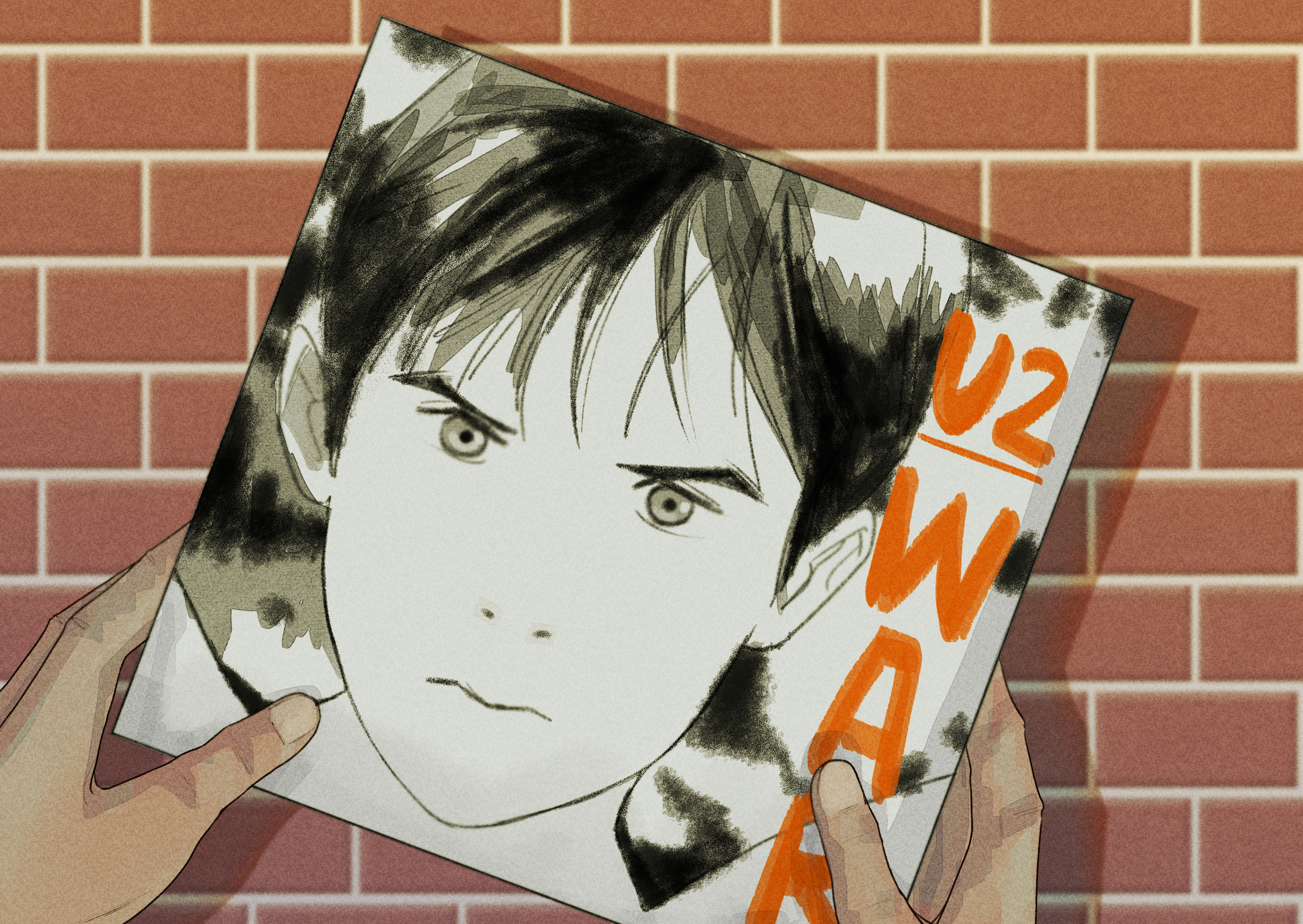
As he entered the downtown Rocky Mountain Records and Tapes on 16th something mysteriously caught his rock-n-roll rebel eye. An image seemed to hover from off the wall and urged him to investigate it more intently in his hands. He turned it from front to back to gauge its spirit and its power. Hazy silhouettes emerged beneath the fiery glow declaring Under a Blood Red Sky. He had heard U2 on radio station KBCO out of nearby Boulder and found their sound was disturbingly mesmeric to him; it burned upon the veritas of consciousness – upon his soul-fire as much as any mere cognitive synapse sending rivulets of electricity soaring through his veins. He beheld the album and felt its vibrations; then (as often occurred when he was experiencing Satori sensations) he relinquished it. An eerie calm took possession over him. He turned down an aisle and purchased U2’s War instead, that being the studio recording from whence many of these live songs came.
He took the album home to his efficiency apartment in Northglenn. He had an all-in-one Rent-A-Center record player system with dual tape decks, as well as an AM/FM stereo receiver fixed upon KBCO, he had a ratty mattress and a lampstand with no shade but truly nothing further except that stereo. He’d had hundreds of albums in Iowa; but they were disappeared now with that life. At times he mourned his musical loss but War contained multitudes.
When John David first heard U2 he froze and drank in all the intricacies and inherently unabashed spiritualities within. He understood that folks were often righteously moved by Bono’s voice, as he was also, but The Edge’s guitar slayed him.
The harpist was a pure and inveterate music snob about guitarists. He logged in his memory a secret pantheon. Layla Clapton of course and anything Harrison, certainly Mark Knopfler and Pete Townshend in relative realms, and great blues gods like Buddy Guy. The Edge however felt certifiably groundbreaking. He maneuvered his way through sonic changes that stimulated atmospheric complexities and teetered into areas that John David felt he had once similarly traversed in his bygone harmonica incarnations. It wasn’t mere instruments that were played, it was the furthest reaches of unreachable eternity itsownself.
He had never heard anything similar, not even the prog-rock virtuosos sounded like that.
That insane sound was all over Sunday, Bloody Sunday the first song on Side One: and it was not only The Edge’s guitar that scorched these sensibilities. Being completely and totally honest Steve Wickham’s breathtaking electric violin also knocked him out, touched by demons, and soothed by angels. It wrecked his brain and his ears. Wickham created a powerful soundscape through tone and guitar effects, using a fuzz box, like Jimi-freaking-Hendrix. There was always something special about purposeful distortion and discordancy. That was John David’s sacred mantra for the first twenty-four years of life; and whenever he found anything in a similar collapsed late-night vein he knew it would disrupt his peace thereafter. Sometimes, he thought, he actually preferred being disrupted.
He couldn’t stop chasing those darkened impulses and, when he first heard War, the visions that troubled his headspace began spinning beyond control; the unattainable, elusive sounds bedeviled him; so he played it on constant repeat for a week until it became assimilated within his consciousness. It throbbed through his DNA and his heart. A heart that pulsed with Irish blood! Who would have thought that even possible years ago? Still, now that the past was present, John David reflected that few understood the debilitating downside of all this. Folks would sometimes whisper that he was indeed crazy. Of course, he would concur with a wicked sideways grin he frequently fondly flashed; certainly eccentric and perhaps full-on bat-shite nuts. In the end it didn’t really matter much in the larger view, not to him: at least, that was what he asserted was the case. But nobody truly believed that. There was always a certain… hauntedness in his demeanor that eluded easy description at the best.
Even when he was shivering cold turkey in a Kansas mud-storm while jonesin’ his way to Colorado and clean communion. John David remembered (and the remembrance brought painful knee spasms of withdrawal to his psyche) awakening naked in a muddy ditch with no recollection of getting there:
“Tis a thing, lads,” he had smirked somewhat derisively. “What doesn’t kill you…”
That was John David flat out; and, damn it, you couldn’t but admire him for that.
He resurfaced somewhere within War. Through U2 for the first time he felt free from the shackles of his own gift. For the first time his soul felt kinship with the affinities of a sound. There was something endlessly metaphysical therein: to find yourself you had to find yourself in else. That else hummed Satori in Denver. As he drove across North Federal wending his way to work on the South Side he was accompanied by The Edge.
He felt the guitar blessing the morning street-walkers, clumped together against the morning chill, their pigtailed skirts baring wildly their professional wares, mummified in cheap overwrought costume makeup and cheaper overwrought Maddog wine that stupefied senses which longed for sanctuary, sweet sanctuary and surrender.
He pondered the ecclesiastical power of a song like Bono’s Red Light. Perhaps it was not mere random serendipity that it preceded Surrender on the album. Wouldn’t sanctuary always required Surrender? All day every day War permeated the soundtrack of life, but not merely as surface noise rather as something subtly subterranean scratching wounds within his soft-flesh soul. It affected him profoundly.
Every song nudged him closer to catharsis, which seemed to reside somewhere in Dublin. A tremor began to vibrate within the twisties of his mind. He was not completely gone – not quite. His stability might be said to float on the leeward side of desolation. He bore so many different moods and temperaments that he considered himself an impressionistic masterpiece. He felt U2 celebrated that. The various personalities within the band were as disparate as were his emotional idiosyncrasies.
Salvation seemed the dominant theme of their temperament, he thought, but it was a salvation tempered by realities of life and death and humble pleasures. He could only dream of giving expression to those emotions through his harmonica or perhaps words. He knew he was close: he knew it. In the past he’d moved people, but it seemed at a dear cost to his fragile soul. To touch God, perhaps, was simply beyond the grasp of anyone not endowed with the karmic grace as shared by The Edge; beyond that, mere mortals could merely dream. John David dreamed those dreams once and felt them fade with each rapidly-receding remembrance. ‘John David has Grand Strands of Tone and Clever Rhythms’… ‘A Melancholy Sadness Pervades his Harmonica’… ‘His Harp Hurts’. It was so strange that he could not remember more. Perhaps it was just better to feel the magic of others’ holy sounds: The Edge’s guitar; and then too: Steve Wickham’s fuzz-fiddle. He put the record back on the turntable.
He found a special theme song persuasively beckoned his attention each day before his morning commute.
When he scored a two-week orderly gig at a nursing home in Wheatridge for the agency he chose Drowning Man. It captured his mood and mode.
He actually enjoyed Wheatridge Manor a lot because the non-agency staff were all empathetically-decent human beings. He particularly enjoyed Floyd, who he referred to warmly as Uncle Floyd because he treated John David as family. Some staff members thought it humorous as he was Irish-American and Uncle Floyd was African-American but it worked for them. He told Floyd about his U2 themes (skinny white boy rock-and-roll joked Floyd) but after John David explained his reasons for choosing Drowning Man Floyd smiled and nodded in agreement: and then, even moreso, when John David recited a few stanzas of Bono’s lyrics he completely understood the underlying intent.
“Well, shoot, little feller, there ya’ be! It ain’t no Bob Marley. But it’s pretty cool. Tonight I’m cooking: told the wife we might have a guest. Yah? In? Downhome cooking! Yah you’re coming. You’ll be there…. Here, theme-song-boy, this is the address where I stay, I told the wife…. Plus, I’m kinda guessing you haven’t rocked a house party for a while? Dear Lord, don’t look so a-feared! Do you see any gangster signs flashing on me – hell, no! You know what I’m thinking of cooking tonight – yah?”
John David took a wild guess and suggested it might be fried chicken? Floyd’s face turned purple, blue, and almost-green. His eyes, which were normally so kind, turned dark with anger as the veins bulging from his throbbing temples threatened to explode. Before an irreversible aneurism took hold he cut loose and swore and sputtered. He moaned that comment was amongst the most racist things he’d heard from a friend. John David shook his head in weak denial. Uncle Floyd put on his meanest mug.
“We’re having fried chicken,” he laughed. “Ah, hell. Always pushing and pushing, getting me riled and ready to thump you: and then, you find a way get me laughing. Theme songs and chicken, yah yah, that got me going. My old lady, I kid you not, is going to think you’re a hoot. Does a fella good, to laugh at a bud. I feel a ton better since you got in my head Drowning Man… That is you, boy. Drowning? Say when.”
John David enjoyed very much having a big sarcastic uncle.
“You are gonna be eatin’ good tonight, theme boy,” chuckled Uncle Floyd. “My place at six.”
“I drink very little so you know,” said John David cautiously. “In fact like not anything like that at all since I escaped outta Iowa: no nothing.”
“Drowning man,” said Uncle Floyd knowingly, “here’s to addictions and your Twelve Steps and my Methodones.”
In between jibes they understood each other.
“I been thinking ‘bout your Drowning Man today,” said Floyd later. “Singer seems to be in a bad way. What’s he doing?”
“Dunno,” said John David. “I think he’s just drowning.”
“Is he the man drowning, or saving?”
“Dunno, maybe it’s like he’s both.”
“That sounds totally messed up to me and I’m the expert of messed up… Poor guy! Booze, you think?”
“Or God, maybe,” said John David thoughtfully.
Uncle Floyd reconsidered.
“Yah,” he said, “I think you got something with that. Maybe we just heard it from our own frames of reference like maybe it was what we wanted to hear and all that psycho-babbly crap. We want to be the heroes but we keep drowning. Have you ever been to a downhome Baptist Church cuz?”
“When I was four for the puppets,” replied John David.
Uncle Floyd laughed.
“For the freaking puppets!” he bellowed. “Ain’t no church I know: puppets, that’s rich. Wished we had puppets.”
“What did you have?”
“We had fire and brimstone! You Catholic boys know ‘bout that.”
“I’m only Catholic by blood I’m Lutheran by choice,” replied John David.
He took a sip of iced lemonade while Uncle Floyd tended the chicken.
“See?” said Uncle Floyd, returning with his wife to meet his curious new work friend. “He’s not so pretty, like me. But his mind ain’t ugly… Oh, you know I’ll be there: that’s his theme. Yah, he got theme songs for sadness, sorrow, surrender…”
John David enjoyed the banter and, after some coaxing, even Floyd’s wife talked with him. He’d definitely come back again.
“Let’s take Johnny to our church,” Uncle Floyd said as they all helped clear the table, “but I ain’t going to no Catholic nothing. Screw that! No re-ci-pro-city for this ol’ Baptist, baby.”
John David said goodbye for the evening with hugs all around: then he drove back North in silence reflecting on the curious evening. Revisiting Floyd’s interpretation of the Drowning Man. Sinner saint or savior people like him and Floyd were drowning. It seemed only through some strange grace that folks eventually find each other. But the saviors seemed to always have to find the ones who were drowning and not so in reverse. That odd paradox reminded him of a trippy book he once read. Named, something like, Zen and something, the Art of some bull-crap. John David recalled it was about drowning.
“The singer was the savior,” Uncle Floyd said. “He is the one saying – don’t you know I’ll be there. It’s written from the perspective of the savior not the drowning man. And, mind you, maybe I’m just thinking about this all wrong. But that seems an egotistic way for some white-boy to sing a song, brother.”
The Denver skyline flickered in John David’s rearview mirror.
“I mean,” Floyd said, “ain’t many of us in this life… that’s exactly saviorish material.”
Uncle Floyd made an awkward cross gesture across his chest.
“Every person is immoral.” Floyd said. “We don’t really want to be but we are. Just look at the two of us, for instance. We ain’t, what you call, the most normally-adjusted cats in the cathouse. We’ve made crap life decisions, I suppose.”
“I know I have,” replied John David.
Uncle Floyd was like a philosopher and scoundrel in one.
“But,” he continued, “we found ourselves a sinner’s break. A holiday made ‘specially for us – just us, for real.”
“What a glorious turn of phrase,” thought John David, clicking his radio – “I mean, that is right up there.”
“Denver!” intoned the DJ. “We’ve got another beautiful Friday night forming along the Front Range. Enjoy the vibe, my friends. If you missed U2 at Red Rocks last June here’s another chance. This one’s for you… Or like, us, let’s make every day New Year’s Day: 97.3 KBCO.”
“Oh, Lord…”
“Yeah, All is quiet on New Year’s Day… Be with you… Night and day…”
“Oh… sweet Jesus.”
“Under a blood red sky… I will begin again…”
John David cranked it mile-high.
The live version torched deeper nerves and spilt blood from unexplored wounds than had the studio version.
“Wait ‘til Floyd hears this,” thought John David, emerging from his car long after the vapor trails of the song had taken flight, “it’s New Year’s Day. New with synchronicity! That was freaking crazy – that was God talking – Talking to me: telling me… SOMETHING…!”

John David turned his stereo on low and then, in a calm meditative place, he proceeded to listen with meditative clarity to New Year’s Day lying next to the speaker. He thought of his life in Iowa and how he’d felt the strange compulsion to escape. It wasn’t exactly a still-small-voice (as in Floyd’s Guidepost Magazines), but rather a deeply-echoing cry of get-the-hell-out-of-here! Or get the here outta hell! He knew that few would ever understand the subtext of his exodus and even he was uncertain of what exactly transpired in the foothills, in leaving the car, taking breath, a large restorative cold-aired Colorado inhalation – that somehow equated to a Christ-Communal sharing. New Years in May.
“Probability, dude,” he told Floyd, “says that every breath we breathe each day contains one molecule of Christ’s last breath.”
“I cribbed that from some maths,” continued John David, “something I read inside a stolen book!”
“Well,” said Uncle Floyd, “Can’t say I’m surprised by that knowledge, you know. You, after all, are not prime normal, nor remotely so, no chance. You can’t help being who you think you are. That’s basic psychology… But let me ask you something… It’s something I been thinking… ever since you told your story. Over a year, wasn’t it?”
That’s right John David nodded.
“Yeah,” he said. “I came here in May last year.”
“So how many of those Jesus molly-cools have you felt in your heart since that first day,” asked Uncle Floyd. “I’m not trying to be all facetious-like or nothing like that so I’m just asking.”
He raised his hand, like a Gospel preacher.
“Well, Johnny,” he said, “I know you and I know our Heavenly Father, God Almighty, and just between us, I say with all respect that consistency is essential. I’m all for the big flash moments of epiphany, I truly am. You know that.”
“I know that,” responded John David.
“But also…” continued Uncle Floyd.
John David amened him.
“We live each day,” Floyd intoned.
“Day by day.”
“…New Year’s Day.”
Uncle Floyd slapped his friend resoundingly on his back.
“Yah,” he continued, “New Year’s every day, brother.”
John David chuckled, he loved his friend’s passion and sometimes felt Floyd was almost as insightful as was U2.
“I hope you’ll spend another evening with us, “Floyd asked, “before you achieve rapture. My woman was really delighted to meet you. We can maybe play your music and – ”
“I’m in. Sounds great,” replied John David, “I really enjoyed meeting her too. I’ll bring the U2 for you.”
“Tonight, maybe…?”
“Not tonight though, I’m sorry. I’ve got my group tonight at the clinic, down south in Aurora off Chambers, and I just don’t like missing too many of them. Otherwise I would…”
“Course, I hear ya’…”
“But who knows?” added John David thoughtfully. “Maybe I can stop by after for some leftover chicken and to play you the album. If you’ll still be up.”
“We will,” said Uncle Floyd, “then maybe some time we can come by your place too. For the reciprocity, you know.”
“Sure, makes sense,” said John David. “But when you guys come, Taco Johno.”
“That sounds good to me,” said Uncle Floyd, ‘just don’t make them too spicy.”
Floyd cringed at the clock on the break room wall ticking loudly.
“Don’t that seem awfully loud today?” he asked. “Because, you know, it’s been a day.”
“Oh, yeah, has,” agreed John David.
“And fast, man,” said Uncle Floyd, “let’s go do our last round and wipe some butts – time to get yours to that meeting, I s’pose.”
John David reluctantly got up. The high spirits of their conversation just a few seconds before was fading regrettably fast. He dearly loved the residents at any time: but the job was wearying and tough. Floyd took the west side of the hall while John David kept pace on the east, as they were constantly competing and bantering about. The joy of meeting Floyd after a year, of pulling himself off the Denver streets surrounded by desperation and fear, of buffeting himself against temptation and of finding for a rare instance a thoughtful and supportive friend, was a blessing he did not expect.
He acutely felt a symbiotic bond between his needs and his friend’s, and it was reflected in U2. War was the soundtrack of connection and hope. He wasn’t sure if he could do as well as his friend had surely done, or would ever do, something more impactful than running away and attending a few group meetings. What was it that kept him from that? His unfortunate self! He wished to expiate his self-perceived sufferings, in living purposeful days. He understood why Floyd kept inviting him over. He was merely attempting to sponsor a recovery that John David was ill-equipped to handle himself.
Besides they were legitimate friends. John David pushed the linen cart towards Floyd’s side of the hall and paused.
“Ya’ there?” he called, familiar with waiting for Floyd. “When I come over later can you remind me to bring up the end game and what my New Year’s Day theme means?”
Uncle Floyd came out of the room squinting one eye expressively like a cowboy in the sun. After dabbing his sweating brow with his sweating forearm, he leaned against the wall saying:
“That’s why you got group, my man. I’m going to ask you to wait and ask those folks about that and then later we’ll try translating all that into human words – not that gobbledygook stuff.”
“Sounds like a plan,” laughed John David knowingly.
Uncle Floyd coughed into his elbow and dabbed at his watering eyes distractedly.
“We ‘bout done?” he asked.
“You look as tired as I feel,” joked John David sympathetically, “it takes lots of work to make folks comfortable.”
He had suffered less than Floyd, but also was conscious of that infernal end-of-workday ache: but, although his neck and feet were seeking attention, he resolutely refused taking meds for any pains. John David thus lumbered off to his car muttering to himself:
“Johnny-buck my old pal, it’s on days like this that your dirty ol’ sin and temptation issues creep… Good thing I got group. I need to share with them what Floyd said about looking harder at Step Three.”
He knew Floyd was right.
“Surrender, little man,” continued John David, reflectively, “you know that’s what you need. You verbalize all these group-speak words but tomorrow you know you’ll be scratching and itching again. That is simply so. Yah, that’s for sure. There are hundreds – who am I kidding? – thousands of ready reasons and excuses, most completely irrelevant, that give you an out… You don’t need excuses, little man. You are deluding yourself that you think so. When you get so close to a real breakthrough, then you bail! Self-sabotage every time!”
He knew his own words were true, spoken with candor and on point. He looked up at the mirror and said calmly to himself:
“Dude just take a breath. Relax and listen. You won’t get anywhere tying yourself up in knots, you know.”
He manipulated his face into a Harpo Marx contortion failing to make himself laugh.
“You have to go tonight, Floyd would insist,” he said.
***
John David sat in the overcrowded waiting room, holding the hand of Floyd’s wife. He learned that her name was Monica, previously he had only known her as the wife or some variation of that until right then when Floyd was rushed to the hospital. The ambulance was leaving as he arrived. He thought it was a mistake. John David had come directly after his meeting and, expectantly, he had wanted to get Floyd’s opinion on what they’d discussed at group. Of course that was not going to happen or at least not tonight. Monica tried her best to make small talk, but neither had words when it came to what they were feeling about their hero undergoing surgery in the next room for what the on-call doctor had disturbingly referred to as a myocardial infarction. He nodded thoughtfully with a seemingly well-practiced sympathetic gesture and said:
“Ma’am. It’s a heart-attack…”
The brightest light in both their worlds lay dimming upon a table and needing a break from the despair which was oppressive Monica began digging in her purse. She found a photograph. John David looked at it, noting how vibrant Floyd once was. He had bought her a blue-tick hound when he got out of rehab as a token of gratitude. It had cost him arms and legs; but that pup had brought them both years of joy! How many years ago that was, fighting through more painful relapses and celebrating more resounding recoveries, together they had been and together they’d always be in the heart of God and the minds of friends, referring to John David and making sure that he would make it through all this, knowing Floyd would wish that also, before finally, hearing the words they feared to hear though they had already sensed that Floyd’s bright redemptive flames had already been extinguished. When that finality abruptly struck her Monica kissed Floyd and whispered she’d been quite blessed and honored; and when the tears came flowing she threw herself over his lifeless chest and sobbed inconsolably at her selfish loss yet understanding he was now at peace. At first she didn’t want to leave him, but then she wanted nothing more than to run far-far away, somewhere in-between was Floyd’s friend John David, who embraced her and drove her to their home to grieve in private.
Surrender!…
Upon arriving home John David opened his U2 notebook where he’d scrawled lyrics. Certainly some were poetic and others of them were pretty. But he’d always found meaning in them. Why were they so insightful and complex? It was as if they understood him. They lifted him and sanctified him: they discovered deep passions within him, unknown passions. He thought of what Floyd had said about Third Steps. Oh his beautiful friend, he grieved, how full you were of fire, of sanctifying flame!… Why take away this spark and not take me?
He simply could not avoid that question and prayed awkwardly for an answer. He found solace formerly in an old missal which he had lost somewhere in his discombobulated frames of being. It was his sister’s prayerbook and it reminded him of her. He never told Floyd about her. An unacceptable resentment against his friend began festering within. Why was he blaming Floyd for his life? Was he already too far gone to try to live a faith-filled life? Could he even envision it? There were so many Steps he’d not yet traversed. He knew it was wrong looking externally for his internal questions, but perhaps that might enlighten the path.
The notebook of U2 lyrics lay before him on the floor. It had fallen open to the fourth song from the second side of War and was entreating him to explore more intently its relevance:
It’s in the things I do and say,
And if I wanna live I gotta,
Die to myself someday…
Surrender, surrender, surrender, surrender…
He paused. He understood what Floyd had been trying to tell him about himself. That vital Third Step! Could he, Surrender, and to what?, to that which was missing from his soul? There was so much that he needed to change: the compulsion that burned throughout his life to do something, for instance. If he could only find the pathway to surrender….
His spirit broke and he began crying. He turned another notebook page and tried to calm himself: but his soul refused to be quieted. He began to rock back and forth in externalized nervousness, while internally his hallowing wail increased. His rocking slowed markedly when his eyes fell upon the lyrics of 40:
Yeah I waited patiently for the Lord,
He…. heard my cry,
How long…. How long….
It was perfect. 40 resonated peace. It consummated his surrender. Its lyrics were scripturally derived from the 40th Psalm of David. He was broken, despaired! He was a prisoner of himself. His soul trembled in humiliation and violently tore away from its moorings while crying:
“Surrender!”
His spasms quieted for an instant, then resumed with muted intensity but not entirely silent. He pressed up from the floor and walked out the door of his apartment with the notebook under his arm. He began to wander aimlessly, losing his way for twenty – maybe forty – minutes until he recognized the surroundings. A cruel complex of stagnant industry sprawled before him. He sensed something about it, something that humbled his objectivity. He stared at the rusted and decrepit structures of under-utilized metal for memories he had buried. He climbed four tremulous flights of open-air stairs and found the elevator chained to the top. Here he’d slept!…. His past was lain raw and his wretched soul cleaved open, exposed.
“I give up! I give in!” he cried.
A night-dove, hearing a stranger’s voice, flew skyward in a fury of wings.
“I surrender, Floyd… I surrender…” his cries grew louder.
The night-dove returned in a circuitous flight and perched high upon a girder.
“I have given you my surrender!” he sobbed, confessing unto the night-dove.
John David felt a blast of heat burn at his eyes and he recalled that same vent warming him against the winter’s chill. He continued to cry:
“Not Floyd… No… no… not to Floyd… I surrender… I surrender unto myself… me!”
Paying no heed to the danger he began trudging up and down the rooftop, clasping the notebook tightly in his arms and murmuring:
“Christ with me! Christ in me! Christ before me, Christ!… Christ in, me! Christ in!… Surrender! I surrender to Christ in me!… in me!”
John David felt his pulse quicken then slow and he eventually climbed down from the elevator. He listened as the song of the night-dove’s singing grew achingly more distant; then felt a healing fire ignite unforgettably.