
Ray was still a bit sleepy when he climbed the steps and slid along the bench seat in the cockpit. It was midnight after all!
“Good evening, “he said to Zach, Southern Cross’s skipper.
“Couldn’t be calmer, could it?”
“Nu,” Zach responded in a tired drawl.
“It’s been like this our whole watch.
“Four hours of moonlit heaven”, Zach’s partner chimed in.
“We’ve had the drifter up all night,” Trish said.
“Nothin’ to report. There’s been no shift in the wind. We’ve been doing about four or five knots…easy to hold the course.
“Follow Venus and you’ll be right.
“Reckon you and Lucy are going to have a quiet night,” Zach added.
He slid along the bench to let Ray take the helm.
“I’ll wait till Lucy joins you, Ray.
“With a bitta luck she might be in the galley gettin’ some coffee on,” he responded. Right on cue a sleepy-eyed Lucy poked her head out of the cabin, two mugs of steaming black coffee in her hands.
“What did I tell ya?”, the young Aussie said, with a smile.
The four wished each other “Goodnight” and Zach and Trish disappeared into the cabin. They’d been on watch from 2000 through to midnight, Ray and Lucy would sail the boat through till 0400.
In all, there were twelve people aboard. Zach and Trish, the owners, and five couples they’d picked up as they crossed the Pacific to New Zealand. Ray and Lucy were not really a couple as such, just friends, but they made up one of the six pairings to fill a watch.
Southern Cross was not an ocean-going sailboard. She was a magnificent boat, just not specifically designed for crossing oceans. She was long and sleek, with none of the bulky features you see on yachts that cruise the open water—a well-rounded bow to help the nose climb over lumpy ocean swells, a broad beam to provide plenty of room below deck, and a well-protected cockpit to give the crew a dry, safe place to face the weather. Ocean-going sailboats also have smaller rigs, less sail area overall, they are built for comfort, not for speed.
Southern Cross was a racing yacht. Built in Germany in 1928, she was one of the first ten-metre class yachts ever constructed—a smaller version of the twelve metre yachts that later became famous jousting off Newport for the America’s Cup. Like a woman in stiletto heels, she had long elegant lines. She sat low in the water with an elongated bow and stern that stretched her waterline length when she heeled over. These boats are built to a strict formula recognised the world over as Ten Metre Class yachts for competition. They are racing machines–virtually empty below deck—but when she’d stopped racing Southern Cross had been fitted out with basic sleeping quarters, a simple galley and a Penta diesel to manoeuvre in and out of dock. Comfortable, but not lavish.
Unlike many of their friends who’d fled Los Angeles for Laurel Canyon or the green hills of Topanga in the early seventies, Zach and Trish found their hideout on the water.
They’d paid a deposit on the boat on impulse with Trish’s inheritance one day whilst strolling around the docks.
They lived onboard illegally at Marina El Saltillo, in California, and were barely tolerated as the dishevelled end of the yacht-racing fraternity. Paint spattered jeans or a torn blouse didn’t exactly adhere to the dress code at the El Saltillo Yacht Club.
Zach and Trish didn’t care much for racing round the buoys; they just loved being on the water.
And one night, again on a whim, they just disappeared over the horizon.
Trish taught herself to navigate crossing the Pacific. First landfall was on Nuka Hiva, a tiny dot in the Marquesas -–the north-eastern-most part of French Polynesia.
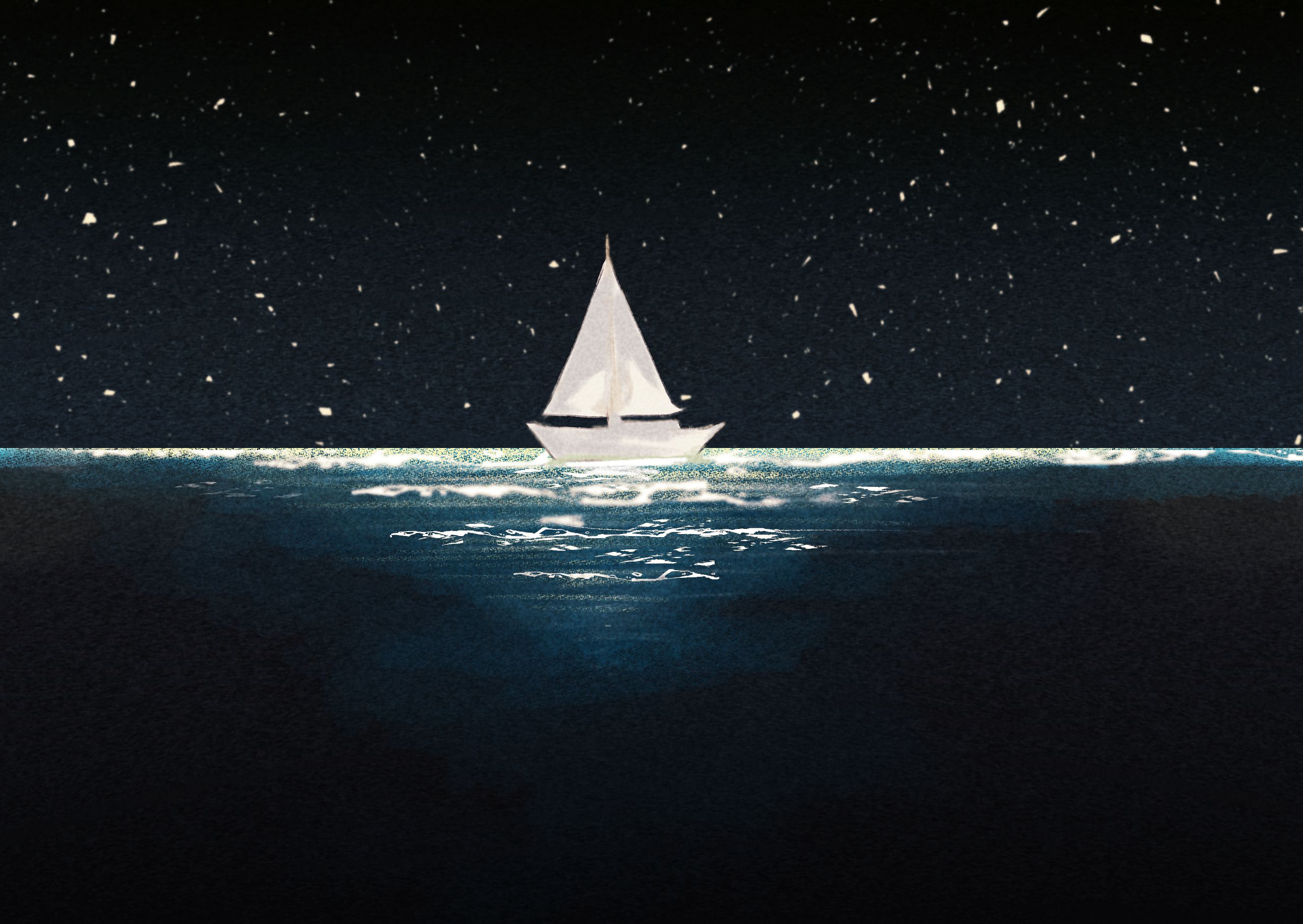
Tonight, Southern Cross is gliding easily through the tropical waters of the Coral Sea. A near-full yellow moon is on the rise behind them, illuminating the yellow Dacron drifter pregnant with the gentle caress of a breeze.
The sky is free of cloud, and while the brightness of the moon is making them difficult to see to the east, the stars are alive in the western sky.
Ray’s hand rests on the helm with the ease of someone who’s already sailed more than 4000 kilometres from New Zealand. He’d fallen into sailing by accident. After meeting a young German guy who was travelling around the world. He’d crewed on sailboats to get from country to country, and then rode a hi-tech, fold-up bicycle on land before catching another boat.
Ray had surfed as a kid, but never sailed, and the idea of backpacking around the world on sailboats got him first bite.
He jagged a job crewing on a 112-foot, three-masted schooner out of Laurieton on the mid north coast of New South Wales, in Australia.
“I’ll work for me keep”, he’d told the skipper, “If you teach me how to navigate.”
He did five trips to Lord Howe Island onboard Sol and then ended up crossing Bass Strait in a 28-foot Herreshoff ketch and had plans to backpack around New Zealand; then everything changed one night when he teamed up with some people to go to a local folk club to enjoy some music.
“Hey, are you the guy who sailed here?
“Yeah.
“Did you see the ad in the paper today? There’s a yank boat looking for crew”.
They were meandering along the footpath one second, then Ray made a sharp right straight into a news agents, rifled through the classifieds of the New Zealand Herald, found the ad, and walked outside to a pay phone.
Within ten minutes he’d been invited down to Half Moon Bay for a face-to-face meeting with the skipper the next morning. By mid-arvo he’d stashed his gear below deck and was lying on his back on a Tressel sanding back the hull ready for a fresh coat of antifouling.
When Ray took the helm, he became a part of a boat. He felt every movement through his whole body, not by thinking about it, by feeling it.
The rise of the stern as the swell lifted Southern Cross, the ever-so-peaceful shooshing sound as the yacht surfed momentarily as the swell picked her up, her tendency to list to starboard, or port –opposite to whichever side the headsail was set on.
And then the same again.
And again,
And again.
A slow, peaceful meditation, almost to the rhythm of breathing.
After only a few minutes on the helm on this night, though, Ray felt distracted.
Something wasn’t quite right.
A vibration?
A noise?
A slight knocking?
There seemed to be something interrupting the rhythm.
Nothing regular.
No clear sign you could hear or see.
It was virtually imperceptible, and Ray wasn’t even sure himself that something was amiss.
He waited, listening, feeling, then he put the cup down and asked:”Hey, Lucy, can you hear a soft bumping sound every now and then?
Silence.
They sat, wide eyed, looking at each other in the moonlight.
“Nah, the only thing I can hear is that shooshing every now and then when a wave picks us up and I’ve got to concentrate even to hear that.
“What do you hear?” she asked.
“I dunno, “Ray said,” I’m not even sure I can hear anything. Just feels like something is loose or something.
“Must be my imagination.”
The Solomons over the horizon behind her, and Samurai—a tiny island off the eastern tip of Papua New Guinea–to the west, Southern Cross was in her element. There was only the suggestion of a breeze, and she was making about four knots.
The yacht was bearing 280, riding the faint reminder of the south-easterly trade winds, and like the first people who’d explored these waters thousands of years ago, Ray was sailing by the stars. He just kept Venus to port of the silhouetted headstay. If the planet became hidden by the jib for too long, he’d have a quick glance at the compass. No need to worry, though, by the time his eyes fell on the illuminated dial he’d already instinctively corrected. There it was –280 degrees–smack on course.
You’d have to try hard to lose your course in conditions like this. The ocean was a milk pond.
Ray felt more together as a person when his hand was on the helm of a yacht than at any other time. He preferred a tiller to a wheel. And the older it was the better. Even with all the improvements in technology–the nylon bushes, the carbon fibre, the petrochemical lubricants–he just felt a wooden tiller was truer. There was nothing between you and the rudder. You could feel the boat, the whole boat, you were part of it. As soon as you shifted the helm, the bow responded. It was instant. Light, like carving a deep turn on a surfboard. Effortless.
He could do the party thing, but he needed a few beers to get him going. He preferred one-on-one conversation to the performances blokes put on in a crowd. He played the game, of course, just like everyone else, to fit in, but he knew it wasn’t him. Never was and never would be. And he was comfortable with that.
Lucy and Ray were very different people.
Lucy was probably about five years younger. She wasn’t sailing because she loved the ocean. Crewing was just an adventurous way to get from A to B, in her case, from New Caledonia, where she’d been visiting friends, to Bali—a serious first step in an overland trip from N’ Zed to London. She was short with Shirley temple curls, and a bubbly personality. She was easy to be around, a bit on the hippie side, well, let’s be honest, right out there. Her wardrobe was virtually all tie-dyed t-shirts and cheese cloth skirts.
On land she wore those heavy, Mexican sandals with car-tire treads.
On the boat she wore nothing. She was comfortable in her body, enjoyed the sun, and wasn’t worried by other people’s eyes on her skin. She wasn’t what you’d call “tough”, though she did have a strong centre. She walked with big steps, hungry to cover the ground. She was not exactly sure of who she was; but clear about who she wanted to be.
Independent. Free.
Half their watch had passed without incident.
It was gentle sailing. Peaceful.
For Ray, though, the feeling something wasn’t quite right wouldn’t go away.
He didn’t want to worry Lucy, so he didn’t say anything.
Another hour passed.
Maybe more.
And nothing.
Then.
The slightest touch.
Too light to call a bump.
“Did you feel that, Lucy?” Ray asked
“What?
“A little bump…I dunno really, a small knock.
“No, I didn’t hear anything. It’s been the same all night to me, just quiet as!”
“Would you mind going up to the main and look around a bit?
“What am I looking for? Lucy asked as she climbed out of the cockpit.
“Dunno, really, anything that’s lose.
“Anything that looks outta place.”
Lucy edged along the main boom, and stood at the mast looking around, the white fibreglass deck well-lit by the moon.
She went back to the cockpit shaking her head.
“All looks good to me,” she said, plonking down on the bench, and shrugging her shoulders.
Ray had deliberately chosen to do the watch from Midday to Four in the afternoon, and then from Midnight till four in the morning. He loved sailing by the stars. The whole universe unfurled above him, from horizon to horizon. Away from all the lights on land in the middle of the ocean the sky had a dimension to it, more depth-of-field. The sky wasn’t just a mass of pinpricks of light. The universe was layered. Some planets so close, it looked like they could fall out of the sky and splash in the water. Others were much further away; some so faint you weren’t even sure you could see them at all—a radio signal with no volume. There were fuzzy clouds of stars tightly packed together. Others, clear and distinct standing alone. Black holes. It was just too big to know; too big to understand. It just was.
Silent.
Eternal.
In the higher latitudes night watches could be uncomfortable. Cold, wet, pitch black and wild. Storms made those watches more dangerous, and most sailors tried to avoid them. To Ray, though, it was all the same—the ocean being what the ocean is. Untameable.
Lucy got paired with Ray because they were both single. Safety had also played a roll. Ray was the most capable sailor on the boat, the most experienced, the crew member most able to sail the boat AND keep a novice safe.
Most nights they’d disappear between the stars in softly spoken raves about eastern philosophy.
They were both in their twenties, brim full of idealism, and disillusioned with the prospect of buying a house two streets down from where they’d grown up, getting married to someone they’d gone to school with and then raising a family—the same as everybody else. They were hungry to learn about alternative ways of living. They wanted to know what was out there in the world, wanted to climb every mountain and find out what was on the other side.
They raved all night about the Tao, yoga, Buddhism, Hinduism, ashrams or the Indian mystic Bhagwan Shree Rejneesh. They just repeated things they’d read in books, of course, they didn’t really know anything about those things, but they were keen to learn, keen to share. Hungry to grow.
Lucy had just finished a book with the pretentious title of “The Kabbalah—Secrets of Ancient and Forbidden Knowledge” and she was full of it.
“As it is above, so it is below”.
“Not sure I know what that means,” Ray said.
“The interrelationship between things in the spiritual world is the same as it is in the physical world we live in,” Lucy responded.
“Right, “Ray said, think I’ll need a coffee for that one.
“You up for another cuppa?
Lucy nodded, as she edged into position to take over the helm.
Ray had stood up and had taken one step into the hatch opening when he stopped. The nagging thought something was loose up forward hadn’t left him, so he thought he’d take a quick look around.
He edged along the main boom unsure what he was looking for, just glancing here and there to see if anything was loose and able to roll across the deck a bit or knock against a stanchion when the boat rolled at a particular angle.
He stopped at the mast itself and checked all the winches.
Nothing was out of place.
He even edged further forward to the bowsprit and looked back on the deck to check his earlier conclusion that everything was shipshape.
Edging back to the cockpit he shook his head.
“Gees, stuffed if I know,” he said, more to himself than anyone else as he climbed down the gangway to make the coffee.
By the time Ray emerged from the galley the first suggestion of light was showing in the pre-dawn sky to the east—no colour yet, just the hint the sky above that eastern horizon was not as dark as it was at the zenith.
Ray knew it would change quickly.
He felt the breeze picking up ever so slightly, and knew their watch was coming to an end.
“We’ll be trying to sleep soon, so I made you a green tea instead of coffee,” Ray said, “Hope you don’t mind.
“Nah, that’s perfect Ray, I was going to suggest that myself, but you’d disappeared below, and I didn’t want to make too much noise for the crew.”
They sat in silence, watching the stars disappear one by one as that first wash of orange washed across the eastern sky.
“You seem comfortable on the helm now, Lucy. I can feel you anticipate the little pull to starboard when the waves pick us up.
“You are in the rhythm.
“Yeah, I really love it. It’s so relaxing, and you drift off into all sorts of thoughts. Memories. Maybe from school. Fights with me brother. Some Auntie or Uncle’s laugh. The strangest things come up. It’s like therapy.”
They both laughed.
“Well, our time’s up. I’ll just have a piss and then rouse the next watch.”
Ray climbed out of the cockpit, and walked easily forward, one hand holding the boom.
He stopped at the shrouds on the starboard side and started to urinate into the water.
Ray was relaxed and looking forward to climbing into his bunk.
He looked down and watched the bubbles floating on the surface where his pee hit the water.
He blinked his eyes thinking moisture may be making him see double because there seemed to be a lot more bubbles than there should have been.
Ray tightened his grip on the shroud and focussed his gaze on the surface of the water.
The bubbles and froth danced on the dark water, but just below that there was something else.
What is that? Ray thought.
Bubbles…nah…a submerged bit of wood or something.
No.
He edged forward to the bowsprit and saw the same thing all the way, and then he followed the stanchions to the stern…the same thing.
Then, it came to him.
They are barnacles.
What he’s looking at is a whale.
That is a sixty foot whale…a humpback ….and all those marks they’re not bubbles, they’re cuts and scratches, barnacles, a whale’s logbook–the chronicle of thousands and thousands of kilometres of ocean travel.
A lifetime.
He turned around and the words just burst out of his mouth:”Lucy, get the crew. Wake ‘em up.
“Everyone.
“Get ‘em up here.”
Lucy was alarmed by Ray’s sudden urgency.
“What’s wrong?, She asked.
“Nothin’ wrong…they just won ‘t wanna miss this.
“There’s a whale right beside us…a whale as big as this boat!”
Ray was in awe of what he was seeing.
Southern Cross is 60 foot long from bow to stern, and this whale stuck out the front and back of the boat. Not a lot, but she was certainly 60 foot long, Ray thought.
He pieced the night together in his mind.
His instincts had been right.
Nothing was loose on deck though.
This whale must have just sidled up alongside Southern Cross and cruised along gently with us. Maybe, she was attracted by our dark hull.
Every now and then we’d touch…and THAT was what I’d felt—not really a bump, just a slight interruption in the sailing rhythm.
The skipper’s head was the first to appear in the cockpit.
“What’s up? He asked, concern in his voice, clearly pissed off he’d been woken up.
“We gotta problem?”
“Nah, Zach, no problem, but com an ‘ava look at this.
Ray was pointing at the water beside the yacht.
The sun still hadn’t broken the horizon, but the light in the sky was blue and you could see the whale’s back as clear as a navigation chart.
“Wholly shit,” Zach said,” How long has that been there?
“All night, I reckon, I could feel a suggestion of a bump every now and then, checked out what was happening up forward a few times, but nothing was loose or outa place.
“I thought I musta been imagining things.
“Then, when I had a piss a few minutes back, I was looking at the bubbles on the water when I noticed the barnacles.
“How big is it?” Fitz asked.
“She’s about the same size as our deck length—60 foot—I reckon.
“A female humpback. They’re bigger than the males.
“Wholly shit.”
By now the rest of the crew were emerging sleepy eyed.
They stood in the cockpit grumpy and unsure why they’d been dragged out of bed.
The whale spout gave them the answer. A strong stream of saltwater gushed twenty foot into the air and fell on the deck like rain.
The crew cheered as one.
They scrambled for positions amidships.
Ray could see Lucy jumping up and down, like she was trying to grow taller, and he relieved her on the helm so she could get a close-up view.
“Thanks Ray, I can’t miss this!”
“Wow…. how many people get woken up with an alarm like that!”
“How special is this?”
“Oh my God, Nature. I just love it!”
“If you told people about this no one would believe you.”
It looked like the activity on the deck had woken the whale up too.
She ducked her head, drew in some water then spouted again, this time with a deep shooshing, humphing sound from deep inside.
One of her flippers moved, and she eased away from the yacht at a slight angle.
About twenty metres away she lifted her head slightly, then ducked below the surface. Her massive, black body followed in a smooth, liquid motion, every barnacle, every scratch and scar rolling past the crew’s eyes like a slow-motion movie that told the story of half a century or more of swimming. A saga of 10,000-kilometre round trips from the equator to the krill-rich waters of antarctica, a journey of between four and six months, that’s been repeated year after year after year.
Did that long white scar on her side come from a scrape with a great white or an orca?
Perhaps a glancing blow from a harpoon?
The thick crusted barnacles beside her dorsal fin? Did they attach and start to grow in the pure waters of some unknown tiny bay on the east coast of Tasmania, a rest stop for mother and calf.
And what about the stories that weren’t written there?
The brothers and sisters she’d lost in waters red with blood.
And the changes she’d witnessed.
So many more shiny things moving around on land these days.
So many more white lines cross-crossing the skies.
The water getting warmer.
More crowded.
Noisier.
The grinding, rhythmic rumble of those massive things on the surface.
And all that stuff bobbing about on the surface that the birds and fish eat.
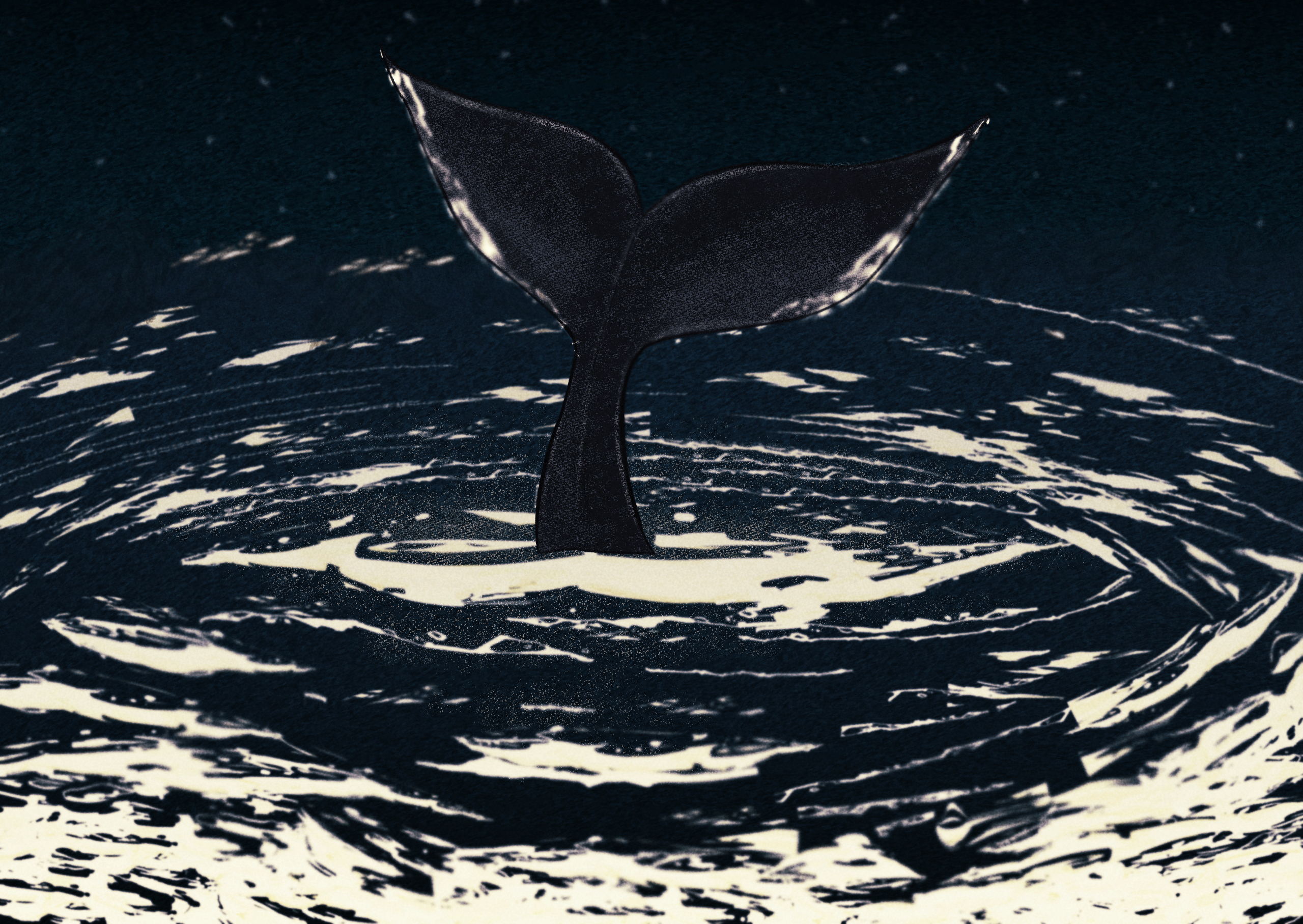
The whale’s slow descent seemed to go on forever before her dark fluke rose as if in salute. With water dripping from its wide base, the fluke rose higher to reveal the white underside as a last “Goodbye” before she silently disappeared.
Onboard Southern Cross there was a collective groan of disappointment.
But no-one moved.
Every eye was on the same spot—the slight disturbance in the water where the whale had disappeared.
It was five or ten minutes before people slowly turned to make their way back to the cockpit.
Everyone was too vibed to go back to sleep even Ray and Lucy who’d been up all night.
“How long had she been alongside, Ray?
“When did you notice she was there?
“Why do you think she cozied up to us?
Everyone wanted to know more. They all had questions, but the cockpit fell silent, and jaws dropped when the whale suddenly burst out of the water from deep below, sending a massive spout into the air.
She rose and fell at full pace now.
Wide awake.
Full of power.
With every eye glued on her she burst through the shimmering, blue surface and climbed into the sky like she had wings. In what was the most spectacular breach anyone of the crew had seen, this gentle giant rose vertical, nearly all of her massive body exposed, twisted in mid-air, her black, barnacled back giving way to her white underbelly, arched slightly and plunged back into the ocean.
Her home.