
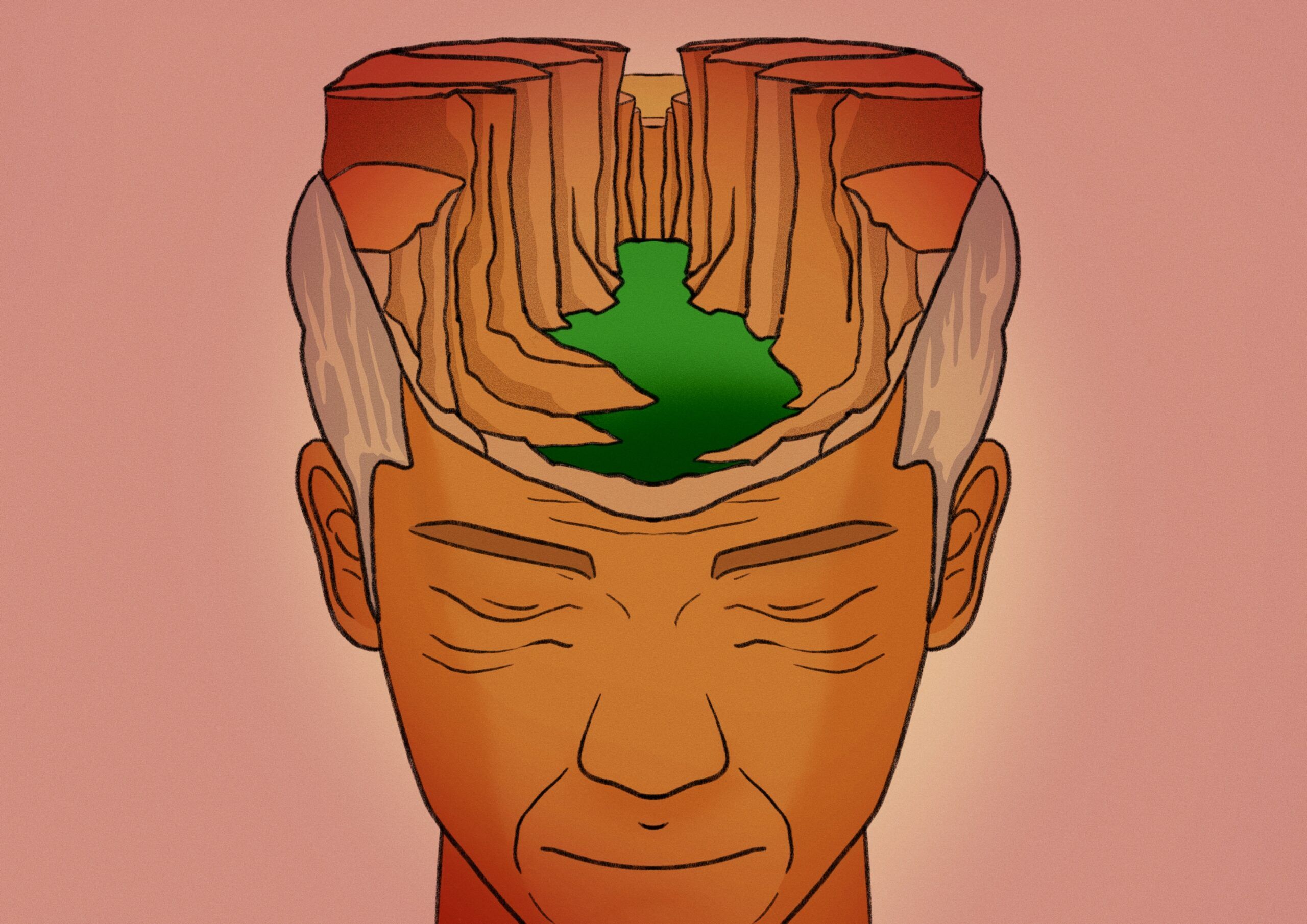
A mosquito drone, as penetrating as the skirl of bagpipes, interrupted his reverie. His attempt at reverie, rather, his pursuit of an Emily Dickinson moment, mystically in tune with the world around him. Reverie alone will do — but not in a world that had shrunk to one noisy annoyance.
He was six days into the river trip that his wife had sent him on — you need to get away and try to have some fun, she’d said, you work too hard — that his wife had researched, had booked, had made all the travel arrangements for, had practically packed his suitcase for. And had then sent him out the door with a kiss. It was either profound love or selfishness on her part. What would be different when he returned home? He hoped his threadbare chair for TV watching, perfectly fitted over time to his contours, would still be there.
Six days into the trip. Enough time to have stopped thinking about work. If only he could. Three jobs: even he knew that was too many. He sort of missed the theater. It was a miracle, and a source of community pride, that an Iowa farm town of 1,300 could keep a local theater going in the age of streaming services. Booking the right films helped. Like that Twilight movie that had packed the 200-seat auditorium. He still smiled remembering the howl generated when the wolf man character took off his shirt, teens and middle-aged moms suddenly shrieking as one. Moments like those, people united in some cinematic thrill, made up for the headaches of the greasy popcorn machine and the staffing no-shows and the projector idiosyncrasies.
The infant formula factory didn’t offer any such rewards. He’d taken a job there as a line worker — a steady 8-to-5 assignment that didn’t require him to bring home any problems — but he’d gotten arm-twisted to lead the maintenance crew after the company learned of his engineering background. It seemed like every day, sometimes before he finished parking, section leaders would corner him about some issue that needed his attention. Or would catch him at the end of the day and get him involved in a repair job that would last until nearly Midnight. A slew of new problems would be waiting as his welcome-home greeting.
He’d taken care of all the clients for his lawn care business — snow removal in the winter — before he’d left for this trip. The grass would get a little shaggy during the almost two weeks he’d be gone, but nothing would go to seed.
The lawn/snow business had been his first endeavor after he’d left aerospace and big-city living to move to rural Iowa. After years spent in an office, the mown grass smell of summer or the crisp air of winter enlivened him. He still enjoyed the work, but the days his body ached afterwards reminded him he was no longer a young man.
The theater had come next. It was run as a non-profit, open Friday to Sunday only. He’d still been a relative newcomer when they’d asked if he would manage it. Maybe they’d already asked everyone else in town, or he just looked like someone who’d say yes. It didn’t pay much; he considered it community service.
He’d hired on at the infant formula factory because he wanted a steady paycheck in case his outdoor business ever went bust. Together, his jobs had erased any recollection of what free time was. And now he was on a raft trip that required nothing more of him than to set up and take down his tent, hold on through the rapids, and show up for meals when called. If he couldn’t leave it all behind here, then where?
Maybe somewhere without intermittent strafing from a mosquito.
They’d moored the rafts on a beach where a side canyon had extended its rocks and grit into the main river, which roared to work past the obstructions. The passengers had been encouraged to walk in silence up to where the canyon dead-ended. Not actually dead-ended, but presented an abrupt wall too steep and tall to climb; the canyon undoubtedly continued for miles and miles beyond.
He was the only single party on the trip. There was an extended family unit that had humorously offered to adopt him; a group of friends from a small town in Arizona — Pickleball players, they giggled, but whether friendship preceded or followed sport he didn’t know; and three couples, ranging from newlyweds to fully seasoned. The groups clustered mainly along their natural divisions, with some intermingling. He found occasion to move between one cluster or another and take part in conversations or listen to the talk. It was nothing special: everyone seemed pretty ordinary, as he undoubtedly appeared to them.
Going up the side canyon they’d reached a point where they could no longer hear the river’s insistent cry. Margeaux, the trip leader, gave them a time by which to return to the rafts and a reminder to proceed silently. He’d paused then to let the others go ahead. He took a seat on a rock of comfortable height and let the sounds that accompanied his companions’ movements recede: throat clearing, the hollow clonk when a stone shifted underfoot and met another rock, an occasional whisper, and more subtle noises, like a shift of fabric, that accompany a person’s best efforts to be quiet. He sat with eyes closed and tried to find the silence. Nope. He opened his eyes and studied the deep blue against the sharp edge of the canyon rim high above. Is this what fun is?
He closed his eyes again and tried to quiet his inner voice. Focus on breath. Breathe. Inhale. Exhale. Slap at pesky mosquito.
After a third futile swipe at the obnoxious whine near his ear he decided to move. He stood and looked around. Margeaux had parked across from him on a bench of sandstone. Her legs stretched in front of her and her arms buttressed her upright torso. She smiled at him and nodded, then closed her eyes.
He made his way up the canyon as quietly as he could. He tried not to disturb rocks when he stepped, but the drainage was littered with so many cobbles he inevitably knocked two together. Their sound echoed softly along the walls. When the echoes faded, an immense silence rushed in, as if the weight of the vertical walls, ten times taller than the distance between them, squeezed all sound from the air. He lingered, felt the canyon world pressing in on him. He moved again to separate from the sensation.
He walked past others who had stopped to sit, some with eyes closed, some gazing at the layered walls of sandstone above. Others walked past him, down canyon, back to the boats and their amenities. Clonk-onk-onk.
Two people emerged from ahead and went by him slowly and quietly. Focused on their footing, external or perhaps internal, they didn’t even give him a glance. When he reached the end he was the only one there.
He stared across a small, still pool whose surface floated below an alcove of dark rock that stood like a sentinel. The canyon, Margeaux had said, contained rocks formed nearly two billion years ago. Maybe some of the weight he could feel was time.
A yard-wide section of the vertical rock sheened with a gossamer veil of water that trickled noiselessly into the pool. No running water led away from the pool; it must instead seep through the pebbled canyon bed. Or sink into the depths, where only water can go.
The hush of the canyon deepened. The air surrounded him with cool moisture. The walls had drawn closer and tightened overhead. He felt embraced, and remembered a time when he’d closed his hands around a moth to carry it outside. He stood in shadow so dark that his surroundings blurred, except for the space immediately around him. A reflection of sky blue from near his feet provided the only distinct light. He heard drumming, then realized it was his heart’s measure.
He looked from the rock to the pool’s surface, which was smooth as a mirror. Highlights from the rock’s contours and facets that caught more ambient light than the surrounding stone created abstract images on the water. He shifted position and a shard of glaring yellow canyon wall from high above joined the bright blue. He stared. Tides settled within him. The multiple reflections, perhaps stirred by air movement he did not feel, merged into patterns.
Awe entered him when the patterns morphed into shapes, three dimensional, a presence under the surface. He saw individuals under the perfect surface, gathering as a multitude, rising toward him.
People, his mind said, but they were just shapes forming like thunderclouds. They did no more than make themselves known, neither welcoming nor threatening. They drew nearer yet didn’t approach, like that movie camera trick where they make the foreground and background appear to shift in opposite directions. He’d never experienced that dizzying effect outside the theatre before.
He dropped to his knees. He held there a few seconds then fell onto his belly, arms splayed in benediction, legs pleated under him.
While thus posed, a force grabbed the center of his belly and pulled. He imagined there was a vine, as wide as a dinner plate, that emerged from him and grew Jack-in-the-Beanstalk quick. It dragged him into the canyon floor, endlessly down, an extraction that grew then eased, grew then eased, cyclic. His body thrashed, as if to escape its captor, but it wasn’t his body being pulled into the earth, it was him, his essence.
He felt the final bit of himself go through, whipped along at the end of the long cable that had been reeled into this other place. He was now within the presence, the many. Sound smeared into an impenetrable quiet. Every diffuse swirl in the nothingness around him was a universe, was him, was everything. The presence embodied him on all sides. There was no water, no canyon, no rock, no form. Only awareness.
Awareness. A thought. Stay.
For an unknown time he stayed, until there came a disturbance, a distortion, a solidification into, into what? A sound? Again. A beat — du … dum … tom … Tom … TOM!
He opened his eyes. He was lying on his back with his feet in the pool. He began to raise himself up but Margeaux paused him with a gentle hand on his shoulder.
Easy, Tom. Don’t move. Tell me what happened.
What happened?
Are you okay?
Okay?
Yeah, are you okay?
I am. I am okay.
You’re crying.
Tom reached up and touched his cheek. He looked at the wetness on his fingertip.
I am. I’m crying.
What happened?
I don’t know. I was kneeling here, looking at the water. Maybe I fell asleep?
Maybe. Have you been drinking enough water?
I think so.
Can you stand?
I think so.
Tom stood and Margeaux walked him back to the boats where the others waited; some explored the snack box, some clustered on the shore in conversation, some rested thigh deep or immersed in the river to counter the sun’s heat.
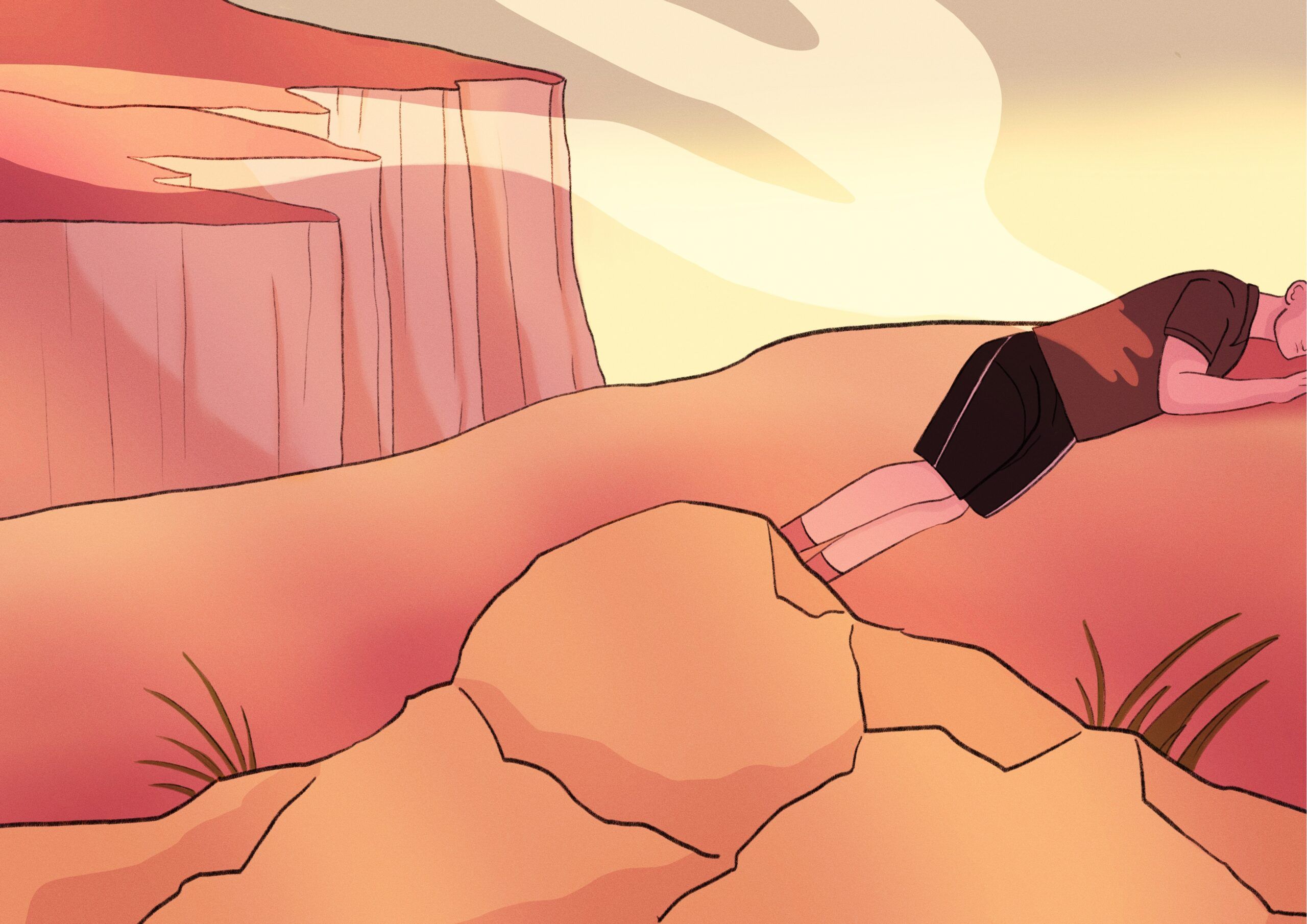
Margeaux called out for everyone to put on their life vests and board. Come on slowpoke, one of the Pickleball players said, handing Tom his vest. He rode at the front of the raft and absorbed big splashes through the rapids, the cold water a welcome connection. The world moved past, motion all around him. He watched canyon walls and sky coruscate off the water. Ripples shattered the scenery into hundreds of individual images that danced on the surface, then dove under and moved like a school of fish.
They reached camp and undertook the now-routine process of unloading the rafts. After that necessary chore, Tom grabbed his bags and went to set up for the evening. He found a place on a small rise where he could look on the river; its familiar noise rose up to him.
His spot was away from the main camp and its neighborhoods of friends and family. He had finished with his tent and was wondering whether to add the rain fly when Margeaux came to see him.
Just wanted to check in, Tom, ask how you’re doing.
I’m doing good.
Happy to hear that. No chance of rain tonight, if you don’t want to bother with the fly.
Great. I’ll leave it off, then.
So, have you remembered anything about what happened to you in the canyon?
Something happened, Margeaux, but what it was, I honestly can’t say.
You aren’t the first, if that helps.
The first?
To experience something there. Black Tail has some magic. Several of my guide friends have stories that, well, that most people find hard to believe. Maybe you’d understand, though.
Maybe. Maybe someday I’ll have a story, too, Margeaux.
I expect you will, Tom. Dinner’s about ready. Come on back down when you are.
At dinner and through the evening Tom didn’t even try to formulate a thought that might contribute to the word eddy swirling around them all. He sat in quiet, half his attention on the circle of people, half on the encroaching night. He helped with clean up, then said goodnight and went to his tent. He got his toothbrush and went down to the river to brush and spit and take one last pee.
They’d camped next to a small rapid. The powerful river spoke loudly, ancient and certain. Tom knew its water once was continuous with all the oceans and seas and the endless rivers that fed them; now it dried up in the desert before it could join. Standing at the shoreline he’d occasionally hear a muffled clonk from a rock that moved along the river bottom. Maybe it was a rock. Maybe it was someone’s misstep along a timeworn path.
He returned to his tent, fell asleep quickly, and slumbered easily. Sometime during the night he awoke. Above, through the mesh of the tent ceiling, he could see the starry multitude that arose every night. But he heard nothing. The massive silence the canyon had pressed on him that afternoon surrounded him again. His hands moved to his belly, expectant.
No presence returned that night, or ever again in his life. Nor did he ever tell anyone what he’d experienced. As he lay there looking at the stars, a line from George Eliot came to mind: We should die of that roar which lives on the other side of silence.
He realized that was his story: to live and die in the roar, not sit in the reverie. And in that realization, slowly, like someone easing up the dial on a stereo, the river grew back into his awareness, reached its full volume, and continued its chortle through the night.