

The happiness consists in realizing that it is all a great, strange dream — Jack Kerouac
1
Other people’s dreams are a bore, your own included. And yet Ed Weiss thought his dream, this one dream, felt different; it rose up in him and stayed, and wouldn’t leave him the next morning. The dream had energy he’d not felt with other dreams he’d had. No, this one was different, he knew it.
“Truly, I just have a feeling this is some kind of message,” he said to Peter, a longtime friend.
“Seriously?”
Ed nodded. “And I know, I know, everyone says that. And I do believe modern psychology will agree with me.”
“About this particular dream.”
“Well, no, but about a dream in general, saying stuff.”
“Like?”
“On your past, maybe something that is about to happen in your life. Freud. Jung.”
“I can never keep them straight. I once heard something about the gestalt of dreams,” Peter offered.
Ed took a moment to let the word Gestalt float around in his head. The coffeehouse was quiet enough that he could hear himself whining.
“This idea that everything in the dream is you. Everything. So you have to concentrate where the most energy, or light, is. When you remember the dream, where is the most light?”
“The girl in a wheelchair.”
Peter leaned back in his chair, folding his arms across his chest. “Okay, tell me about her. Start from the beginning.”
This was the dream:
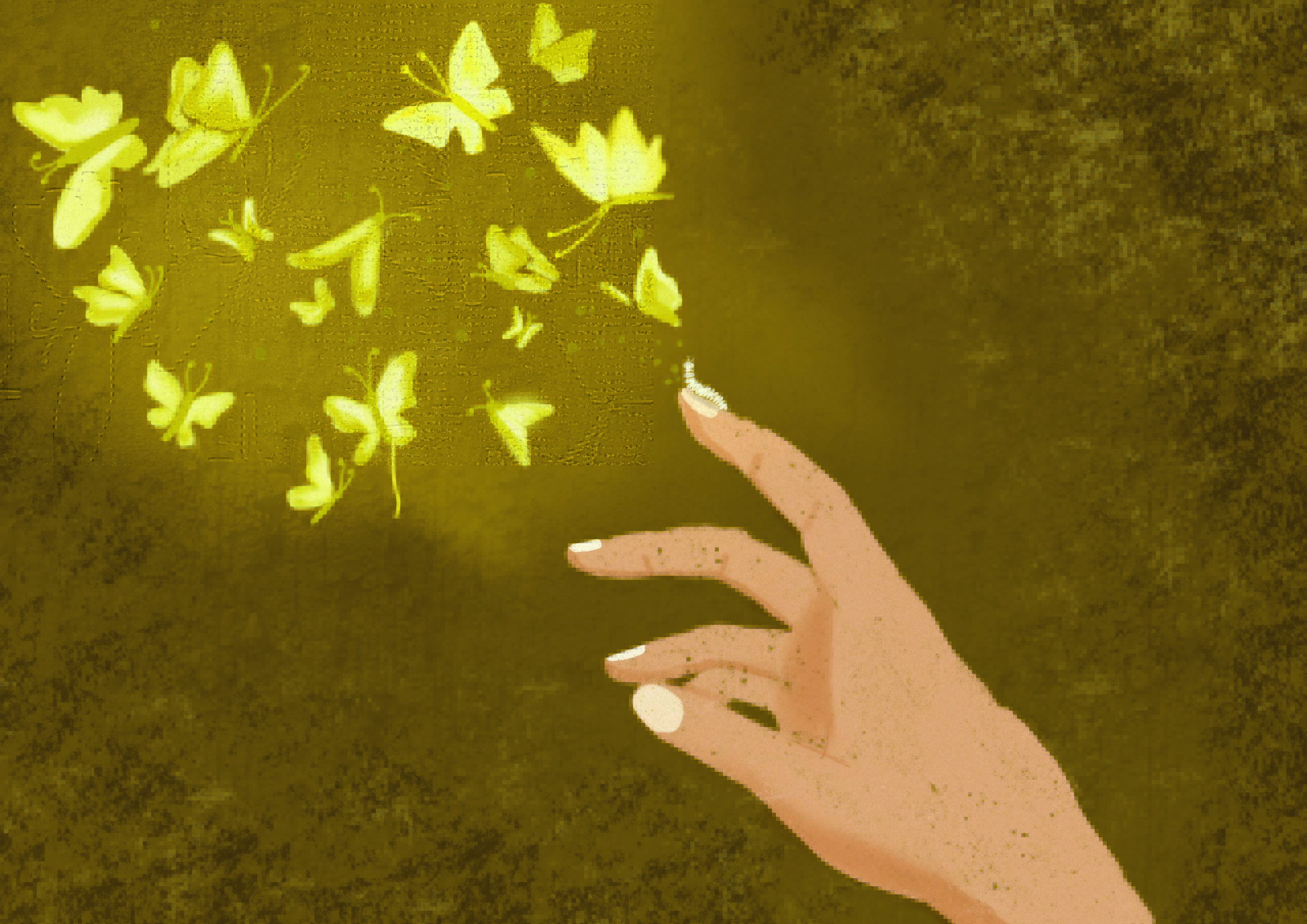
“I was in a busy shopping mall. In an abandoned store. I was lying on the floor, and beside me was a girl in a wheelchair; her legs were somehow impaired. And I was helping her out, and closeness, and an all-enveloping sense of love overcame me. Her light, her face. Warmth and love. I kissed her, and there was an incredible joy. Recognition. And then out the shop window, I could see my wife nearby getting her hair cut. I panicked. I ran away, fearing discovery, for it felt like a betrayal. I ran through the mall and out into the parking lot. After the parking lot, a field, and then to a berm, I went over the small hill and saw in the distance another structure, a building of some kind, where I could hide. I carried a stack of papers under my arm, which I dropped piece by piece as I ran. I was stopped by the police for littering, and somehow I was let go. And at the new building, an outdoor market of some kind, my wife was beside me, and we bought something to eat and chose to sit atop a nearby hill with picnic tables and Adirondack chairs. We went up there to eat, and we sat in the sun. She stretched out her arm, and along it a thin worm inched its way; she held it aloft and said something, and then, in the brilliant sunlight, the worm turned into a butterfly and flew… I was getting texts, Where are you? Where did you go? And my heart ached with such a longing.”
Peter smiled sympathetically. He said the dream was interesting, all those images, “and given what you’ve been through.”
Ed watched his friend walk away, then stood for a moment, looking at his distorted image in the shop window.
2
He was already beginning to misremember or forget parts of the dream entirely. The girl in the wheelchair was fading from his mind. That night, at his apartment, Ed sat down at his kitchen counter with a pencil and some paper. He needed to get it down before everything was gone. He drew quickly. He was not artistic in any way, and the drawing turned out quite badly. It was frustrating. He threw the drawings into the garbage. After a few more attempts, he gave up, got a beer from the fridge, and sat on his couch to watch SportsCenter. While mindlessly watching sports, he noticed a small piece of paper on his coffee table, a flyer for an art show in the neighborhood, which his neighbor had given him when they were both in the laundry room in the basement. She was just down the hall.
“Hey,” Ericka said, opening the door. “What’s up?” She was in her nursing scrubs.
Standing at the entrance to her apartment, Ed told her about his dream and how he tried to draw the girl in the wheelchair. “You’re a nurse, but also an artist, right?”
She agreed to help him and invited him in. They sat on her Futon and while he described the girl in the wheelchair, Ericka sketched. It took several sketches to get it right, matching up with what was in Ed’s memory. “That’s it,” he said, finally. “That’s her.”
Ericka placed her pencil and the drawing on the table in front of them. “How about a coffee?” she said and rose, going into the kitchen. She returned with two mugs. “Hope you take it black because I don’t have milk or sugar.”
Ed took the mug and smiled. “Great.”
He was fixated on the drawing, holding the ceramic mug in front of him like he was frozen.
“Makes sense, given…” Ericka said.
And Ed turned, “Now what?”
They decided to post it on social media and, after doing so, sat there longer than Ed would have liked, refreshing their screens, she on her laptop, Ed on his phone. But nothing.
At her apartment door, Ed said, “Thanks for helping me. It’s crazy, but…”
“We all have our thing,” Ericka said warmly, “Goodnight.” And closed her door. Ed went to his apartment, flopped on the couch, and fell asleep.
Overnight, the sketch drew increasing attention; someone fed it into an AI application to create a photo-realistic image. When Ericka showed it to Ed the next morning, he gasped. AI had nailed it. “That’s her.” The image drew comments and suggestions. “There are names — profiles. Some online, some not…” he said.
“Of course, I mean…”
He hugged her and immediately withdrew all in one fluid motion, regretting it. “I’m sorry, I got caught up…”
Ericka shrugged one shoulder. “No biggie, just don’t make it a habit.”
3
At work that day, he bothered his co-workers enough that a complaint was filed with Human Resources. Ed kept asking if anyone knew the girl in the wheelchair in the image.
“It’s creepy,” one said. Another, “This doesn’t feel healthy.” While still another said, “He needs help.”
When Human Resources came to talk to him, he was already packing up his things. Ed raised his hands like he was surrendering and said, “I’m going to take a sick day…” And he left.
On his way home, Ed inexplicably got lost. He must have traveled the route a thousand times through the city, but there was a construction zone he’d forgotten about that diverted him, and another road he’d been familiar with was far too congested. He pulled off in anger and found himself in an unfamiliar part of the city. It was unfamiliar but also reminded him of something else. He wandered for some time, down these streets, looking for anything that told him where he was or where to turn. His phone was no use, as he appeared to be driving in a coverage-dead zone. Ed pulled over. Rolled down the window and sat there until he realized he’d pulled up alongside an old and now abandoned mall.
4
The parking lot was apocalyptic: stained, with black, tarry spots, cracked, heaving concrete, and waist-high weeds. A few abandoned shopping carts were scattered about, tipped over, or sat dumbly against light poles. The doors and windows were covered in weathered black-grey board, on which warning signs were tacked. Trespassers will be prosecuted, the sign read, and Ed could see the warning had been posted every few hundred feet to make a point. Ed circled the mall’s footprint and came to the back, where a loading dock offered an unlocked entry. He shimmed the door up, held it in place with a block of wood, and crawled under the door. It was pitch-black inside, save only the dim light coming from beneath the door he’d propped up. Using the flashlight on his still coverage-dead phone, entered the dark labyrinth.
“Ed, this is stupid,” he said aloud, but continued to walk through the dark room until he came to the main mall concourse. Piss-yellow light showered the mall inside from ceiling skylights. He turned off his phone flashlight. “Hello,” he whispered, not expecting an answer, and receiving none. He walked the first floor and took the inoperable escalator to the second floor with that uneasy feeling in his legs that there was supposed to be motion, but that, of course, there was none. The escalator was dead.
Ed took several trips around the mall, first the first floor, then the second, growing more and more frustrated with every step. He was looking for the right store, the one where he encountered her, and where he saw his wife through the window getting her hair cut. When he finally did locate the store, he thought briefly that the mall was playing him for a fool and had hidden the corner on the second floor from him, only now revealing it because he was about to give up, almost as if wanting to test him to see if he truly wanted to find what he’d dreamt. The store was at the end of several, with a hallway leading to restrooms between it and the hair salon whose identity was only confirmed by Ed spying a dusty, torn poster of three individuals with supposedly new haircuts under the wording: A Cut Above. He then looked to his left, and there it was. X marks the spot, for there was indeed a gigantic “X” on the window facing the hallway. No other windows, he could recall, had a similar or anything like an “X” on it. He went inside.
It was darker inside the vacant store, with little in the way of garbage on the floor, but a thick layer of dust and grime, and if he stood just right, with the yellow light coming through the front window of the shop, and if he crouched and angled his head, he could see that on the floor someone had written in the dirt: “Find me.”
He was overcome with joy, but it did not last. From below, he heard a noise, and when he looked out the window, he could see flashlight swords crisscrossing in the air. “This is private property, and you are trespassing,” a voice boomed. Ed took out his phone, crouched, angled, and took a picture of the message on the floor. Outside the store, he glanced down to the first floor and could see two uniformed police officers running up the dead escalator. Then he ran along the second floor in the opposite direction toward the end with the loading dock. He left the building the way he came in and sprinted across the parking lot, the officers not that far behind him, calling, “Mr. Weiss. Mr. Weiss.”
5
How do they know my name?
Ed couldn’t find his car, so he ran as far away from the voices as he could, through the parking lot, over a small grassy berm, and across a cornfield to a closed farmer’s vegetable stand, which brought him up short. “This is from my dream…” he said. The stand: It was where he and his wife came after the mall, inexplicably cordial, seeking something to eat. Nothing was amiss in the dream then. They took the food to some picnic tables behind them, up a small hill, beneath some oak trees.
Ed turned and went up the hill. As he crested the hill, a person came into view there under the oak trees. It was her.
“Edward,” came the voice, and it filled his soul with such a fluted glory the likes of which he’d only felt while in the dream; he nearly fell entirely overcome. “I’m Aegis. Please come here, hurry, we haven’t much time.”
She hadn’t moved her lips. Ed went to Aegis, sitting in her wheelchair, under the oaks. They both smiled in recognition, and Ed fell to his knees, tears filling his eyes. “I knew it.”
“I know,” she said and cradled his head in her hands.
Ed looked at her and couldn’t take his eyes away. Through his wet tears, Aegis looked prismatic and fringed in shimmering diamonds. “What…” he finally said.
“You saved me,” she said, and he could see her talking now.
“How?”
She looked over at the nearby cornfield. “A… season ago. In the city, I was running, and I was desperately trying to get away from my pursuers… and the traffic, you ran out and held me in your arms. Shielding me. We were hit by a car. You went one way, and I flew into a lamppost.”
Ed believed what she said had happened, but he had no memory of it. None. “I don’t remember.”
“That’s why I sent you the dream. The pursuers were there too; they came as your wife.”
“I don’t understand.”
“I am from… another room, on another day and time. I came here to hide from captors. And they followed, and came after me. A season ago, you saved me, and from that moment… now into the farthest points of here and now, and there and then, and back, we are eternally joined, in gratitude and… love…” Aegis said, and she lifted her arm to the sun, and there she moved the air, making visions and words in the encircling mist from a butterfly tattoo on her outstretched wrist, which morphed into thin black ink and took ethereal flight exiting Aegis’ fingertip. Find me.
He was speechless in the glowing aura of Aegis, her smile, and the words and images, airy and dancing before them, slowly vanished. This must be a dream, he thought, or I’m mad, and then heard a voice from behind, authoritative and enforcing.
“Mr. Weiss.”
Ed turned. The two police officers chasing him from the mall stood there, and between them was his childhood friend, Peter.
“Peter?”
Aegis grabbed Ed’s hand. And the glory surged.
6
“I thought he was fully recovered,” Ericka said, disappointment in her voice. She was standing next to Dr. Peter Folsom in the ward’s multiple-purpose room. There, near the bank of barred windows, sat a slumped Ed Weiss in a chair beside a girl in a wheelchair they called Jane Doe. “And she’s back. Wow.”
“Ed’s relapse was disappointing; we thought it best to have him recommitted, back on his medications, and stabilized. Thanks again for that, Ericka. And Jane Doe…”
“Aegis,” said Ericka, raising her eyebrows.
“Right. Jane Doe is back, well, somehow, and we are going to double-check this, slipped out again into the night.”
“The mind is a strange thing.”
Folsom nodded. “Indeed.”
“Hey, look, isn’t that sweet?” said Ericka, pointing toward the couple. They were holding hands. Nurse Ericka turned and walked away.
Dr. Peter Folsom said to her as she left, “Reflexes,” and his pointy, blue-tinged tongue flicked out and back into his mouth like that of a reptile.