
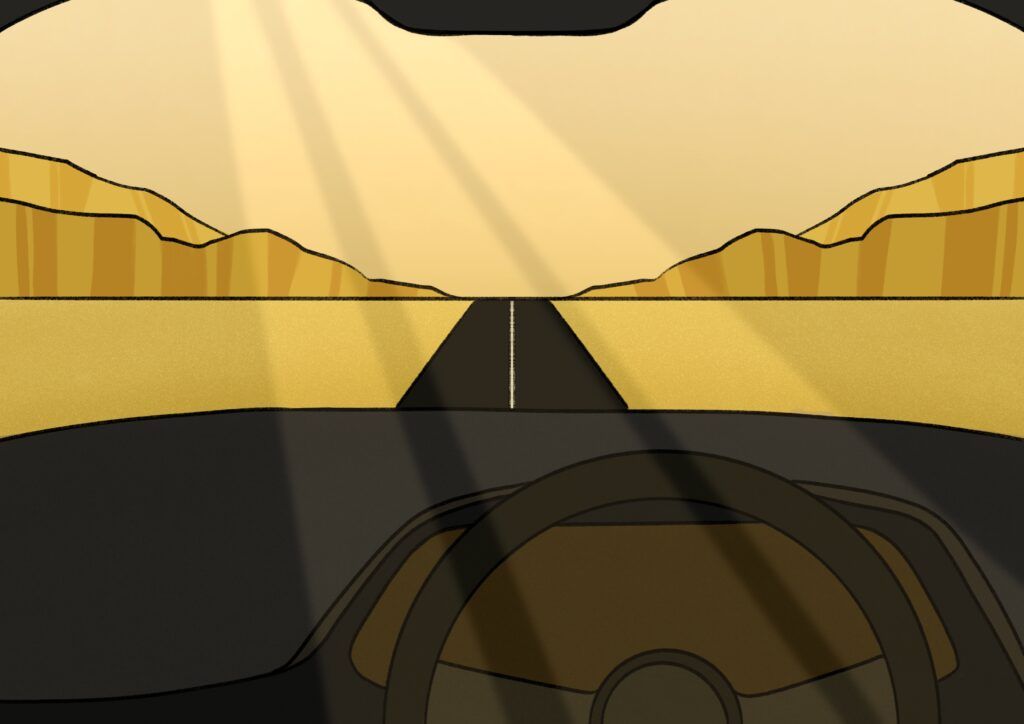
Callie zooms past Campus Avenue in Upland where she has sometimes stopped for Starbucks. Having texted the assistant director that she is on her way, she drives the studio’s boxy green Kia Soul on the 210 freeway. She usually exits Campus Avenue for Starbucks when driving east, but on this cloudy day, she spots a break in the dark clouds where sunlight sneaks through, and she pushes ahead. A column of light shines down, God-light, focusing on a section of freeway. She hopes to drive through it, but the spotlight disappears. She’s reminded of an elevator headed for a subbasement.
In Los Angeles, when she left her roommate, Lilly, who was dressing for work, Callie said, “If my mother calls you, just hang up the phone.”
“That’s not polite.”
“Fuck polite. Just say I’ll be back in six to eight weeks after the shoot.”
“You didn’t tell your mother you were going?”
“I emailed her. Earlier, I said I might get the job. She argued I was too young to travel alone.”
“Aren’t you?”
“I’m twenty-two, for God’s sake. The studio trusts me. They’re even having me deliver an Arri Alexa XT with some Atlas primes.”
“What the hell is that?” said Lilly.
“Camera and lenses.”
Shortly after that conversation, Callie took to the road with a need for freedom, ready to start her life.
With the hum of the wheels underneath her, she hopes to layer her life with what she constantly misses, her dad’s gentle support. He died last year. She glances at the console, programmed with her first hotel, to see that it’s a mere 609 miles to go, nine hours. She whoops as if she has just won the lottery.
The whole trip, two thousand one hundred miles, could have been split into four days, but Callie told the A.D. she could do it in three. She figured three days should be fine, up to twelve hours a day, roughly six hundred fifty miles each day. She just wants to get there. She has never driven so far with anyone, let alone by herself.
What she didn’t anticipate is how monotonous the landscape becomes after Palm Springs, like looking at a calloused palm for hours. The putty desert with constant concrete unrolls ceaselessly in front of her. The vacations of her youth, when her father would drive them north to Hearst Castle or Big Sur, had better views.
She stops at the George S. Patton Military Museum off Interstate 10 to pee, pausing to glance at rusting WWII tanks and trucks in the high dusty setting. Then comes Blythe, California; Quartzite, Arizona; Phoenix and the knuckled hills and scrub brush as she speeds toward Tucson.
She knows where exactly she’ll stop for gas, what time she should change her tampons, and the two Days Inn motels she’ll stay at, one in Lordsburg, New Mexico, the other, Weatherford, Texas. She’ll take the expensive digital movie camera and lenses in with her at night, even if they can’t be seen in the back of the Soul’s hatchback. She’ll buy sandwiches at gas stations so that she can eat while she drives. She’ll also stop to stretch, take bathroom breaks, and grab coffee.
She listens to Jeff Buckley’s version of “Hallelujah,” so fucking perfect, then to her father’s favorite song, “Baba O’Reilly,” by the Who. After a while, the music from her playlist loses its impact, so she pauses it and listens to the tires hum on the road.
When Callie packed and was looking for an extension cord that she might need for her time away, she came across a framed photo from her mother. It showed Callie at age four, sitting high on a bench at the back of a pickup truck, and her then-thin mother, in her early thirties, wore a green print dress full of big blossoming flowers. They both sported sun hats and smiles, free and easy.
God, her mother. After Dad had died, Callie made a deal with her mother. They would only talk on the phone once a week. They could have dinner once a month. Callie now notices her mother has left five messages on her silenced phone over the past day. She calls her. She will do her best to remain cordial. The woman, after all, is still her mother.
“Hello, Mom. Sorry, I’ve been under a time crunch.”
“I find out from your roommate you’re driving to Alabama?” Her voice booms through the Soul’s speakers thanks to Apple CarPlay. “You couldn’t tell me?”
“I sent you an email.”
“You know I don’t look,” her mother says. “This is why I need you here.”
“Well, I’ll be in Alabama for two months.”
“For Jesus’s sake. What’s wrong with you?”
Callie sighs quietly. She pictures her mother smoking a cigarette in her usual blue house dress. Patiently, Callie says, “We’ve gone over this many times. My whole life, you’ve tried to control me.”
“This is you blaming me for your father, isn’t it?”
“You’re a narcissist, Mom. I have a book on it. I have to breathe. I need space. Be patient. We may find something eventually.”
“I’ve given you space your whole life.”
Callie has learned to let her mother feel like she’s won. Callie says nothing.
“What do you hope to accomplish?” says her mother. “You’re running from me, is that it? Then what?”
“This will give me a chance to improve my resume and see how normal people live.”
“Normal? A trailer park isn’t any more normal than a homeless encampment in Echo Park. Just buy a tent and live on the street a week. That would be easier.”
Callie stays silent.
“Life is harsh. People are bad,” her mother adds. “You don’t see that. And now you’re going to live like a slut in a trailer park.” Her mother often goes to the extreme for effect. Callie decides to do the same.
“Yes, I’ll have a sign out front, ‘Free fucks.’”
“Enough!” shouts her mother.
“You see how it feels?”
Callie apologizes soon enough. After all, her mother had found Callie her first job at the studio. Her mother, an administrative assistant to a big producer of a hit cartoon series, knew the right people to ask. Callie, however, wanted more than grabbing coffees and reading scripts. She pushed for this production job.
They each say goodbye.
* * *
Getting up at dawn, Callie dresses and eats the buffet breakfast, going for the hard-boiled eggs and yogurt. She savors the texture of each, then texts the A.D. that she made it to Lordsburg and will be on the road soon. She sees he wrote the day before: “Drive safely.”
She plunges into Texas, and the state just does not stop. Most of it drones on relentlessly flat and dry; no wonder people carried rifles in their pickups. You just fucking want to shoot something or someone. However, at one point, Spotify plays an incredible piano piece—at least it starts out that way until bongos come in, then an acoustic guitar, and a male singer says, “Billy … he’s down by the railroad tracks, sitting low in the back seat of his Cadillac.” A character named Diamond Jackie comes in with the sound of violins and a saxophone. What the hell was this song? Hook it to the night train?
In the distance in front of Callie, in a roiling sky and just as rain starts, lightning flashes above what looks to be an approaching mesa. The music and the scene, it is just so perfect, even the line, “Listen to your junk man.”
She looks at her console and sees the song is “New York City Serenade” by Bruce Springsteen. How has she never heard this before? Moments like this are rare. Her mother probably never felt anything like this. Poor Mom.
On the third day, she takes longer at the buffet breakfast than the day before because she’s not eager for such long stretches of nothingness. She’s still in endless Texas. Mid-afternoon and bone weary from the constant traveling, she crosses the Mississippi River where at last there is green and trees, and she sees a sign for an historical landmark. She doesn’t stop at these things usually. She should. She needs a break.
She pulls off at the next exit, and, following another sign, glides into a parking lot. In front of her is a big grassy field, nothing else. How is this historical? On the far side of a lawn so green, it could be a cemetery waiting, and there appears some sort of mausoleum. Because it has a marble dome, maybe it’s a mini-planetarium. A figure walks from there, and as he gets closer, she sees it’s an older man with a red Make America Great Again baseball cap and cane. She gets out of her car. As he gets closer, she steps toward him and says, “Excuse me. What’s historical here?”
The man looks at her as if she’s from Mars, and all he says, in a deep Southern accent, is “Are you shuckin’ me?” He looks disgusted and marches off into the parking lot.
She decides to walk to the marble thing in the distance, and halfway there, she sees canons, a few statues, an obelisk, and a plaque explaining this was where a battle took place that marked the turning point to ending the Civil War.
She returns to her Kia, drives a little, and finds the Vicksburg Military National Park Visitors Center, a small pavilion with black-and-white photos on display showing how muddy and brutal the battle had been. She watches a short movie documenting it. General Grant took on what everyone thought was impossible to do: overcome the Confederates who had the high ground, canons, fortifications, and thousands of troops. Vicksburg, on this bluff above the river, controlled the traffic on the Mississippi and supplied and fed the Confederates. Take this place, Grant knew, and the Confederates would be choked off from its supply line.
Why hadn’t she heard of this place, this history? Her high school history classes missed it. Fellow Americans with rifles had charged at each other, shooting, each side losing one to three thousand soldiers a day. They would fight hand-to-hand. Blood flowed. It was brutal. General Grant surrounded Vicksburg and hammered the city with cannons from the east and from the river in the west and cut food supplies to the city. People suffered, and Confederate General Pemberton surrendered July 4, 1863. The day placed fresh meaning to what a union was. Now there is no one but Callie.
As Callie trudges back toward her car, already having burned up more than two hours of her travel time, her stomach falls. She realizes that the number of things that she does not know makes her a ghost in the present like those in the past. If she were to die at that moment, she would be simply a puff of dust in the wind—much like a young soldier here in the summer of 1863. She is meaningless. Maybe her mother was right. She really is a zero with a face.
She texts the A.D. that she’ll arrive after five. He says he’ll leave a key under her trailer’s front door mat. Her production assistant roommates won’t arrive for two days.
Later that same day, she crosses into Alabama and follows the signs for Birmingham and stops for dinner. She wants to eat quickly as it’s getting near sundown.
After that, she approaches Bessemer, where the trailer park for the movie will be. The movie, Red Clay Express, is a romcom/thriller about a young woman, Wendy Ward, who lives in a trailer park, works at a café specializing in fried chicken, and meets a Birmingham Coca Cola bottling executive when she accidentally spills gravy on him. They stumble on each other again at a bookstore where she learns he’s a widower. He sweeps her off her feet. Callie’s boss, the A.D., describes it as Rebecca meets Pretty Woman. Callie has not seen either film—more things she does not know.
However, the moment she sees the signs for the park, Eastwind Estates, she turns into the neat asphalt driveway in the dark. Callie realizes that as much as she planned for this trip, she hadn’t planned on arriving so late. The car’s clock shows it’s after ten p.m. Where’s her trailer? She feels as if she’s stepped into a real-life movie, like a scene she’s seen a hundred times. In her car, she smokes a joint to unwind. Everything feels so strange. Maybe she’s in a screenplay. Fade from black to:
EXT. EASTWIND ESTATES – NIGHT
CALLIE HARRIS, 22, drives up the dark drive and sees a sign for the office. She parks, the only car in the parking lot.
She steps from her green boxy Kia Soul toward the front door of the office in a small white building, a rectangle of aluminum siding. The small structure is dark.
A SMALL SIGN says, “Community Room” and below that, “Manager, Room 1.” A more temporary paper sign below that says, “Film Production Office, Room 2.”
CALLIE tries the door. Locked. Callie looks at her iPhone and the last message from the A.D.
THE PHONE’S SCREEN reads “Your trailer is number 110. Key under the front door mat.”
CALLIE walks up the drive, looking in the dim light at the signs at an intersection. Units 100 to 120 are to the left. She walks that way.
A dark figure, a HUSKY MAN, emerges from the side of a trailer with one outdoor light. With a thick beard and a drunken gait, he spots Callie and stops.
MAN
Hey, darlin’. What’s your name?
CALLIE
I’m busy.
MAN
Just tryin’ to make conversation.
CALLIE hurries on without replying. She glances back.
THE HUSKY MAN grins in exaggeration.
CALLIE walks faster, worry on her face.
FROM THE SHADOWS, in the smallest slash of light, the man rushes at her and grabs her.
As she screams, he covers her mouth with his big hand.
MAN
We all need affection, girlie.
With his other hand, he grabs one of her breasts. She struggles, tries to wrestle her way out, but he just laughs.
She bites his fingers. He shouts in pain, then grabs her with both hands and shakes her like a rag doll.
CALLIE
Mom! Mom!
ANOTHER MAN (o.s.)
(shouts)
Hey!
ANOTHER MAN, hard to see, rushes in, grabs the attacker from behind, and throws him on the ground.
CALLIE scuttles into the dark. She rushes to her car and locks the door.
INSIDE THE DARK CAR
Callie holds herself and sways.
CALLIE
(crying)
Mother…
* * *
It’s morning in the trailer park. Evie Duben-Jones, early thirties, director of photography, walks toward the park’s office in a small white building. She is proud of herself for suggesting the park’s abandoned minimart and laundry center be turned into a mini-studio for shooting the inside of the heroine’s trailer. It’ll make shooting faster and coherent. Her director, the internationally renowned Jewel O’Neil, a fellow Australian, fell in love with this Southern story as a metaphor for the struggles of love, especially when one person is an outsider.
While the park has mostly modern double-wides, one small section of the park has older, single-wide trailers, the kind with cheap skirting around them. That’s the look they’re going for. The fact that the trees are so tall and mature makes the place nicer than she expected. Maybe they can be digitized out.
Outside the park’s office, Evie spots a new girl waiting, probably the new production assistant. The girl wears white shorts and a black T-shirt showing a young male guitarist and the words “Frampton Comes Alive!” The girl simply stares at the boxes she’s delivering. One box holds an Arriflex camera, the other, a set of Atlas prime lenses that Evie wanted for the second unit created in the last week. She hired a cameraman she loves working with to head up the second unit. He will shoot stock footage of Birmingham life that the director wants to intercut with—the university, the bottling plant, and downtown scenes. The girl looks sad.
“Are you okay, honey?”
“Fine,” the girl says.
“Okay,” says Evie. “How was the drive from Los Angeles?”
“This country’s bigger than I thought.”
Evie unlocks the doors to the office, and they walk in. “There’re a couple truck drivers in this park who spend five or six days a week driving across the country. There are a lot of dull jobs on this earth.”
At that moment, a man in a blue short-sleeve shirt enters the building, and when Evie sees him, she smiles. He’ll be second unit. She’s glad to be working with this cameraman again. He’s sharp. “Kevin, the camera and lenses just came in with, um—” She looks at the girl.
“Callie,” says Callie.
“Yes, Callie,” says Evie.
“Did you hear there was almost a rape here last night?” blurts Kevin.
“Here?” says Evie.
“Yes,” says Callie. “In the one-hundreds section. Someone jumped me.”
“No!” says Evie. “You? Is that why… how’d you get away?”
“A man heard me scream, I guess. He jumped on my attacker, but I just ran. I don’t know who helped.”
“Oh, God,” gasps Evie. “That’s not the way you want to start a new job.”
“I don’t know if I can do this. I shouldn’t have come.”
“I’m so sorry this happened.” Without even thinking about it, Evie hugs the girl. She feels Callie, less than a decade younger than herself, hug her back. It reminds Evie about having a child. She and her husband want to start. Maybe tonight. He’s here for one more night. She’d like to be a mother.
“The manager said the man called the police,” says Kevin. “The attacker had been trouble earlier. Have you met the manager, Mrs. Wellstone?” he says to Callie.
They all look at the manager’s door, which has a window, but it’s closed and dark.
“She’s dealing with the director and production manager right now, at breakfast,” says Kevin.
“I better talk to the assistant director,” says Callie.
“Listen,” says Evie. “I’ll talk with Doug, the A.D., and request that you work for us. We get a P.A., which is what you are, so I’ll ask for you.”
“What would I do?”
“You’ll hold the cable behind the second-unit camera as I move,” says Kevin. “As you probably know, we don’t use film anymore. Everything’s digital.”
“I can use you, too,” Evie says and smiles. “There’s lots to do. You’ll get us what we need. You’ll often have to deal with the extras, keeping them away from us, aware of how to help them. You’ll probably work with the art director, too, when we need it. Each day, each hour, will be different. We start shooting in two days.”
“And we’ll get you your walkie talkie,” says Kevin.
Callie looks at them both and nods.
“Don’t worry,” says Kevin. “We’ll keep you safe.”
“Absolutely,” says Evie, who pauses to look at Kevin the way her father sometimes looked at her mother after a great meal. Callie will learn that film sets can feel like family.
* * *
Outside, Callie ponders the D.P.’s accent. Evie wasn’t Southern. Australian? How unusual to have a female director as well as a cinematographer. Callie nods that it’s good to stay on.
The sky is gray. A slight breeze flows across the park and through the mature trees, bringing with it a rustling sound and the smell of bacon. Someone’s cooking.
She walks on the soft grassy patch next to the office building, and she brushes at a reddish mark on her white Bermuda shorts. She notices on the ground a bare spot where there isn’t grass but red dirt. Ah—Red Clay Express. She would soon learn that clay sewage pipes are made from this red clay. She shouldn’t have worn white, bad idea. However, she loves the deep pockets.
She had parked the car at her trailer, #110, and will soon turn in the car to the A.D., Doug. He will give it to the transportation department. Her Soul will travel back-and-forth between Eastwind Estates and the hotel where most of the crew will stay. She and the other two P.A.’s are supposed to live in the park and be some of the first on set each morning. Doug explained this to her before she left Los Angeles. He said she will get her Soul back when they shoot elsewhere in the city.
Callie notices the exact trailer where the man accosted her last night, and her breathing stops. She remembers his rough hands, his beer-infused breath, and his deep voice calling her “darlin’.” Her emotions say to flee. Maybe she needs to rethink this place. Should she take Evie’s offer? She came here for a reason, after all. It wasn’t about her mother but about starting an interesting career.
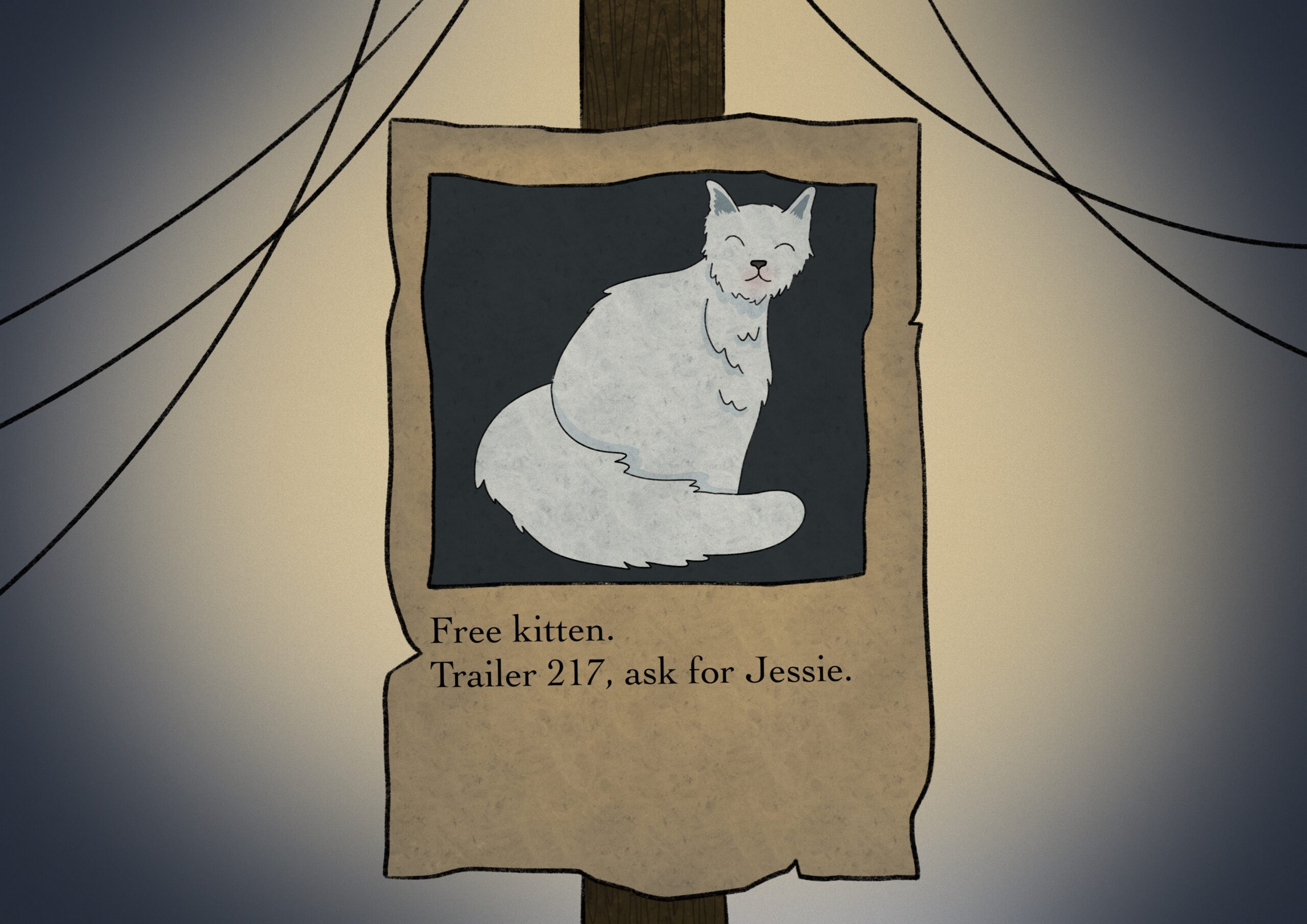
She steps forward and notices a paper stapled to a telephone pole with a picture of a long-haired kitten in color, and the words, “Free Kitten. Trailer 217. Ask for Jessie.” A cat would be nice. Maybe she will stay.
What Callie doesn’t know is that she will meet Roger, the man who saved her last night and learn he works building cars at Mercedes in nearby Vance, Alabama. She will date him before the shoot is almost over and before she has to move back to L.A. Roger is a good guy, strong like a football player, and loves holding hands. He will love her kitten, too. She will ask him to move to Los Angeles with her.
The sounds of kids laughing has Callie turn. A boy and girl, arms linked, spin each other. She probably would have never noticed this in Los Angeles. Maybe she’s getting in tune with the universe. She walks on.
A young woman walks a brown wiry-haired mutt on a leash, and the dog sees Callie and strains to get near her. Callie says, “Beautiful dog,” though it wasn’t, and the young woman in jeans says, “Thanks. You all workin’ on the movie?”
“Yes,” says Callie.
“Lucky you,” the woman in jeans says.
Callie feels dizzy at that second yet smiles.
A crack in the clouds opens above, the sun bursts through, and this time Callie feels the light. It’s as if she’s flying, enveloped by the arms of her mother.