
Light poured down from the back of the Flannery Auditorium like the benevolence of some minor God. Halfway to the stage it began running out of steam, was wheezing and staggering as it cleared the mezzanine, and by the end of its journey had collapsed in the vicinity of the apron, where it lay convalescing.
Its weakness could not be blamed upon a thicket of heads through which it was forced to navigate. Aside from the directorial staff seated in front and those hopefuls backstage waiting to audition, fewer than a dozen people were in attendance. They were spread out in ones and twos, nattering away or staring dully at their phones, pausing only when the friend or loved one they had sacrificed their Saturday afternoon to support made his or her way onto the stage to beg the favor of Thespis.
“Is that your boyfriend?” said Helen.
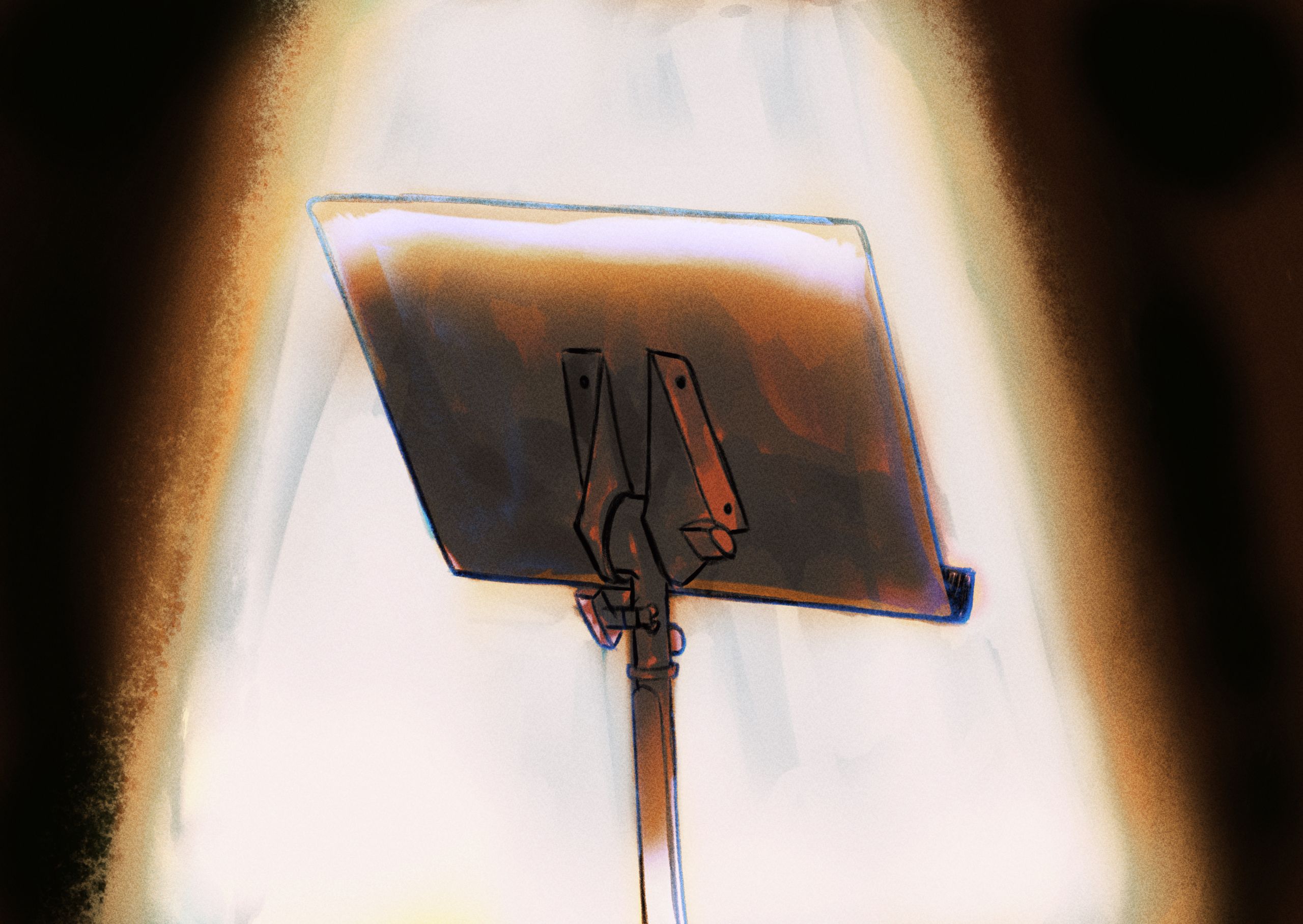
Jane looked. “That’s a stand for sheet music, mom.”
There were actual humans on stage as well, though none of them were Callum. A man in a varsity jacket emblazoned with the letter ‘R’ walked arm-in-arm with a woman in a cardigan and poodle skirt, a vision so out of date it would have been quaint forty years earlier – which, from the looks of things, was about how long it had been since the two auditioners had attended high school themselves.
When the pair reached center stage, the man pointed to an empty spot about ten feet away. “Look, a crowd,” he said.
“Must be some sort of accident,” said the woman. The pair drifted closer. “Look at that school bus propped up on the curb.”
“Someone’s been struck,” said the man. “Look there, on the ground.” They both looked. The man twisted his mouth. “They’re a menace, these damn school buses. They take too long to come to a stop.”
“Thank heavens we’re not underclassmen anymore so we can drive ourselves to school,” said the woman. She pointed offstage. “Oh good, here comes the ambulance!”
“You know there are forty-three thousand automobile deaths in the US every year?” said the man. “And hundreds of thousands more are injured.”
“Do you think he’ll make it?” She jerked her head toward the wreck.
“I don’t know, baby,” said the man. “I just don’t know.”
“Is this a play about vehicle safety?” whispered Helen.
“I don’t think so,” said Jane.
“You should see the way people drive through our neighborhood,” said Helen. “The sign says twenty-five, but you see these young kids driving these…I don’t know what you call them…trucks? SUVs? They look like tanks, they’re so big, and here are these itty-bitty kids can barely see over the dashboards flying along like nobody’s business – paying no attention, mind you, with their noses down like this, playing their jewels or fruits or whatever that game is that everyone’s always doing on their phones – and here we are in a neighborhood where children play, which is the only reason the town finally stopped ignoring our petitions and installed those speed bumps, only they aren’t the normal bumps that give you a jolt when you go over them but the big, flat ones, so the kids, I swear to you, treat them like ramps and drive faster if anything…”
Jane nodded along. She paid as little attention to the auditions as to her mother’s story, absorbed by another drama playing out inside her head as she imagined the various ways the evening might progress. All but the most delusional scenarios ended in heartbreak. But she would be prepared, and there would be delicious food and hopefully a new part for Callum to help take the sting out of things. All would be fine in the long run.
“…end up pinned against the curb with their intestines hanging out, just like that,” said Helen, pointing at the empty stage.
“That’s terrible,” said Jane.
The casting director shouted for the next pair to be sent out. A moment later, Callum emerged from the wings in the company of a young woman. He skulked into view wearing a shabby peacoat with the collar turned up, his hands buried in his pockets and his shoulders scrunched as if he were walking headlong into a December wind. His wrinkled trousers and matted hair gave him the look of a man who had hopped straight out of bed to come onstage.
“Is that him?” said Helen.
“That’s him.”
“Oh, he’s as plain as you described him!”
Callum drifted to the front of the stage. When he came within range of the footlights, much brighter than the overheads, strange shadows played across his face and gave him a vampiric appearance. He bowed. “Callum Foote, auditioning for the part of Alton,” he said.
“We know,” said the casting director. “We’ve got the list right here.”
Now the young lady tiptoed forward, her finger raised. She was rather attractive, Jane noticed, and wore a dress short and tight enough that no one else could help noticing either. “Howdy!” she said. Even beneath the dim lighting her blond hair sparkled like it had been dipped in gold dust. “I’m sorry, is that the same list y’all posted backstage? Is my name spelled with an i or a y?”
“Katy Emerich?” said the director. “K-a-t-y?”
“I thought so.” She put her hands on her hips and gave him a look, as if he were a child she’d caught sneaking a cookie before dinner.
“Is that wrong?” said the director.
“It should be with an i.”
“K-a-t-i-e?”
“Just K-a-t-i.”
“Are you sure?”
“I think I know my own name!”
The director grimaced and made the revision.
“She’s very pretty,” said Helen.
Jane shrugged and let her gaze wander the auditorium. The Flannery had a shabby grandeur, like a high-society debutante who had slipped into dotage in her later years. Untold layers of dust, nicotine, and grime had given the walls a sepia tone, as if through neglect management were attempting to create a sense of nostalgia their productions could not possibly achieve. Above the proscenium stretched a mural featuring mythological and religious figures in various states of heightened feeling. There was Dionysus with his head thrown back, imbibing from a silver goblet as robed nymphs cavorted at his feet. Nearby, a naked Mercury swept down from the heavens, caduceus in hand, sending a herd of Roman peasants scattering for cover. The scene became somewhat grimmer as one panned to the right, where a flock of cherubim had gathered to weep over the body of Saint Edmund the Martyr, whose torso resembled a pin cushion after Viking archers had used it for target practice. The overarching theme seemed to be that one never knew what one was going to get out of life, an apt moral for a venue that had once hosted both the Royal Shakespeare Company and the Buckwheat County Community Players’ musical rendition of The Karate Kid.
A gasp issued from onstage. While Jane had been distracted, Callum and Kati-with-an-i had gotten into position and were beginning their scene. Callum lay sprawled on the floor, apparently in some sort of distress. Kati ran over and took him by the arm.
“You’re all bruised!” she said. “What brutes football players are!”
“Don’t be so hard on them,” said Callum. He staggered to his feet and shook his head like one of the Beatles to demonstrate he was getting his bearings. “Modern life provides few opportunities for transcendence of the conscious mind.”
“I suppose,” said Kati. “Sports are so rough, though.”
“So they are, the precipitations of a most finely dispersed general hostility. Yet they do foster a communal spirit.”
“My name’s Bonny.”
Callum kissed her hand. “Alton.”
Helen leaned over. “I thought you said this play was set in a high school.”
Jane opened the mock program she had grabbed in the lobby and read from the inside cover. “Mr. Fixer-Upper, a romantic-comedy adaptation of the classic Robert Musil novel, The Man Without Qualities, set in a modern-day high school.”
“The dialogue’s a bit elevated.”
“Maybe they have a strong English program.”
“Ah…” Helen retreated to her seat to consider this. A moment later, she added, “Callum seems like a nice boy.”
“Yes,” said Jane, and unfortunately, she meant it. A part of her wished he was more like the guys she normally got mixed up with – aggressive, vain, self-centered. Instead, he was nice. Too nice. There was something childlike in the way he doted on her, holding doors and pulling out chairs with a golden retriever’s stumbling eagerness. It wore her down. Every gesture was laced with desperation, as if she were a rare butterfly that had alighted on his finger that he was terrified of frightening off. She could never love Callum, yet felt an aversion to causing him pain, just as one recoils at the thought of clubbing a baby seal.
The scene ended. Another began. A pair of women playing high school students who looked as though they had time-traveled from two separate decades were making preparations for something called the Centennial Prom Planning Committee.
“Did you remember to place the chair for Principal Leinsdorf?” said the woman in the gingham peasant dress. “The chair with the armrests, like he likes? And the silver bell for me?”
“Chair’s ready,” said the other woman, who wore a spandex miniskirt, t-shirt, and stonewash denim jacket. “I can’t seem to find the bell, though.”
“Look harder, Rachael.”
“Gosh, Dotty, lighten up. What’s the big deal about a bell?”
“I keep forgetting you’re only a freshman. It isn’t enough to regard everything done or undone as one’s personal concern, but to consider its general import.”
Jane stifled a yawn and wondered how much more of this she would have to endure. Mercifully, it was not long before Callum materialized in the aisle beside her.
“The man of the hour!” Helen beamed. “Look at him – he’s adorable! Like a little elf!”
Callum blushed. “You must be Helen. It’s so good to meet you.”
“You were great up there,” said Jane.
“Splendid,” said Helen. “A first-rate job! I really believed that you had been beaten by hoodlums!”
“The Director asked me to stick around to run through another scene,” said Callum. “That must be a good sign, right?”
“Of course,” said Jane.
“The part’s as good as yours,” said Helen.
“Anyway, that’s why I came up here,” said Callum, “to say hello and let you know that it’s going to be a while yet before I’m finished.”
“Take all the time you need,” said Jane.
“I’m sorry I don’t have more time to chat,” he said to Helen. “You’ll be joining us later for dinner, won’t you?”
Before her mother could speak, Jane said, “Actually, I booked us a table for two tonight. La Maison Rouge?”
“Oh, that’s too bad,” said Callum. “Maybe they could make an exception, pull over another chair?”
Jane grimaced. “They frown on that sort of thing, I’m afraid.” She glanced over her shoulder and gave her mother a pointed look.
“Please,” said Helen, “don’t change your plans for me. I can’t make it tonight anyway, I…have a Scrabble game.”
“Scrabble?” said Callum.
“Yes, I’m mad about it,” said Helen. “All my friends are.”
“Well, no harm done then, I suppose.” He smiled broadly. “All right, I’m off. I need to go over these new lines before they call my name again. It was so good to meet you, Helen.”
“Likewise.”
“Hopefully we can have a proper conversation soon.” He turned to Jane. “Wish me luck!”
“Luck,” she said, giving him a peck on the lips.
“Break a leg!” said Helen.
Callum grinned and scampered off down the stairs. The women watched as he faded into the gloom at the front of the house.
“I hope my fib sounded convincing?” said Helen.
“It was so bad it was good,” said Jane. “I almost believed it myself.”
“I was looking forward to getting to know Callum better. He seems a perfect gentleman.”
“Some other time, mom. You wouldn’t have felt comfortable glomming onto the side of our table, anyway. It’s gauche.”
“And in a French restaurant.” Helen covered her mouth. “How mortifying! Yes dear, you’re absolutely right. Thank you for thinking of me. I shall simply put my disappointment to one side and remind myself that this is a romantic outing. That grandkids may come as a result makes the sacrifice easier to bear.”
“Jesus, mom! You’re hoping I get knocked up?”
Helen winced. “Must you be so vulgar about it?”
“It’s the vulgarity that leads to the grandkids, you realize?”
“There was nothing vulgar about how you were conceived. Everything was strictly by the book.” She took a Chapstick from her purse, rubbed it on her lips, then replaced it and snapped the bag shut.
Jane watched as her mother began putting on her coat. “You’re leaving?”
Helen nodded.
“Don’t you want to watch the rest of the audition?”
“It’s a bit cerebral for my tastes. Besides, it will be easier for everyone if I’m not here when it ends. You know how these polite boys like Callum are. He’ll feel obligated to invite me to dinner again. I’ll refuse, he’ll insist, and it will turn into a scene.” She threw up her hands at the thought of it. “I prefer a graceful exit.”
Jane held her mother’s hand. “Thank you for understanding.”
“I understand more than you appreciate,” said Helen. “I was a young woman once, too.” She gave Jane’s hand a squeeze, then slid past her into the aisle and departed out the back of the theater.
Jane watched her mother go before turning her attention back to the stage. A sweaty, egg-shaped man was holding forth on the importance of the Centennial Prom Planning Committee.
“What has brought us together,” he bellowed, “is the shared conviction that a great testimonial arising from the midst of the student body itself must not be left to chance but needs guidance by an influence that sees far into the future from a place of broad perspective…!”
Jane yawned openly this time. She wondered how understanding her mother would be after learning she had dumped Callum. That wouldn’t be for several weeks, if all went well. In the meantime, she would enjoy her brief reprieve from the incessant drumbeat of maternal guilt. Whether the guilt that replaced it after tonight would be any easier to bear remained to be seen.
**********
The appetizer had come and gone (a duck foie gras terrine with seasonal chutney), several glasses of Bordeaux had been downed, and the dinners (a poulet roti for him, a pithivier aux legumes for her) had been picked over as thoroughly as they were going to be that evening. Callum sat with his legs crossed, staring down at the mangled chicken carcass leaking grease onto his plate. A pain in his tailbone made him squirm. He uncrossed his legs before crossing them the other way. More than an hour into dinner, and he had yet to come to terms with the low-backed chair with slanted seat that seemed to be pitching him forward onto the floor. He had read somewhere about this trick of restaurants to make diners uncomfortable so they could increase turnover. It seemed unthinkable that a French bistro that championed its authenticity would stoop to such chicanery. What was more French than to linger over one’s meal? Not that Callum had any desire to linger. He would just as soon hurry home, so he could shut himself in his room and never come out again.
Across the table, Jane looked at him with a pained expression. “I’m sorry,” she said.
“It’s not your fault,” said Callum.
“Still,” said Jane. She looked miserable. Callum felt his heart warm. After all, he thought, what is love but feeling another’s pain as acutely as one’s own.
“There will be other parts,” he said, almost managing to sound like he meant it. Not quite. He clearly wasn’t that good of an actor.
Only a few hours ago he had been blissfully unaware of that fact, flying high on the wings of his “callback” and the presumption that his place in the cast was assured. A second scene with Kati-with-an-i. Her character, Bonny, had just discovered that Callum’s character, Alton, had a girlfriend, and was scheming to come between them so that she could be Alton’s date to the Centennial Prom. Was it the sexually charged nature of the scene that had done him in? Certainly it had been distracting, knowing that Jane was somewhere up above watching as a beautiful woman in a skintight dress squirmed against him like a bear scratching its back on the side of a tree.
But no, the director had denied him even the scant comforts of that excuse. No sooner had the scene ended than a voice called out from the front row (“Hey you!” it had said, rather than call him by name, a bad omen in retrospect) and asked him to approach. Callum came downstage and knelt beside the apron, where the director waited with arms crossed and a clipboard in hand, smiling benevolently.
“I just wanted to thank you for agreeing to stick around to help Kati with her lines,” he said.
“Of course,” said Callum. “It’s good practice for me, too.”
“That’s exactly right. You know, there aren’t a lot of actors these days with that sort of attitude. You keep plugging away and you’re going to be just fine.”
“Just tell me when and where you need me.”
The director chuckled. Callum chuckled back. Only when the chuckles had faded and the two continued staring at one another did it dawn on them that there had been a misunderstanding.
“I was just wondering when…” said Callum.
“When…?” said the director. “Oh…oh, you thought…”
“Oh…you mean…so I’m not…”
“No…oh, I see how you…”
“When you had told me that…”
“Yeah…no, I…”
“For another scene, I thought…”
“Right, no…that was…Kati needed…I figured…”
“Ah…right…”
Eventually, enough sentence fragments had passed between them to establish that Callum had been cut before his first scene had even ended. He lacked, in no particular order, believability, voice control, physicality, natural instincts, emotional range, charisma, adaptability, and “a certain je ne sais quoi”. Kati, however, had required a line reader, and if Callum had a strength it was his ability to accurately read words off a page. His fate had already been sealed, even as he stood in front of Jane and her mother gushing over his good fortune.
They sat in silence while a busboy cleared the table. A moment later their waiter reappeared and asked if they wanted dessert. Callum shrugged without bothering to look up from the table. Jane asked if they could have a few minutes with the menu.
“It’s too bad your mother couldn’t join us,” said Callum, not for the first time that evening.
“Mm,” said Jane.
The silence grew frostier. He could hardly blame her for being annoyed. He thought about trying to explain himself but decided against it, knowing his propensity for making things worse.
There had been something distracting him during that first scene, something far more difficult to compartmentalize than Kati and her dress. From the moment he had stepped on stage he could see their faces looking down at him – not Jane and Helen, nor any of the other audience members, but his parents. His father, eyes creased and jaw clenched in disgust, had clawed at his chest, as if in the throes of the heart attack he always claimed Callum’s acting would inflict upon him. His mother, fettered as she was by the bonds of maternal love, showed no signs of anger but shook in silent grief over the son she had lost to so shameful a vice.
In retrospect, only one moment from that day remained as a silver lining for him – those brief minutes between scenes when Helen had told him that she was proud of him. Perhaps she had only said it out of politeness. No matter. Politeness had never compelled his parents to sugarcoat their opinion of him. Even insincere praise, offered out of a sincere desire to make him feel good about himself, was a precious gift.
It would not be fair to suggest that Callum had a poor upbringing. His parents had been there throughout his childhood, which was more than a lot of people could say. What he had lacked was a source of unconditional love, someone who supported and championed him regardless of his mistakes. Helen was the doting mother he had always needed. His own mother loved him, in her way. But Helen seemed to like him, if their initial meeting were any indication. In felt good to be appreciated for who he was, not in spite of it.
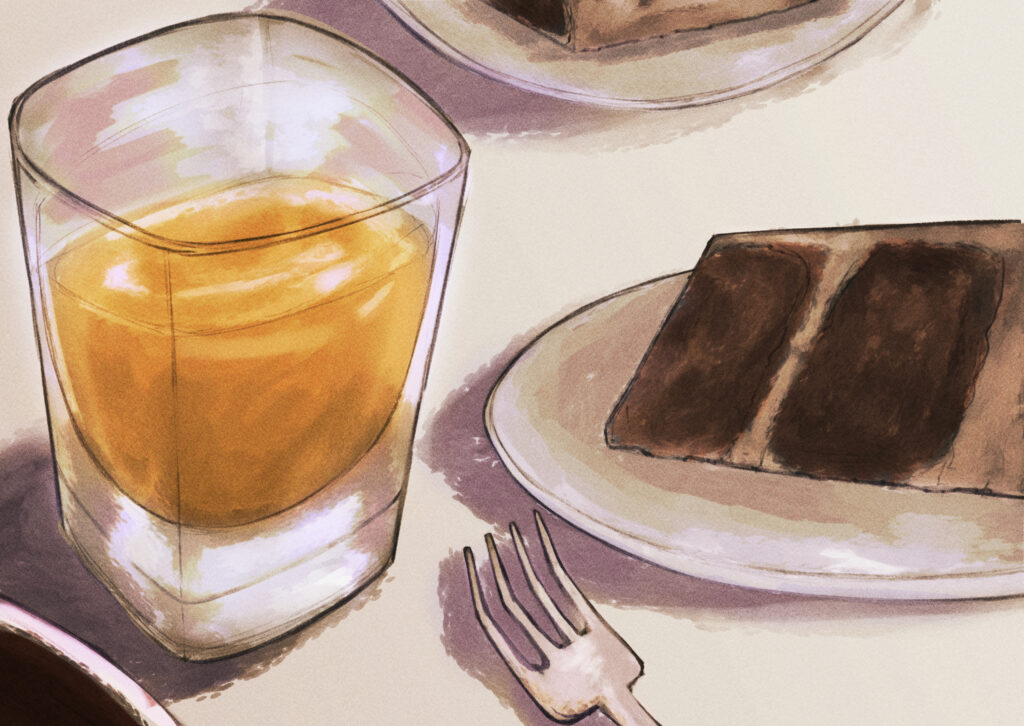
His chest swelled with validation. Across from him sat Jane, a young woman more beautiful than any he had ever dreamed of being with. Out of all the men she could have with just a snap of her fingers, she had chosen him. Did that not say something about his worth? Was he not in a better place in life than he had any right to expect? What did a part in some play matter next to these things, next to love and family? In a sudden burst of feeling he called the waiter back to the table and ordered two pieces of chocolate cake and coffees. “And two brandies,” he added, on a whim. He looked at Jane. “I want to do this right.”
Jane appeared troubled. All evening long she had been preoccupied with something. At Callum’s words, however, her mood softened. Her eyes grew rounder, and she nodded, even showing the hint of a smile. Her outward change mirrored the one that was taking place inside of him, and he wondered if this wasn’t the beginning of some new phase of his life. His twenties had been wasted on self-pity and childish pursuits. Now, at thirty, he felt as though he were in the throes of an epiphany. There would be no more fear, no more cowering on the sidelines while life paraded past him, viewed from afar but never possessed. He would live boldly, smash through the barriers that for so long had held him back and demand to be included, consequences be damned.
When the food and drinks had been delivered he lifted his glass. “Jane, I want to thank you for being there to support me today. Even though things didn’t turn out the way I had hoped, the only thing I’m capable of feeling right now is gratitude. These last few weeks have meant more to me than I could possibly put into words. You’ve made me happier than I’ve ever been, but more importantly you’ve made me a better person.”
Jane’s cheeks flushed. He knew that she was embarrassed. She always seemed uncomfortable with his compliments, something he could relate to but which nevertheless surprised him in her case. He imagined that people had been singing her praises all her life. Perhaps it was just natural modesty. Regardless, he refused to be circumspect. Whatever discomfort his public display might cause her would be worth it for her to know how profoundly she had altered his world. He had never felt so certain about something in his life. He knew what he had to do.
“Jane Simmons,” he said, getting out of his chair and going down on one knee, “will you marry me?”
She stared down at him, as impassive as a department store mannequin. He began to wonder whether she had heard what he’d said. A moment later she raised her glass to her lips and downed her brandy in a single gulp. When she looked at him again, it was with the somber expression of a veterinarian emerging from a botched surgery into a waiting room full of expectant children. “Callum,” she said, “I have something I need to tell you…”