
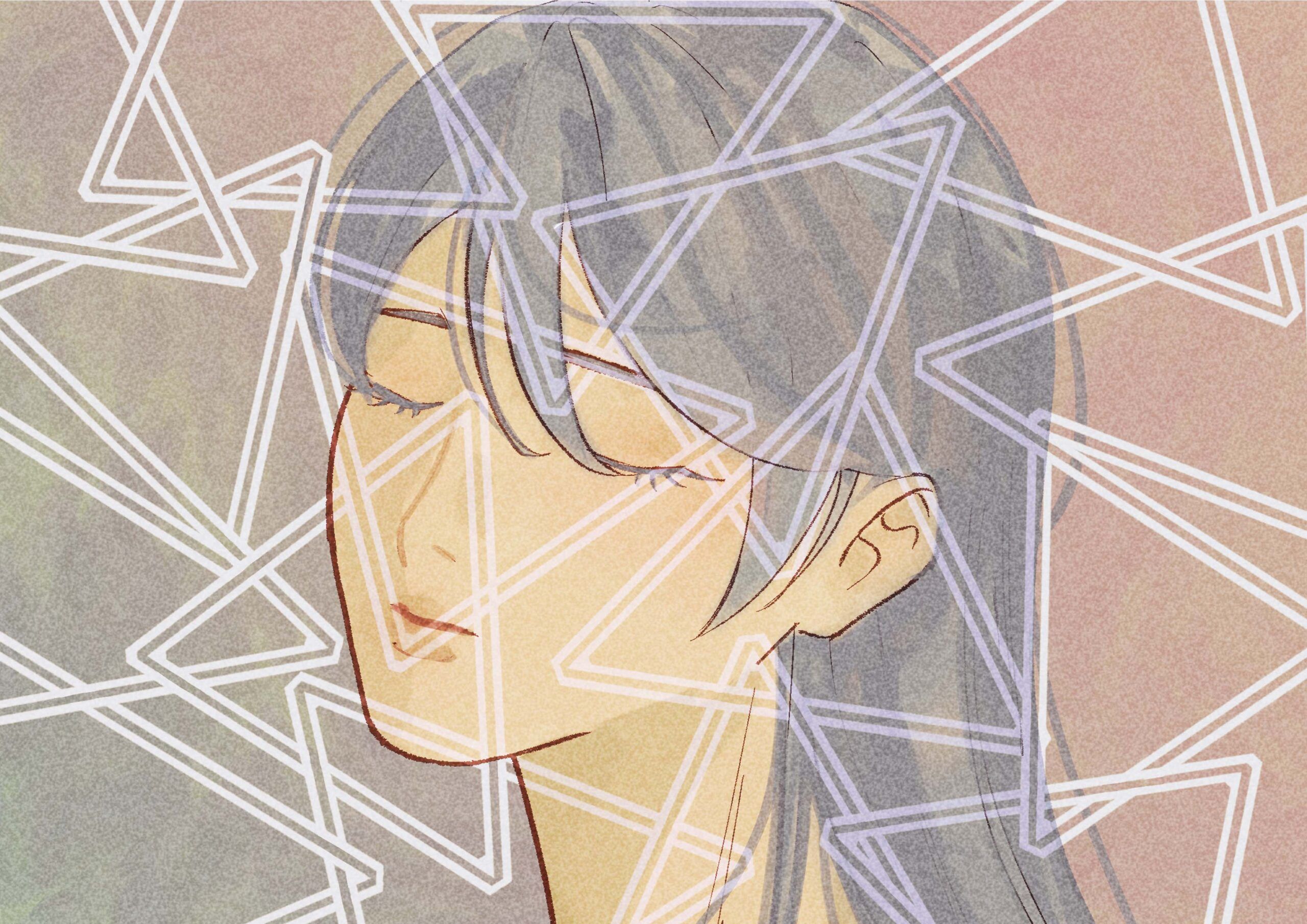
The day after I brought my three-year-old home from the hospital, I began to feel a strange sensation. I’d been traumatized. Little Riley had been traumatized, having had cranial surgery to remove a tumor. My husband, John, I’d discovered soon after my marriage to him, was a rapist, if one can refer to one’s own husband that way whenever he touched me without my permission.
I realized that a triangle has only three angles and three sides, a geometric equation adequate to catch a rat and watch him go crazy chasing his tail. Thus far, my life had been a maze of angles, straight and jagged lines since she was small. But for seven years prior to my marriage, I had suffered no mental illness.
The lines started to close in on me; however, when my terrible eagerness to please entered into a firm, unholy union with my vanity. I was consumed with the desire to impress friends whose bank accounts tripled mine and John’s. I was committed to the perpetual game of competition that marked almost all of our communications.
John said he’d learned at college that it didn’t pay to be a nice guy. Whereas he thrust himself into the demands of competition with flair and a tall beer, I fumbled. A wealth of charm could not conceal my introspective nature and crumpled-flower sensitivity. I gossiped with the same zest as everyone else, but it jolted some personal chord in me.
I wasn’t able to slash back with the sword’s razor edge, joke about it at the next cocktail party and come home still feeling punchy. If I’d been five-years-old again, I might have repeated what I said then when I felt traumatized at preschool: “Some people are angry on the outside and they know why, but some people (like me) are angry on the inside, and we don’t know why.” Or I might have said: There’s a fast bully inside out of control who hits little girls with rubber bands stretched out too far.
One evening in late January, I looked out of my bedroom window into the night sky and saw the moon covered by dense, gray clouds, but there was a silver rim circling the clouds that seemed to spin around the white moon. A distinct voice in my head said: “Something bad will happen very soon, but you will survive.”
Still, that night when I put away the Christmas balls and danced to Beyonce’s “Crazy in Love,” I wasn’t thinking about the personality’s multiple angles and sides; the mind’s mazes where the spirit can get lost and trapped in a panic chase headed nowhere but back to ground zero. I was still naïve concerning the equations of chemistry balanced on the sleek surfaces of reality cards that could, with the right amount of heat, blow the mind and make the body burn from the inside out.
But that January day it all came together and fell apart, rippling down my spine like a giant bolt of electricity. I dreamed of witches flying over the world; my uncontrollable, crumbling world. Burning witches. A woman in black ready to fly out and shatter the glass of store windows, dressed for Halloween.
I phoned my gynecologist after hours to tell someone at the other end that I felt I must black out, at least temporarily, or die. The pain pressed intense circle impressions around my throat, and Riley was crying for a bottle upstairs. The doctor who answered said that he refused to be used by neurotic patients calling at all hours, and there was nothing he could do to help.
In a flash, the world had changed radically from a place where I was, at least temporarily, able to look out from the safely circumferenced region of inner self to the people, events and ideas outside, to a world where I was caught deep within the inner self and the boundaries were as blurry as winter’s day in Vermont.
I tried to throw up, thinking for a moment that the dread was something tangible that had invaded my body and, like black bile, I could purge myself of it. After a while, I feared that I couldn’t sense where the world ended, and where I began.
The real me was lost and terror-filled, like that small child I once was, at the playground where my mother had dropped me every day. I wasn’t sure where I ended, and the other children began. I had a strange, sickening sense that there had once been two or three other dimensions to my personality, like separate angels who held hands and provided homeostasis. The panic had torn one of the angels away and the others were holding on to sanity by a line as thin as dental floss.
I could no longer connect with John, with my mother, or even with little Riley. I couldn’t even connect with God. I was out on a line somewhere in the vastness of space, and didn’t know if I could ever come home again, wherever home was.
I found myself thrust into subterranean spaces, hurling faster than the speed of light into the vast, unchartered terrain of the mind where night is day and day is night; the road expands to engulf the whole horizon and then contracts within seconds to a narrow sliver. Colors were brighter than bright, or not at all, and a little boy’s cry was just the twin brother of a dull moan in the pit of the gut. No one could fathom how simple a life I would require, if only I could live one day without the terror.
***
On a morning in June, exactly six months from my mental breakdown, I walked into the kitchen to fix Riley’s breakfast. I stood there for a moment, staring at my toddler’s scribbled rendition of Superman. Suddenly, I felt ripples of light and warmth zipping down my spine. It was white gold. It was love. It was the pure power of love, not from John or my mother, or even from Riley – but from God. I remembered then and now, that bullies come and go, but God is forever.