
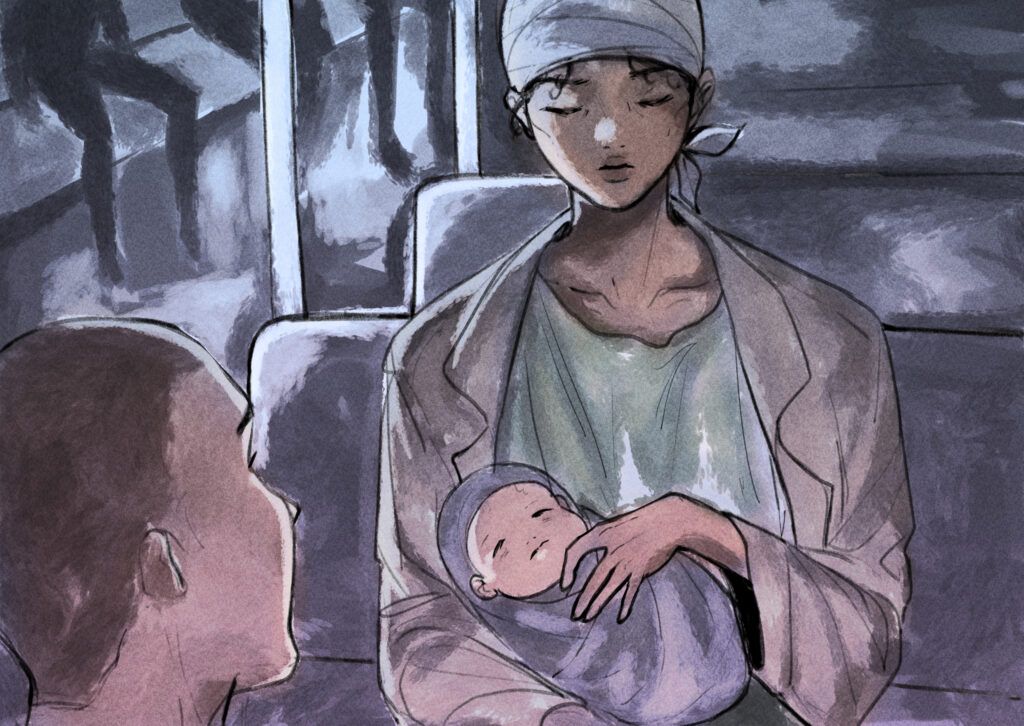
Elijah got on the “A” train at Euclid Avenue in Brooklyn. He wondered if he’d see the woman with the baby today. It had taken him a week of trips, back and forth to City College up in Harlem, to realize that she was homeless. The woman with the baby was always there when he got into the last subway car. She was a tall, slim black woman, light-skinned with short hair pressed close to her head by a light blue scarf. The woman stayed on after he got off at 135th, never asking for money; she just sat clutching her baby to her chest, rocking back and forth. The blanket was a slightly faded shade of white, and Elijah could not tell whether the baby was a boy or a girl. When the child started crying, the mother murmured to the child and began to breast-feed inconspicuously. The baby seemed to be hungrier in the morning because Elijah never saw her breast-feed on his way home from class. The first few times he saw her, he thought she was dropping the baby off and picking it up from somewhere. But then he noticed that she had the same clothes on each time. A green dress was visible under the
frayed tan overcoat, her shoes plain, black and flat. When he noticed the same green dress three days in a row, he knew she must have spent all day and night on the train.
Elijah stepped into the car as the doors closed. He’d left early, trying to make it to his 8:30 class. Some of the usual early morning riders were there when he got on, mostly white people who had gotten on in the Rockaways. They had most of the seats, but by midtown Manhattan they would be gone. In the middle of the car, two middle-aged women with dark hair spoke hurriedly in a Slavic language. He had seen them before, and once one of them had pulled thick rubber gloves out of the shopping bag at her feet. They were the kind he saw the cleaning ladies at City use when they cleaned the bathrooms late at night. The women would get off at 14th Street together and wait for the local.
There was an Irish man who always stood against the last door and looked out of the back of the train at the station receding into the darkness as if he had left something behind back in the Rockaways. On one Saint Patrick’s Day a couple of years before, while the other white people in the car had on green shirts or green skirts, he wore a cap with a little button on it that said “Kiss me, I’m Irish.” Today, he stood with one work boot on a toolbox, glancing at The Post between stations. He’d usually leave that paper behind when he got off at 42nd Street. Elijah sometimes grabbed it and scanned the sports section, skipping the “criminal of the day” news and the ever-present Y2K virus doomsday prediction in the front. Years before, when Elijah had first started taking the train in the morning, the Irish guy never looked out the back window. Back then he read his paper with concentration. And he wore an interesting wedding band on his finger. It was gold with two hands together over a heart. A year passed before Elijah started to notice the man looking up distractedly from the paper. His eyes had bags under them as if he hadn’t slept all night. He would twirl the wedding band nervously on his finger, pulling it up a little, revealing a ring of slightly paler skin beneath it. One day the man got on without the paper at all. He had a silent conversation with himself all the way to 42nd Street, his lips flexing silently under a blond mustache and his feet shifting on and off the toolbox. The next time Elijah saw him he had no band on his finger, just a pale ring of flesh where the band had been. Around this time is when the man started staring out the back window of the train.
When everyone settled down into their seats, Elijah looked around for the woman with the baby. He heard the baby before he saw it. The woman was trying to make her crying child take the brown nipple that poked out slightly from the green folds of her dress. The trains ran all night, and he wondered if she ever left. Perhaps she left only to eat, digging in the garbage bins where people discarded half-eaten hotdogs and pretzels or to relieve herself at the dark end of a platform where no one could see. She had to be eating something so that the baby could keep breast-feeding. Where did she wash? She did not smell because when people did take that other corner seat they merely glanced at the baby and gave a perfunctory smile. The first week that he noticed her, the baby cried incessantly. People frowned at the noise, the cries interrupting their conversations about workload, mergers, and plans for vacations. She usually took the same corner seat at the end of the car so she could lean against the wall and have only one person next to her. The rest of the people didn’t recognize her from day to day. Was he really the only one aware that she had been wearing the same clothes for a week? They didn’t look up from their papers and into her face and realize it was the same woman each day. He took a seat across from her. The woman didn’t notice him glancing at her, so focused was she on the baby.
A brown skinned Latina woman brushed passed him as the doors closed and took a seat further down towards the back of the train. She wore a blouse and bright blue skirt with matching heels. Her clothes were usually formal but colorful, not the dark colors and pastels that the executive and managerial women wore. She used to catch the train right at 7:30 so she could meet her friend, a similarly dressed Latina woman, at Broadway-East New York. Together they rode the train to Jay Street, complaining about their secretarial jobs, somewhere near Borough Hall in Downtown Brooklyn, where they got off the train. They spoke half in English and half in Spanish. With three years of high school Spanish under his belt, Elijah understood about three-fourths of their conversation. Their boss was a prick. He was always on the case of the one who got on at Broadway-East New York. Elijah had decided that they didn’t work at any of the countless city agencies or courts near Borough Hall, because they never talked about going to a union rep or filing a grievance, just what each one should do to avoid their boss’s wrath for that day. About two weeks ago, the first one had gotten on, and when her friend’s stop came up, she merely glanced up at the opening doors. She didn’t look around nervously, but instead put on a Walkman and closed her eyes. Elijah had not seen the second woman since. The woman who had gotten on with him today at Euclid sat down across from him now and immediately pulled out her Walkman, turning up the volume as she placed the small plastic headphones in her ears. At Broadway-East New York, the train jerked to a halt. The secretary glanced out beneath her lashes at the name of the stop just outside the window. She closed her eyes and rested her head against the metallic panel behind her. The baby down the aisle kept crying, refusing its mother’s breast.
A black man in a dark brown UPS uniform got on at Utica Avenue. He was reading the Daily News and didn’t look up as he stepped on the train. The front-page trumpeted Guliani’s latest plan to fix broken windows and crime at the same time. He waited for the doors to close behind him so he could lean his tall frame back against them. The man had a slight potbelly and his uniform didn’t seem to fit right. Elijah wondered if the company paid for a new one or if he would have to foot the bill out of pocket. The woman with the baby had given up trying to breast-feed and was instead trying to rock the child to sleep. She soothed it with words that Elijah could not hear above the grating of the wheels beneath them.
A Caribbean woman and her daughter got on at Nostrand Avenue. They stood by the pole in the middle of the car. In a quick-paced, heavy accent she tried to explain to the child to be good while she was taking care of Alison, someone else’s child. She was probably heading up to the West Side to be a nanny for some white kid, Elijah thought. Then he wondered who usually took care of the little girl while her mother watched someone else’s?
The train pulled into Chambers Street. People in dark business suits rushed up the steps to go work on Wall Street or in the World Trade Center. Heels matched skirts and loafers matched pants. Elijah wondered how many of the white women he saw had left their children with a black woman, like the one standing by the pole, while they pursued their own careers. Elijah had two aunts down south, Aunt Belle and Aunt Phyllis, who worked taking care of old sick white ladies in nursing homes. His aunts were paid by the week, no medical coverage, no retirement. That was one of the only jobs in town, and that’s why his mother had moved up north. One time, his mother had gotten a call that Phyllis was sick and had to go to the public hospital. His aunt didn’t get paid while she was out sick, and his parents had to send down money so she could pay the rent. Whenever he walked down to the West Side from City College, the sight of black and brown women pushing little strollers with pink babies made him cringe and think of his aunts and the small southern town he had visited as a youth on summer vacations. Visions of vast slave plantations flooded his mind—large houses with mammies on the front gallery bouncing little blond babies on their knees.
When the doors opened at Chambers, white people in business suits got on from the New Jersey suburban PATH train. One couple, a man and a woman, wore similar grey suits. The pleats in her skirt matched the ones in his pants. They always got off several stops later at 59th Street Columbus Circle, probably to work somewhere on 57th Street where all the office buildings were. The woman carried a tote bag with a Master Card logo on it. It held her work shoes while she wore her white Reebok walking sneakers. Elijah thought they had to be more than just fancily dressed clerks, the way they made a point of getting to work early. Their dress, their manner, the way they held their briefcases and the business section of the Times assertively out in front of them, taking up as much space as they could—all these things let others know that they were climbing the ladder several rungs at a time. The pair sat right next to him. They complained about work also, promotions, deadlines. A Chinese man got on at Canal Street selling plastic or battery-operated fur toys for a dollar. A Chinese young woman with an NYU book bag got on behind him. She got off at West 4th in the Village, brushing past two white girls in black leather jackets and torn jeans. There were so many people on the train now that Elijah had to move from side to side to keep an eye on the woman trying to quiet her baby.
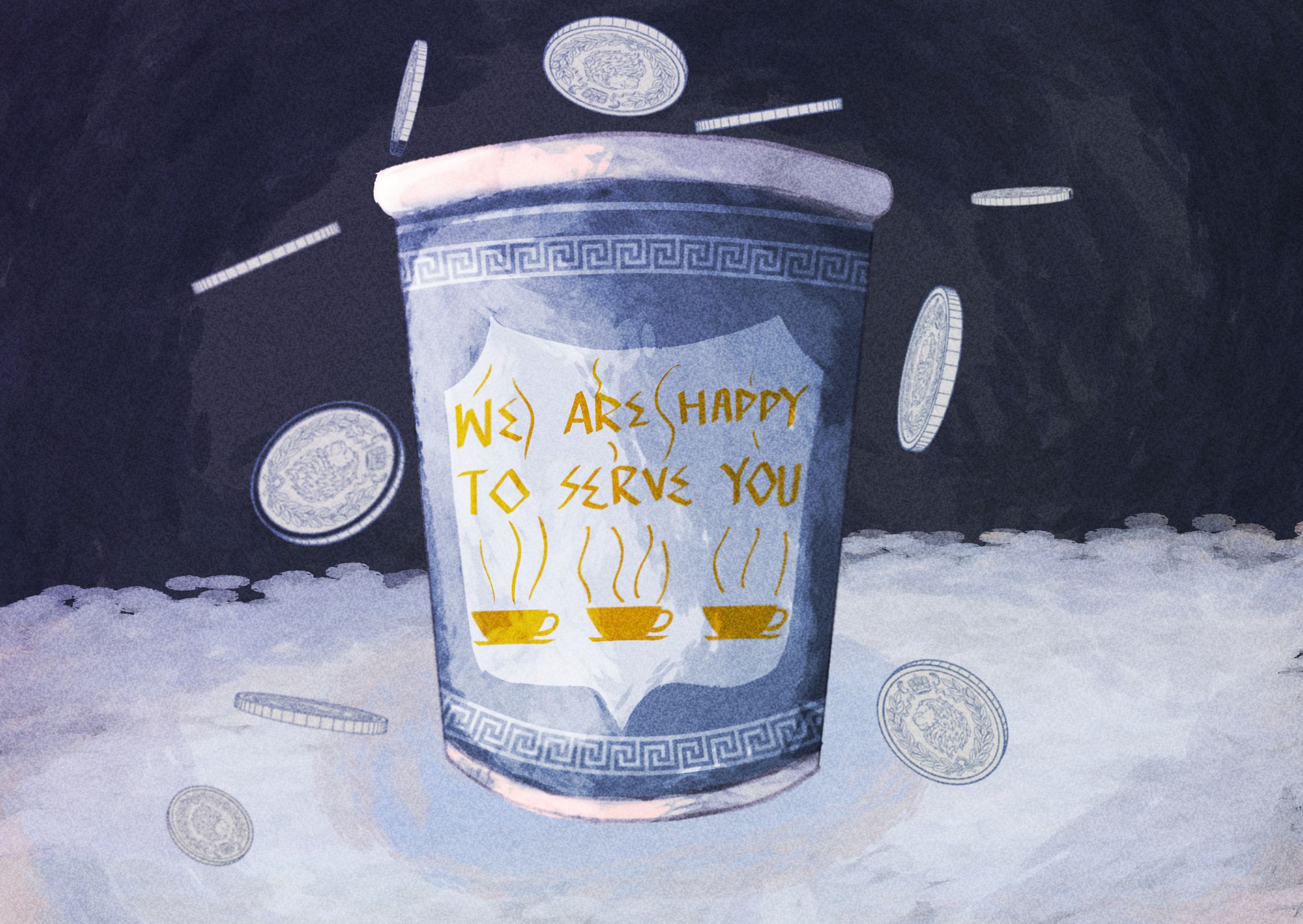
Just as the train pulled out of the West 4th street station, the metal sliding door between the cars was flung open. A young black man with cerebral palsy jerked spasmodically into the car. He was a little younger than Elijah, maybe seventeen or eighteen. The roar of rushing air in the tunnel could be heard behind him, and above that Elijah could hear the man emitting a sing song tone, as if he had as little control over his voice as his body. Contorted and crooked, he fought for each step. He jerked and twitched intermittently, his knees bent and touching as he forced his sliding feet forward. His head swiveled away from the people in the car as if he were talking to the wall next to him. Drool dribbled as he struggled to speak. His left hand was clasped to his stomach and his twisted right hand clutched a white and blue disposable coffee cup with Greek designs on it. WE ARE HAPPY TO SERVE YOU written in gold letters across. The train was crowded now and people leaned in, ostensibly to make room for the young man to pass, but also to move away from him. As he twitched forward, his hand shook and the coins in the cup rattled to the halting rhythm of his steps. “Please give to a boy with cerebral palsy… Please give to a boy with cerebral palsy.” The coins rattled as the subway car grew momentarily silent, even the baby’s wail.
When Elijah was in high school, anytime someone did something clumsy, like drop their tray at lunch or trip up the stairs, he and his friends would call them a “Spaz” and imitate someone with cerebral palsy, twitching their neck to the side, contorting their hands into claws at their chests and slurring their words. When he had graduated and was a freshman at City, there was a student with cerebral palsy who took one of his classes. Seeing her walk to class with her knapsack had seemed perfectly natural then. But somehow, here under the glare of the fluorescent lights in the cramped subway car, the guy struggling down the aisle was stripped raw.
The white woman in the business suit next to Elijah broke the momentary silence and spoke to the man with her.
“Most of these people are just faking. It’s a scam. This is one of the reasons I left the City. They’re even on the East Side now.”
“Back when I used to drive, they’d get you coming off the bridge with those squeegee things. Giuliani needs to build a PATH train stop at 59th Street.”
The woman nodded in agreement. For the next two stops, they kept on like that, loud enough for everyone to hear, sighing in exasperation whenever someone farther down in the car reached over and dropped some change into the shaking coffee cup.
Elijah looked over at the homeless woman. She had somehow managed to quiet the baby. She rocked back and forth with it, shushing the child to sleep. He looked again at the green dress and tan coat. Was this the last thing she had been wearing when …what? Her house had burned down with everything in it? She lost her job and got kicked out of her apartment? Maybe she was robbed and lost all her stuff and the rent money. Did she rush out the door with the clothes on her back just a few steps ahead of her husband’s fists? It crossed Elijah’s mind to ask her. The aisle that separated them was as wide as the river that separated his house in East New York from wherever the couple to his left lived in New Jersey.
As if a bell had gone off, the man and woman got off at 59th, as did almost all the other white people. Most went up the stairs to the office buildings above; some of them waited on the platform to take the local to the Upper West Side, but a few stayed on the express to 125th Street in Harlem. Good, he thought. Go back to New Jersey! The train was less crowded now. It rushed through darkness, past the flickering brightness of local stations…72nd…8lst…86th. He looked again across the aisle at the woman.
Questions sparked in his head like the passing lights. How wide was the gulf between him and her? He rented a basement room from a woman who owned a two-family house on Van Siclen Avenue. During his last year of undergrad at City College, his father was laid off, and his parents had moved back down South. They had helped with tuition, but without his father’s job, things had gotten too expensive. They both missed their relatives in Georgia, so they went back, rented a small house down there. They had offered for him to join them when he graduated, but he knew there was no real work there. He wanted to be a teacher, and teachers made crap down there. He’d end up doing construction work or some other typically non-union work. Instead, he’d gotten a partial scholarship for a grad program in education, also at City College, and he found a part-time job doing market research—a fancy way of saying, he called people up and asked them what kind of tooth paste they liked best.
What would happen if he lost that job? What if the place closed or his boss, Mrs. Crawford, decided she just didn’t like him? How long would it take him to find another job? Three months, like the last time? Or maybe longer? Never? What if Mrs. Watson raised the rent or sold the house and moved back to North Carolina to be with her son, like she was always talking about? Would he find another room to rent as cheap? Or would he be sleeping on the subway right next to the woman with the baby across the narrow paper-strewn aisle?
96th…103rd …110th…16th…125th. The woman never looked up at the stops or Elijah staring at her; she focused solely on the baby.
The car seemed more crowded than it had at Chambers Street, even though there were less people on now. He wanted to get up and move away from the woman, but he thought she might think he was looking down on her—the way white women held their purses tighter sometimes when he sat next to them. Good ole six o’clock news, he thought. Show people the same thing every day and they think that’s the only reality. He, too, got caught up in it. Around some black guys, he might also wonder, “Is he going to try something?” But he would never move over or hold his knapsack tighter. He wouldn’t want to make the guy feel like the white women made him feel, like a dangerous animal. His stop was next. 135th. He could leave the enclosed subway car and the woman behind, until his ride home.
A week later, Elijah got on the “A” and found the woman there. He didn’t want to run away from her. The couple from New Jersey had run all the way across the river. He wouldn’t move. The baby was not crying at all this time. The green dress the woman wore was wrinkled and the coat was soiled. He thought about giving her money and felt the ten and two fives in his pocket that had to last him to the end of the week. And he hadn’t bought all his subway tokens yet. Besides, it was that couple from Jersey that needed to give up some money. Why should he miss lunch? He slipped angrily into his seat across from the woman. She shook the baby even though it wasn’t crying. It seemed to be asleep. This was when she usually fed it, but the baby wasn’t hungry today.
At Chambers, the business suit couple got on looking more similar than ever. They sat across from him. They, on one side of the doors, and the woman and child, on the other. At the next stop, the young man with cerebral palsy appeared in the glass of the door that led into the car. The rattling of the change in his cup could be heard before the door opened as he struggled to grab hold of the handle.
“Not this clown again; he’s got to get a new act,” said the man in the suit from across the aisle shook his head in annoyance. The woman next to him sighed. The woman with the baby kept rocking her child. Then the door flew all the way open and the shaking voice of the young man could be heard from the within the rushing air between the cars.
“Please give to a boy with cerebral palsy. Please give to a boy with cerebral palsy.”
Just as he was about to take a tentative step into the car, the train lurched forward in preparation for departure. He lost his footing on the metal planks that jutted out in between the two cars. He could not hold open the door, hold his cup, and keep his balance all at once. The cup tipped over and fell out of his hand. It had been three-fourths full with change. Most of it cascaded down in silver and copper chunks between the cars. It tinkled onto the steel grating between the cars, like metallic rain, and then much of it bounced off onto the tracks below.
“My money!”
The screech that came from him silenced the couple across from Elijah and even stopped the woman from rocking the baby. The car door had finally caught on its latch and was held open so everyone could see the young man struggling against the jerking train as his body twitched, bending so that he could get to his knees.
“My money!”
He scrambled sideways on his knees like a broken crab, clawing between the metal planks of the car, in a futile attempt to reach his coins a few feet below him on the tracks before the train started moving.
“My money!”
The train was about to pull out. He would be crushed in between the metal jutting out between the cars as it slammed together momentarily. The business suit couple and everybody else in the car looked at him scrambling spasmodically down on his knees. Elijah looked over to the woman with the baby. She stared down at her baby, no longer rocking and only murmuring down as if to block out the cries from the young man on his knees. Elijah saw now why the baby hadn’t cried. It wasn’t breathing. Though she rocked it, the child’s limbs hung loosely. He could see its chest beneath the blanket; there was no movement. The baby’s eyes did not flutter as they had before. No baby he ever saw slept that soundly. Its skin was a pale ashen brown. Its mouth hung open as if in a silent pantomime of the wail that came from just outside the car.
“My money!”
Elijah jumped up and pulled the emergency cord. The train, which had just started to roll forward and gather momentum, suddenly jerked to a stop. The wheels screamed out a complaint. The boy was still picking up his coins, using two hands just to grasp hold of a nickel. The emergency cord was right above the woman and the dead baby. She was still rocking maniacally back and forth, and Elijah stared down into the empty gaping mouth of the child.
“Hey, what the hell are you doing? People got to go to work here!”
It was the man in the suit, but the voice seemed to come disembodied from the baby’s mouth. Elijah looked up. The couple was staring at him. He saw the image they had of him reflected in their round, blue pupils. Their eyes seemed to play an optical trick that flattened the woman with dead baby, the guy with cerebral palsy, and Elijah himself into one contiguous being that was going to make them late for work and delay their ascension up the ladder. Elijah wanted to scream and point and explain, but his mouth would not form the words. His body shook, and he felt as if he might lose control. When the doors finally hissed open, he rushed out of the car and up the nearest stairway, knocking people
aside as he ran. He didn’t hear the couple’s curses behind him as he rushed out into the sunlight. He left them down below—along with the screech of the train wheels, the boy’s plaintive cry for his coins, the baby’s empty scream, and two pairs of cold, unseeing blue eyes.