
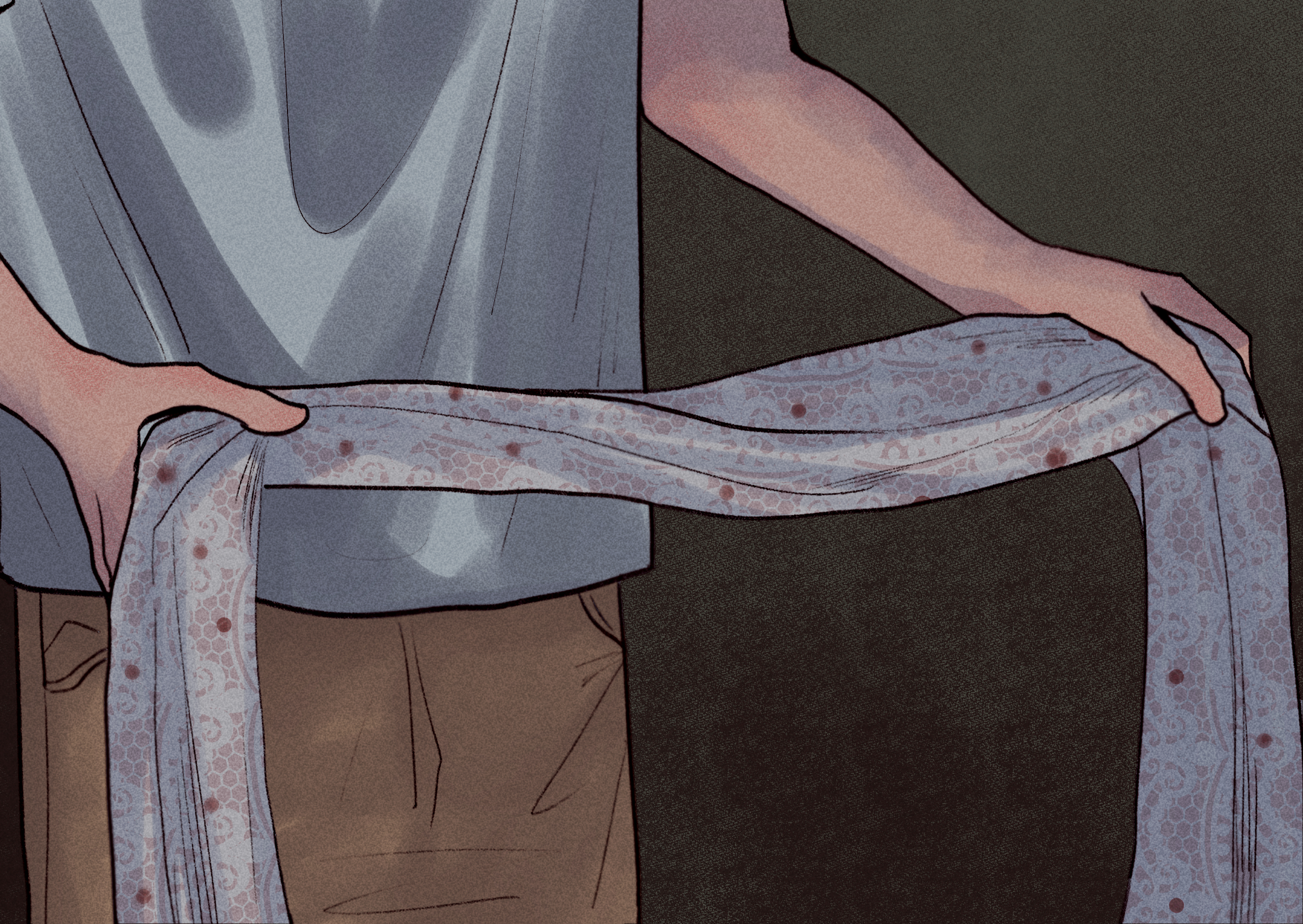
Yavor Velich was seven years old the August his mother sent him up to the attic for a tablecloth. He came down forty minutes later carrying it in both hands like a tray. When she took it from him she said, “Took you long enough,” and she did not look at his face. If she had, she might have noticed something different there, and many things would have gone differently afterwards. But she was busy that afternoon. The priest was coming.
The town was Lindenfeld. The street was Lindengasse, a row of three-storey houses with iron balconies and small back gardens, twelve minutes’ walk from the cathedral and four from the river. The Velich family had lived in the same house since 1872. The stairs to the attic creaked at the fourth step. They had creaked there since Yavor’s great-grandfather’s time, never repaired, because the family had decided across several generations that a creaking step is useful: it announces visitors, and visitors announce themselves.
Father Marek was coming for tea. He had, at Easter, admired Frau Velich’s needlework on a tablecloth she had brought to the parish luncheon, and Frau Velich did not forget compliments paid by priests, or by anyone in a position to extend them onward. The tablecloth she wanted was the one with the cross-stitched pomegranates, made by her own mother in the winter of 1923, kept in a cedar chest near the dormer window. Yavor was to go up, find it, bring it down. Specific instructions. Frau Velich did not believe in leaving tasks open to interpretation.
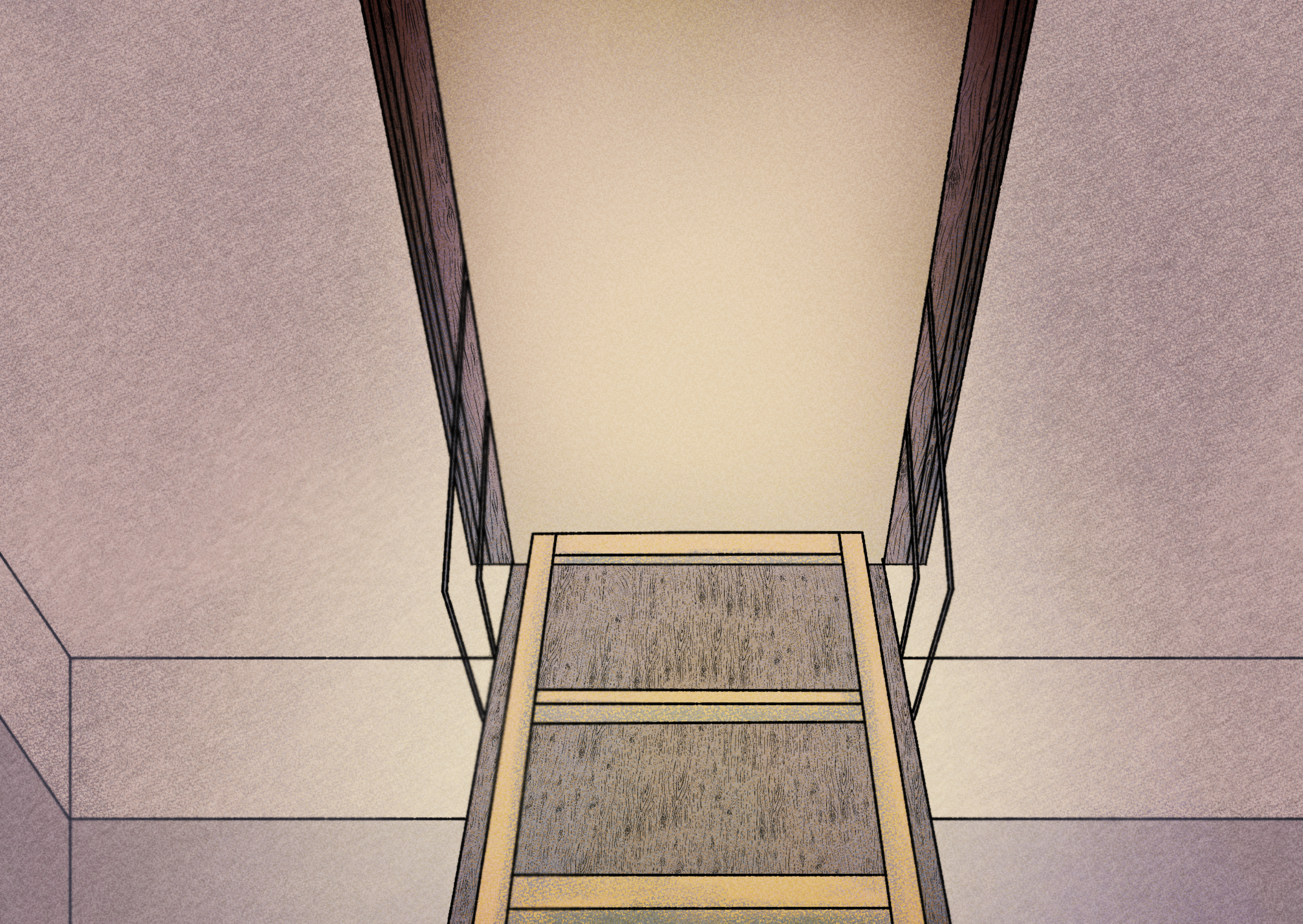
He climbed. He pushed the trapdoor. He stepped into the attic.
The light up there was not like the light in the rest of the house. Downstairs the windows were polished every Saturday with vinegar and old newspaper, and the light fell on polished floors in clean sheets. The attic light came through one dormer that had not been cleaned in forty years, and what reached the floor was a kind of suspension. Gold hanging in the air, slow and granular, the way honey hangs in a jar held up to a window.
A well-trained child would have walked to the chest, opened it, found the tablecloth, carried it back down. Yavor was a well-trained child. At seven he was perhaps the most carefully trained child on Lindengasse. His mother had begun his training in the cradle. He knew how to stand when adults were speaking. He knew how to refuse a second helping of cake at a neighbour’s table in such a way that the hostess felt flattered. He knew how to kiss the priest’s hand in the manner the priest expected.
He did not walk to the chest.
He walked to a shape in the far corner, under a sheet.
The sheet was grey with age. Under it was a square wooden box about the size of a sewing machine but the wrong shape for one. Yavor lifted a corner. He saw walnut veneer inlaid with brass. He saw a flat round platter, a metal arm with a tip the shape of a tiny diamond. He saw a handle folded against the side that looked as if it would unfold if he pulled it.
He pulled the sheet all the way off.
It was a gramophone. He knew what that was. He had read about it in a school book, in a chapter on the history of recorded sound. He had read the chapter twice because the photograph had held him in a way the photograph of the radio had not. A gramophone held music. The music sat on a black disc. You wound the handle. You lowered the arm. The music came.
There was a disc on the platter.
The label at the centre was faded to a colour somewhere between pink and brown. The printing was in old script, but two words were clear. One was HAYDN. The other was String Quartet, Op. 76, No. 3. Beneath those, smaller, was a single Latin word, and Yavor sounded it out: Emperor.
He knelt in front of the gramophone. The splinters of the floorboards pressed into his knees through his shorts. Splinters were the first thing he would remember afterwards, when he tried to reconstruct what had happened. Not the music. The splinters. The small specific pain of kneeling on a floor that had never been sanded.
He unfolded the handle. It went stiff at first, then less stiff. He turned it six times, the way the school book had said you should, and from somewhere inside the machine he heard a clock-winding sound.
He lowered the arm onto the outer edge of the disc.
There was a moment of dry hiss, as if the room were holding its breath. Then a violin began, very quiet, joined by a second violin, joined by a viola, joined by a cello. Four voices, the same age and yet none of them in agreement at first. A line went up. A line came down to meet it. Both held a chord. Both began again.
Yavor sat back on his heels.
He had been told, in the way children are told things, that music was something one performed for a priest at Christmas. His mother had taught him to sing. She had taught him to hold the hymn-sheet with two hands and to keep his chin up. The music coming out of the gramophone did not require a chin. It did not require a hymn-sheet. It did not require him to be anywhere except where he was, and it asked nothing in return for being there.
He had been watched since before he could remember being anything. He had been watched in his cradle by his mother, who polished him the way she polished her icons. He had been watched in the yard by neighbours, who reported every fall and every odd word he said and were given small glasses of sweet schnapps for their trouble. He had been watched at church, in the shop, on the way to school, in bed. He had been watched so continuously that he had learned, without knowing he was learning, to perform himself even when he was alone. When he played in his room, he played as a boy being observed, though there was no one in the room.
In the attic, for the duration of the Emperor Quartet, he was not watched.
He did not know he was not watched. He had no word for the feeling. He only knew the music was finding a space inside him he had not known was there, and that the space was being addressed, in a language older than his own.
The piece had four movements. The second was the famous one, the slow theme, the hymn Haydn had written for an emperor and a country that had since moved on without him. The viola carried the melody quietly while the violins kept their distance above it. The cello held the floor. It was the simplest line he had ever heard, and he understood, without being able to say how, that the line was being remembered rather than invented. Someone, somewhere, had hummed it once. Someone else had written it down. A third person had made it into a quartet. Now it was singing itself again in an attic on Lindengasse, to a boy who was not supposed to be listening.
The piece lasted twenty-two minutes.
When it ended there was another hiss, then a click as the arm rose. Yavor did not move. Time had moved without his help. The gold suspension in the dormer had thickened and changed angle. From downstairs his mother was calling his name.
He stood up. His knees had the red imprint of the splintered boards. He folded the handle back. He picked up the sheet. He laid it gently over the gramophone and smoothed it the way it had fallen before, and he did all of this with the care of a boy who had understood, in twenty-two minutes, something he would not be able to articulate for many years.
He had understood there were two of him.
There was the boy his mother had made, who was about to carry a tablecloth with cross-stitched pomegranates to a table that would be admired by a priest. And there was the boy who had heard the Emperor Quartet. That boy had no mother. That boy had no tablecloth. That boy had four polite voices in his head that had treated him as company.
He walked to the chest. He took out the tablecloth. He carried it down. His mother in the kitchen took it from him without looking and shook it out.
“Took you long enough.”
He did not answer. He stood for a moment in the doorway and then he went out into the yard. There was a chicken pecking at something in the corner. He sat on the back step and watched it. The boy his mother had made watched it with attention. The boy who had heard the quartet sat behind him and did not interfere.
That was August 1958.
They lived. The mother polished the boy. The boy went to school. He did well. He grew tall. At nineteen he left Lindenfeld to study engineering at the technical institute in the capital, and his mother, kissing him goodbye at the station, told him she had not raised him to be ungrateful. He had not, in his own memory, been ungrateful for anything. But he wrote to her every week.
He came back for Christmas. He came back for Easter. He came back for her sixtieth birthday and her seventieth, for the small stroke that did not kill her, and the second one that did. He buried her in the cemetery on the hill above Lindenfeld in the spring of 1992, on a Wednesday morning when there was a thin rain that kept stopping and starting like a polite cough.
Yavor was forty-one. He had worked for a Swiss firm for nineteen years. He had a wife and a daughter. He had not, in those nineteen years, gone up into the attic on Lindengasse. There had been no reason. The chest had been brought down years ago. The gramophone he had not thought of, in any conscious way, since he was nine or ten. It sat at the back of his memory the way a pressed flower sits in the back of a book one has not opened.
After the funeral, his aunt Ilse made coffee in the kitchen.
She was eighty-three. She was his mother’s older sister. She had lived three streets away her whole life, had never married, had kept his mother’s birthdays and her grudges. She poured the coffee and sat down across from him.
She said, “I was sorry to hear it.”
He said, “Thank you.”
She said, “Your mother was a hard woman.”
He said, “She was.”
There was a silence. The aunt drank her coffee. Then she said, without looking at him, “She loved you.”
Yavor said, “I know.”
He drank his coffee. He looked at the table. After a while he said, “Tante Ilse, do you remember the gramophone in the attic? The one under the sheet?”
She said, “Of course I remember it. Your grandfather’s. Why.”
He said, “It was there when I was a boy. I went up once. I played a record. I have been wondering, all these years, what happened to it.”
She set down her coffee.
She said, “Your mother sold it.”
He said, “When.”
She said, “The day after Father Marek came for tea. The summer you were seven.”
He looked at her.
She said, “She told me about it that week. She came over to my flat in the morning and said, Ilse, the boy has been touching things in the attic. She did not raise her voice. She did not seem angry. She said she would deal with it. The next day she sold the gramophone and the records to a man on Drachenstrasse who bought such things, and she said the matter was closed.”
Yavor put down his cup.
He said, “She knew I had played it.”
His aunt said, “Yes.”
He said, “She never spoke of it.”
His aunt said, “No, of course she did not. She did not believe in speaking of things. She believed in adjusting the conditions so that the things did not happen again.”
He sat for a while.
He said, “Why. It was only a piece of music.”
His aunt looked at him with the patience of a woman who has lived long enough to see most patterns repeat.
She said, “Yavor, it was not the music. She had heard you. She had been at the bottom of the stairs for the last seven minutes. She heard you not coming down. She heard you not breathing. She came up four steps and stopped at the fifth, and she stood there and listened to the rest of it from below. She told me. She said she had stood there and listened to the whole second movement, with her hand on the rail, and that for those seven minutes she had not known her own son. She said, Ilse, he was up there with someone I had never met.”
Yavor did not say anything.
His aunt said, “She sold it because she was afraid of him. The other one. She did not know whether he was going to live or die or what he was going to do with you. She did what she could. She removed the cause.”
He sat for a long time.
After a while he said, “She heard the second movement.”
His aunt said, “She did.”
He said, “Was she fond of it. After.”
His aunt said, “Yavor, she never spoke of it again to me, in the rest of her life. Not once.”
He drank the rest of his coffee. He thanked her. He kissed her on the forehead. He went out into Lindengasse.
The thin rain had stopped. He walked toward the river. He passed the cathedral. He passed the Marienplatz, where a quartet was rehearsing in the bandstand for a Sunday concert, four young people in jeans, sawing at their instruments without much joy. He stopped to listen.
They were rehearsing the Emperor Quartet. The slow movement.
He stood on the cobbles and listened for as long as it took them to play it through, twice, with stops. The viola was a girl of about seventeen in a yellow jumper. She had a long neck and a thoughtful face. She was the only one who was getting the line right. The others kept her waiting.
When they finished he walked on toward the river. He did not weep. He had not wept at the funeral, and he did not weep now. But he understood, walking along the Linde with his hands in the pockets of his good wool overcoat, that his mother had, in her own poor way, been listening to him all his life. She had not known what she was hearing. She had been frightened by it. She had tried to make it stop.
It had not stopped. It had simply moved out of the attic and into him, and into the streets of the town, and into the bandstand on the Marienplatz where a girl in a yellow jumper would, in twenty minutes, get the line right at last.
He thought, walking, that he would buy the girl a coffee if he ran into her on the way back. He did not. He went home. He told his wife about Tante Ilse and the sold gramophone.
His wife said, “She must have loved you very much.”
He said, “I think she did.”
He sat down at the kitchen table. He listened, for the first time in many years and properly this time, to the music in his head that had been playing there since August 1958, polite and serious, four voices that had treated him as company, and that, for the rest of his life, would.
# # #