
In the age of legends, the mighty kingdom of Talafor was ruled by a vain king named Velmir. The king could not resist any chance to marvel at his own reflection, be it in a polished chalice or a puddle of water. By decree, gilded statues of him adorned every corner of the land until there was not a direction on the compass where his face could not be seen. He journeyed always with a grand mirror, the tall likeness within being his only counsel.
King Velmir’s vanity was matched by his cruelty and the ease with which he took offense. When Lord Beltru, ruler of the minor realm of Reisha, renamed him the Mirror King in jest, he threatened Reisha with war. To appease the king, Lord Beltru emptied his meager treasury as contrition.
But the unflattering name persisted. Many continued to call Velmir the Mirror King, the name whispered within his own kingdom and said openly by his bitterest enemies.
As a lesson to all, the incensed king vowed to erase the Reishans from existence. He tasked his son, Prince Ashir, to gather his fiercest soldiers and lead them across the Black Sea. The Talafor army swept through the lands with ease and soon besieged Luksom, the last standing city. There, one thousand Reishans sheltered against a foe ten times greater.
Before battle, King Velmir offered to spare the city from destruction for a tribute in gold equal to the weight of every man, woman, and child. It was a price he knew full well could not be met. Lord Beltru averted an attack by promising the king a gift more precious than all the wealth of Talafor.
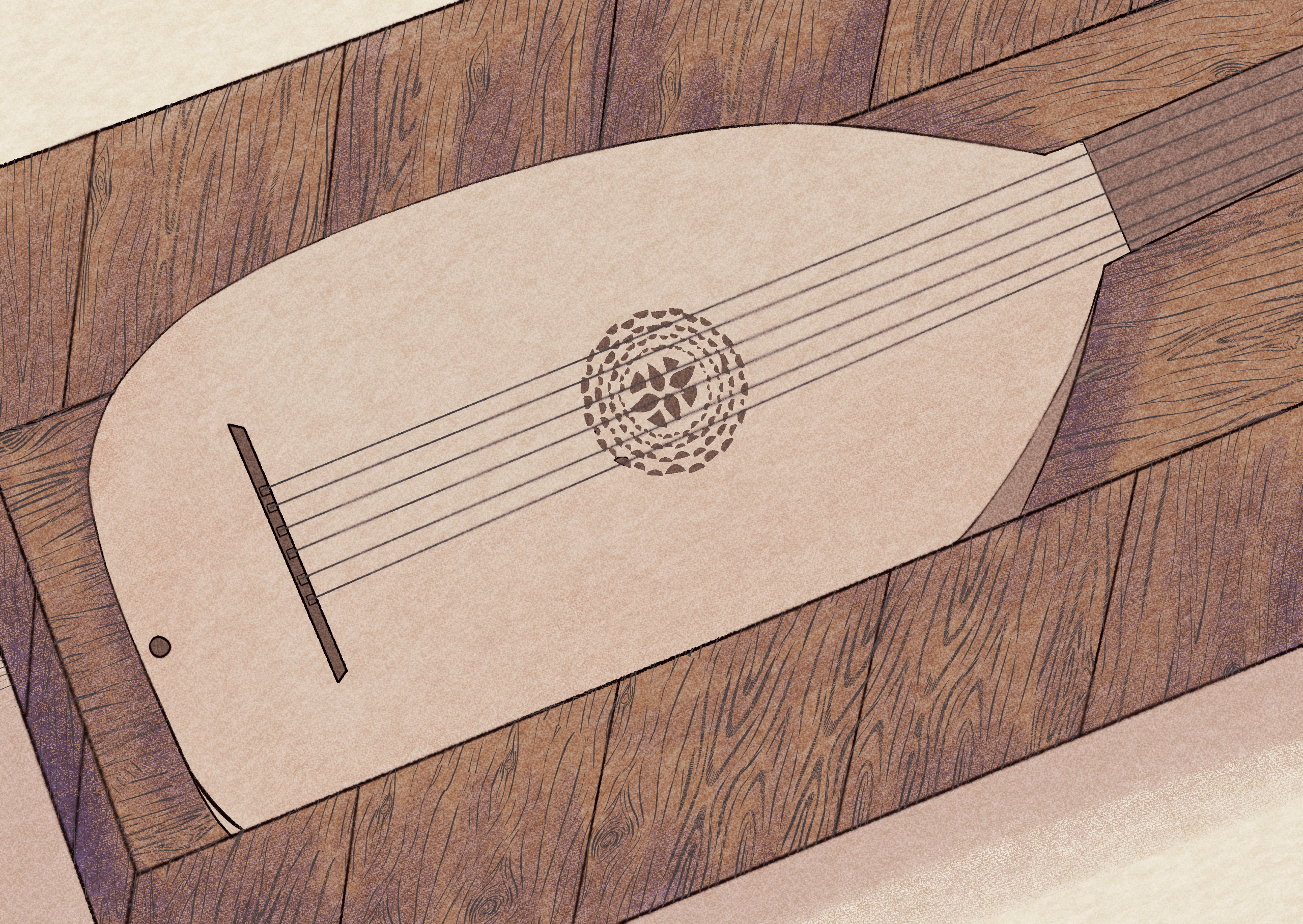
When Luksom’s garden walls parted, a shriveled man with an ashen beard shuffled out onto the battlefield, carrying a long wooden box on his hunched back. The old man laid the gift at the king’s feet and revealed its treasure. It was a simple lute. Angered by the insult to his father, the prince drew his sword and prepared to take the man’s head. To his surprise, the old man did not flinch. Prince Ashir realized the man was sightless.
“A lute!” Velmir mocked the Reishans for making such a measly offering. Talafor soldiers laughed along with each insult their king hurled. But their laughter ceased once the blind man played the lute and began to sing.
“Ethriel! Oh, Ethriel!” His voice, deep and passionate, carried across the battlefield. “You were the fairest of all the angels.”
The men of Talafor knew the angel’s name. It came from the beloved “Fable of Ethriel,” an ancient lore known in all the kingdoms, though they had never heard it in song. They listened, transfixed, as the old man sang of Ethriel’s wondrous beauty with vivid words that belied his blindness. He plucked the lute strings with exquisite mastery, his spindly but nimble fingers missing not a single note.
The old man’s song retold the story of Ethriel, an angel of light whose brilliance brought joy to the darkest souls. Many gods courted her, but she fell in love with a mortal—a gifted musician named Tren. His songs of selfless love touched her more deeply than anything the formidable deities could conjure. But her proud father, Krau, the fire god, disapproved of the match and threw the man into a smoldering volcano. When his daughter found the musician, he lay near death. Desperate to save him, Ethriel tore flesh from her perfect body and face to restore his life, at the cost of her own.
Once healed, Tren brought the angel’s remains to her father and mourned her with his most beautiful song. Hearing the singer’s voice, Krau finally understood his daughter’s love for the mortal. The remorseful fire god cried two great rivers, and their waters doused the fire of his flaming skin. Krau’s colossal body stiffened and shattered and became the Coal Mountains. The Twin Sorrow Rivers flowed from his tears and collected as the Black Sea.
Never had the Talafor soldiers heard music more captivating or heartfelt. Their thick armor could not shield them from the singer’s anguished voice or the sorrowful melody. Ten thousand pairs of battle-hardened eyes wept. Their tears streamed down breastplates, softened iron grips, and drained away bloodlust.
When the song finished, Prince Ashir raised his sword high over the blind man’s head, but he could not see well enough to bring it down, for his own eyes brimmed with tears. Lord Beltru spoke the truth. Their gift of music transcended a dynasty’s worth of treasure. The prince sheathed his weapon. He pleaded with his father to spare the Reishans and their priceless artistry.
King Velmir, his eyes dry, refused. He commanded punishment be delivered.
Prince Ashir begged the blind man for forgiveness. The singer, his voice now hoarse, humbly asked the prince to remember the Reishans in return, then offered his neck. With a heavy heart, the prince gave his solemn vow to the singer and drew his sword. Down came the blade, swung with such speed and skill that the only pain suffered was by the executioner. Tears poured from Ashir and collected at his feet as a dark pool, a small Black Sea of his own sorrow.
In the following days, the Talafor army destroyed Luksom. They tore down every building, burned every book and musical instrument, and slaughtered every living thing.
Reisha was no more.
As the triumphant king and his men sailed home, he was awakened one evening by a forlorn chorus. When he reached the ship’s deck, he saw Prince Ashir, his only heir, hanging by the neck from the ship’s mast. His lifeless eyes glistened with remorse.
Velmir shed tears for the first time in his life. Their drops splashed together on the ship’s deck. Even amidst tragedy, the king could not resist admiring his own reflection in the tear puddle. “Did he save any last words for me?” the king asked.
“No,” Ashir’s guard answered, on his knees grieving. “My prince prayed to the heavens, repeating, ‘Forgive me. I forgot to ask your name.’”
“Whose name?” the king asked.
“The Reishan singer he slew.”
Upon hearing this, the king erupted with rage and cursed his son for being weak. But his vile words were drowned out by the cresting chorus that had broken his sleep. It was a song, resounding in unison from every ship in his fleet.
The king’s men sang the Song of Ethriel.
Despite King Velmir’s repeated demands for silence, the singing grew louder. Consumed by fury, he commanded that all soldiers who uttered the blind man’s song be slain. The order provoked the men, more so when it came alongside the heartbreaking announcement of Ashir’s death. Their beloved prince, the first warrior into every battle, the humble general who never broke his vows, was gone. With Ashir’s passing, all hope for a better ruler was lost.
The inconsolable soldiers rebelled. They devised a suitable punishment for the cruel king, chaining him facedown to his grand mirror and tossing him into the deep Black Sea. As Velmir sank into the depths, he had his own reflection to idolize until his end.
When the soldiers returned home, they smashed all likenesses of the king and forbade his true name to be spoken. From that time onward, he was remembered only as the Mirror King.
Today in the land of Talafor, fathers raise their sons to seek beauty, not in mirrors, but in the compassion of those they love. Across the vast crop fields, within bustling markets, and even inside lavish courts, they still sing the Song of Ethriel—the last song of Reisha.
END