
Cassie doesn’t like bugs anymore. She stands in her bedroom, her hands on her hips, deciding, right then and there, that she no longer likes the cockroaches she sees scuttling across the kitchen floor, or the worms she finds buried beneath the flowers in her mother’s garden, or the spiders that spin their webs in the corner of her room. No, she doesn’t like any of them, and as she thinks this, she can’t help but feel angry.
Did you know that? She asks her mother later that morning. It’s July, and the air is cool and soft and her mother is sitting next to her on their front porch. She is looking at Cassie with a small frown, and Cassie falters a little under her gaze. Did you know that I decided to stop liking bugs?
Whatever for?
I don’t need to like them, Ma. They’re just bugs.
Oh, her mother says. She looks into the distance. She scratches at a spot just above her knee, and Cassie watches as the spot turns from pink to bright red. She hopes her mother will not scratch her skin to the point of it bleeding. It scares her, this thing that her mother keeps doing. Cassie almost reaches out a hand to stop her from scratching at it more, but the look on her face stops her. But you’ve always liked them, her mother says, distractedly. You’ve liked them so much.
Well, Cassie says. I don’t anymore.
That same morning, Cassie begins throwing out her collection of bug memorabilia. She grabs a trash bag from the kitchen, starting the process by dumping out her bug plushies. There’s Mr. Woozle, a purple bumble bee that her brother got her for her thirteenth birthday; Dottie, a large butterfly she won at the summer fair; and Meep, a soft and fluffy silkworm that she often uses as a pillow. The three plushies go head first into the trash bag, already forgotten. Then, her books. These books range from size and color, their topics shifting with them. Books on bees, beetles, crickets, dragonflies, worms, snails, centipedes, and spiders — she has them all. There’s a history that’s been contained inside of these books, a sort of care that Cassie has always considered sacred. (Her father bought most of them. Her brother used to read them to her.) The spines of the books are bent, cracked, with the pages torn, folded, and highlighted. If one were to flip through them, they’d see the illegible scrawl of Cassie’s handwriting on most of the pages. She has spent so many nights in her room reading these books. She has spent so many nights loving them, too.
She dumps them into the bag.
There are her clothes too, almost all bug-themed: her bumble bee shoes, her butterfly dresses, her beetle socks, her caterpillar pants… the list goes on. She shoves the clothes and everything else she can think of into the bag. There’s no hesitation, just that anger.
By the end of the day, when the sun has turned into a hazy glow that makes her room shine red and gold, the trash bag is filled to the brim. The last to go is her ladybug umbrella, which she stuffs into the bag with a grunt. Once done, she stands back, looking at the tightly packed trash bag and her empty room. It feels different. She isn’t sure what to think.
She turns to find her mother standing by her door with her arms crossed over her chest.
Her mother is typically a loud woman, but the last three months have turned her into someone else entirely. Nowadays, Cassie’s mother shrinks in on herself. She isn’t as bright. She isn’t as cheerful. She doesn’t laugh anymore, either. Instead, she’s someone who scratches at her skin until it bleeds; she’s someone who forgets things easily, things that shouldn’t be forgotten (like when to buy food or toothpaste or toilet-paper); and, sometimes, she’s someone who looks at Cassie like she doesn’t know her at all. When Cassie looks at the spot above her mother’s knee, she notices that it’s just a little more red than before, but there’s no blood there.
She brightens every room she steps into, she remembers her brother telling her, just three months ago, on her birthday. They were standing in the corner of the kitchen, watching their mother stick thirteen candles into Cassie’s bumblebee cake. At least, that’s what Dad used to say. There was a small pinch to his mouth. They were both like that. Both the center.
What about you and me? She remembers asking him. Are we the center?
No, he said. We’re not, but that’s okay. We’re good listeners. We help everything make sense.
She wonders, vaguely, if he would think the same now. A part of her knows it doesn’t matter. He is dead, and she is here, and her mother is a different person. It feels like a little too much.
You weren’t joking? Her mother asks, bringing Cassie back to the moment. You’re really throwing them all away?
I don’t like them, Cassie says, and oh,she’s angry, she’s soangry. I don’t want to like them.
Cassie, her mother says.
I never liked them, actually. I pretended to.
You don’t mean that.
No, I do. Timmy was the one who liked them and I only liked them because he got me the toys and read me the books and it’s so stupid that I pretended to like them for him. It doesn’t matter. He’s – he was so stupid.
There’s a tremble to her mother’s lips. She reaches for her knee and begins to scratch at it. Cassie can’t watch the blood well up again. She can’t bear to witness her mother’s pain. She looks away.
Okay, her mother says. I- alright. I’m sorry. There’s an awful pause. Cassie wishes that her mother would stop scratching at her skin. There’s a desperate need for her mother to be her mother again, but Cassie doesn’t know how to make that happen.
When she turns back around, her mother is gone.
From where she stands in her empty room, Cassie watches as the red and gold from the sun shifts into something more soft, something more blue. She hears the buzz of crickets and the shriek of cicadas outside. Has her room ever been this empty?
And suddenly, she can’t help it. She’s trembling all over. She grabs at the trash bag, tears it open, and the contents of what were once her room spill out. Her bugs are here and she grabs at them all — her books and her plushies and her clothes — and throws them. She throws the books against the wall, the clothes to the floor, the plushies at the door. It doesn’t help. She feels worse, like something is trapped in her throat. She tries to rip the butterflies off of her dresses, tries to black out the bumble bee stripes on her shoes so that they are barely recognizable, barely hers, and yet she can’t, something stops her from doing so. She breathes hard and she trembles and she can’t take it. She wants her mother.
Ma? she calls out, breathing hard. When her mother doesn’t respond, Cassie stands. She tries again, opens her mouth and shouts as loud as she can. Ma? I’m sorry.
Her mother doesn’t reply. Cassie runs out of her room, down the stairs and into the kitchen. The lights are dim. The front door has been left wide open. An icy dread fills her. She trips over her feet to get outside, and suddenly, she can’t bear the thought of being in that empty room ever again.
She starts toward Mrs. Johnson’s house, who lives just ten minutes away and told Cassie to get her if she ever needed anything. Cassie knows Mrs. Johnson will help her. She knows Mrs. Johnson will make sure her mother’s alright, because Mrs. Johnson knows what happened to Timmy and she knows that Cassie and her mother have never been this alone before.
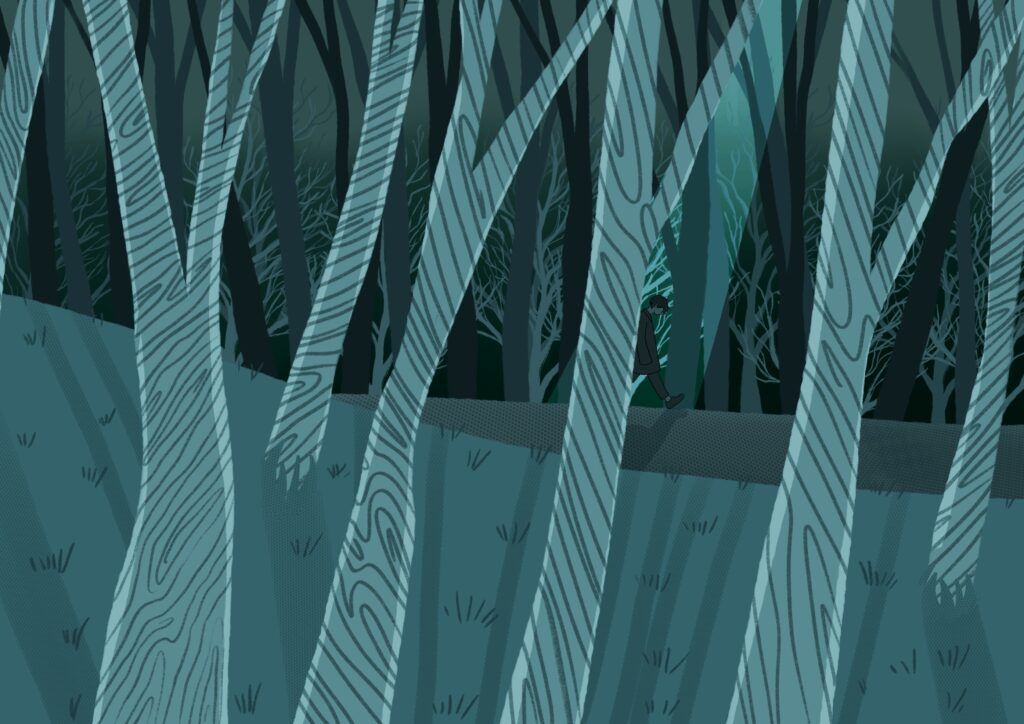
The forest that surrounds the house is thick with overgrown shrubbery. Cassie and her mother live forty minutes from the nearest town and another thirty from Cassie’s school. Because it’s summer, and Cassie does not need to go to class, this is the first time she’s taken this path in a while. Normally, going to school requires her to take the bus, which has her walking through this path and onto the road right next to Mrs. Johnson’s house. Timmy used to walk with her too, but they always took different buses because he went to the high school an hour away and she only just finished seventh grade. She hasn’t walked this path since then, so it seems unfamiliar to her. Still, she tears her way through the undergrowth, her pants catching onto the branches and brambles. She wonders what will happen when September comes. Will she return to school? Or will she remain here, in her empty room with her even emptier mother?
She trips. She ignores the pain, stands up, and keeps on running. Her feet are tangled and her knees are stinging. It doesn’t matter.
I shouldn’t have let her go, she thinks. It’s a mantra. I shouldn’t have let her go. I shouldn’t have let her go. But it’s Timmy’s face that springs to mind now. It’s his lovely ears that she thinks of, poking out from beneath his curls. It’s his stupid grin and his crooked teeth. His bruised elbows. His annoying laugh. Her brother. Her big brother. I shouldn’t have let him go.
Finally, she breaks free from the forest and collapses onto the road in front of her. She has dirt smudged all over her shirt. There’s a few leaves tangled in her curls, too. When she looks down at her legs, she sees, just above her right knee, a cut there. It’s deep, already welling with blood. She’s surprised that she doesn’t feel the pain of it.
There’s something wrong. She realizes there’s something very wrong, because when she catches her breath and looks up, she realizes she’s not in the right place, she’s not even sure she’s here, no, not really. The house that stands in front of her isn’t Mrs. Johnson’s. It isn’t a house at all: yes, it stands just to the side of the road, much like Mrs. Johnson’s house does, but it doesn’t have a row of peonies in the front of the yard or an old jeep parked in the driveway. It also isn’t painted blue with gray shutters and a white roof, and Cassie sees no sign of Mrs. Johnson either, who often makes her presence known whenever she sees Cassie. No, this is not Mrs. Johnson’s house. This is nothing Cassie has ever seen before.
What stands in front of her resembles a very large cocoon, but Cassie isn’t even sure it’s that. It’s oval, brown, solid-looking, and large enough that Cassie wonders what could be living there. But the outline of this large cocoon structure is shimmering, almost like a mirage, and while the structure is, indeed, brown, the colors within this brown shift with each second. She sees a dark brown at first, and then a beige, and then something that looks more red but isn’t quite red either. Against her better judgment, she steps forward. She reaches out her hand. Her head feels like someone is pushing against it very hard, and try as she might, she cannot remember for the life of her why she is here or what she is supposed to be doing. Instead, she keeps her hand pressed against this cocoon. The warmth from it is gooey and fresh and it fills her hand. She finds herself being pulled into this warmth, this gooeyness, this freshness, and she does not fight it. She holds her breath and closes her eyes, and when she opens them again, a startled sound escapes her.
The inside of the cocoon is not so different from the outside: the walls shimmer with different shades of brown that sometimes resemble red and then orange and then brown again, and it’s incredibly warm and comforting. But two chairs have been placed in the center, and in a far corner lies a bed, a desk, and a bowl of what looks like the chocolate fudge her mother used to make for her and Timmy every Christmas Eve. Cassie blinks a couple of times, and when the image around her becomes less hazy, she sees something else too.
A creature sits comfortably on one of the chairs. Cassie notices that it has six legs, two wings, a very thin and long torso, and a tail. She blinks and keeps on blinking, and as her sight becomes sharper, she realizes that what she’s seeing isn’t a dragonfly, nor a butterfly, or even something as simple as a mosquito or a cicada. This creature’s torso is curved upwards where it should be straight, and its wings have delicate, translucent webbing. Cassie sees that it also has three tails, and while she remembers that she does not like bugs anymore, she finds herself momentarily forgetting why.
The creature looks up. Cassie feels her breath catch, a new feeling overtaking her. It’s a mix of fear but underneath it, there’s something that’s beginning to bubble.
Hello, it says, softly.
You’re a Mayfly, she says. She blinks a couple of more times. Are you real?
She doesn’t expect the creature –the Mayfly– to reply, but it does. It laughs, and its laugh makes Cassie shift on her feet.
I suppose I am, it says. Cassie cannot see its eyes clearly, but she knows that they are there, and if she thinks back to the diagrams in her books on Palaeopterainsects, she remembers that mayflies have five eyes. This Mayfly can see her in five different ways, and she is frightened that such a thing could be real. Is she as tall as she thinks she is? Is she as wide-eyed and messy? Does this Mayfly see her chapped lips? Her dirt-covered legs? The leaves in her hair? Her freckled hands, her awkwardly broad shoulders? This Mayfly is far larger than what a normal mayfly size would be, so it must see everything. She starts to tremble.
Are you real? Cassie asks again.
I’m as real as I can be, the Mayfly says. It does not laugh like before, but it doesn’t sound annoyed, either. It looks at Cassie with a soft tilt to its head, and although Cassie wishes she could remember why she is here and what, exactly, she is meant to be doing, she thinks this is the only place she is supposed to be right now.
Sit down, Cassie, the Mayfly says. You’re bleeding.
Cassie looks at her knee and is surprised to find that the red cut has blossomed into a wound that is smeared with sticky blood. Suddenly, she feels dizzy. She feels a bubbling sort of anger, too.
Why? she demands. What if I don’t want to sit? I’m fine.
Cassie.
What?
The Mayfly sighs, so human-like, and despite this bubbly anger in her stomach, Cassie doesn’t feel like she wants to argue with this Mayfly. She doesn’t think she can stand much longer, either. She walks toward the chair next to the Mayfly, lifting herself up onto it with a bit of a struggle. It’s a large chair, and when she is finally able to lift herself up and sit down, she does so with a sigh of her own.
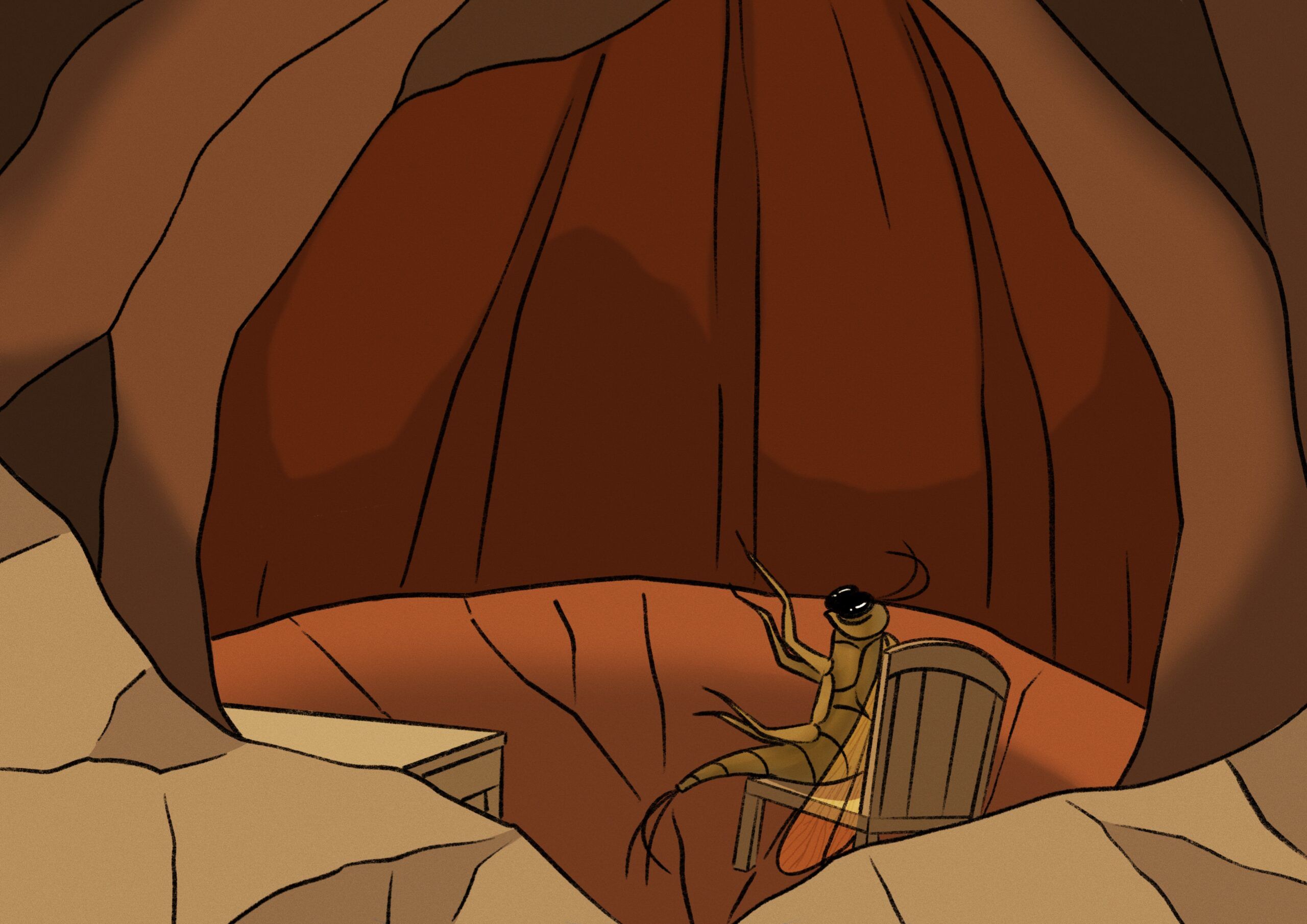
The Mayfly scuttles over to the table, and carries back the bowl of fudge and a box of bandages to Cassie. It holds this bowl out for Cassie to take, and while Cassie stuffs three pieces of fudge right into her mouth, she struggles, while staring at the Mayfly, to chew each piece slowly. By the time she looks back down at her knee, she is surprised to find the cut perfectly bandaged and cleaned. The Mayfly has returned to its seat next to her, and it looks at her in a way that makes her want to yell.
She reaches over for another piece of fudge. Her mouth is full of it. The Mayfly still watches her.
Do you have a name? Cassie asks, swallowing the fudge with effort.
No, it says. I do not.
Cassie scrunches her nose. Everyone has a name.
I’m sorry.
Why are you sorry?
That’s another question I have no answer for.
That’s incredibly unhelpful. Are all mayflies this unhelpful?
The Mayfly doesn’t reply. Cassie reaches for another piece of fudge. She knows that the fudge will get stuck to the root of her mouth, and that she will no doubt spend the next five minutes trying to dislodge it with her tongue. But there’s no urgency for her to leave. She feels as if she could stay here forever, and maybe she can, maybe she will, since she can’t remember why she wouldn’t want to anyway.
The Mayfly stares at her.
How did you know my name? Cassie asks.
The Mayfly shifts in its seat. It folds two of its legs (would Cassie consider them arms? Hands?) over its torso. Cassie is unsure how to decode the expression it wears on its face (if one could even call it an expression). Do bugs have feelings? Does this Mayfly have feelings? Does it feel as angry as she does?
The fudge still sticks to the roof of her mouth, reminding her that she’s here, yes, but that her anger is also there too. She remembers the anger. Oh, how she remembers it. It curls inside of her like something that’s rested too long underneath the sun. She puts the other piece of fudge back into the bowl.
Oh, Cassie, the Mayfly murmurs.
A weird, gurgling sound has started to fill the space. At first, Cassie thinks the Mayfly is choking, but it sits there, very calmly, and the sound that echoes around her isn’t calm. It’s atrociously painful. It almost makes her kneel over. She cannot stop crying.
I don’t like bugs, she says with rageful tears trailing down her cheeks. I hate them.
If the Mayfly is offended by this, it doesn’t make this fact known.
Why do you hate them? it asks her.
My brother. He liked bugs. He was the only one who liked them.
That’s why you don’t like them?
No. She shakes her head. You don’t understand, my brother – he liked them. He was my brother, he’s still my brother, and I loved them because I love him and he’s my brother. She fists her hands in her hair. She squeezes her eyes tight. I need you to understand. I’m trying to understand. I don’t… like feeling this way. I don’t like hating him.
She wipes at her cheeks. She breathes in and out.
Can you tell me about him?
Cassie opens her eyes again. I just did. Are you deaf?
No, the Mayfly says, a shocked sort of laugh escaping its mouth. Tell me about him. What was he like?
When Cassie has spoken to others about Timmy, it’s been to clarify that he’s gone or how she’s felt about his death. The replies are always the same: I’m sorry for your loss and this must be so hard for you and I know what it’s like to lose someone like this and he wouldn’t want you to be sad, Cassie. You need to move forward. But Cassie isn’t just sad. She’s angry. She’s furious.
Your brother? The Mayfly urges within the silence. I want to know what he was like.
Cassie can still taste the fudge in the back of her mouth. Her tongue feels thick and heavy. She doesn’t want to feel this anger forever.
He was five years older than me, she says. She’s still crying, but somehow, it’s easier to talk. To breathe, even. His favorite color was red. He had big ears like me and blonde hair like my Dad. He loved cooking with my Ma. But he loved bugs the most. They were his favorite thing in the world. He liked that not many other people liked them either. I started liking bugs because of that. Because of him.
What’s your favorite bug?
A bumble bee.
And your brother’s?
Cassie frowns. I don’t know, actually.
You don’t?
No, I don’t. She takes a second. I guess I didn’t know a lot about him. He killed himself three months ago. I never knew he was that unhappy. My Ma said he fell and hit his head and everyone at his funeral kept telling us how sorry they were about his accident. But I kept thinking…what accident? Timmy wasn’t clumsy. He could climb any tree and balance on one leg and he was good at everything. I heard Mrs. Johnson talking to my Ma about it, telling her that it might help if she saw a therapist because Timmy was old enough to remember when Dad left and I think a part of Ma worried that it was because of him that Timmy did what he did. And I guess Mrs. Johnson was worried that my Ma would do it too. Kill herself, I mean. She pauses. But I don’t think he killed himself because of that. He was sad. He was… really sad. We found notebooks he had written in. I didn’t understand.
And what about you?
Cassie lets out a breath. What about me?
Do you feel that way? Do you feel sad enough to do that?
No, she says, surprised at her own answer. I like watching sunsets. I like going to school. I love my Ma. I think I would miss her too much if I died. She gives a little shrug. I also don’t know if anyone else would like bugs if my brother isn’t here to like them.
Your mother doesn’t like them?
No.
And you don’t either?
I don’t know. Maybe.
Cassie watches the Mayfly turn a chocolate fudge over in its… claws? Hands? They’re not hands. She doesn’t know what they are. But there’s a haziness to everything now, and with it, the image of the Mayfly has become so unclear. Its appearance changes with every second, and for a moment, Cassie sees the form of a boy in front of her, and then a teenager, and then a man. She blinks, and the Mayfly returns, although hazy.
You’re angry, it says.
She nods. I’m angry. I feel bad about being angry.
Why?
Because I’m angry at him and I don’t think I should be.
Maybe he was angry at himself too.
Maybe, but we could have talked about it together. He could have waited. I miss him more than I’ll miss anyone else. He’s my best friend. Do you think he misses me too?
Yes.
Cassie squints her eyes. She can’t see much of anything anymore, not even the Mayfly. She tries to reach out. She almost falls off the chair.
Am I going to be trapped here forever?
The Mayfly laughs, but its laugh sounds a little horrified. It sounds a little more human.
Of course not. I’m a bug. A human-sized Mayfly, at that. Mayflies don’t live longer than a full day, so I’m only here for now. I’m here for you.
Why?
Why not?
I don’t know who you are.
That’s okay. We don’t have much longer.
We don’t?
No, it says. She feels it take her hand. Its claw is cold against her hand. I’ll walk with you.
Cassie can barely see anything, but she trusts the Mayfly enough to let it lead her forward. They walk together, and before long, she realizes that the coldness of the Mayfly’s claw has been replaced by the warmth of another hand. She wants to be angry. She wants to be rageful. Instead, she just feels warm. She knows the anger will come in waves, and that it’ll choke her, and that most days, everything will feel unbearable and sticky and not at all right. But eventually, the memory of her brother will be sweeter, tinged in honey and sugar, and she will only miss him. She will never stop missing him.
Can I ask you a question? she asks.
Of course, it says. You can ask me anything, Cassie.
Do you know what my brother’s favorite bug was?
She can’t feel the warmth of the hand anymore. She knows she’s well ahead now. But it’s okay. It’s okay.
There’s no need for the Mayfly to tell her. She knows the answer already.
Eventually, she’s blinded by a bright light, and when she rubs her eyes, she’s able to see clearly again. She’s in the forested area close to her house. The colors are brighter, the greens and browns swirling together, so that she sees the leaves and dirt that stick to her shirt, her legs, and her hands. She keeps rubbing at her eyes. She keeps walking, too.
There’s a fresh sort of soreness that’s taken over her body. She brushes the leaves off of her shirt, her legs, and her hands. She winces, but she can still taste the fudge in the back of her mouth. She looks down at her knee. It’s bandaged. The sky above her has darkened, sprinkled with stars.
Cassie?
Her heart leaps inside her chest. She remembers, now, what she was doing, what she was supposed to have been doing all along.
Ma?
She hears her mother’s panicked laugh, and sees her then, too, running down the unwoven path toward her.
I’m here, oh my Cassie oh my God I thought you were–
I’m sorry, Ma, Cassie says. I’m sorry. I went out looking for you and I didn’t know where you went and –
I went to Mrs. Johnson’s to get some butter! I went out just for a second but when I got back you were gone. You were gone, oh my Lord Cassie I’m so sorry- I’m sorry my sweet girl I–
You didn’t throw out my bugs yet, did you?
Cassie’s mother has reached her now, but she stands back, almost as if she’s afraid to come any closer. Cassie notices that there’s no fresh scratches to her mother’s arms or legs. She stares at her. Her mother stares right back.
Oh, honey, she says. Of course I didn’t.
Good, Cassie says. I need to put them all back.
Do you need help?
Cassie nods. She reaches for her mother’s hand.
I’m sorry for saying I didn’t like bugs.
It’s alright. It’s okay. I’m… I’m sorry too.
For what?
For not liking them as much before, I suppose. You’re going to have to show me how to.
Might take a little time for that to happen, Ma.
Cassie is unsure if her mother will ever really like bugs, and she almost tells her this. She almost breaks the spell of the moment. But then her mother laughs, and although it’s an unsteady laugh, perhaps a bit of an awkward one too, Cassie recognizes it for what it is. Her mother is laughing again.
She hopes it takes a really long time for her mother to learn to like bugs. Somehow, she knows it’ll take a lifetime.