
Ellie had spent the majority of her teen years building the perfect escape route. At eighteen, she left home with a single suitcase and a train ticket to Chicago. By twenty-three, she had a degree, a job in publishing, and an apartment with floor-to-ceiling windows. At twenty-eight, she was engaged to a man who fit into her life like a well-edited sentence. By thirty-three, she had secured the promotion she had been aiming for since her internship days. And now, at thirty-six, she stood on the balcony of her high-rise condo, looking out at the city that had made her.
A single text shattered it all. “Dad’s in the hospital. It’s bad. Come home.”
Home. A word she had spent her entire adult life redefining. Home was now independence, career, momentum. It was not the small Pennsylvania town she had left behind. Not the smell of the steel factory. And it definitely was not the house with the creaky porch swing and the mother who spoke in sighs.
Still, she went. She went home.
As she drove from the airport straight to the hospital, she looked at the town she had fled. Perhaps she had grown larger, stretched by the big city and ambition, Bethlehem seemed smaller and grimier than she remembered. She clicked the fob on the rental car, letting the beep beep reverberate through the parking deck as she strode with long, confident steps.
The smell of the antiseptic and the lobby that tried too hard to look cheery with paintings and silk flowers could not hide the truth: this was still a fucking hospital.
Her stride shortened, her steps felt heavier as she exited the elevator. Her mother sat stiff-backed in the third-floor waiting room, clutching a Styrofoam cup. She looked up, sighed and put the cup down. But not to rise to hug Ellie. She picked up a paper-back copy of a Danielle Steele novel.
“I wasn’t sure if you’d actually come,” her mother said, her voice tight, her lips pursed.
“He asked for you. You should go in.” She looked down at her book.
Ellie nodded, her feet moving before her mouth could say things she couldn’t take back. Out of the corner of her eye, her mother licked her finger and turned the page. Ellie had been excused and she cursed herself as she felt a sigh almost — almost — escape her lips.
She opened the door slowly and peeked in. Her father lay in the bed, a thinner, paler version of the man who had once lifted her onto his shoulders to pick apples. His eyes flickered open.
“You came,” he rasped.
“Of course I did.”
He smiled faintly, a ghost of his old grin. “I always knew you’d find your way home.”
Ellie almost laughed. She had spent years proving him wrong, forging a path that led anywhere but here. And yet, here she was. She sat by his bed and held his hand. His skin soft and paper-thin.
For the next week, she stayed. She sat with her father, listened to the stories of neighbors who still spoke of her as if she had merely gone away to summer camp instead of being gone for decades, and slowly started to thaw the strains of a mother-daughter relationship that had never matured beyond teenage rebellion.
She remembered the last time they had spoken without pretense: her mother insisting she should be looking for a suitable man, someone steady enough to take care of her. You can’t expect your brothers to support you when we’re gone, her mother had said.
Ellie’s laugh had been sharp, almost cruel: In case you haven’t noticed, Mom, women can vote, get their own credit cards, even own land without a husband. Her mother’s reply had been nothing but a long sigh, the same one Ellie still heard in the silences between them.
She had expected to feel trapped. Instead, she felt something else — weightless, like the air had thinned. For so long she had called the city her freedom, but here, in the narrow streets and the hospital waiting room, she realized that freedom had been an illusion. She hadn’t outrun her mother’s sighs or her father’s porch swing; she had only been circling them, orbiting home from a distance.
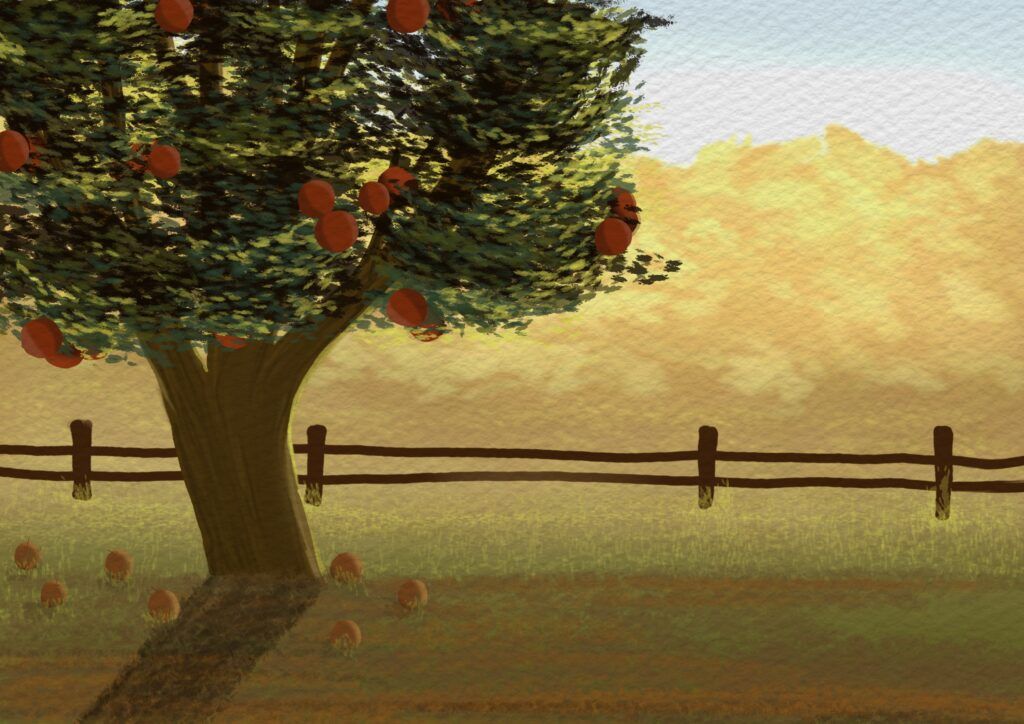
On the morning of her flight back to Chicago, she walked through the backyard one last time. The swing set was gone, but there were still marks on the ground, scars where grass wouldn’t grow. The apple tree was still there, its branches heavy with fruit, the same tree where her father had hoisted her high to reach the brightest apples while her mother sighed from the porch. “You spoil her,” she had called out to her husband. “Let her pick the ones off the ground.”
“But those are bruised!” Ellie had protested from her father’s shoulders.
“They’re perfectly fine,” her mother replied, already sighing over pies and cider and applesauce.
Ellie reached for an apple, surprised at how easily it came loose in her hand. For years she had called this place her cage, yet now she felt the strange pull of gravity, the recognition that escape had only tethered her more tightly. She reflexively stepped around the fallen apples until she heard the creak of the porch door. Without looking back, she bent over, gathering the apples from the ground, eventually using her sweater like a stretched-out hammock to hold them.
Her mother stood on the porch, arms folded, lips pursed, as Ellie dumped her haul into the empty bushel basket that always sat on the top step. She saw the lines of concern, etched from years of having to worry about supporting her family. In the times the mill shut down, the pie and cider money was all that kept food on the table. She did it quietly, without emasculating her husband. Ellie hadn’t thought about what that must have felt like, how her mother managed.
It struck her then how much of her own stubbornness, her grit, came from the woman on the porch. She had spent years calling it control; maybe it was just survival by another name.
“I suppose you’ll be glad to be leaving,” her mother said. “I know you’re busy so don’t let me hold you back.”
Ellie looked down at the apples, weighing her mother’s words. “Mom, you’ve never held me back,” she said, with a tremor in her voice. She leaned against the porch post, looking at the yard while she bit into a slightly bruised apple. She looked over her shoulder at her mother. “I can stay home a while longer. Maybe we can make applesauce with these.”