
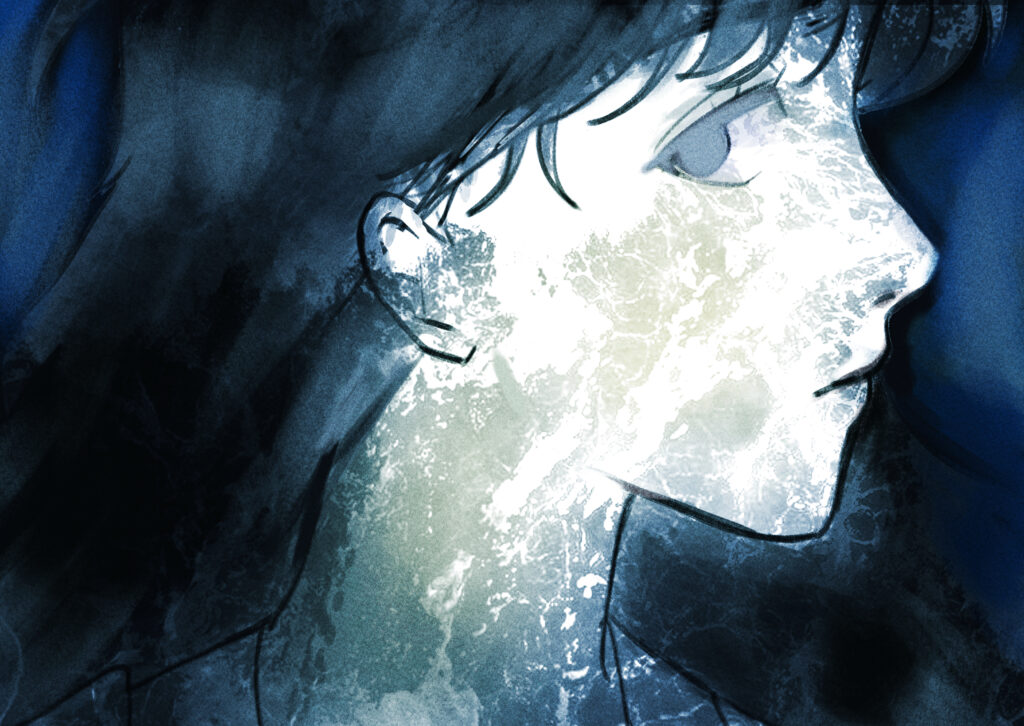
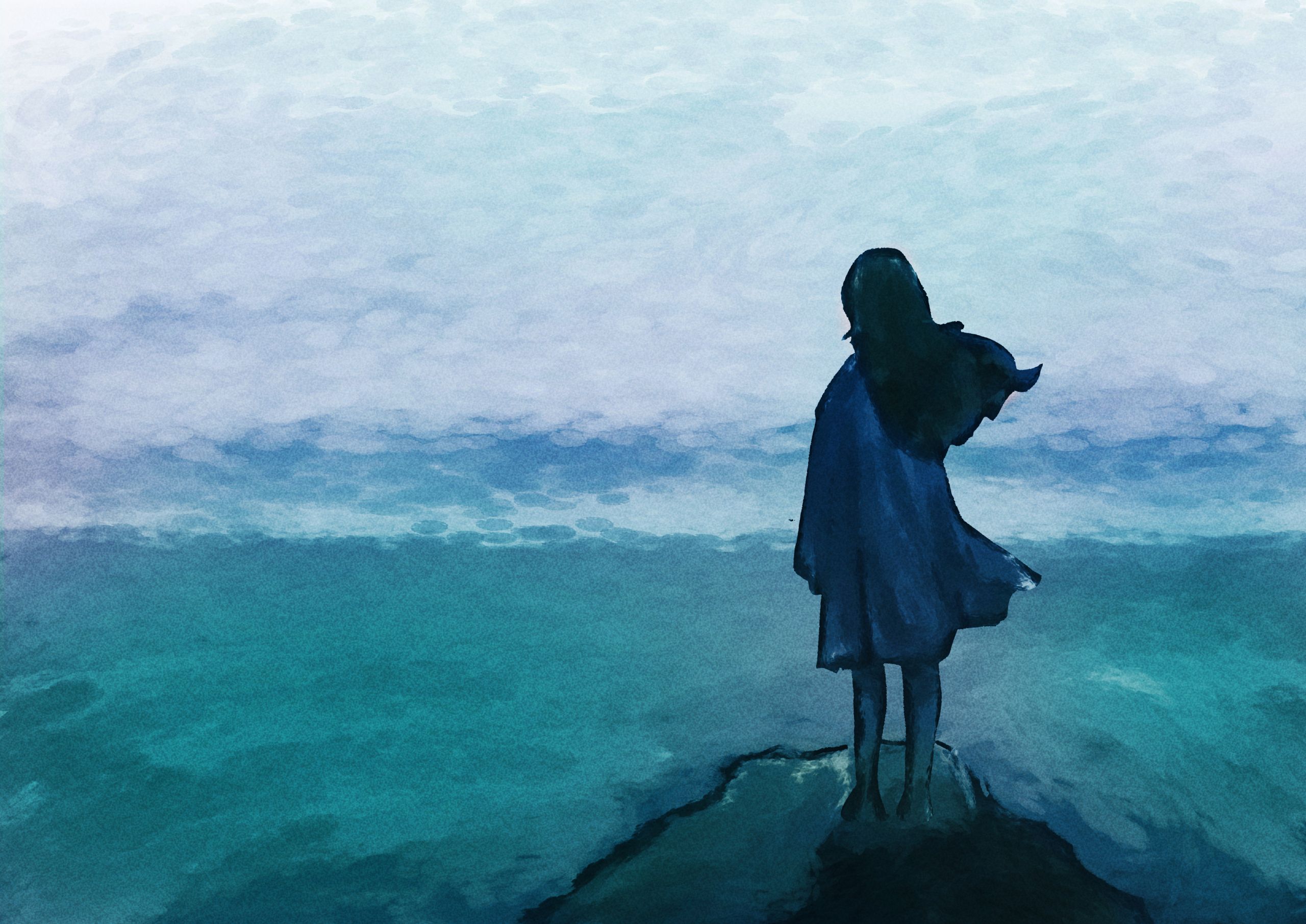
She stood at the cliff’s edge in Big Sur, where the land cleaves open like a wound and the sea roars up to meet it – not softly, but with the sound of something ancient and unresolved. The wind braided itself through her hair, tugging it toward the drop like a dare. She lifted her hand slowly and brushed the coarse fleck of salt from her cheek with two fingers. It had landed there without invitation, carried on the wind from the ocean’s belly, a grain of sea-matter, once valued as currency, that had found a home in the cradle of her skin. It clung – not wet, not cold, just present – and now it too lived between her fingers.
She smiled. The salt sparkled in the light, a tiny shard of earth’s deep history, brittle and perfect. She rolled it gently, meditatively, between the tips of her fingers – thumb to forefinger – until it softened under her warmth into something more intimate than mineral, more human than geology. Then, she brought her hand to her nose and inhaled.
It smelled like underwater mountains, the ghost of tidepools evaporated in sun. It was briny and layered – iron and wind and the memory of drowned forests. Sedimentary, she thought, and smiled again. Compressed centuries, dissolved lives. A scent that held both the ache of time and the wildness of now.
And in that moment, it felt familiar. As though her body had known this salt before – long before she stood on this cliff. As though something in her blood had once been ocean, and was only now remembering. She let the salt fall, finally, letting it go the way she had come by it – lightly, without ceremony. But something remained, a tingling on her fingertips, a hush inside her.
Below, waves fractured against the rocks in slow, thunderous collapse, again and again.
She had been here before – many times. Her boots knew the familiar grooves in the earth, the places where the grass gave way to crumbling sandstone, where the scent of salt and sage clung to the air. And still, it overwhelmed her. The vastness of it. The way the ocean didn’t care whether she was there or gone. The way the fog moved in like a thought she hadn’t yet earned the words for.
The cliffs here were not passive. They did not politely contain the view. They surged upward like a mutiny of stone, defiant and wild, jutting into the open jaw of sky. She felt, as she always did in this place, both infinitesimal and exposed – her thoughts as loud as the tempestuous waves, her pulse more insistent.
The sea below wasn’t blue but a combination of blue-black, grey-green, constantly shifting – a live thing, pulling in the sky, vomiting it back in fragments. It crashed in rhythmic violence that felt personal, like it was working something out. It was beautiful. It was brutal. It was the kind of beauty that doesn’t care to be loved.
She wrapped her arms around herself. Not because she was cold, but because she needed something to contain her. The wind, the water, the weight of the world pressing into her skin – it all felt like too much and not enough. Somewhere inside, something mirrored the ocean’s unrest.
This place had seen her many selves. The adolescent who came to marvel. The teen who came to survive. And now, this version – a woman still searching, still asking. As if the cliff might answer. As if the sea might offer acknowledgment.
She didn’t cry. She didn’t smile. She just stood there, suspended between the earth and the falling sky, and let herself feel the wild ache of it all. The haunting. The majesty. The unbecoming.
She retraced her steps, following the winding sandy path that had delivered her to the cliff’s edge today and so many days before. Shuffling across footprints that preceded her, Sam drew up an image of the body affixed to the feet. They couldn’t have been larger than a five and a half, slender, at least those still fully intact, not having yet been disturbed by the wind or another creature assuming the same path. A young girl, maybe seven or eight, light on her feet. She wears a faded cotton dress the color of seafoam, its hem brushing her knees as the coastal wind lifts it in soft flutters. Over it, an oversized oatmeal cardigan hangs loosely on her shoulders, sleeves swallow her hands. Her feet are bare, soles dusted with damp sand and seaweed strands. Around her neck, a simple leather cord with a beachglass pendant swings gently as she bounces. She looks back every now and then for her mom, smile wide across her face. Her mom’s footprints nowhere to be found. The little girl’s hair is wind-tangled and sun-kissed, a crown of wild waves. Tucked behind one ear is the sprig of dry lavender she picked.
Sam climbed the steps to the front porch. She had arrived alone mid-morning, a bag slung over one shoulder. The house she picked clung to the cliffs like a barnacle to rock, weathered and tired, its shingles grayed by salt and time. It’s not grand – no gates, no polished brass – but it stood with a kind of dignified exhaustion. An old sea captain who’s seen too many storms to pretend anymore. The bones of it were crooked with age, the porch slightly slumped, but every board exactly as it should be. The air smelled of brine and eucalyptus, and somewhere beneath it all, of woodsmoke and regret.
For the second time today, she unlocked the creaky blue door that stuck just enough to feel like a threshold. Inside, the light was golden and oblique, pouring through wide, uncurtained windows that open to the Pacific like arms flung wide. Hypermobile. The floorboards groaned softly beneath her steps, their voices more companion than complaint. The furniture a patchwork of generations – plump armchairs in sun-faded stripes, a long pine table worn smooth in the middle by elbows and laughter and turmoil and tears and quiet mornings spent with coffee and knicks from an old knife peeling apples.
A threadbare rug anchored the living room like a boat tethered to shore, and seaglass was scattered in bowls along the windowsills, catching the light and tossing it back in green and blue fragments. The walls were hung with paintings of the ocean in its many moods – tempestuous, gentle, unknowable. The house has spent decades trying to understand its own view.
There were ghosts here, but not the kind that rattle chains. Just a sense of presence, like something just left the room or was about to return. A hush. A heartbeat. The place felt held, kept. She put the kettle on the old enamel stove, opened a window to let the wind speak, and watched the sea blink under the late afternoon sun. Her friends would be here soon, but for now, the house was hers – hers and the ones who came before. The silence was deafening. And it was listening.
Sam moved through the kitchen, one hand gripping her cup of tea. Remnants of her grocery run on her way from the airport occupied the counters. Unattended bags brimming with green things and glass bottles of kombucha that had clinked like wind chimes in the backseat of her rental car. The fridge was stocked with chlorophyll and intention. She pulled a ceramic plate from one of the cupboards, a thin film of dust rubbed off on her fingers. Sam rinsed the plate before adorning it with avocado and other leafy things, grounding things, food that grew close to the soil.
She carried her plate of colors to the long pine table, its knots and grooves softened by her company. When she settled into the chair, she opened the latest essay from one of her favorite climate writers on her phone. A couple sentences in, and the words flared like a match in her chest. Line by line, she felt her blood rise, her breath catch, shorten. The essay wasn’t new in its revelations. The words themselves didn’t give rise to this bubbling reservoir of emotion – it was more or less a continuation of the dialogue to the tune of, what if we get this right, what if we imagine the future we want instead of the one we fear and steer clear of everything that could possibly thwart that narrative.
But something set her alight. Perhaps a combination of the writer’s tone – clear-eyed, mournful, blisteringly urgent – and the eminence of nature outside her window. Perhaps she was tired of this spin on the state of the world – she was fucking fearful. And visualization wasn’t going to save the world from the doom that awaits if we simply ask ourselves, what if we get this right.
The fork slipped from her fingers, a floret of broccoli dangling loosely from the tooth of the utensil on the other end of her rage. Sam pushed back her chair and took to pacing the floor as if she could walk her feelings into the floorboards beneath her feet. As if motion itself could hold her together. Her voice spilled into stillness, fragmented mutterings and full-throated exclamations that ricocheted off the walls. She began cracking open, splintering under the weight of knowing and not knowing, of caring too much and not knowing where to put it all. She felt for an invisible scarf around her neck to release the contraction of her throat. Her shoulders trembled. Her mind looped the same questions, each one sharper than the last. Her breath started to leave her in shallow, startled hiccups. A bird trapped behind her ribs flinging itself against the bone. The walls pressed inward. The room felt too warm all of a sudden. Too still. She imagined smoke instead of lullabies. Her hands went cold, despite the rising temperature of the room and the furnace of her body. She clutched her knees to her chest, perhaps gathering all her scattered selves – the girl who once planted sunflowers, the woman who contends with the notion of bearing children, the body trying to anchor itself in a world unraveling by degrees.
Tears came like thaw – sudden, unstoppable – and she was both drowning and dehydrated. She wanted to scream into the earth but all that came was a whisper – what more can I do?
Outside, a bird sang into the breathless skies. Pale and ordinary, those skies watched Sam come undone, not cruelly, not kindly, but with the vast indifference of something that has always been and may not always be. Light filtered through ozone like a dying promise. She lowered her body to the floor, laying back completely. Her chest still tight, but the tears now tapered into salt traces on her cheeks. Above her, the ceiling dissolves into sky, and for a moment, she imagined the atmosphere as skin – thin, precious, breakable, the only thing between them and the void. She felt its fragility mirrored in her own body. A leaf tapped against the glass windows framing the ocean, begging her to notice how it still moves. She pulled herself up, hugging her knees to her chest. The body insisted on surviving when her spirit stuttered, why, she didn’t always understand.
For fuck’s sake, Sam, she whispered to herself, voice cracked and trembling, trying to muster something resembling resolve as she peeled her body off the hardwood floor. Her limbs felt like wet branches – shaken loose by the storm and now expected to perform structure. The corners of the room still pulsed with that post-panic haze, a softness that wasn’t soft, but disorienting, stepping into the fog inside her own head.
She stood slowly, bracing herself on the table, eyes stinging, heart thudding out its lingering dismay, a metronome gone rogue. She tapped her phone. Two hours until the others arrived. Two hours until she had to smile like nothing was wrong, pretend that she hadn’t just dissolved completely over an essay – an essay, Jesus Christ. Like she hadn’t just imagined herself choking on the air of the year 2050 – hell, 2035.
She stumbled into the kitchen and ran the tap too long, watching the water spill from the faucet. As she cupped her hands and splashed her face, the shame hit hard, rising up bitter behind her teeth. What was she even doing? Crying alone in a borrowed house? She was supposed to be the one who held it together. The planner. The stable one. The one who could read a climate essay without spiraling into existential paralysis.
But this wasn’t like heartbreak or burnout. This wasn’t the sort of ache you could call your mother about. This was the grief of futures. The terror of inheritance. And the worst part was – no one did this to her on purpose. No one soul to blame. Systems too big to touch, too slow to change, and too urgent to ignore.
She looked out the window and saw the wind pressing through the tall grass. But even that felt hollow – like nature was trying to comfort her from a distance, and she knew, deep down, that nature had long since stopped being neutral. It was fighting for itself. The fires, the floods, the storms that moved like angry gods through towns. If she can breakdown, can’t they?
She thought of her generation – of friends scrolling on their phones between articles about heatwaves and mass extinction, and ads for sandals. Of Zoom calls with climate organizers in one tab, and job rejections in the next. Of the way they joked about not having kids not because they didn’t want them, but because how could they bring life into a world they weren’t sure would hold?
She dried her face on a kitchen towel and stared at her reflection in the microwave door – eyes puffy, mouth set, jaw tight with the effort of appearing whole. The ache hadn’t gone anywhere, but it had quieted, like a bruise no longer fresh but still tender when pressed.
All right, she hushed. Not to summon courage exactly, but because silence felt heavier than words. She started tidying the counter, arranging fruit in a bowl, lighting a candle. Anything to keep the despair from metastasizing.
Outside, the wind stirred again, more gently this time. And still, her friends would come. And she would smile. And she would pour drinks. And maybe, if the timing felt right, she would let one of them see the truth of her – not the panic, not the breakdown, but the tender, unspoken thing beneath it – the desperate love she still held for this world. The fierce belief she still had in this shit.