
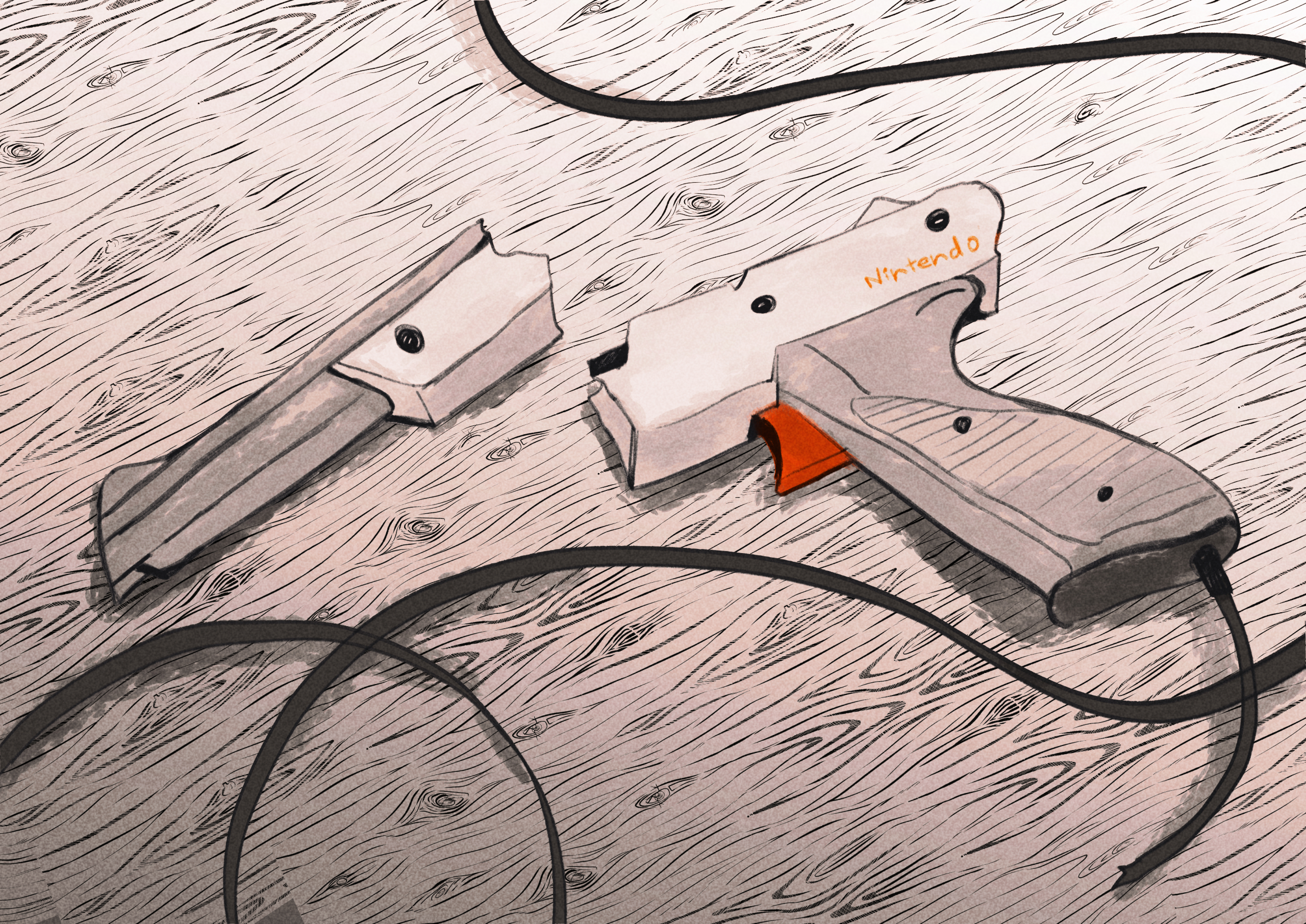
The summer of 1989 is known as the summer without video games. My parents would say they wanted to raise me the way they were raised, but what really happened is my mom threw my Nintendo down the stairs like Moses threw down his stone tablet (thou shall not play video games). And it broke in half like a stone tablet. She ripped the cords out of the wall like she was ending a patient’s life. She held the zapper gun in her hands and pointed it at my head. “It’s a beautiful day,” she said. “You need to go outside, or I will go insane.” So, I went outside. My mom locked the door behind me.
That summer between fifth and sixth grade I stayed at my best friend’s cottage on Crocker Lake. My parents gave me away for the summer and Matteo’s parents adopted me.
I like my new family. My parents are the age of grandparents. They’re Abraham-and-Sarah parents, my mom was forty-two when I was born. She liked to remind me that all her friends warned her about having a kid at her age, but she didn’t listen. Mr. and Mrs. Lopez are much younger than my parents.
The only time we left the cottage all summer was to go to the Super Mercado in Twin Lake for groceries or to go to church. We had to go to catholic church. It was Mrs. Lopez’s one rule, though she wasn’t what I call religious. Communion captures my attention, “this is my body broken for you, this is my blood spilled for you.” Not just words…
But the rest is boring. We sit in Prince of Peace Catholic Church trying to memorize the lyrics to the diarrhea song. I write it down and pass it to Matteo who passes it to his little sister Juna. She puts it into the offering plate.
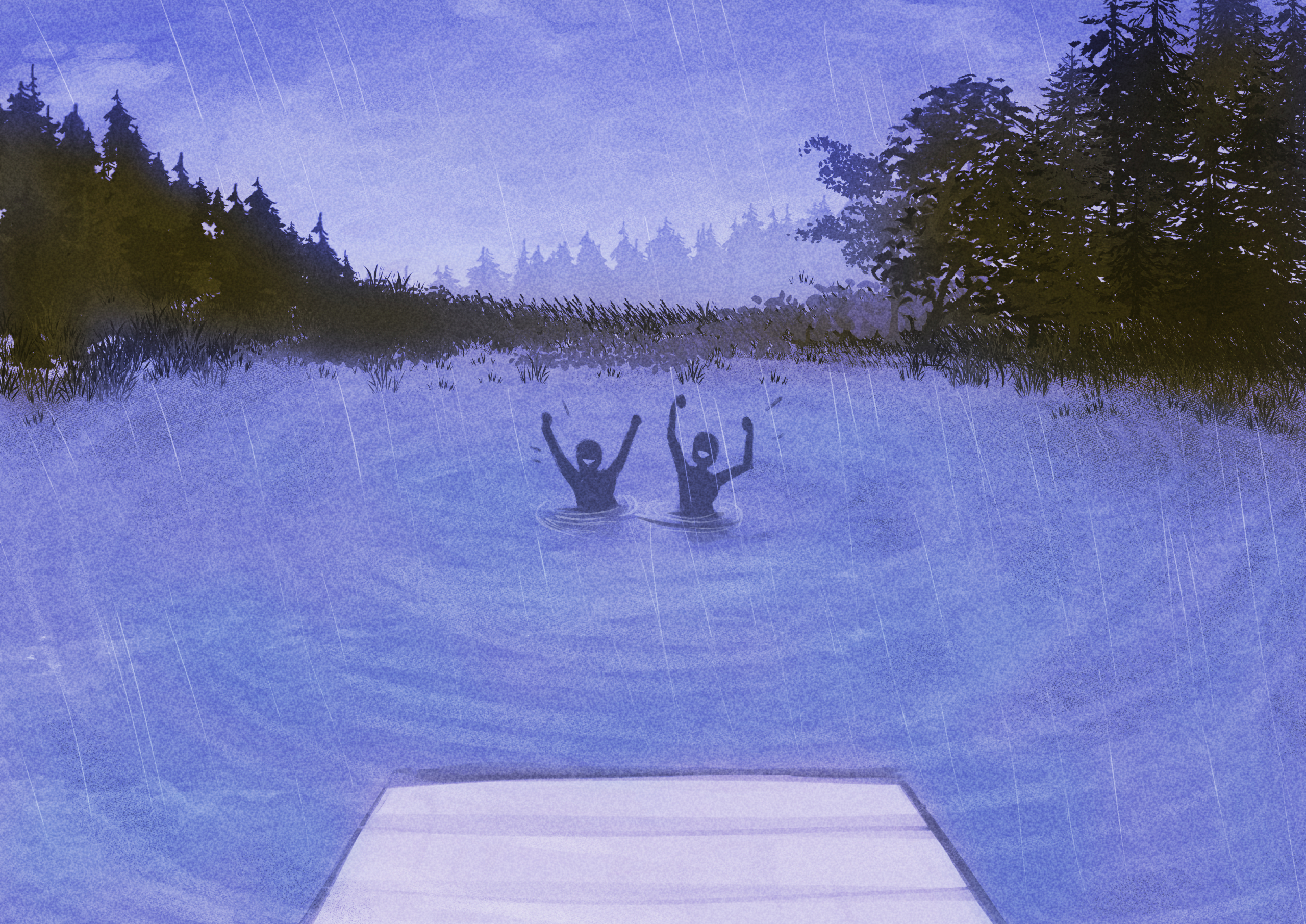
I’m in paradise. Matteo and I spend the summer swimming first thing every morning. The best is swimming in the summer rain. We go water skiing on weekends. Matteo’s dad Bruno can water ski barefoot. We go fishing with worms we find in the flower beds. We fish in a stagnant corner of the lake filled with lily pads. We caught little fish, yellow perch and blue gills the size of our hands.
We’re allowed to do whatever we want. We have our own paddle boat we take around the lake, looking at the summer girls in bikinis. We sleep in a tent in the backyard most nights, with heavy flashlights that double as radios.
Matteo’s mother Lola makes the best Mexican food, tacos al pastor with pork and pineapple, enchiladas in red and green sauce, tamales wrapped in corn husks and filled with beef. I’m hungry nonstop, especially after swimming.
“Ask your dad if it’s time to eat yet,” I said.
And Matteo asked his dad. “We just ate,” he said. “I know it’s not you asking. I know who’s really asking.”
Then I had Juna ask. “Ask your dad if it’s time to eat yet,” I said.
And Juna asked her dad. “We just ate,” he said. “I know it’s not you asking. I know who’s really asking.”
There’s no TV, but there is a set of The Little House on the Prairie books.
“Be careful with those books,” Lola said.
“It’s not the Mona Lisa,” Bruno said.
“To me it is the Mona Lisa,” Lola said.
“I don’t know if I approve of my children reading those books,” Bruno said. “White man books.”
“Of course they can read them,” Lola said.
“Hombre malvado is twenty-five when he starts making whoopee with Laura, who is still a little girl.”
There’s one other book at the cottage by this fellow named Richard Bachman called Thinner. The book has a bloody handprint on its cover.
“It takes a lot to get me excited about horror,” Bruno said.
“Imagine if Stephen King knew how to use words,” Lola said. “It’s about a man who eats all he wants but can’t gain weight, because of a curse.”
I ask Bruno if its ok if I read the Little House books to Juna.
“Just let me think about it,” he said.
He finally agrees. But what Juna and I do, is we pretend I’m reading the Little House books to her. Then by sleight of hand, I actually read her Thinner.
I fell in love with listening to the grown-ups talk in English and Spanish, a beautiful coordination with both languages. They use words like treasures. It’s glorious to listen to them talk, like hearing words change color. I listen and listen, and I wish I could listen better. My parents never talk.
Bruno and Lola would have their friends over and drink and smoke right in front of us. Miguel Angel and his wife Kissy, mujer blanca from Kentucky, they call her. And a large man named Hector. Kissy gets upset if they speak one hundred percent in Spanish.
“You know all the earth used to speak one language, one set of words,” Hector said.
“Babel-builders,” Bruno said.
They all smoke Laredo cigarettes nonstop, chain-smoking. They smoke their lungs out, and we breathe their smoke in. All the while we know cigarette smoke contains four thousand chemicals, fifty of which cause cancer. This is a dangerous childhood I had!
Bruno is amazed at how much I eat. He makes a big deal out of it. When he has his friends over, he calls them into the kitchen to study my eating habits, watching me eat menudo right out of the stockpot.
“You eat like a goat, kid. Cerdo grande y gordo,” Hector said.
“This boy is good friends with your cocina,” Miguel Angel said. “Is he a goat or a man?”
“That food is eating him as much as he is eating it,” Bruno said laughing.
“Like watching munching cows,” Hector said. “Masticando vacas.”
And I’m too full for words.
One time late at night I’m the only kid up and I’m listening to the grown-ups talk.
“Take a seat,” Bruno told Miguel Angel.
“Where does the ten-thousand-pound gorilla sit? Anywhere he wants,” Miguel Angel said.
Bruno is showing everyone his business cards, which say he’s a used furniture dealer.
“Do you sell furniture?” Hector said.
“It’s a jest,” Bruno said. “That’s what Al Capone’s business cards said.”
I liked hearing Bruno and Miguel Angel argue.
“Stop voting Democrat. Quit drinking from the fat cat’s toilet,” Bruno said. “Democrats gave us trampers, drug abuse and the grooming of kids.”
“It’s Republicans who did those things to us. Put your money where your potty mouth is,” Miguel Angel said.
Bruno said he gave five hundred dollars to Saint Mary’s food bank.
“You’re making a brag. Don’t make light of money. You’ve grown accustomed to money. How do you reconcile your corazon sangrando with your puno de hierro?” Miguel Angel said.
“I’ll speak plain English, the definition of an asshole is someone trying to be someone else,” Hector said.
Bruno tells about his idea for a nonprofit, for ugly girls.
“We will call it No Bonita. And we will hire men to take these girls to their prom. These girls who don’t go to prom. They don’t get asked. What do you call it?” he said waving his hands, in search for the word, “Self-esteem! These poor girls have low self-esteem. They marry some asshole from Albuquerque. No Bonita is not for white girls,” he said. “The men in the clubhouse want to keep it white. I speak for the girls of color.”
“Or else these chicas commit suicide,” Hector said.
“My nonprofit will decrease suicide,” Bruno said.
“You were always fighting bullies and gangs, now suicide,” Hector said. “In China people commit suicide by eating a pound of salt.”
“Let them eat salt! In China its either salt or get run over by a tank,” Miguel Angel said.
“I like your idea, but there may be some hombres, perhaps, too confident in the sexual realm, who will abuse this kindness. Get these teenagers embarazado,” Hector said with his hands holding his stomach.
“We’ll pay for the wedding,” Bruno said.
“They say half the people who get married in Kentucky are teenagers anyways,” Kissy said.
“Half of them are siblings,” Hector said.
“You just took the words right out of my mouth,” Kissy said
Then Bruno brings out the Tawney Port.
“I’m giving my liver what it wants,” Bruno said.
And they start to talk about Ted Bundy.
“He’s dead, electrocuted in January,” Bruno said.
“It’s such a sad story,” Lola said.
“Life is a sad story,” Miguel Angel said.
“Life, my friends, is a pile of shit,” Hector said.
“Sometimes it’s beautiful,” Kissy said.
“Don’t correct my English,” Hector said.
Bruno and Lola share a cigarette, passing it back and forth like a joint. They only smoke when they drink.
“Bundy and I would get along famously,” Bruno said, “because I understand him. Bundy started as a thief. It all starts with retail theft. He went from killing them to savoring them, ripping their young bodies open slowly. Those victims gave up too easily. They don’t fight back.”
Then he calls me to him. He uses me to reenact a Ted Bundy abduction, wrestling with me, overpowering me. They decided to do an experiment on me, tying me up. They gag me, to see if I can escape. The towel they gag me with smells like one hundred armpits.
Lola walked in on the experiment.
“What’s going on?” she said.
“We’re just trying something out,” Bruno said.
I think to myself, I might be in trouble here.
“Look at his eyes,” Bruno said about me, “the eyes of an animal being trapped. See the look in their eyes when they realize you are the last person they will ever see. Bundy understands people like to slow down and look at an accident. That’s how he got those girls.”
Bruno reaches for the Tawney Port.
“No more Tawney Port,” Lola said. “Leave the Tawney Port for the white folks.”
I want to tell Lola, No! Give them the Tawney Port and let them keep talking!
“You will soon have all the kids in the house tied up,” she said.
“I would never tie up my own children,” Bruno said rubbing his chin.
Matteo’s cousin Bell from Gary Indiana came to visit for two weeks. She’s fourteen. I asked her to go and ask for food, and it works! She came back with food for me!
I have a simple crush on her. We all sleep in the tent together. She suggests going skinny dipping one night when it’s too hot to sleep, and we did it. When she takes off her clothes, she catches me looking. We look wildly at the stars. She smokes! She lights a cigarette, and she smokes. She smokes like a movie star. She offers me the cigarette. “I will never smoke,” I said, “it’s very bad for you.”
The next day all our fun is over. Bell can’t go swimming because she’s on her period, her very first period. She can’t sleep in the tent because she’s having her period.
“No more sleeping in the tent for you,” Lola said.
The adults go crazy providing Bell every level of comfort.
“I need a four-letter word for a sign of love,” Lola said. She’s doing a crossword puzzle in the newspaper.
“Kiss,” Kissy said.
“Now you’re speaking my language white woman,” Miguel Angel said.
“I’m so glad someone’s reading those books,” Lola said, seeing me and Juna go outside with Little House books under our arms.
“I read those when I was a girl,” Kissy said. “It’s so wholesome that he is reading those books to Juna.”
“In the nineteenth century the number one profession in America was farmer,” Bruno said.
“I have no words for that,” Lola said.
Matteo has his thirteenth birthday in July. He’s now my age. I learned that Feliz Cumpleaños means happy birthday. We have a piñata, we have carne asada. I get him a Stretch Armstrong. His parents got him a pellet gun, which we can’t wait to take into the woods.
We shot at a crane and two white geese in Muskrat Lake. The full morning sun is hot, even in the forest. We can see mist clinging on the cattails, but we soon get lost in woods. We couldn’t find our way back, we even lost Muskrat Lake. Mosquitoes are everywhere. I’m bawling like a baby, eating unripe berries.
The birds won’t stop chirping, chatting. Woodpeckers hammer into tree bark with their pronounced beaks. I’m worrying about wolves, somewhere a wolf is waiting for us to grow tired. We find a two-track but that gets us even more lost. I’m bitter and exhausted, ready to quit. “Don’t shoot, don’t waste ammo, we may need it to survive,” I said. I keep thinking we will find a cave. It’s getting late. We’d have to sleep in a cave until they found us. But I wouldn’t be able to sleep in the cave due to all the unfamiliar noises and echoes. And bats! Terrifying visions of bats, with their superpowers, their echolocation.
How we got out of the woods is we walked north, then west, then south, then west. Then we ran into Duck Lake Road, which we walked down until we found Holton Road. Once we found Holton Road we knew how to get back to the cottage. We walked seven miles down Holton Road! Night fell on us like four walls closing in.
When we got back to the cottage it was very dark. How tired and feeble are my feet! They ache when I stop walking, and I start crying in front of everyone.
“He needs food, give him some food,” someone said.
I go back home the week before Labor Day and catch my mom playing The Legend of Zelda. She’d spent all summer mastering that video game. She’d even created a notebook with hand drawn maps of all the dungeons for the first and second quests!
I asked my mom, “What’s for supper. Do we have anything to eat?”
“Why are you talking like a Mexican?” she said.
In middle school, I walked into the boy’s room, and someone offered me a cigarette. That’s how I started smoking.
I walked into Matteo’s house when no one was home, that’s how I started stealing.
Once I realized Matteo’s house was always empty during the day, I started going to his house instead of going to school, eating Mexican food from their refrigerator, laying in their beds, napping. Watching TV with my hand in my pants like Al Bundy.
His house is always unlocked. I only steal small-time stuff, CDs, video games, a Saint Christopher medallion, the camel from a nativity set. I sell it at Genie’s Pawnshop for cigarettes. I found marijuana, but I didn’t take it. I found money, but I didn’t take it.
One time, Juna finds me. Just as I’m on the point of slinking out the door. I don’t know if she was in the house all along, or if she entered after me.
“Hello,” she said.
“Hi,” I said.
We are toe to toe. I’m holding a portable radio, a gold bracelet, and the real treasure—an English-Spanish dictionary.
She kisses me. Time stops and opens its eyes for the first time. I’m melting at the knees. Her lips are a slippery slope. I want her to take me to her bedroom, where we’d close the door. We’d make baby love.
We’re both embarrassed.
I want to say something, but I don’t have the words, so I kiss her again.
A car pulls into the driveway. Juna rushes me out the back door.
That’s it for me and Juna. I soon got someone pregnant, and Matteo and I didn’t hang out. He got into drugs. I got into diapers. I got a job at the age of fourteen. We had different friends. His parents soon divorced.
Now I’m forty, I have a wife and six kids. We live in a three-bedroom house on Lake Avenue, where you can see the smokestack from the coal-fired power plant from our front porch.
I go to a bar downtown with my wife. This is around the time they’re imploding the mall. People in the bar are talking, drinking, saying lovely things to each other.
I see Juna, with a group of girls. She’s beautiful. She’s tall. She still has her freckles. She still has jewels for eyes. She said she’s glad to see me. She’s with a bachelorette party, some friends from work. She buys me a drink. One word leads to another.
“You didn’t have to do that,” I said.
“De nada,” she said.
“Grassy ass,” I said.
“Are you making fun of my language?” she said.
“No,” I said. “I took three years of Spanish in college because of your family.”
She said something in Spanish.
“I have no clue what you’re saying,” I said.
My wife is a good sport, she lets us talk, though she’s showing a certain fatigue. Juna tells me she’s married. She’s a teacher. I tell her I have kids, she tells me she has kids. She tells me her parents got divorced.
“I knew that,” I said.
She said she lives in her parent’s old house. She said her dad’s rich.
“He was always rich,” I said.
She tells me Matteo’s in bad shape, drugs, cocaine and heroin.
“With those two bad things, bad things come,” she said.
He uses a wheelchair. Lola is taking care of him. He can’t take care of himself.
I told her my sister lost her teaching job. I told her my brother is divorced. She said Hector shot himself. Then I realized we’re telling each other bad news, but we can’t keep anything from each other.
Oh, how well we remember our summer together!
I even remember how Juna tried to remove her freckles with lemon juice. Juna even remembers how Operation was missing a funny bone, so we had used an orange tic tac until I ate it. We remembered other things, the blank checks we stole from her parents, the lyrics to the diarrhea song. “Thinner” we both said at once cursing each other like gypsies.
“Do you remember me getting lost in the woods with your brother?”
“No,” she said.
“Now don’t pretend not to have a memory,” I said.
“I’m not pretending, tell me.”
So, I told her what a baby I am, like I was offering testimony.
“Remember that face you made when you discovered the ingredients of menudo?” Juna said.
We talked about everything, except the kiss. Maybe she forgot, or maybe it didn’t happen.
I’m sitting in the car with my wife.
“She didn’t mention the kiss,” I said.
“That’s the girl?” my wife said.
After all, I had told my wife about the kiss many times, too many times. Like I was the artist whose fame rested on a single painting called “The Kiss.” How I told my wife is not how I’ve told you. I told her it was a little girl’s kiss, and that nothing that strange has ever happened to me.
“It’s obvious she wouldn’t want to bring it up since I was there,” my wife said. “If you want to talk about it so badly, go back in and ask her. I’ll stay in the car, go back.”
So I go back in the bar, but Juna’s not there. When I come back outside my wife is gone. Three men stumble out of the bar after me, drunk, drunk, drunk, carelessly slurring my beautiful words.