

Now
The night was cooling fast, the sky washed in that soft, church-parking-lot sodium glow. He eased his hybrid to the curb in front of a tidy brick house in a cul-de-sac that might’ve looked identical to the others if not for the sagging basketball goal and the slightly rusted mailbox flag bent at a 45-degree angle. His daughter’s friend unbuckled, said something polite and practiced—“Thanks for the ride, Mr. McNeil”—and jogged toward the porch, hoodie swinging at her hips.
As he pulled forward to turn around, the beam of his headlights swept across the family’s parked minivan in the driveway. The tag: APR 2025.
Three months expired.
It shouldn’t have mattered. It didn’t matter. But Danny’s brain snagged on it. A flicker of nervous calculation ignited—What if someone had noticed? What if a cop drove by? What if the kid’s dad had come out and struck up a conversation? The reflex rose in his throat like acid: You know how DMV stuff slips through the cracks…
He hadn’t said anything, of course. No one had asked. But still, he’d rehearsed the deflection, the softened story. The lie—not the kind meant to deceive, but the kind meant to hide. Not from others, but from shame.
He parked in his own driveway a few minutes later and didn’t go inside right away. The house was lit, the porch bulb glowing warm above the azaleas. But he sat in the car, one hand still on the gearshift, watching the digitized clock blink forward. It unsettled him—the way that old, soft panic had emerged so easily, so naturally, over something that didn’t involve him at all. It was muscle memory. Not the memory of driving, but of explaining. Of covering. Of ducking out of judgment before it fully formed in someone else’s eyes.
He thought about how he’d learned to do that. When. Why.
And suddenly, the name Nash Gentry bloomed in his mind like a migraine.
Then
The fellowship hall at the Pensacola retreat center had been repurposed for the evening’s Bible study. Stackable plastic chairs formed uneven rows, and the teenagers—still damp from the Gulf, sand dried in the creases of their ankles—slouched and rustled through paper-thin handouts printed with verses and questions. A few of them, including Danny, had a sheet of notebook paper folded discreetly in a lap, trading comments back and forth in the universal language of adolescent boredom.
Danny was thirteen. It was the summer before high school. He wore a Myrtle Beach shirt with a seagull stitched on the pocket and still half-believed he might return from this trip changed—more interesting, more confident, more connected to something bigger than himself.
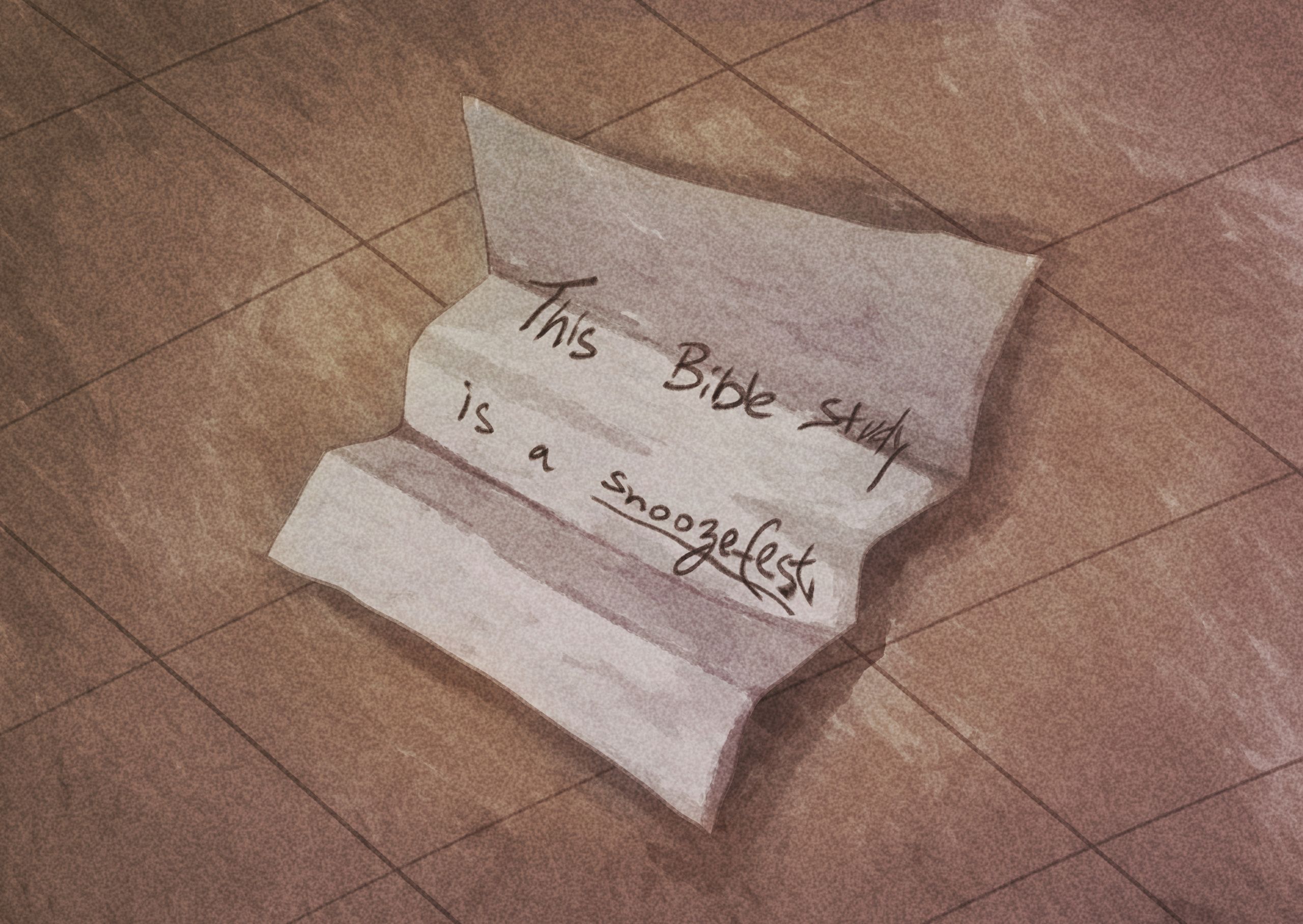
He passed a note to Chad Rowell during a lull in the lesson. “This Bible study is a snoozefest.” A joke, barely that. A vent. A whisper shared between the bored and the breathing.
Chad laughed. Then, like a switch flipped, stopped laughing. He passed it over to Mark Dupree, and then he past it on to Charlie Staples. And he passed the note forward.
To him.
Nash Gentry.
Deacon. Occasional youth leader. Father of Amy and Becca. A man with the look of someone perpetually disappointed, even when he was smiling. He read the note silently, blinked once, then rose to his feet.
“I think we should take a moment,” he said, his voice somehow both genial and cold. “Some of us are struggling with the purpose of tonight’s study.”
The room shifted. Heads turned. He hadn’t named names, but everyone knew. Chad was staring at his shoes.
Nash held the note like a napkin he’d pulled from a used tray.
“I won’t embarrass the young man who wrote this,” he said, already doing exactly that, “but if the Word of God is a ‘snoozefest’ to you, maybe it’s time to reconsider what you’re doing here.”
Silence spread like spilled water. Danny stared at the overhead light, throat closing, every hair on his arms standing at attention. His face burned.
The rest of the lesson was quiet. No more notes. No laughter. Just Nash’s voice, unwavering, as he continued the handout as if nothing had happened.
Later that night, in the dorm room, Chad apologized—kind of. “I didn’t think they’d pass it on. I thought they would agree.” Danny shrugged, pretending it didn’t matter. Pretending he hadn’t just been taught something: that honesty could be dangerous, and that adults like Nash Gentry didn’t correct in private. They performed power for an audience.
He didn’t sleep much that night. Not from guilt. From shame.
Then
He arrived at the Gentrys’ house in a borrowed sport coat, slightly too large in the shoulders, and khakis with a faint ironed crease he’d tried to revive with steam from the bathroom shower. His boutonniere, a single white carnation, trembled in his palm as he rang the doorbell.
The Gentrys lived in a updated farmhouse that had been in the family for generations out on acres of land off of Five Forks Road at the end of a cul-de-sac; their lawn shaped by a landscaper’s precision—no bare spots, no weeds, just plush, obedient green. His own front yard had patches of stubborn clay and crabgrass, and he’d helped his dad stretch a garden hose from the neighbor’s spigot more than once when the water bill went unpaid.
Amy opened the door, her dress a pale lavender with ruffled shoulders and a ribbon at the waist. Her smile was genuine. Grateful. They’d been friends for years, and she seemed to know he didn’t quite belong in this setting.
Behind her, Nash Gentry emerged from the hallway in a blue blazer, hair combed back like a news anchor. He looked the boy over—up, then down—and offered a handshake.
“You clean up well,” he said, which could’ve been kind. Could’ve been.
The camera came out. Amy’s mom, Jan, adjusted the lighting in the foyer, posing them beneath a framed print of the Beatitudes rendered in colonial script. Nash Gentry stood just off to the side, hands folded like a judge between rulings.
“Stand up straight, son,” he said, not unkindly. But not warmly, either.
The photos clicked. Amy looked radiant. He looked like a guest star in a show that had already been on for a few seasons without him.
In the car, en route to the gymnasium where the dance was held, he adjusted his jacket sleeves and kept checking his breath. Amy talked about school, about music, about how she hoped they played something from INXS. He liked her laugh. He liked the way she didn’t make a big deal about this being a date.
And still, the shape of Nash Gentry’s disapproval clung to him like humidity. Not for anything he’d done—he hadn’t even passed a note this time. Just for what he wasn’t. The kind of kid who belonged. The kind of kid who came from tidy lawns and fitted jackets and the unspoken confidence of knowing nobody in this room was judging your father’s car.
When the photos came back a week later—developed at the Eckerd Drugs in Lilburn—he looked at his own expression and thought, I look like I’m trying to disappear.
Now
The link came from a friend, a group text chain where they shared old church photos and half-hearted reunion invitations. He almost didn’t click it—he usually didn’t—but something about the subject line, “Lilburn Royalty Honored by State”, caught his eye.
It was a scanned resolution from the Georgia State Assembly, dated ten years earlier but newly unearthed, commemorating Nash Gentry’s service to the community. It praised his decades of legal work, his tenure as a deacon, his commitment to youth, and his leadership on the Downtown Development Authority.
The language was dense, ceremonial—Whereas, Mr. Gentry’s integrity and example have shaped a generation… Whereas, his service to the church and the city remains unmatched…
He stared at the screen, jaw tightening. A strange feeling welled up—not quite anger, not quite envy, but something closer to disbelief. Not because it was untrue. Nash Gentry had done those things. He was that man, to them. And yet, the man in the proclamation shared almost nothing with the one who’d made him feel so small.
He wasn’t angry at the page. He was struck by how easy it was to be erased. How someone’s legacy could be carved in marble while the bruises they left behind lived only in the soft tissue of memory.
He didn’t even notice his hand gripping the side of the desk until his knuckles went white.
Nash Gentry. Honored. Admired. Still called “Brother Gentry” by people who probably had no idea what it felt like to sit under his gaze with a borrowed jacket and a trembling boutonniere.
He thought of his parents. What would they have said if he’d told them about any of it? About the shame, the setups, the questions they didn’t prepare him to answer?
They would’ve shut down. Maybe denied it. Maybe said, “Be respectful.” But mostly, they would’ve shrugged it off, like houses during a controlled demolition, blaming it on misunderstanding and not malice. They were doing their best to blend in. There was no room for someone else’s embarrassment.
So he had absorbed it. Quietly. Efficiently. Like the carpet under the communion table that covered the stains from every spilled cup.
And maybe that was what struck him now, sitting alone in his office, watching the cursor blink below Nash Gentry’s name. Not the honor. Not the decades of community service. But the way shame had a way of curling into your own voice, your own posture, your own instincts—so much that, even now, decades later, he still thought of how to lie his way into safety before anyone even asked a question.
Then
It was supposed to be a simple youth night. Pizza in the fellowship hall, a handful of games, a few praise songs led by the student a cappella trio before Brother Gentry—Mr. Gentry, as his daughters called him—delivered a devotion on “integrity.”
But two of the three singers were no-shows—one with the flu, the other grounded for sneaking off to see Die Hard.
Danny,, thirteen and deeply uncomfortable in his own skin, was the third. The Frozen Chosen, those that raised funds to rebuild the church when lightning struck and set it afire, loved to hear Danny’s voice on Sunday mornings. Danny had the kind of voice that soothed older ears but did not mean much to his own generation. He sat off to the side, assuming the singing would be skipped or they’d throw on a cassette tape from the AV closet.
Instead, Nash Gentry clapped his hands and called for silence. “Well, looks like God has a soloist tonight.”
The room turned toward him.
Danny froze.
He knew the songs—they practiced every week—but he didn’t know the keys, or how to start them. He had never led anything in his life. His voice was fine in the middle, buried. Singing by himself was one thing, leading others alone was another.
He opened his mouth to protest, to say something—anything—but Nash was already ushering him forward, a hand gently pressing between his shoulder blades.
“It’s good for you,” Nash said, sotto voce, smiling down at him with that patronizing warmth that somehow made everything worse.
He stood at the front of the room, pulse in his ears, unable to remember a single opening pitch. He stumbled through the first verse of As the Deer, voice cracking on every high note, breath skipping, eyes darting toward the back where Nash stood with his arms crossed.
When he finally sat down—stomach churning, cheeks burning—the room politely clapped. Nash did not.
Instead, Nash said, “Let’s give him credit for trying. Even when unprepared.”
That stung more than the performance.
It wasn’t just the moment—it was the subtle message: I can put you up here anytime I want. I can show them exactly how small you are.
Danny would replay the sound of that phrase—”even when unprepared”—for years. Not because it was overtly cruel, but because it was offered as kindness, wrapped in the same voice used to praise top students and pray for the sick. A performance of humility masking a performance of dominance.
He began, from that night forward, to build defenses. Quiet ones. Internal rewrites. Phrases rehearsed. Escape hatches invented. He would never again be caught unready—even if that meant lying.
But it wasn’t the dishonesty of trying to pull something over on another person. It was the dishonestly of subversion and distraction. And to Danny’s mind, that must have been a lesser sin.
It had to be a lesser sin.
Then
It was a Sunday evening, one of those quiet rides in Nash Gentry’s white Cadillac after church when the air felt scrubbed clean from three hymns, a sermon, and the din of youth group chatter. Nash Gentry had offered to drive Danny home, since his parents were tied up with post-service cleanup.
Danny climbed into the plush front seat of Gentry’s Cadillac, trying not to touch anything—polished wood paneling, the faint smell of pipe tobacco and lemony leather. Gentry drove with one hand, the other resting lazily on the wheel, his eyes always scanning—intentional, methodical, the way he seemed to observe the world for weak spots.
They turned into the apartment complex just off Arcado Road, past the sagging chain link fence and the weedy corner lot where old tires collected rain.
That’s when Gentry saw it—Danny’s family car, a pea-green ’77 Crown Victoria station wagon, wide as a barge, squatting low in the driveway.
Louisiana tags.
Two years after they’d moved.
Gentry slowed and tilted his head slightly. “Still got those old plates, huh?”
Danny, thirteen, smiled faintly. “Yeah,” he said.
A pause.
Then Gentry: “Why hasn’t your dad changed the registration?”
The question wasn’t cruel in tone—it was casual, lightly curious, as if they were talking about the weather or a football score. But Danny felt the air suck out of the car.
He didn’t know the answer.
He had never thought to ask.
But to say I don’t know felt like an admission. And somehow, admitting not knowing about car tags—especially to a man like Gentry—felt like confessing to something deeply personal, something embarrassing. So he lied.
“To avoid the taxes, probably,” he said, in a voice trying too hard to sound knowing.
Gentry chuckled. Not cruelly. Not kindly either. Just a dry noise that made Danny feel as though he’d made a mistake, but Gentry wouldn’t bother correcting it.
There was no follow-up. No lecture. Just a beat of silence that said: I see everything I need to see.
And Danny, burning now with shame, stared down at the floor mat, a hole worn through where heels had dug in.
That lie—small, reflexive, pointless—would echo louder than most truths he told that year.
He realized then: the lie didn’t come from malice. It came from a survival instinct. A thin little shield between him and Gentry’s gaze. He would go on using that shield, again and again, for years.
He would want to confront his father, but when he walked inside he saw his parents gathered around a dinner table with bills unfolded before them. Both of his parents looked tired, trying to pay ten bills with only the money for seven of them.
Then
The phone had been dead for three days when Nash Gentry asked why he couldn’t get through.
They were standing outside the sanctuary, jackets slung over one shoulder, the early fall air carrying the sour smell of overwatered grass. Nash Gentry had tried calling to talk to Danny’s father—details blur. What remained, even now, was the question.
“I tried your house three times,” Nash said. “It just rang weird. Like not even ringing.”
Danny’s heart skipped. He shrugged, a little too casually. “Yeah,” he said. “My sister got in trouble for calling all her friends long distance. Dad said she blew like a hundred bucks on the phone bill.”
It came out clean. Quick. No hesitation. The lie arrived fully formed, like a reflex. Like a muscle twitch.
Nash cocked an eyebrow, bemused. “Is that so?”
Danny held his gaze for a moment, praying to God the question was rhetorical.
And that was it. Nash moved on to talk with someone else while Danny stood there, heart racing.
But later, sitting in his bedroom with no dial tone humming through the receiver, Danny stared at the beige plastic shell of the phone and felt a small, hot knot form in his chest.
His sister hadn’t done anything. There were no long-distance calls. The truth was simpler and colder: the bill hadn’t been paid. Again. Just like the electricity last month. Just like the eviction notice the year before.
They lived in the apartment now. His dad’s station wagon still had Louisiana tags. His mom bought groceries with coupons and said things like, “This’ll have to last us ‘til Friday.”
But none of that could be said aloud.
To say the truth would’ve felt like stripping naked in the cafeteria. To admit it—to Jason, or anyone—would’ve made it real. The shame wasn’t just about being poor; it was about being seen as poor.
So he lied.
And something about how easy it had been—how automatic—stuck with him.
Not just the content of the lie, but the fact that it had offered him a path out of humiliation, and no one had noticed.
He didn’t plan to become a liar. He didn’t relish it. But in that moment, he learned something crucial: you could stay safe behind a lie, if you built it fast enough.
And so, over time, he got faster.
Now
He sat for a moment longer in the driveway, engine idling, the soft tick of cooling metal punctuating the silence. The kid had already slammed the car door and jogged toward the house, backpack bouncing. At the steps, she paused to jiggle the handle—locked. She rang the bell and waited.
The car in the driveway still bore the sticker: registration expired three months ago. A minor oversight, probably. A bill forgotten in the shuffle of a busy life. But Danny felt the old flutter in his gut anyway—an instinctive brace for shame that wasn’t even his.
He imagined the kid being asked about it. Imagined the way a question like that might land: not harsh, but precise. The way Nash Gentry used to do it. Just enough judgment to plant a seed. Just enough silence after the question to make a boy fill it in with a lie.
And then the words came, so easily. “To avoid taxes.” Or whatever today’s version would be. Anything but the truth.
He put the car in reverse, backed out carefully, and turned onto the street.
As he drove, he thought about the thousands of little lies he’d told—not to deceive, not to manipulate—but to stay upright. Lies as scaffolding. Lies as insulation. Lies like stitches, holding something together until it healed.
It hadn’t made him dishonest. Not really.
It had made him resourceful. Adaptive. Human.
“It wasn’t deception, exactly,” he thought. “It was survival. Because I was a kid, and it worked.”
In the rearview mirror, the kid was already inside. The door had opened, someone had let her in.
He turned up the radio, something soft and forgettable filling the car.
Ahead, the streetlight turned yellow, then red. He slowed to a stop.
And for the first time in a long while, he let himself feel just a little bit forgiven.