
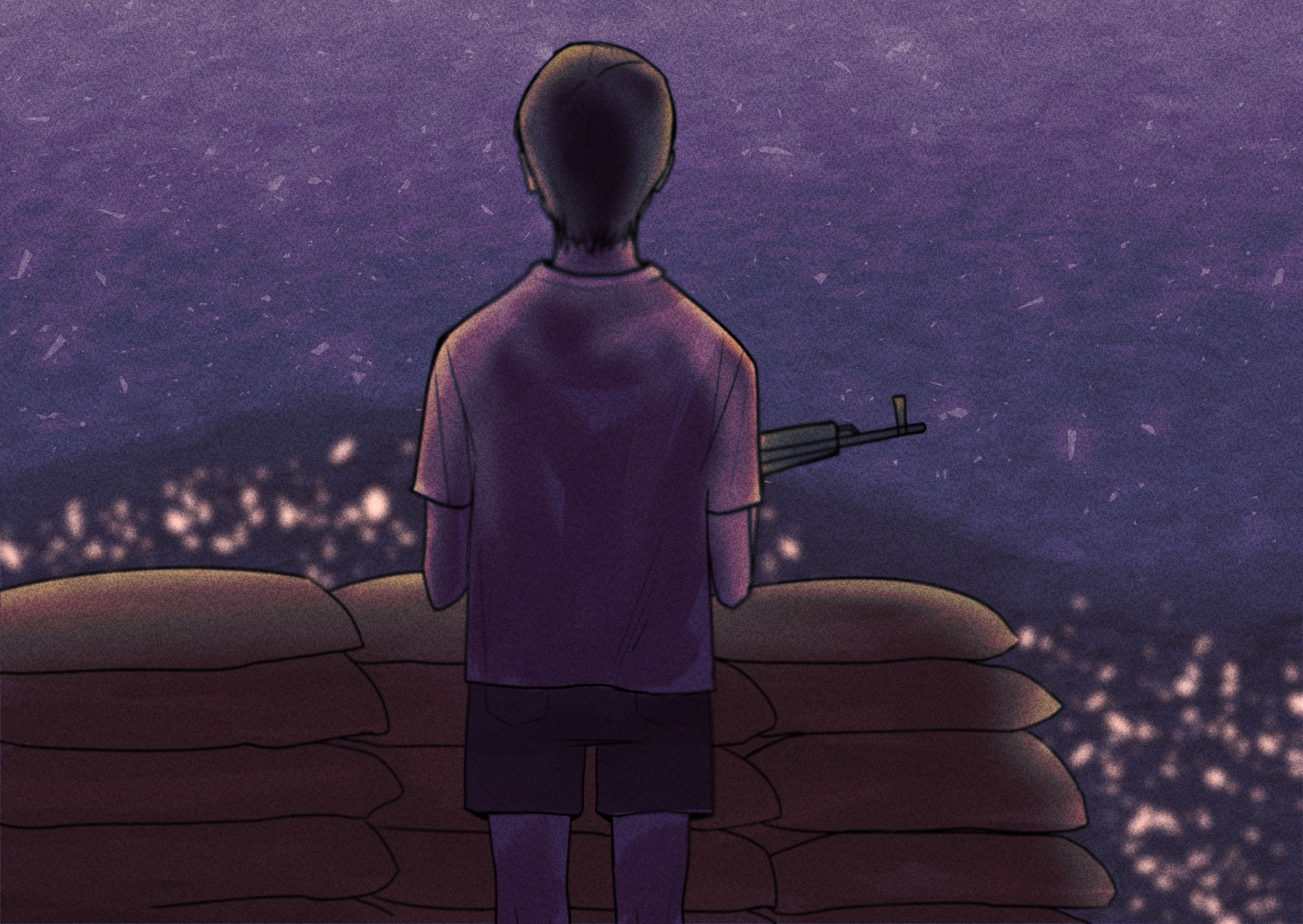
Stacked sandbags. I wear Havaianas flip-flops and a tank top, holding an AK-47, observing the largest favela in Latin America through a crack at the top of a cliff.
Tonight is the final episode of the eight o’clock novela. There are hundreds of thousands of points of light. I am responsible for the South sector. In my hands, high-precision binoculars reveal the police station on the main avenue.The patrol cars are leaving from there, dozens of blue and white vehicles. The red sirens on the roofs flash. Around me, darkness and complete stillness. I turn the binoculars toward my parents’ shack. Mamãe is in the kitchen, and Papai is beside her, helping to pick the stones from the beans. The TV is on to watch the ending.
“If you can see someone’s face, they can see yours too,” Papai used to say when he saw me on top of a chair, with toy binoculars propped on the window, pointing at the top of the hill. A circle of tattooed youths. One of them had a massive gold crucifix around his neck. A thin mustache, brown skin, and a scar on his forehead. He turned his face toward me. Startled, my binoculars fell to the ground and the lens shattered. Túlio ‘Navalha‘ discovered me that day.
“The vermin are coming. May God have mercy on them. We won’t. Take your positions.” Túlio on the radio. I lean against the pile of sandbags. One of them tears, and sand sticks to my sweaty back.
I prop my binoculars on the stone block so I can clean my shoulder. The sling holds the rifle against my neck. There isn’t even a breath of wind. I crouch to grab my water bottle. To this day, it hurts when I have to bend my knee. I end up losing my balance, and my left leg knocks the binoculars over. I hear a slight sound of breaking glass.
“Motherfucker,” I whisper.
Maybe it’s better this way. They won’t be able to see me.
I finish drinking all the water from the bottle. I toss it into the air and kick it, leaning my body into the strike. It flies far, hits one of the posts of a small improvised goal made of PVC pipes, and goes in. Two boys were playing soccer there this morning.
It was a sunny Saturday, the ball was in the air, I adjusted my body for a volley, and with the instep of my right foot, I kicked with precision. It hit the post hard before bulging the net. I ran to Papai. He was kneeling, kissing his wooden rosary. We were champions of the community tournament. There was a scout from Flamengo that day. I saw him pointing at me.
Papai bought me a guaraná natural. Sweet and sour, how I loved that. I only drank it on special days. On the way home, a policeman waved to me: “Great goal, craque. I want to see you at Flamengo one day.” Today he was Delegate Perini, commander of the operation.
From my position, I can see Flamengo’s stadium now. Its floodlights were on that day. Tiny dots ran from one side to the other on that enormous green carpet. I pick up the binoculars to try to see the ball, but the view is blurred because of the broken lens.
The first sounds of gunfire begin. I strain my eyes to see the other positions. “No one abandons the trench. Today the men are separated from the boys.” Túlio is sealing our fate.
“Do you want to be one of us in the future?” A huge white banner with blue letters was placed at the school entrance on Vocational Day. The lists were on the classroom doors, and I ran to put my name down. Only for two talks: soccer player and policeman.
Oscar grew up in the same alley as I did. He loved guaraná natural. There was no meat at home, but he ate beans every day. He went from being the star of the community pitch to a spot on the Brazilian national team.
“Good luck, future champion, a hug from Oscar.” I couldn’t take my eyes off the autograph on the sleeve of my shirt as I left the school gate. That was when I heard: “Psiu, psiu, Juliano, come here real quick.”
It was Túlio. Leaning against a lamppost, smoking a cigarette with one hand and holding a crumpled piece of paper in the other.
“Was the conversation with Perini good?” he asked, crumpling the paper even more.
“Ye-Yes. I liked it. But I preferred Oscar’s. I want to be a soccer player.”
He pulled the sleeve of my shirt to read the autograph.
“Who doesn’t want to be a soccer player? The sun rises for everyone but only shines for a few.” And he threw the cigarette on the ground, spitting from the corner of his mouth. Silence. He continued: “You are a good observer. That is very important. I have a position for you. I see you as the star of my team.”
He stretched out his hand and gave me two R$100 bills, along with the crumpled paper. “Buy something for yourself and for your parents.” I took the bills and the paper, my hand trembling.
“You know where to find me.”
On the way home, I put the bills in my pocket and opened the crumpled paper. It was the list of all the students who participated in the talk with Perini.
I opened the front door; Papai was sitting with a guaraná natural in his hand. “Tomorrow we’re going to see Flamengo‘s stadium up close. They called you for a tryout.”
The coach threw me a red vest. Papai waved from the bleachers. I walked to the center of the field and looked at the Rocinha favela from a distance, searching for my house. The training began. I positioned myself on the front line. Right on the first ball, I received a pass on the left wing, controlled it with elegance, a shimmy past the first marker, entered the penalty area, and… from behind, a defender came in cleats-first at my right knee. I felt a snap, tried to stand, but the leg couldn’t hold me. I sprawled on the ground.
In the infirmary, the doctor lamented what happened: “We need an MRI to confirm, but I think you tore your anterior cruciate ligament. You’ll need surgery. Six to eight months recovery.”
My eyes filled with water. Papai gave me a strong hug, promising that we would return, but knowing that it wouldn’t happen. That night, I didn’t sleep a single minute. I heard Papai crying for the first time in my entire life. He prayed the Our Father repeatedly and asked God to bless me.
The R$200 was enough for Mamãe to rent a small beauty salon on the main street. That afternoon, I decided to walk down the alley to see her.
“Who killed Roberto Maciel?” I stopped for a second at the bar on the corner, about thirty meters from Mamãe’s shop. The small TV on top of the beer cooler flashed the faces of the main suspects.
The favela had talked about nothing else for days. I placed my hands on my hips. The bar owner hurried over: “Need something, Seu Juliano?” I was responsible for collecting the tax on the street. “Nothing, Seu José. All good.”
“Don’t miss the final episode of the novela O Sol Nascente tonight after the news.”
I lit a cigarette and stood outside the small studio. Mamãe had worked as a manicurist for forty years. When she didn’t have a place, she used our living room.
With the salon rent on the main street, the number of clients doubled. We started having guaraná natural three times a week.
She told all her clients that I’d gotten the money for the rent selling phones at Seu Irineu’s shop.
I waved to Mamãe through the glass. I watched her wet the cotton with acetone and carefully remove the polish from Dona Jurema’s nails.
“Heavens, Jurema. It’s not Juliano, no. He’s always been loyal to Seu Roberto—very discreet and polite. I think the killer is that Conrado. I’ve suspected him from day one. That one’s a snake.”
Jurema laughed. “You think it’s him because of his tattoo and earring? Stop with the nonsense, Mariette. That’s old thinking. Every young man has those nowadays.”
“My Juliano doesn’t,” and she kissed me on the head when she saw me sitting beside her, stubbing out my cigarette in the ashtray.
Jurema turned her face toward me but quickly looked away to her nails.
“The Juliano in the novela is so handsome, Jurema. It’s a name for handsome men,” she said, looking at me. “Besides, since when does a driver kill his boss? Juliano didn’t do anything. I’m certain.”
On the way back, I heard the beep on the radio:
“Heartthrob, Heartthrob, you copy?” The joke about my novela namesake irritated me, but I tried not to show it to the others.
“Yeah, Túlio. I copy.”
“Tell us, today do you kill or do you die?” He spoke with a laugh, which generated other reactions on the radio: “Heartthrob assassin.” “Why’d you kill Roberto, you traitor?” I passed the radio from one hand to the other, pressed the button to respond, but let it go.
Sunset was arriving. The last rays illuminated the rooftops of tens of thousands of shacks. Most of them made of concrete slab, fiber cement tiles, PVC.
The few covered with metal sheets reflected and gleamed like tiny stars in a sea of darkness.
That night, the stadium floodlights go out as soon as the last practice of the day ends. The sounds of gunfire now mix with the shouts of residents. A news bulletin interrupts the novela: “Police Operation in Rocinha live, we ask residents not to leave their homes.”
The radio messages don’t stop arriving. “Ribamar is hit,” “Go up, go up, give me cover, Damião—Galhardo shouts,” “Shot in the leg, help me—Robinho speaks with labored breath.”
All the names on Túlio’s list. It is our reunion with Delegate Perini.
Robinho reaches my position. He collapses behind the sandbags. His leg is bleeding profusely, a deep, wet crimson. He tries to stanch the flow, yanking off his own shirt and pressing the fabric against the wound, but the cloth is already completely soaked, turned a dark, uniform red. Robinho doesn’t speak; he simply lays his head back against the stone and closes his eyes.
“Wake up, Robinho, wake up,” I shout, giving him light slaps on the face. I look around. But I quickly have to cover our bodies with the sandbags. A police helicopter flies near the South sector with night searchlights. Over the loudspeaker they say: “The favela is surrounded. Raise your hands and come out of your hiding places.”
I turn off my radio. I take the rifle off my neck. I raise my hands high and walk toward the edge of the cliff.
The sun is beginning to rise over the sea. In front of me, tens of thousands of shacks. The sky is clear today, and you can see Cristo Redentor from anywhere you are in Rio de Janeiro.