
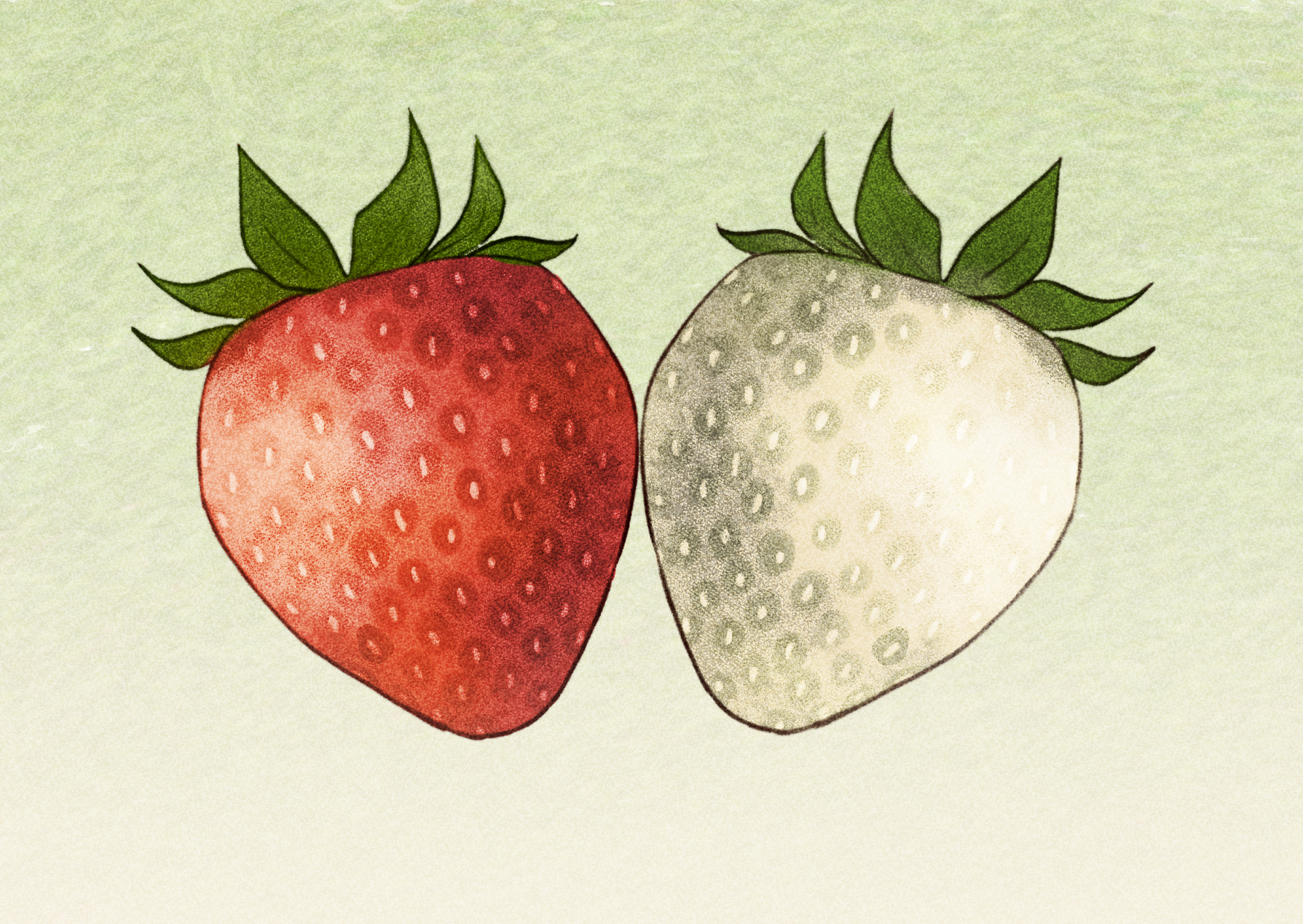
Strawberries
When I was little, I was much more fascinated with things growing in the earth. Now, I feel sometimes I take them for granted, walking past growing things without a second thought much of the time. I don’t tend to a garden, have indoor plants in my room, or keep flowers alive for very long. But when I was younger, I was much more attuned to the magic of growing things. In retrospect, I don’t think it was the garden exactly, but my grandmother in the garden– who I call Nana– who made it so magical for me. Nana dressed me in my jacket and little boots– my “wellies,” she called them– and led me to the garden to pick strawberries during the day. When my grandfather, Papa, came home in the evening, she would say to me, “Did you tell Papa what we did today?” and I would smile, happy she let me tell him our story: we had picked strawberries, rinsed them, and eaten them. Marvel of all marvels! Sometimes I think I like the look of strawberries more than the taste of them. They taste wonderful and sweet if you get a perfectly ripe one– a bit deeper red, barely soft, but not too soft. It takes some science. They are a little underwhelming or crisp if eaten too early. The more pale, the less sweet the strawberry will be. When I became a teenager, I toyed with the idea of becoming a tattoo artist; I said I could never have one because they were too permanent. However, by the time I was nineteen years old, I was enrolled in university, unlikely to become a tattoo artist– but I wanted tattoos. I figured that I wanted tattoos representing things I knew to be permanent, and my past was permanent to me, as it had already been written. I wanted a tattoo of strawberries, for Nana and Papa’s old house, and for all the time Nana had spent with me. I was anxious to earn the approval of my then-boyfriend on the topic of the tattoo; he did approve, though rather reservedly, but he said he wanted to come with me to the appointment. I told him that guests weren’t allowed in the studio, and was he okay with that? He said yes, and that he would wait in the car. I told him it would be at least a couple of hours. He insisted regardless. While I got my first tattoo, on my ribs on the right side of my body, I wore a green plaid button-down shirt that had been both Nana’s and Papa’s, which they’d shared when they were younger and roughly the same size. The appointment took about three hours. I looked at my ribs in the mirror, bearing a smile I couldn’t rid myself of, so happy I didn’t immediately regret my decision, as I’d worried I might. I almost ran outside to the car, ecstatic. The boy I had left in the car was pissed– literally and figuratively. He complained to me about how long it had taken and that he’d had to pee in a bottle. I didn’t know why he didn’t just pee outside, as men are apt to do. I didn’t know why he didn’t ask for my keys, and drive away– maybe we had even driven there in his car and he had the keys; I don’t remember; I tell myself surely he couldn’t have been that silly– but I don’t remember. I do remember that I was quiet and remiss that I had even let him come. The joy of the tattoo had already faded, while the ink was still leaking and mixing with my blood under the plastic. There was still a deep excitement inside me, but I smoothed it over, quieting my expression and emotions, and restraining them under his irritation. The car was silent, now a hostile environment– no place for sweet things and green vines to grow. I buried my excitement and joy like seeds in the earth.
My boyfriend of three years now is half-French. He has tanned skin, from being outside. His middle name– the name I call him here– is Mathieu, given to him by his mother, who is from Quebec. He is a gardener, and he spent the latter part of his life on a farm. He shows me the magic of growing things. He loves my tattoos, and encourages me to get more, while he traces and kisses them. He often calls me Mon Fraise affectionately– “My Strawberry”. Sometimes he sucks on the strawberries slightly, so my skin turns a deep reddish, and the strawberries become ripe. I love him. I discover that love and strawberries taste wonderfully sweet if you get a perfectly ripe man, a perfectly ripe berry– a bit deeper; barely yielding soft skin, firmness underneath. Because I began to love Mathieu while we were friends, and he began to love me after I informed him of this, he has always told me I have grown on him; he says, “You have grown on me so much it would hurt so bad and be sooo destabilizing to pull out your roots now.” He is Mon Jardinier, My Gardener. I am rooted in him; joy, excitement and hope for the future is allowed to grow before his eyes, warmed by his gaze, encouraged by his hand, furling out of my body, burying itself in the soil of his skin and sinking in.
Tom Yum Noodle Soup
My first bowl of Tom Yum noodle soup occurred while I was sitting in a restaurant called Thai Cuisine, having dinner with Mathieu, his father, and his grandmother, ‘Yaya’. I didn’t know what to order on the menu. Generally I am a very patterned person: if I order something from a restaurant and like it, I am sure to order it again. I view restaurants usually not for themselves, nor for their whole menu, but as my favorite item from the restaurant: if we are driving to Texas Roadhouse, for example, we might as well be driving directly to “Steak kabobs with seasoned rice and a loaded baked potato,” because that is how I see Texas Roadhouse, as that is what I know I will order. If I am going to Bella’s for brunch, I am not actually going to Bella, an Italian-Tuscan fusion restaurant– I am actually going to see my dear friend, “Eggs Benedict with ham”. Usually I ordered Pad Thai with shrimp, but the problem was that that’s my favorite dish from Lemongrass– a different Thai restaurant. So I couldn’t order Pad Thai, because we weren’t at Lemongrass, so therefore I was not seeing my Lemongrass-Pad-Thai-with-shrimp. I instead ordered Tom Yum noodle soup. When asked what type of protein I would like, I asked the waitress which type she preferred. She said she liked that particular soup with beef, at a spice level of three. I have ordered it exactly that way ever since. Mathieu’s father was paying for our meal; I was very grateful, and nervous. I wanted him to like me. When they brought the soup over, however, my anxiety and self-consciousness melted away as the steam furled over my face. It looked wonderful. I thanked the waitress profusely, and said I was about to go swimming [in the bowl]. It was a dumb joke, but Mathieu’s father seemed pleased that I was happy. I was very happy that he was pleased by my being happy. Later I mentioned this observation; Mathieu told me that it was probably a familiar and comfortable situation for his father; his sister would often order a big bowl of soup at restaurants, and their father would look on her with delight as she ate it. I was a little wistful at this. I missed a man old enough to be my father looking at me with delight while I ate. This used to be a familiar situation; but I didn’t recognize the longing within the moment, and so it was not stripped of its comfort. The soup was wonderful, sweet-and-sour spicy broth with beef, green things, bean sprouts, and some mysterious and marvelous little fried triangle-chip melting and dissolving in the bowl. I order it every time I go there, as I cannot be in the restaurant without having it. Most recently, I ate this soup when Mathieu took me to Thai Cuisine as a gift, to celebrate my birthday. I was turning twenty-two in three days. I was worried we were arriving at the restaurant too late, but he assured me we had time, ordered a dessert for me, assuaged my fears with ice cream, fried bananas and ice cream– the only dessert I ate for my twenty-second birthday.
Breakfast
The meal I am best at making is breakfast. This ability I learned when I was about nine or ten years old; I began making just-add-water pancakes on the griddle. I was precise in proportions, wiping the tip of the glass measuring cup to not let batter dribble down and pool onto the counter, and always using the same green bowl to mix. I crafted pancakes of uniform shape and size, fitting as many as possible onto the griddle at once, and the leftover batter I used to make “baby pancakes”. This was especially helpful in my house as I could make my younger siblings pancakes before my mom got up for the day; we were homeschooled, therefore a child who can fend for themselves– and better yet, their siblings– is one to be praised. When I was eleven years old, visiting Chicago with Nana and Papa for a cousin’s graduation, my mom mourned over text how she had lost their “little pancake-maker” for a few days. As I became older I progressed to eggs, first scrambled, then fried. Cooking eggs also was a point of pride for me; my mother often talked about how eggs were a difficult thing to cook properly. Papa himself sometimes was accused of stirring eggs too impatiently and vigorously, sometimes making them ‘rubbery’. I never spoke ill of them. I have always loved to eat my eggs with cheese; I thought this was normal practice, but found out later in life that not everyone makes them so– my mom informed me that she always added cheese just so we would eat them better. Now I eat eggs most times with cheese– melted in while they are still in the pan– or with hot sauce, sometimes ketchup. I enjoyed being relied on to make all the easy and wonderful components of a breakfast: eggs, bacon, both crispy and soft, toast, pancakes; all so simple and pure. I never learned to make French toast; my younger brother, the second-born, was very insistent about his ability to make the French Toast; as the toast was his claim to fame, he was fiercely protective of this identity. During sleepovers at Nana and Papa’s house, Papa always made breakfast. Nana doesn’t cook; she has always flitted in and out of the kitchen, adding extra cheese to something, or basil to the pizza, or getting napkins– but Papa was always the one cooking. When I rose from my couch-bed and walked about twenty feet to the kitchen as he called us for breakfast, he smiled at my entrance every single time I can remember, and said something like “Look whooo it is!”. He would continue smiling at me, not taking away his gaze, till I gave a small smile in turn and asked “What?”, or more explicitly, what he was thinking? He would still beam at me, tilting his head to one side, sometimes resting his dimpled cheek on his hand if he was already sitting at the table; lights twinkled in his dark brown eyes, and he’d say “You’re so pretty,” in a certain voice. While he said this, I was wearing my glasses– which I wore every day from when I was nine years old until junior year of highschool– and my hair, greasy, in a ponytail, before I had bangs to soften my features– and pajamas, before there was any softness or shape to my body. He said this when I had long fingers and arms, a strangely shaped nose, and not the slightest inclination of being pretty. Whenever I enter Nana and Papa’s house for family events now, sometimes Uncle Josh is standing in the kitchen at the counter, facing away from me when I come in. His stature is great; he reaches six feet tall, sometimes the shape of him makes me realize again who I am missing when I come into the house, the first person I laid eyes on upon entering, and I cry. Whenever I visit Mathieu’s family at their farm in North Carolina, I fantasize in the weeks leading up to the visit; I fantasize that Mathieu’s father will call my name for breakfast. I imagine entering the room, I imagine his long brown fingers as he hands off the plate to me; I imagine being able to be reminded of Papa, and cry. Then I wonder why I would fantasize about crying, why I would fantasize about performance of grief. I do not think it is not a performance exactly, but a longing to be met by grief; a longing for it to reach out to me holding a plate of eggs, and ask what is wrong with me, why I am crying, what I am missing. It is a longing to tell. The first time I ever visited Mathieu’s farm was two years ago to celebrate his birthday; it was days after Thanksgiving. Mathieu cooked an egg sandwich for me with leftover homemade stuffing for breakfast. I feel still that it is one of the best things I have ever eaten. This past summer, during a trip to Massachusetts, he made me a fried egg with melted cheese on a cheesy bagel. I was in love with the bagel. As he is dairy free, the constant addition of cheese just for me melds him to my heart. Certain foods tasted different in Massachusetts; the air felt different and cleaner, all baked goods and cheeses were different, having come directly from farms nearby; all made my soul more whole and rested. In times of rest fear grows in my heart; I am afraid in tranquility, but not when there is breakfast to eat. It feels like there is nothing more right in the world; the intimacy of another satisfying my body in the morning, the intimacy of another melting cheese for me.
Wasabi Peas & Flamin’ Hot Cheetos
My dad has always loved spicy snacks. He attributes my love of spicy snacks to himself, which is probably fair– I crave spicy foods now, as though I can never have enough of them. When I was a child watching my dad eating wasabi peas, I would often ask him for some– and he would drop about three or maybe four into my hand. If you’ve ever eaten them, you know they are the size of peas. So this is a rather meagre amount. They are dried peas coated in wasabi powder and horseradish. When you eat them, if you inhale the horseradish in the wrong way, you feel it enter your nasal cavity and have a sort of sneezing, sort of choking episode, and tears come into your eyes. This is all part of their charm. My dad’s favorite wasabi peas come in a can, from the brand “Hapi Snacks”. His other favorite snack, when I was young, were Flamin’ Hot Cheetos– we never bought them ourselves. I was always privy to loads and loads of regular Cheetos at Nana and Papa’s house, but my dad was the only person I knew who acquired Flamin’ Hot Cheetos. Sometimes I asked him for some to share, and similarly he’d offer me two, or three– occasionally, even one– hot Cheeto. I was always a little bit disappointed asking him, because I got the snack, but I suspected he didn’t really want to share with me very much. But he does seem to enjoy the fact that he shared some attributes with me, like my “stupid” sense of humor– as he calls it– and love for spicy snacks. I feel that maybe I love them, because he introduced me, yes– but also because I was always left with a craving for more. I don’t think he was ever aware of leaving me with a craving: I now know that he likes to introduce me to new things, and wants me to experience what he loves. He has– by accident– never fed me with the thought that I might be hungry. Recently, my dad was diagnosed with Celiac’s, meaning he is very strictly gluten-free: he is forbidden from eating many wonderful things, like bread and pastas. He has always loved to connect with other people over food– sharing the names of restaurants, his favorite dishes, new things they may have not tried and will perhaps like. My father was diagnosed with Celiac’s disease shortly after Papa’s death, when both of my parents’ burgeoning health problems revealed themselves through the stress of caretaking and illness. Papa died of pancreatic cancer– he could not process his food; blockages in the pancreatic or bile ducts result in indigestion, lack of appetite, and jaundice. These are physical signals of the tumor’s pressure on surrounding organs, and its interference with the pancreas’s ability to release the enzymes necessary to break down our food. When Papa died, his organs were shutting down. His body was internally bleeding, his skin was yellow; in a way, he starved to death. As we all were around his bedside still, Nana lifted the cat up to view his yellowed body; the cat was all too close to the corpse, she said she was “showing her” so the cat “wouldn’t be confused”. My mother often talks about how she could tell you everything Papa ate in the last month of his life; and how, compiled, it all would’ve fit on a child’s plate. I found the sudden inability of the remaining men in my life to eat eerie.
Now, when I come home, my dad offers me whatever latest snack he is eating, as he makes new discoveries void of gluten. He holds out a bag or morsel, asking: “have you tried these?” And, when I say no, he offers it to me, urging me to have some.
I cannot think of many images more painful than a father starving to death. Fear makes me more forgiving; I do not want to see my father starve. I am grateful for even meagre amounts now, as he and I are left with our cravings, hungry.
Coffee
My first sips of coffee were early in life. As I spent much of my time at Nana and Papa’s house while my mother worked, I experienced my first tastes of coffee there with Nana. My mother– who was on and off with my father–worked three jobs in the daytime; she came to pick me up in the evenings. I knew my mother to get Starbucks coffee; she ordered strawberry frappuccinos in her early twenties, and later on nearly always the same drink, her signature order: a white chocolate mocha, size venti, with whipped cream on top. Nana and Papa were unique to me, in that they made their coffee at home with a coffeepot. It was a large Mr. Coffee coffeepot, and always produced too large an amount for Nana to finish; she kept their sugar in a glass wire clasp jar. She taught me how to help make her coffee; at first I was instructed in her desired proportions of cream and sugar– two spoonfuls of sugar, lightly rounded, and enough creamer to turn the coffee the same shade as a buckeye’s center; as I became older– around ten or eleven years old– I learned how to grind the beans themselves in the red electric grinder, measure spoonfuls of grounds to dump in the filter, fill the coffeepot with the correct amount of water, and press start. When I heard the coffeepot come to life, sputtering, gasping, I knew I had correctly fulfilled all the steps. In restaurants, Nana used the little plastic cups of creamer with foil lids for her coffee; if I helped her open the cups and pour them in, she would fill them afterwards with a bit of coffee for me to drink, diluted with cream. She told me that was my coffeemilk, and explained to my mother how it was a reward for helping her. Sometimes Nana would leave her cup of coffee in the bathroom on the counter, and I drank as much as I could hold in my mouth, then kept it there as long as possible, to hold the taste. I did the same when my mother left her Starbucks drink unattended– drank as much as I could without raising suspicion, and held it in. Eventually I began drinking coffee of my own accord; I passed this unspoken threshold in about eighth grade. Steadily throughout junior and senior year of high school, I made one cup of coffee in the morning, and drank it in an open mug on the way to school, leaving the dirtied mug to retrieve out of the car when I got home later that day. Nana and Papa continued drinking coffee out of a pot; in a particularly sweet ritual, Papa ground coffee beans for Nana before he went to bed. He measured them out, put them into a new filter, and filled the pot with clean water– all that was left for her to do in the morning was press start.
Now he is gone, and there is no one to make coffee for Nana in the mornings. She rises– no more coffee and breakfasts in bed– makes her own coffee, takes the dog out by herself both when she wakes and before she sleeps; the house is silent most times. This kind of absence is incomprehensible. Where there were traces of touch, affection, thoughtfulness– simple acts of making another’s life easier– now there is only self reliance. For my twenty-second birthday, the only physical present I received was a French press coffee pot. I enjoy grinding the beans in the electric grinder– this one a sleek black color. I have not heard the loud screeching, chopping sound of the grinder anywhere else besides my countertop in the last dorm room I will ever live in, and Nana’s house. I raise the container to my face and inhale the beans sometimes as I did then, hoping for some phantom burst of energy from the mere smell of them. I have not smelled the beans, freshly powdered, or seen their little shells be torn away in a whir of blades anywhere else besides the last dorm room I will ever live in, and Nana’s house. Now I grind them, measure them out, and pour them directly into the glass pot, with no filter. Boiling water is then dribbled over them evenly; they are stirred; they are left alone. In four minutes they are pressed– coffee steeps atop the press; to be poured into a cup. I almost always never finish the entire cup of coffee.
Slim Jims, Vienna & Italian Sausages
I have always had a love for processed meats. When I was younger, someone– I think it was Papa– asked, “You know what that’s made of, right?” pointing to my Slim Jim. He informed me that a Slim Jim is made up of pork, chicken, and beef; and not three different animals, but “the worst parts of the animal”. This information has never swayed me from eating them, perhaps because Papa himself, while informing me, was eating them too. Recently on a family vacation, my youngest sister and I were in my parents’ bedroom, adjoined by a balcony. My sister, Grace, asked my mom for a Slim Jim. I requested she bring me one too, and she did. She informed me that she habitually peeled them, then tactfully showed me how she slits the skin of the Slim Jim, tears it off in one whole piece, and eats the translucent papery skin all by itself, followed by the meat of the Slim Jim. I asked to try a tip of the skinless Slim Jim; she obliged, albeit grudgingly. I do not like to tear the skin off my Slim Jim, but I like that she has her own personal ritual for eating one, and I am happy she shared it with me. Since I was a child, I eat my Slim Jims little by little, and try to savor as much as I can. I keep them both in their skin and in their plastic wrapping, pushing them up like a popsicle till the whole thing is eaten, as I don’t like to get my hands greasy. One time when my other, slightly older teenaged sister, Cate, was riding in the car with my boyfriend Mathieu, she asked him about the massive Monster-sized Slim Jim he had in the backseat of his car. He told her that he was in the habit of buying them for me and hiding them– in my backpack, his bedroom, and in the car, wherever I might become hungry. He told her that he suspected I was beginning to find out his secret and expect the Slim Jims; I did not actually expect them, however, I simply thought they popped up every once in a while for me to eat, by his good graces. But I supposed that’s the whole point. By now, he’s gotten me many variations: Slim Jims that come with a cheese stick, jalapeño, chili-cheese, and even nacho flavored Slim Jims. Some I like more than others, but I eat them all.
I have a ritual when it comes to Vienna sausages, too. They are tiny sausages, about one inch long; they come in a can. When you open the can, you see five little circles of sausage as they’re sitting up on their sides; there is a little water at the bottom of the can. Many people don’t like these, as they are exceedingly cheap and artificial-tasting. But I love them. Papa loved them too– when he opened a can he always held it out to me and asked “sausage?” Sometimes Nana cuts them in half and eats them on Saltine crackers; I like them that way too, but also plain, out of the can. My ritual is to pick out what seems like the slimmest sausage– even though they’re all about the same– and eat it, saving the best-looking one for last. Papa used to work at a hot dog stand called Bemo’s in Chicago; in Chicago, the hot dog is sacred. It never ever comes with ketchup, but instead as an all-beef hotdog on a poppyseed bun, with diced onions, yellow mustard, tomato, an entire pickle spear, and celery salt. One of the few videos I personally took of Papa was of him singing during a sleepover. My siblings and I were staying with Nana and Papa for several days while my mother was visiting Los Angeles; it was my sophomore year of high school, four years before Papa was diagnosed with cancer. In the video, my phone is placed in my lap and the screen only shows my face from below, smiling and trying to not betray that I am recording. Papa’s voice is singing over a baby sister’s coo; he is regaling us with a commercial from 1967. The transcription is as follows:
“What kinds of kids eat Armour hot dogs? Fat kids, skinny kids, kids who climb
on rocks. Tall kids, sissy kids, even kids with chicken pox, the hot dogs,
Arrrrrmour hot dogs, the– you’re not recording me right?”
The video ends there. I now know the lyrics are “tough kids, sissy kids, even kids with chicken pox love hot dogs…” Much of the surviving media of his life evidences a love for making and eating hot dogs; he loved not only these, but Italian sausages too. He would eat them with his hands, the grease on his fingers not bothering him at all. It never bothered me, either, when the grease was on his hands. Writing this, I can smell the grease now, mixed with his sweat, a little bit of cologne, and sometimes a different greasy smell from machinery. When I try to describe it, it is gone from my nose. During countless sleepovers at Nana and Papa’s house, Papa would go to bed earlier than us, to wake for work the next morning. But regardless of how late it was, if I went into the kitchen and opened up the fridge looking for something to eat or drink, he would always appear to awake at the same time, approaching from the bedroom somehow so quietly I had not heard him, whereas most of the time his footsteps creaked throughout the entire tiny farmhouse. “You want something to eat?” he’d ask. I could say no, but it was already too late. He knew I was hungry, and even if he didn’t know, he would offer food until I was hungry. “I got sausages in here. Italian sausages. You want Italian sausage?” It was futile to refuse; the offers would continue until accepted. I saw this; I never turned down his offers of food. It is a valuable thing, to be fed when you are hungry– no matter the price, quality, or social consensus of the food you are offered. I still eat Italian sausage, and Vienna sausages, always replaying the questions “You want something to eat?” and “Are you hungry?” in my mind, even though those questions are no longer asked of me in the same way. The gift of a Slim Jim is something I never turn down– it is far too valuable to me to pass up.
Black Walnuts & Persimmons
Black walnuts and persimmons are gifts of the earth; a black walnut cannot be eaten, granted, only smelled. The scent is unmistakable: slightly citrusy, bitter, and woody; their green shells, dappled and tough, peel off in chunks to reveal the walnut inside. Persimmons can be eaten; I used to pick them up under the tree from which they fell, in a church’s graveyard across the road from Nana and Papa’s house. Nana would take me on walks, and her border collie, Sam, would trot a little faster at the smell of persimmons; he loved to eat them off the ground. She let me pick up a few, carry them back to the house to rinse and eat them. I do not eat them now; they mush into a pulp under my feet as I walk around my college campus. The persimmons fall from a particular tree, I do not know which one. I am simply overwhelmed by autumn as the smell of them rises from the ground, I never trace their source. The woods are great around me; I kick the black walnuts as I walk. I kick the same one further and further in front of me until I lose sight of it or it explodes, shedding its shell and flinging the pieces all around. As I kick them I feel nervousness in my heart; fear clamours there; I have always had an apathy towards the future: wondering about it intensely, expecting the worst, brimming with expectation of dissatisfaction. But I have not been dissatisfied. Instead, I am overwhelmed by the nourishment that has met my body, more real and wonderful than I can imagine. Though I am alone now, I think of how I love to be outside with Mathieu, to feel the wind and the sun on my face, to hear the deafeningly quiet rustle of leaves in the trees; it is my simplest and deepest joy. I cry, overwhelmed by what is: the leaves around me, yellow-gold; the sun filters through them to shine on me. The core of my existence, the core of who I am, feels as though it is a little girl on the swing hanging from the great tree in Nana and Papa’s yard, walking with Sam, eating persimmons; the very core of me, returning indoors, excited to eat a salami sandwich: this is the core which Mathieu has seen, and touches. He has been there with me, in those moments of hunger and satisfaction– when I am with him, I am there. I am myself, in all love and craving, fear and desire. The yellow in the trees looks increasingly golden, the light dappling through them increasingly real, and I remember the black walnuts as they overwhelm my nose and I am crying. I am never more myself than now; I touch eternity in the smell of the black walnuts and in the fruits of autumn to be eaten. I touch eternity as I eat the favored foods of the dead; my life blooms out before me still, golden and orange. I can hardly fathom what it will be like to bring a child into the world where I am now, a sense of knowing another lying in-between us, warm, hungry, desiring to be fed. But now, now I know this love too, there is gold and orange all around me; I am going to eat lunch.