
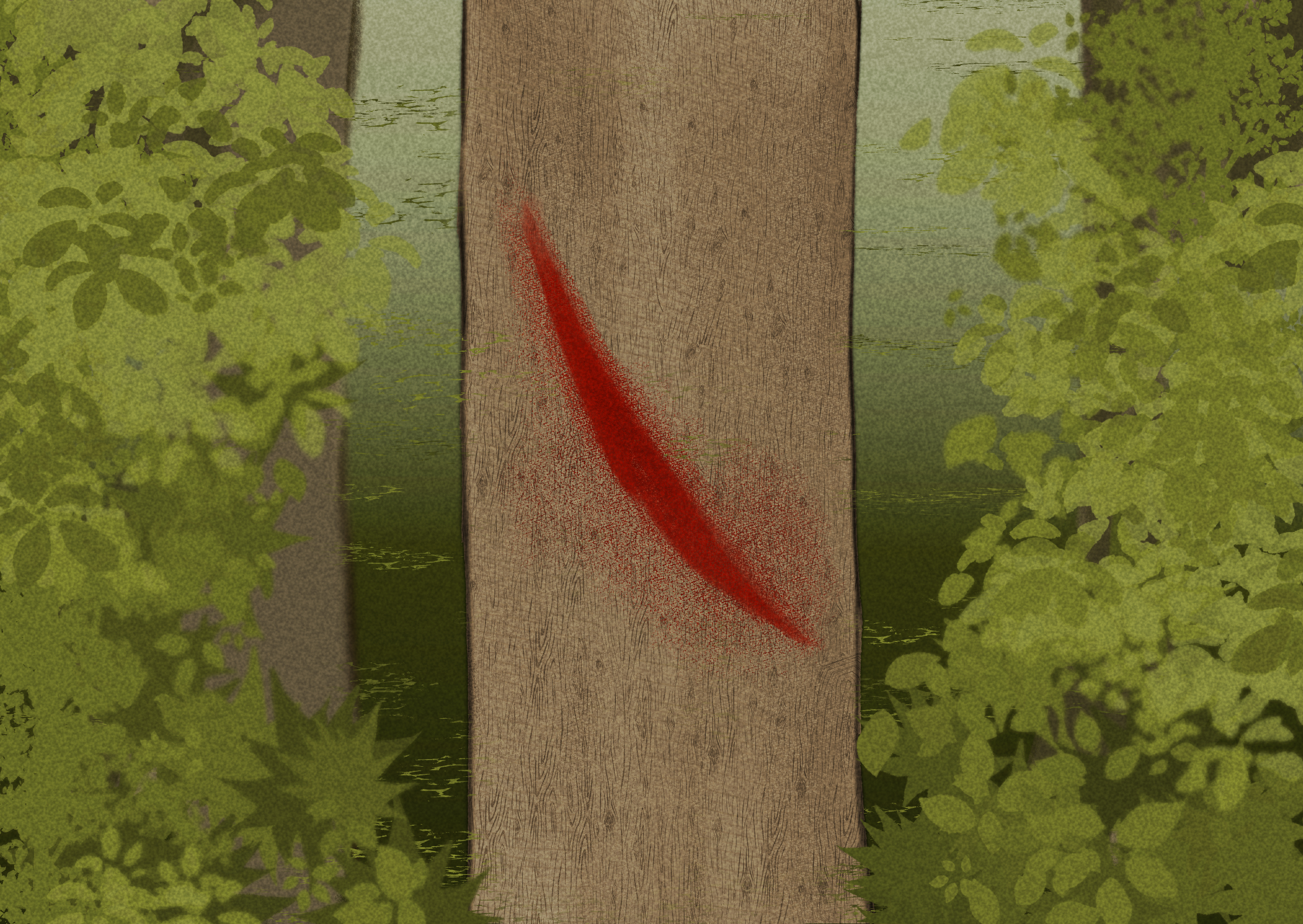
The day they marked the trees, I thought somebody had murdered them.
A red slash, bright as spilled chilli powder, ran across the bark of the older mango tree, a little above where my hand usually rested.
I was cycling past on my way back from the milk shop when it jumped out at me, harsh against the brown trunk, like a teacher’s correction on a perfect exam paper.
I braked so hard my cycle squealed and for a second the whole lane felt different.
The afternoon heat, the laundry drooping from balconies, the smell of frying onions and car exhaust—all of it stayed the same. But the trees looked… worried.
Don’t ask me how trees look worried. They just did.
Their shadows seemed thinner, hesitant, like they didn’t know how far they were allowed to fall anymore. I dropped the milk packet in the dust, wiped my palm on my shorts, and pressed it against the mark.
The paint was dry.
Someone had decided this before I even woke up. I did the only thing that made sense.
I called the others.
“Guys, emergency. The mango trees have been assassinated,” I announced, standing in the middle of our lane like a news reporter who had swallowed a microphone.
Rayan leaned out from his balcony on the first floor of the building opposite.
“Assalaamu alaikum to you too,” he said. “What did they do, throw bad mangoes at you?”
“Worse,” I said. “Come down. Bring Sid.”
“I’m not his secretary.”
“Sidharth’s not your secretary either,” I said. “He’s too quiet for that.”
Rayan disappeared with a sigh and the slam of a door.
Two minutes later he trotted out of his building gate, in slippers that made a slap-slap sound, Sidharth walking behind him with his usual calm, hands in his pockets, hair already flattened by the heat.
“What now?” Rayan asked. “I was in the middle of a very important thing.”
“Scrolling reels is not an important thing,” I said. “Look.”
I pointed at the tree. They both stopped.
“Oh,” Rayan said.
The usual jokes vanished from his face, like someone had wiped them off with a cloth.
Sidharth stepped closer. He didn’t say anything at first, just studied the mark the way he studied maths problems, like it would eventually confess a formula to him.
He touched the bark with two fingers, gentle.
“It’s… a cutting mark,” he said finally. His voice always surprised me, because it came out softer than I expected. “They use red paint to mark what’s going to be demolished.”
“So it is murder,” I said, feeling vivaciously proud of myself for being right.
“We don’t know for sure yet,” Sidharth said quietly. “Maybe they’re just repainting the lane, maybe it’s some survey—”
From behind us, someone snorted.
It was the kirana-store uncle, dragging a crate of soft drink bottles towards his shop.
“Survey, haan,” he said. “You kids don’t read the notices? They’re widening the road. These two trees are in the way. Municipal fellows came in the morning, marked them. Three weeks, bas. They’ll be gone.”
He said it the way people say, “Tomorrow is Monday.”
He hauled the crate into the shade and disappeared inside, bells on his shop door jingling once.
Three weeks.
The heat pressed closer around us.
A little bead of sweat trickled down the side of my neck.
“No way,” I said. “They can’t cut them. They’re… they’re historical.”
“They’re mango trees, not freedom fighters,” Rayan said, but it sounded automatic.
“You know what I mean,” I said. “They were here before half these buildings. My grandmother says they were planted after the ’86 floods. When the water went into everyone’s living room. People promised to plant trees when it receded so they wouldn’t forget. How can they just—”
I slapped the trunk lightly, as if scolding it for not defending itself.
A ripe mango, somewhere higher up, bumped against another and fell.
It landed with a soft thud in the dust between us, sending up a small ring of powder.
None of us moved to pick it up.
“We won’t let them,” Rayan said.
I looked at him. He wasn’t joking.
His eyes were sharp, dark, the way they got when we were one run away from losing a cricket game.
“How?” I asked.
He shrugged. “We’ll figure it out.”
Sidharth had already taken out his phone. “I’ll search the municipal tree protection rules,” he murmured, more to himself than to us.
I stared at the red mark again.
Three weeks.
“Fine,” I said. “Then we start today. Operation Save Our Shade.”
It sounded ridiculous as soon as I said it. But the two of them didn’t laugh.
And just like that, the mango trees became our responsibility.
We decided, very officially, to form a team.
We met that evening under the bigger tree, the one with the low branch where we’d spent half our childhoods hanging like badly tied laundry.
The lane was softer then, the heat finally loosening its grip; women stood at balconies talking, kids dragged schoolbags home like corpses, bikes honked lazily at the lane’s entrance and then gave up, because nobody ever moved quickly here.
I arrived with binoculars I’d stolen from my uncle’s cupboard, Rayan brought a plastic bag of chips “for strike ration,” and Sidharth came with a small notebook and a pen.
“First, we need roles,” I announced, pacing up and down like a dictator in slippers. “Every good mission has roles. I saw that in a movie.”
“What’s our mission?” Rayan asked, sitting cross-legged, back against the trunk
Sidharth sighed.
“You’ll be the watcher,” Sidharth said to me. “You’re always in the lane anyway. You notice things.”
I puffed up a little. “Obviously. My eyesight is like 20/10.”
“That’s not—never mind,” he said. “I’ll do the… research.”
He held up the notebook like it was a weapon.
“And you,” he said, turning to Rayan, “talk to people. You’re good at that.”
He grinned. “Finally, someone recognises my talent.”
“Your talent is lying confidently,” I said.
“That’s called diplomacy,” he said. “Look it up.”
“The point is,” Sidharth said, “we can’t just stand here hoping they change their minds. We need signatures, proof, something. There’s a procedure for tree felling. If they violated any rule, we can complain.”
The thing about Sidharth is: you expect him to be passive because he’s quiet.
But under that silence he’s always… planning. Thinking three steps ahead, the way he does in chess. The day I realised that was the day he checkmated me in eight moves while eating a biscuit and not looking at the board.
“Okay, Research Department,” I said. “What do we do today?”
“Today?” he said. “We start guarding.”
We took it seriously.
I climbed onto the low branch and sat there like a badly dressed crow, binoculars around my neck, surveying the lane for suspicious bulldozers.
Rayan walked up and down with his “petition notebook” (which was actually an old maths notebook with failed sums on the first few pages) asking people to sign even though he didn’t yet know what the petition would say.
Sidharth sat on the pavement in the roots’ shade, back against the trunk, reading municipal bylaws on his phone and making notes.
We lasted three hours before my mother shouted from our balcony demanding to know why the milk I’d gone to buy at noon was still hanging warm from my handlebar.
But three hours felt like something.
By the time I went to bed that night, the trees felt less like background and more like friends. I imagined them whispering to each other above the roofs as the lane fell asleep.
Of course, adults had opinions.
“You kids and your dramas,” Rayan’s father said when he heard about it at dinner. “Road widening is good. Do you know how long it takes me to cross that junction every morning? Twenty minutes, minimum. Honking, dust, idiots parking everywhere. They cut two trees, and the whole area improves. That’s called progress.”
“What about oxygen?” I asked. I was at their place because my mother had run out of onions and believed borrowing them from neighbours was a valid social activity.
“If we need oxygen, we’ll buy it in cylinders,” he said, joking, but with that edge that adults always had when they talked about new things. “Anyway, they’ll plant saplings somewhere else.”
“Somewhere else is not here,” Rayan muttered.
His father ruffled his hair absently. “You enjoy the mangoes while they last,” he said. “Don’t get sentimental about wood.”
My grandmother, when I told her, reacted differently.
“They can’t cut them,” she said immediately.
“Uncle from the shop said three weeks,” I said. “For road widening.”
She shook her head. “Hmph. Like roads will feed us. These trees fed us when the flood took everything.”
Her voice softened. “Your Dadu and I planted them. We were younger than you. The water had just gone. The government gave us rice and useless plastic buckets. These we planted ourselves.”
She wiped her hand on her sari and went to stand at the window, looking out at the trees as if they were her own children.
“Three weeks,” she repeated, but this time it sounded like a challenge.
Between these two reactions—progress and memory—we moved up and down all week like a see-saw.
Some neighbours shrugged. Some signed our half-baked petition immediately. Some laughed.
“People only care about what’s inside their walls,” I grumbled, as we sat under the trees one evening, sharing a single mango between the three of us, the juice dripping down our wrists.
“That’s not entirely true,” Sidharth said.
“What about you?” I said. “You live two lanes away. You don’t even get the shade here half the time.”
He was quiet for a moment, wiping his hands on his handkerchief in neat, precise strokes.
“My building’s trees got cut two years ago for parking,” he said. We fell silent.
We bumped shoulders, the three of us, that casual bump that you pretend is nothing but secretly feels like armour.
The summer stretched out like melted toffee.
Day after day, we showed up.
It became a routine, the way school had once been our routine before holidays swallowed the timetable.
Morning: I did “watch duty” for an hour before my mother could invent chores. I tried the binoculars again and again even though both lenses were scratched and everything looked like it was under water.
Afternoon: Sidharth came after lunch, notebook and pen always in hand.
He had drawn a tiny map on the front page, marking each tree in the lane with a dot. Our two mango trees were circles.
“They must have an inventory,” he said. “If they cut these, they’ll update it. If there’s a discrepancy, we can use that.”
I barely understood what he meant, but I liked that he sounded like a lawyer on TV.
Evening: Rayan arrived when the light turned soft; his favourite time, because that’s when everyone stood outside. He went around with our petition notebook.
“Sir, we’re trying to save the mango trees,” he’d say. “They give shade, oxygen, childhood memories, all free.”
One uncle at the corner shop scowled. “Childhood memories don’t pay my EMI,” he said. “My wife almost fainted last week crossing that junction with grocery bags. If cutting trees makes roads wider, cut them.”
“But sir—”
“Go do homework,” he said, and turned away.
Sometimes Rayan came back with three signatures.
Sometimes with one.
Sometimes with none.
“Most people sign,” he said one day, flopping down at the base of the tree. “They don’t even ask what it’s for. They just see paper and pen and sign, like their hands are bored.”
Sidharth gave me a long look.
“That’s actually… not entirely wrong,” he said.
We cracked up laughing, the three of us, until a passing aunty shushed us because her baby was sleeping.
The laughter always came back, even on the days when we were tired or sunburnt or fed up with adults.
It was like the trees.
You thought the branches had stopped growing, then suddenly there’d be a new one, reaching further.
The first time I realised the trees were not the only thing we might lose that summer was the day Rayan told us he might be moving.
We’d just finished a particularly embarrassing petition attempt where we’d tried to convince the gym guy on the corner to sign and he had flexed his biceps and told us to “save our own bodies first.”
We collapsed under the tree, exhausted.
My back itched with dried sweat.
Sidharth was drawing something in the dust with a twig, a small box with arrows.
He was quiet.
Which was suspicious.
“What now?” I asked.
He stared up into the branches, their leaves a bright, stubborn green against the sky. “Baba got a letter,” he said. “Our landlord wants to sell this building. They might not renew our lease after this year. Might even ask us to go earlier.”
For a second, the lane went muffled, like someone had put cotton in my ears.
The cars at the far end, the pressure cooker whistle, the TV faintly blaring a soap opera theme—it all faded.
“Move where?” I asked.
He shrugged, not looking at me. “Don’t know. Some other rental. Maybe further out. Maybe another neighbourhood. Baba was on the phone all night with his cousin.”
“So?” I said, a little too loudly. “You’ll still come here. You’ll just get a bus. Or cycle. Or teleport or something. It’s not like they’re going to move to Mars.”
“Yeah,” he said, but the word sagged in the middle.
My chest felt tight.
I imagined our lane without Rayan’s balcony. Without someone leaning out every day yelling, “Aarib! Did you pass or fail maths?” across the street. Without him bringing out water when we played cricket until our throats burned.
I tried to joke, because that’s what I do when something feels like it’s cracking.
“If you move, who will I annoy?” I said. “I can’t do both jobs. Annoying you and annoying myself is too much of a workload.”
He actually laughed, but it was small.
“I don’t want to go,” he said quietly.
I didn’t know what to do with that sentence. It sat between us like an extra person.
Sidharth, who had been a silent knob of worry this whole time, reached out and put his hand on Rayan’s shoulder. Just one brief squeeze.
That’s the thing about Sid.
When he finally says or does something, it doesn’t waste time.
“We’ll figure it out,” he said simply.
The same way we’d said about the trees.
For the first time, I saw the connection clearly: everything rooted was being threatened with being uprooted.
Trees, families, routines.
Nothing was staying where it was supposed to stay.
It stopped being just about shade and mangoes and became about saving the feeling that something in this lane was solid.
That when we came back from wherever life pushed us later, something would still be standing in the same place, waiting.
We gave our petition a title, in big, uneven letters: SAVE OUR SHADE.
Underneath, in slightly smaller writing, I added, OUR CHILDHOOD ALSO LIVES HERE.
Sidharth rolled his eyes but didn’t cross it out. We drew a thick chalk circle around each tree trunk.
“What’s this for?” Rayan asked.
“Boundary of respect,” I said. “No peeing dogs, no spitting uncles, no random leaning bikes. Sacred ground.”
A kid from the next lane deliberately dragged his cycle inside the circle and parked it there. I cussed him out with such fury that he never tried again.
The dog, however, ignored the circle entirely.
We let it. It was clearly on our side.
We laughed, because we didn’t know what else to do with the feeling in our chests.
News of three boys “saving the trees” travelled through the neighbourhood the way all news did: through balconies and gossip and that one aunty who knew everyone’s business two minutes before it became their business.
One evening, a man with a camera hung around our lane, clicking pictures of the trees, the red marks, and our chalk circles.
“Uncle, are you from the news?” I asked, suddenly breathless with possibility.
I imagined us on TV, me giving a speech, my grandmother crying proudly in the background.
“Local environmental blog,” he said, showing us a card I forgot to read properly. “You kids are doing this?”
“Yes,” Rayan said, his chest expanding. “We’ve collected forty-seven signatures so far.”
“Forty-four,” Sidharth corrected. “Three are illegible.”
The man laughed and took our picture, standing in front of the tree with our notebook held up like a trophy.
I made a serious face, like a revolutionary.
Rayan attempted a charming half-smile.
Sidharth blinked.
“We’ll go viral,” I said as he left.
We did not go viral.
If the post went up somewhere, we never found it.
My internet was too slow to search properly anyway.
But that one afternoon, being photographed, felt like someone had stamped real on what we were doing.
Two weeks after the red mark appeared, a notice went up on the lane’s message board.
It was typed, laminated badly so that bubbles of air showed under the plastic, and had the official seal in one corner.
It announced a community consultation meeting to discuss the road widening project and “associated tree relocation and/or removal.”
Meeting: Sunday, 5:00 p.m., in front of Building C-4.
“Relocation,” I said. “As if you can just drag a whole mango tree somewhere like a sofa.”
“Sometimes they do transplant trees,” Sidharth said. “It depends on the roots.”
“How do you transplant thirty years of laddoo-eating under this branch?” I asked, thumping the low branch we always sat on. “Where do you put the memory?”
“You’re being poetic again,” Rayan said. “It’s annoying.”
“We have to go,” I said. “To the meeting. This is our chance.”
“Adults only, I’m sure,” Rayan said, but his eyes had that spark.
“We’ll stand at the back,” I said. “They can’t arrest us for listening.”
“Actually—” Sidharth began, then stopped when he saw my face.
“Fine,” he said. “We’ll go.”
Sunday, 5:00 p.m., our lane looked different.
People who never stepped outside suddenly materialised, fanning themselves with newspapers, sunglasses perched on their heads.
A folding table stood in front of Building C-4. A junior engineer with rolled-up blueprints and a corporator’s assistant were already there.
Our mango trees loomed at one end of the lane, their red marks bright, almost glowing in the late afternoon light.
We stood near them, petition notebook tucked under Sidharth’s arm, our best serious faces on.
“Stand straight,” I whispered to Rayan. “You’re slouching.”
“You stand straight,” he muttered back. “You look like a crooked lamppost.”
“Shh,” Sidharth said.
Someone cleared their throat in front. The junior engineer began talking in that polite bored way officials have when they’ve done the same speech six times already that week.
“Road widening,” he said. “Traffic congestion. Emergency vehicle access. Long-term benefit to the area.”
People murmured. Some nodded. Some shook their heads. Everyone argued in low, buzzing clusters.
When it was time for “community feedback,” the assistant asked, “Anyone has any concerns?”
An uncle launched into a long complaint about drainage. Another wanted a speed breaker. One aunty asked for more streetlights.
No one mentioned the trees.
My stomach twisted.
I looked at Rayan.
He looked at me.
“You speak,” he whispered.
“You’re the diplomat,” I whispered back. “My mouth says too much.”
“That’s the problem,” he said.
Sidharth, between us, whispered, “We all go.”
But my legs felt like they’d been stapled to the ground.
Suddenly, walking to that table seemed like walking to the stage in school assembly with no speech.
Before I could decide, someone else stepped forward.
It was the widow from Building B-2, the one we’d always called Dadi even though none of us were related to her.
She was thin, draped in the same faded cotton sari she wore every day, hair pulled back in a bun. She fed stray cats and watered the plants in front of the building when the pump worked, and barely spoke otherwise.
Now she stood in front of the crowd, hands folded loosely at her waist.
“These trees,” she said, her voice surprisingly clear, “were planted after the flood.”
My grandmother stiffened beside me.
I hadn’t even noticed she’d come.
“They were planted when we had nothing,” the widow continued. “No furniture, no proper floors. Just mud and water and mosquitoes. The government gave rations. But these trees…” She looked down the lane, her gaze catching on the red marks. “These we gave to ourselves.”
The lane was very quiet.
“You say road widening,” she said to the engineer. “Fine. Maybe the road will be better. But there should be some… mercy also. Some place that stays the same. For children to remember that once, someone planted something not for money, not for cars, but just for shade.”
Her voice shook on the last word.
I felt my throat close up.
“This is sentiment, Auntie,” someone muttered from the back.
“Yes,” she said. “Sentiment is also a kind of truth.”
She turned away, eyes shining, and walked back slowly to her spot near the cats.
Something in my chest cracked open.
Before my brain could talk my legs out of it, I stepped forward.
“We have a petition,” I blurted.
“We, um—we collected signatures,” I said, suddenly aware of how loud my heartbeat was. “We’re kids, but we also live here, you know? These trees… they’re like… like our holiday homework spot. And our cricket boundary. And our free fridge. And… I don’t know.”
Words tumbled out of me like marbles.
“I know road widening is important. I know traffic is bad. But—I just think if they’re cutting something that’s been here longer than us, we should try once to not cut, no? At least try?”
I turned helplessly to the others. “Sid, help,” I hissed.
To my shock, Sidharth stepped forward too.
He didn’t look at the crowd. He looked at the engineer.
“Sir,” he said simply, holding out the notebook, “this has forty-four signatures from residents of this lane. We cross-checked addresses. We just… want you to consider if both can happen. Road and trees. Or if there is any other way.”
He held the notebook out like an offering.
Rayan, not to be left behind, squeezed in between us.
“And if you need volunteers to control traffic here, we’re free after exams,” he said.
A few people laughed.
It wasn’t mean laughter. It was surprised, a little proud.
The assistant took the notebook, leafed through it. The engineer sighed.
“Look,” he said. “Plans have already been made. It’s not just your lane, it’s the whole stretch. Two trees here, three trees there… We measure, we decide, we…”
He trailed off, looking up at the branches.
Whatever he saw there, I will never know.
He turned to the assistant. “We can propose a modification,” he said slowly. “Perhaps keep one tree. Reduce the footpath widening here, extend it further down… I will have to convince my seniors.”
“Convince them,” my grandmother said sharply from where she stood. “You also live somewhere, no? You also have some childhood tree in your memory.”
People chuckled again.
The assistant whispered something to him.
The engineer thought.
“Alright,” he said finally. “We’ll put it to a vote, for this lane. Keep both trees, or keep one tree, or remove both and plant new saplings elsewhere. The majority will be our lane-level recommendation. The final decision is higher up, but we will write it, okay?”
Everyone began talking at once.
It was messy.
It was loud.
Democracy, in our lane at least, looked like three aunties arguing and a man in a banyan complaining about termites.
Someone shouted, “Keep both!”
Someone else shouted, “Cut both!”
Hands went up, like mismatched flags. For a moment, it was evenly split.
“Children can’t vote,” the assistant said when my hand shot up instinctively.
I felt my arm burn with rejection.
“But they’re the ones who’ll live with the result longest,” the widow from B-2 said quietly.
That sentence settled on the crowd like dust.
“Fine,” the engineer said. “Let them vote. It’s not official anyway, just for our note.”
He raised his hand. “Those who want to keep both trees—hands up.”
I lifted my arm so fast my shoulder twinged. Rayan’s arm shot up beside mine. Sidharth’s went up more slowly, but once it was there, it stayed.
Around us, more hands rose.
Some tall, some small.
My grandmother’s, the widow’s, the kirana-store uncle’s (which shocked me), three teenagers from the next lane, the gym guy (even more shocking), and many others.
The engineer squinted, counting.
“Those who want to remove both trees?” he asked.
Fewer hands this time.
Still some.
“And one tree only?” he added.
A scattering of uncertain palms.
He did mental maths, lips moving.
“Majority for keeping both,” he said at last. “We will note it.”
The cheer that went up felt bigger than our lane.
It wasn’t a stadium roar, nothing like that.
It was a ragged, hopeful sound, like people who had expected to lose but suddenly discovered they might not have to.
I realised my hand was still in the air.
I let it drop, and it landed on Rayan’s shoulder.
His landed on mine.
Sidharth, on my other side, didn’t say anything, but I felt his fingers gripping the edge of my sleeve, small and steady.
We stood like that, three boys and two mango trees, while the engineer rolled up his blueprints and the crowd slowly dissolved back into evening routines.
No one promised us they’d never cut the trees.
No one could.
But for the first time since that red mark appeared, the fear in my stomach loosened a little.
We had done what Sidharth wrote at the bottom of the page:
We’d made a record that we tried.
The rest, we’d have to live to see.
A year later, the red marks faded to a dull pink, almost invisible under new layers of bark.
The road was wider in patches.
They’d nibbled at the pavement down the lane, but when it came to our stretch, they’d curved it slightly, an awkward bend around the two mango trunks.
“It looks like the road is bowing to them,” I said, as we sat on the low branch one humid afternoon, school bags thrown at the base.
“You’re being poetic again,” Rayan said, but there was no complaint in it.
He hadn’t moved yet.
The landlord had changed his mind, or the market had changed, or something adult and boring had happened. They had another year on the lease, at least.
His balcony still leaned over the lane like always, with his mother’s money plant spilling down in green loops.
Sidharth had grown taller.
His notebook had turned into a proper file now, where he kept copies of things he thought might be important someday: the photo from the blog that did eventually post our story (tiny, pixelated), the printed note from the municipality acknowledging the lane’s preference, a leaf he’d pressed from a storm-fallen branch.
Our petition notebook lived in his drawer.
Sometimes, when we were at his house, we’d open it to the last page, where my overdramatic poem and his quiet line shared the same paper.
We never read it aloud.
We just looked at it, then closed the book again.
“Do you ever think about if they’d cut them?” I asked now, leaning back against the trunk.
“Sometimes,” he said. “Then I get sad. So I stop.”
“Deep,” Rayan said. “Very philosophical. You should become a monk.”
“You should become quiet,” Sidharth replied, which for him was basically stand-up comedy.
We laughed, the sound mixing with the rustle of leaves.
A boy from the next lane, younger, cycled past and looked up at us with wide eyes, like we were part of the tree.
We waved.
He waved back.
I watched the sunlight catch on the mangoes, still small and green.
They’d be sweet in a few weeks. Another summer was starting. Another set of exams and arguments and unexpected letters, the kind that change everything.
I knew none of this would stay exactly the same.
Not the lane, not the road, not us.
One day Rayan would move, or I would. One day Sidharth would be too busy with some big, important work to sit under a tree all evening.
But for now, they were here.
The trees were here. We were still three shapes in their shade.
“That summer,” I said without meaning to, “we thought we were guarding the trees.”
“What?” Rayan asked.
“Nothing,” I said. “Just talking like a poet.”
Sidharth gave me a small, knowing smile.
I looked up into the green, sun-studded ceiling above us.
It leaned over our lane the way it always had, branches curving towards each other like old friends.
I realised, with a sudden, quiet certainty, that the trees had been guarding us too.
Guarding our jokes, our fights, our whispered fears.
Guarding the part of us that still believed something could be saved if you just stood there and refused to move.
I didn’t say that out loud.
It was too big for words.
Instead, I plucked a half-ripe mango, tossed it down to the dog, and made a stupid pun about “fruitful activism” until both Rayan and Sidharth groaned and hit me with their school bags.
We leaned into each other, and the mango trees folded their shade around us like a secret we were all keeping together.
For a little while longer, the world outside the lane could wait.