
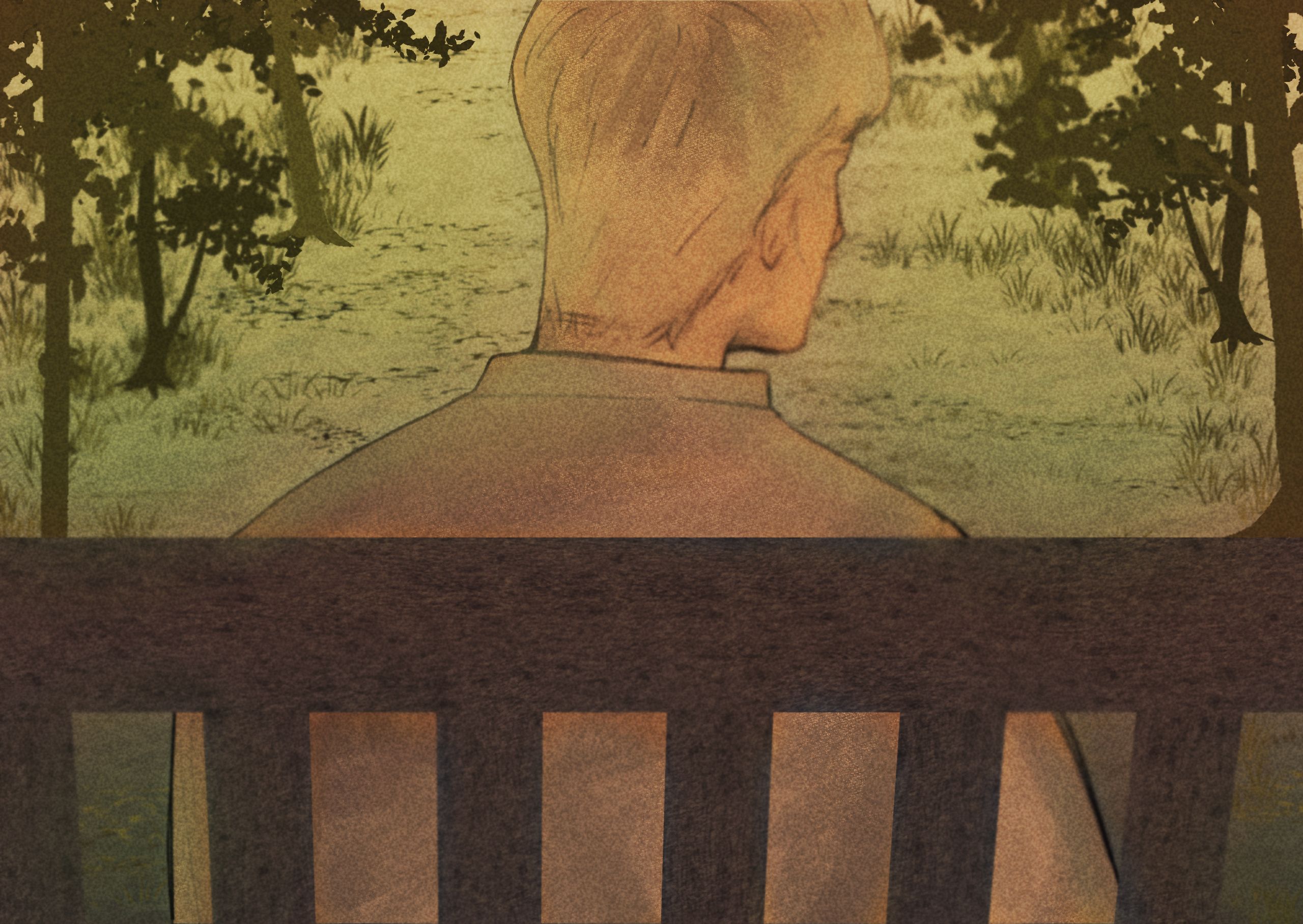
God, it looks like Daniel. / Must be the clouds in my eyes.
~ Elton John
Is this seat taken? Do you mind if I talk a little?
I’m not great at small talk—weather, sports, politics—I can’t keep up like I once could. The world seems to have gotten away from me. People these days have their own way of speaking and listening. But you seem like the kind of young lady who might be okay with an old man telling his story.
You ever been to Story Park? Off Evergreen? It was called Foothills Park until ‘69 when all the storytellers took it over that summer. Wannabe professionals and the like. Beatniks, poets, and bums. Older guys with cigarettes and bottles in paper bags. I went there as a young man and listened to those lost men talk of our cosmic agency. I used to think the name was charming—“Story Park”—like the park was a place that only existed in a novel.
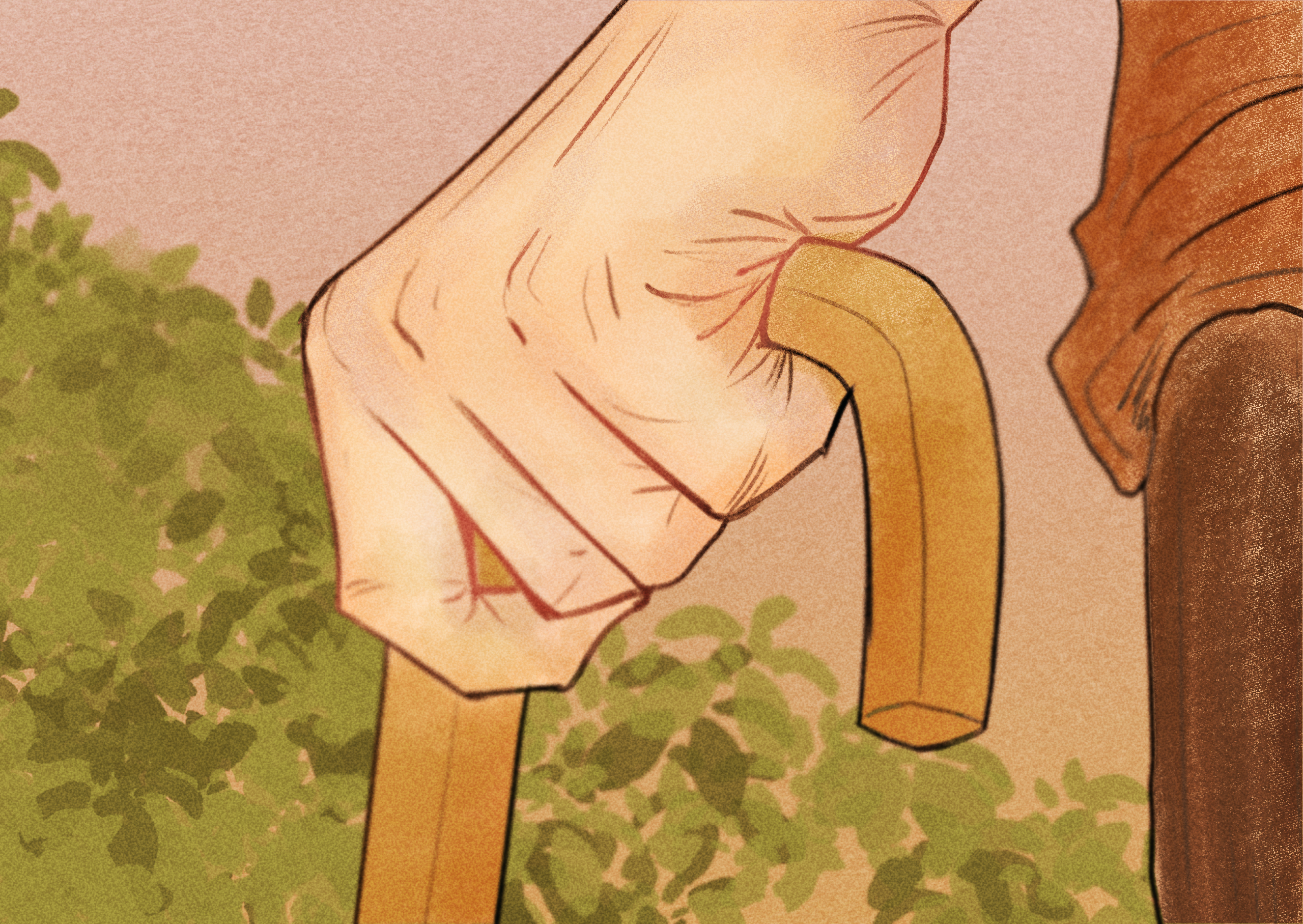
Nowadays, I go there every day. Morning til evening. I bring my cane and a thermos of instant coffee, maybe a sandwich. At the north end of the park, there is a bench I’ve come to cherish. It faces the trees. I can’t see them well anymore, but I like to think they remember me.
I’m legally blind now—though you’d never know it by looking. My eyes don’t have cataracts like most folks my age. Some disease with a name that sounds like a rock band from Germany. Macular Degeneration. I still catch outlines. The center of my vision has clouded over, though. All I see are the ghosts of things. The details—the stitching on a jacket, the face of a stranger—those are gone. Like trying to remember a dream five days later.
The last time I saw my daughter, she was standing under those trees. Not really her, probably. But God help me, it felt like her.
Danielle.
That was her name. Still is, I suppose, though people called her Dani, even Nellie, depending on the day. But to me, she will always be Danielle. The name Gretchen and I gave her when she came into this world, screaming like she already knew it was going to be hard.
She was bright. Beautiful, too. Typical dad sentiments, I know, but she really was. Huge brown eyes. Hair like her mother’s—coarse, dark, wild. But her brain–jeez, that girl was sharp. Reading at three. Drawing blueprints for a rocket ship at six. At eleven, she asked for a microscope and stopped believing in Heavenly Father in the same week.
That’s when things started to change.
She grew quiet, more guarded. I’d find her sketching at night, pages full of eyes and mouths, faces of boys I didn’t recognize. Not scary, exactly, just unreadable. Some days I’d catch her staring into space—not hearing us when we’d call. She lost interest in hanging out with her girlfriends, quickly abandoning any sleepovers or day activities. She became allergic to her own smile and the dresses we bought for her, opting to wear my old t-shirts and these big sweatpants, stained and smeared. On our weekly Sunday drives through town, she’d stare out the car window watching groups of kids and adults as if their kinship was an unknowable secret.
I prayed again and again, but the Lord was silent, and I didn’t know what to do to help her. One day, coming home from work, I found her in front of the TV. Staring into it but not really watching. I told her she was too young to be zombie-ing in front of the screen and that she might go blind sitting that close. She was fourteen then. I snapped at her, saying only her name—somewhere underneath it all the things I wanted to say but couldn’t. I squatted down in front of her and said her name again, gently this time. My hand on her shoulder. My sweet girl, don’t you know how lovely you are? None of those words came but I wish they had. Looking back, she must have seen my vision of her as a burden, as a role in a play she never signed up for.
Something changed shortly after that and she started dressing herself up again and hanging out with a couple of her old girlfriends, the strained effort visible in the way she walked and laughed. The night of her first junior high school social, she returned home an hour early, saying nothing to Gretchen or me and locking herself in her room. She wasn’t great at the whole make-up thing. The blotchy lines of her makeup and the uneven weight of her lipstick gave off the impression not that she didn’t know how to properly apply it but that she botched it on purpose in an attempt to display the absurdity of it all. Close to a year went by and she stopped applying make-up altogether. She went back to wearing my old t-shirts. One night, she came home after a movie saying, “Allison is a bitch.” We never saw Allison or her other friends from church again. Danielle started hanging around the boys—but not in a way that made Gretchen and me worry. She wasn’t being promiscuous; she was a tomboy. She started smiling after that. I did worry but for altogether different reasons: she was never going to be able to live a normal life if she didn’t get on track, figure some things out, embrace her femininity. If she wanted a good career or a husband, she’d have to clue in.
She met Eleanor shortly before her fifteenth birthday, and her face lit up again the way it used to. Eleanor was a striking beauty, beyond her age in looks and attitude. Like her maturation had been fast-tracked by God. Gretchen and I would see them walking home from school together, starting as small dots down the street and turning into close friends walking side by side. They’d sit and talk in the backyard under the walnut tree for hours.
When the weather became frigid they moved their discussions into her closed-door room, but—and I’m no expert—it didn’t sound like girltalk. There was an existential weight to their words. An awareness of themselves because they were mature for their age I assumed, but I now know what it was. They were both outsiders, strangers to the rest of the world and strangers to themselves. Eleanor stayed for dinner most nights, claiming that her mom was working nights or something. At first, we’d thought that Eleanor was getting Danielle into drugs—like marijuana or something. But when we walked in on them embracing each other in damp ecstasy, in a flicker, we understood that they were lovers. Danielle was gay.
Gretchen was more lenient with her, saying that we should stay out of it, but I was adamant that Eleanor and Danielle shouldn’t see each other anymore. I remember saying, She’s just entered high school. Okay, she’s gay—fine. The church and world are more open now. But she’s too young to be dealing with this. She needs to focus on school. Set herself up for success. I don’t care—I really don’t—I just want her to be happy. When I think of it now, I can see how blind I was, even then.
We caught Eleanor and Danielle in the middle of the night some weeks later. The next day, she went missing—only for us to find her hiding out at Eleanor’s home, a double-wide in the trailer park at the north end of town, where the parents appeared to still have the minds of teenagers themselves. On the ride home, I asked her, What else is going on, Danielle? This thing with Eleanor aside, I can sense something else is going on with you. Did your mom and I do something? Please Danielle, I want to help you, I really do. Please tell me. She didn’t say anything for a long time. She stared out the window, her eyes red and puffy from crying, not watching the road but just staring at the space that was there. She said, Dad, you can’t understand. I’m not even sure if I totally do. I’m just not like other people. That’s all I know.
Gretchen and I decided to send her to a program for girls where they stay in a facility in the city. A place where all the girls like her could share their stories and heal together. She returned several months later, standing more upright but faking a smile as she walked through the front door. All she said was that healing was a myth. Sure, physical wounds might heal—but the spiritual ones, she said, lay open, collecting dirt from the world. She said that. Those exact words. I thought of a chip in my windshield and how one needle-sized crack grew and eventually scattered across the glass. I wondered if Danielle’s heart was similar: breaking more and more over time from one tiny crack. I just didn’t know how the first crack formed. She wanted to see Eleanor but we refused.
The next morning when she failed to turn up for breakfast after our calls, we found her cold and breathless in the bathroom off of her room, a bottle of acetaminophen open and empty next to her. The world we knew crumbled and we began a new one where our only child was gone and we didn’t fully understand why. We buried her next to my parents and next to mine and Gretchen’s plots in the old cemetery on the foothills. About a month before her seventeenth birthday. It’s hard to believe that was thirty years ago. Although we divorced a year after she passed, Gretchen and I still talk twice a year. She calls me on Christmas and Danielle’s birthday. Just to check on me. We don’t really talk about Danielle.
But just two years ago, when my eyes really started to go, I remembered the Story Park I knew as a young man and decided to take the bus out there. It had changed a lot, but I wandered around taking in what differences I could see despite the oncoming blindness. I found that bench facing the tall waving trees and sat down, listening to the passersby and the leaves that rustled like crumpled paper. I peered around the dark cloudy center of my vision, seeing the red blur of a hoodie and the dull flash of a bird taking flight. Below the tall trees, I saw a figure meandering through the park, and suddenly the center of my vision began to clear.
It was a man. He eased himself down and huddled against the trunk on one of the trees. He was skinny. His boney hands clutched the blankets around him. Probably lost. Definitely hungry. I felt an overpowering draw, like the world itself was looking back at me, beckoning me forward.
What are you looking at, old man? The young man said in a hoarse voice.
I just want to help, I told him.
You can help with money. Money helps everyone.
He looked up at me and I saw her face. The gray clouds from my eyes had dissipated for a moment. Danielle had these big brown eyes and so did he, along with the slightly down-turned shape of her lips. Where did you come from? I asked.
I handed him two twenties. He took them. Looking between the bills and me.
From Denver originally. I need to get to the mission on Fourth. My girl is there waiting for me. Need to get back to Colorado. She has kin there. They’ll take us in.
What’s your name, son?
Daniel.
My eyes filled. I knew it was. I knew it, I told him.
I gave him another twenty, and just looked at him and wept.
What is up with you, man? He rose, eyeing me. You need some help.
I don’t really know what’s happening, son, or who you are. I just want to say I’m sorry—for all of it.
He rose up and walked away from me, but I yelled after him.
In my mind, I saw Danielle as a baby. I told him, See that bench? If you’re lost or need something—anything—I’ll be there. Every day after today.
He looked back at me before shuffling away out of sight. In that look, I saw Danielle clearer than I’d ever seen her when she was alive. Something about this boy. This man. Suited her. I watched him walk out of my sight until the clouds in my eyes returned. Since then, I have questioned what I saw that day, if my vision really did return for that moment. But I’ve come to realize that it doesn’t matter. The moment was real enough. I will likely never see her again in this life. But I’m there every day—heading there this morning with my instant coffee, in fact, and I will continue to be there, hoping that he’ll take me up on my promise.
I don’t know how long—
Oh this is your stop? Okay. It was nice talking with you.