
“Stipend,” they had said. That was worrisome. “You will be given a generous stipend,” is how it was phrased. He didn’t like “stipend,” as a word. It had a childish way of hinting at incontinence. “Stipend”…“stupid”…”depends”…“diaper” was the course the phonics tended to steer, invariably, while racing through the word association passageways inside his head. “You will be given a stupid diaper,” was a kind of riff he’d developed, to amuse himself. But he couldn’t escape the feeling that he’d made a mistake, or that the upcoming summer approached all the more quickly now that it was ruined.
“Ja-a-ake,” called Celine. The impending summer camp had been haunting him all spring, but moments like this, when he actually enjoyed the company of a child, provided relief. “C’mon, Jake! Pull me on the train!” He found it hard to refuse Celine, with her too-small T-shirt and her mischievous, wiggly arms. She had a slight build, but the muscle mass she did have was raw sinew. Among second graders, she scored 15th percentile in size, 90th percentile in strength: that was Jake’s guess. He loved thinking in “percentiles,” because it made him feel data driven. The education and childcare world was all about data, for some reason. He didn’t get that, but of course he would play “Train” with scrappy little marionette Celine.
He was fascinated by this sort of imaginative play, because it involved a very straightforward, seemingly endless fabrication, understood as fake by all parties involved, but maintained for the fun of it. Kids loved using their imaginations in this way, and they did it all the time; adults typically hated it, convinced they were no longer a party to such foolish make-believe. Jake had a robust imagination, so he was adept at improvising different features of the train stations on Celine’s route: “Next stop, Basketball Hoopville. Beautiful Basketball Hoopville, where everything is hoop-shaped, and the nets are woven of the finest sateen.”
“Ja-a-ake! Hehe! What’s sateen?!”
The kids were so loud, so loud and so spoiled. They spent the afternoon barking orders and assaulting one another with plastic “scoopers.” The “scoopers,” which came in an array of colors, had been purchased for the school years ago, originally comprising a children’s jai alai set. It might seem unnatural to take a group of invigorated juveniles and introduce equipment from an obscure, high-speed gambling sport, but The Arbor School was undeterred by such considerations, unwittingly generating a behavioral chimera (when all of the jai alai balls were inevitably lost on the roof) that manifested itself in daily combat simulation, wherein the scoopers were used as swords, and guns.
It was 5:52 PM. Celine’s mother was late. “Ja-a-ake! What’s the next stop, Jake?” Celine asked, her hands clasping a repurposed jump rope. Jake didn’t know the next stop.
He was worn out by the screams and the hitting. And then there were the parent emails, which flowed like sewage, flooding his inbox through the digital cloaca that was the after-school family listserv. It was always a request for special treatment. “Do you think the Magic instructor could make an exception for my son? I know the class is limited to eight-year-olds and up, but ever since his uncle let him watch The Prestige two weeks ago, Asher has been obsessed with faking his own death. We believe a general-education magic class might redirect him, and teach him that real magic isn’t all about trap doors and deceit.”
The Arbor School was one of a few small, “Independent” schools in Fort Greene. “Independent” sounded better than “Private.” For a school to call itself “Private” is exclusive, discriminatory, wrong. “PRIVATE” is a sign on a cast iron gate, outside of a golf course. “Independent,” on the other hand, suggests courage and fireworks. An “Independent” school doesn’t keep people out; it merely has the freedom to keep people away, if it so pleases. “Indeed, a tree CAN grow in Brooklyn,” is how Dani, the School Director, had put it during Jake’s interview (which went poorly). “A tree CAN grow, Jake, and that tree is a child.” “Ah,” Jake had said. “I know what you mean, I think.” “What? What do I mean, Jake?” “No, well, I mean, a child, in a sense— “ “Picture a sapling, Jake, newly planted on the sidewalk, next to the Brooklyn-Queens Expressway, or what have you. That’s the child, you see? And I like to think The Arbor School, well, you know those little sticks that go on either side of a sapling, to steady it with twine, or sometimes wire? Well, we, the school, I think we’re like one of those sticks, and the other stick is the parents, and we work together to provide support, by pulling the child in opposite directions.” This was said shortly before she forced Jake to do a role-play, wherein she was the misbehaving student, and he was the After school Director tasked with redirecting the child without using “you statements.” The role-play ended with Jake unsure of whether or not the role-play had ended: ”You can’t give me a ‘Time Out,’ Jake; at The Arbor, we call it a ‘Break.'” “Wait, are you still in character, or are you really saying that? I can’t — I don’t know what’s real.“
Jake had always struggled with the positive verbiage expected of him as After-school Director, because the kids seemed so deserving of harsh rebuke. He yelled, and often. “Hey!” was his mainstay, and he tried to put lots of megaphonic bass-boost into his voice. “Hey! Get off the thing!” he would thunder. It frustrated him that he couldn’t name this off-limits thing they always sat upon, and that he had to refer to it as a “thing.” His only other option was, “Hey! Get off the big wooden shelf that holds mats!” but that was too wordy, and “holds mats” does not roll like thunder off the tongue.
The after-school program was a big revenue stream for The Arbor School. This was the case for many after-school programs in Brooklyn. Parents were willing to pay large sums of money to savor their children’s absence. When he first became the After- school Director, Jake naively believed parents needed their kids to be in the program because they were at work; then he noticed that many of them would arrive at pick-up wearing stylish athleisure, carrying long green stalks they had acquired at the farmer’s market. It was also common to see parents arriving in a brown outfit covered in a curious layer of white powder, looking very much like the pricey almond croissant that started their day. Why were these parents covered in confectioner’s sugar? Jake wondered. He soon realized it was a coating of minerals and plaster (very natural), the kind that is deposited on one’s fashionable canvas utility pants through the elective toil of a boutique course in adult ceramics. And sometimes, though less common than the athleisure and the chalky residue, he would notice, mid-conversation, that a parent had been drinking, heavily.
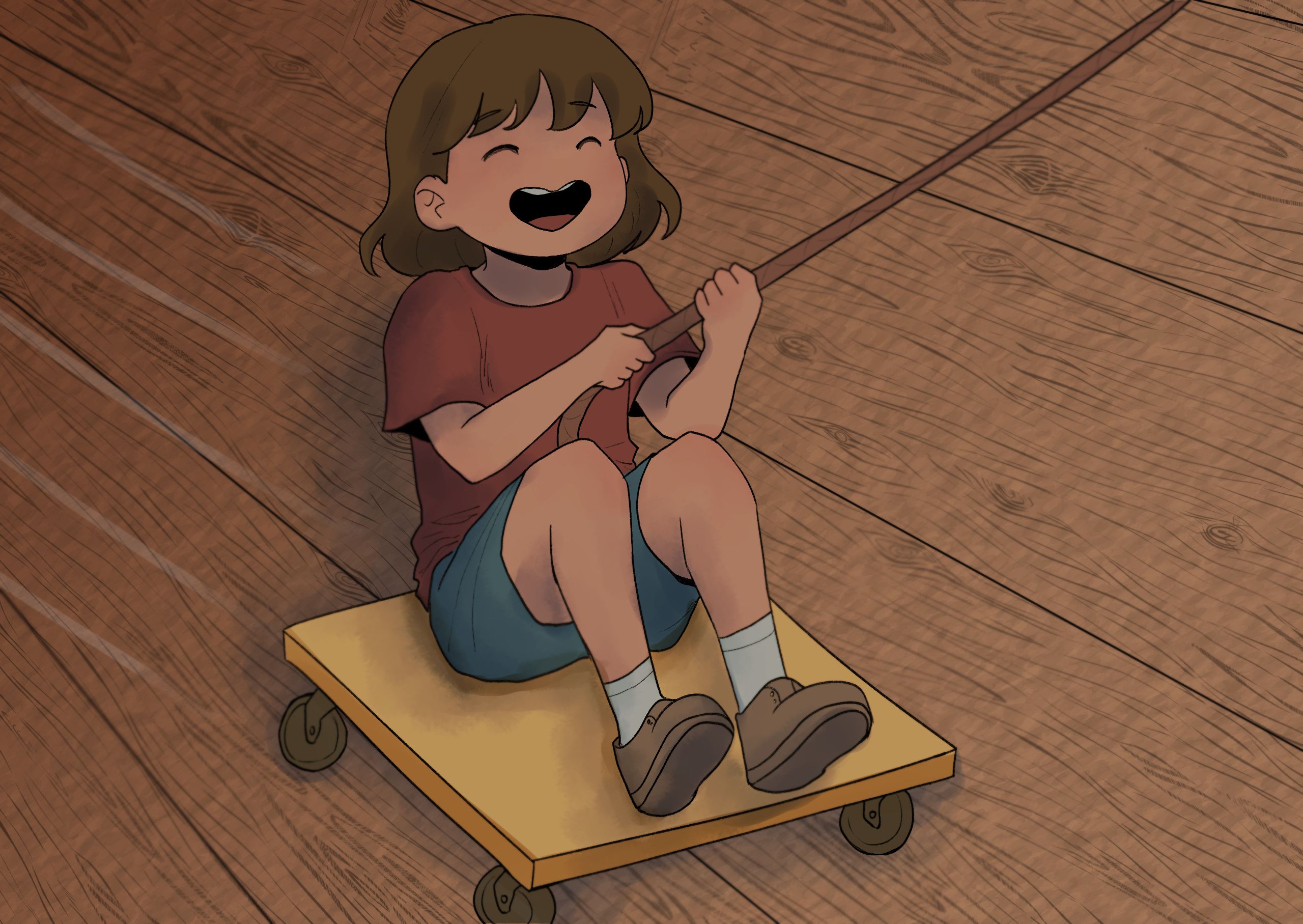
Celine’s mom wasn’t one of these parents, but she did have a lateness habit that Jake resented quite bitterly. “Super speed!” Celine called out. She gripped the rope and smiled big and felt a centrifugal rush as Jake hauled her in circles, which was a draining task, since he had to exert himself, crouching, towing, while ensuring the safety of his giddy passenger in a room full of hazards. The multi-use gym that they used for indoor recreation was furnished with plenty of modern dangers, like phys-ed equipment carts and portable basketball hoops, but it also housed other more imposing threats that, like the building itself, were pre-war, and were therefore dense, metallic, and capable of mutilating the younger generations. Not the least threatening of these was a large electric fan that, when turned on, sounded like it was hurtling across the everglades. One day, Dani had asked Jake to move it to the other side of the room, to dissipate fumes from a neighbor’s backyard barbecue. “There’s a hot dog smell,” she said. Jake remembers straining as he leaned the 6’9” monolith against his chest, its protective cage etching a rusty grid onto his face. He remembers noticing the sheer slicing potential of the fan’s dust-caked vanes. They were cold and unforgiving. He worried the fan would magically sputter to life, fall to the floor, blow apart like a crashing helicopter. Despite his efforts, the fan would not yield, because it weighed approximately 300 pounds. By essentially asking him to drag a windmill across the French countryside, Dani had once again set Jake up for failure. This was her specialty.
Celine laughed, oscillating on her bright-yellow square of plastic with its spinning casters, holding onto the jump rope like she was tubing on a lake. “Wheeee-heeeee! Super-fast-speed, Jake!” The kids called the teachers and administrators by their first names at The Arbor School, so everyone could be on the same level. “We’re all growing together in The Arbor, Jake,” Dani had said. He had never gotten used to it; it made him feel compromised as an authority figure.
Once a week, Jake and Dani would have a meeting to “check in,” and Dani would always launch the meeting by asking Jake if he “had anything,” leaving him floundering for content, because he had nothing. “Do you have anything?” she would ask. “Uhh, yeah…” and then Jake would present her with the most abject, meaningless fluff in the history of the workplace. This week’s meeting had been characteristically strained and discordant. Jake had scrambled for something to say, after being asked if he had anything, and came up with, ”Is, uh, so I cleared out the stairway, the one the fire inspector told you was blocked. I, eh, I took the floor puzzles and placed them elsewhere, so no one will see them or step on them.” “Hm. What about downstairs, in the basement? Did you move the, uh, you know, those long sorta skateboards in the box?” “I don’t — what skateboards?” “There are — there’s a box down there, and the church doesn’t want any after-school stuff down there, but you have a box of skateboards down there.” “I — hmm. I don’t have skateboards. Do I? Weird.” “Yeah, they’re down there. The church wants them moved.”
Every school Jake had worked at was affiliated with a church, somehow. Before moving to New York, he had taught at a public school in downtown Boston that was attached to a Chinese Evangelical Church. Sometimes, when he stayed late grading papers on a Friday night, a large group of teens and their hovering mentors would enter his classroom, and use it to conjure Jesus, and carry out inscrutable social activities. There was lots of unexciting, conservative dancing, the kind that can only serve to cool, numb, or otherwise incapacitate the sexual organs. And the music, flat and dry, was further steamrolled and desiccated by the way the church group clapped, in an unsatisfying way, on the one and the three, instead of with the snare drum, on the two and the four. On other more solemn nights of the week, he’d be in the classroom preparing his whiteboard for the next day, and a prayer group would enter, partly comprised of some of his fellow educators. Ms. Zhao, for instance, a funny round woman with an old soul, who was mocked by 7th graders, ruthlessly, on a regular basis, once included Jake in her prayer (an honor for which he was unprepared). “Mr. Sandros,” she said, warmly and inclusively, while holding hands with four fellow supplicants at the table, “do you want us to pray for you, too?” He couldn’t imagine saying, “No, keep my name out of your mouth, Ms. Zhao,” or, “You would do well to exclude me from your worship, Ms. Zhao,” or, “No, Ms. Zhao, do not pray for me. I am afraid I am beyond redemption,” so he said, “Yeah,” and then, there he was, scrawling the next day’s lesson objective on the board in red marker, as Ms. Zhao rattled off a petition to the Lord: “…and please God, let Mr. Sandros be sheltered by your benign embrace, and his family protected, and his heart strong, and let his spirit soar and be blessed on this beautiful Tuesday evening, because Mr. Sandros is good, Lord, and he gives so much to the kids each day…” and he did, in fact, feel touched and a little blessed, or at least grateful someone was using his surname.
Jake had found the skateboard conversation with Dani to be particularly frustrating and emblematic of their communication problems, since he really had no idea what she was talking about. His after-school program had no skateboards, so it was impossible for him to have an entire box of them. “I’ll check. That’s weird,” is all he had said before leaving Dani’s office, punctuating their stilted interaction with the request, “Can I have a clementine?”
The clementine was quite juicy, and exuded such pleasing puffs of citrus as too transport him, briefly, away from the staircase he descended in pursuit of these skateboards that did not exist. He imagined himself on the beach, in a tropical location, walking barefoot along the shore, where one tracks lines of seaweed, dismembered crab pincers, and remnants of sand-tinted spume, moved by the breeze. That would be nice. He liked the seaside and the heat.
Where would he be this summer? Jake had had every intention of running the upcoming summer camp, when he first accepted Dani’s offer, but, as the weeks passed, he lost motivation, or panicked — or both. He had disappointed himself, because he really tried to be responsible, this time. He thought he had it.
The clementine was peeled, now. He wandered The Arbor School basement with tiny clumps of rind jammed beneath his thumbnail. Jake didn’t mind. The clementine was extremely fresh, and he was eating it two to three segments at a time when he noticed the box, sitting underneath the staircase, beside a shopping cart that was filled with half-painted papier-mache coconuts and oars. The box contained no skateboards. It held plastic gym class scooters, the colorful, square kind with swiveling casters, beloved by Celine.
“Speed, Jake! Speed!”
The box of scooters had been easy enough to move to an appropriate location, but Jake had not escaped that experience without losing even more respect for Dani. He couldn’t work with someone who didn’t know the difference between a skateboard and a gym class scooter.
Jake had needed the money. That was not the best reason to accept a Summer Camp Director position; regardless, he thought he could suck it up, put his head down, and eke out his measly stipend. But after a couple of months of sparse, half-hearted preparation, and a growing resentment toward Dani and her unlikeable learning institution, he had allowed the camp, by very small degrees, to disappear from the tangible universe, while continuing to lie about its advancement. He had no plan; he just wanted employment until the end of the school year, and he was convinced, in this fog of occupational dysfunction, that part of his job was to maintain the illusion of an approaching summer program.
“How’s camp registration going?” Dani would ask, checking in. “Good,” he would say, “lots of interest.” And this was true. Registration was in fact really good. Lots of parents were signing up for the camp, and filling out various medical forms and waivers. This paperwork would eventually be straightened, alphabetized, and placed neatly into manila folders. From there, Jake would cull the relevant information from each folder and transfer it onto a shared spreadsheet. The flush fields of this spreadsheet were all that mattered in the way of measuring Jake’s progress. This spreadsheet, so unreal, so easily bloated with data, held godlike sway over Dani.
By May 17th they had already reached their registration goal of at least 10 kids per week. Week One was particularly juicy, with a list of 12 kids, two of whom were named after bodies of water. These 12 kids would bring in a total of $13,200, for the first week alone. Many of the families had already submitted deposits in the form of personal checks, which had become torn and dog-eared after being jammed into the bottom of Jake’s book bag. He would never submit the checks to accounting.
The camp was getting more sign-ups than last year, because Jake had invented some electives that really got the families’ attention. Dani had advised him to “Go ahead and come up with something, you know, something new, if you have any ideas for the camp,” so Jake had launched a small email campaign that overused the phrase “we are igniting children’s interest,” which he found amusing, because it brought to mind children, ablaze. One of the emails was quite the ripsnorter. It explained how unbelievable the inflatable planetarium was going to be on Tuesdays and Wednesdays: “Much like the universe, your children’s minds are constantly expanding. For this reason, we will put them inside a five-meter, starry dome with an airlock.”
Jake thought this offering was sort of laughable because the school did not even maintain inflatable kickballs properly. All of the kickballs were deflated, or were working their way toward deflation through the effects of a slow leak. One parent had noticed the deflated ball problem in November, a soggy month during which most kickballs descend into gritty, sad obsolescence behind a dumpster. She wrote to Jake, complaining that “the ball looked like it was from an alley in Calcutta…I asked Sadie what they did with the deflated ball, and she said they wore it as a hat.”
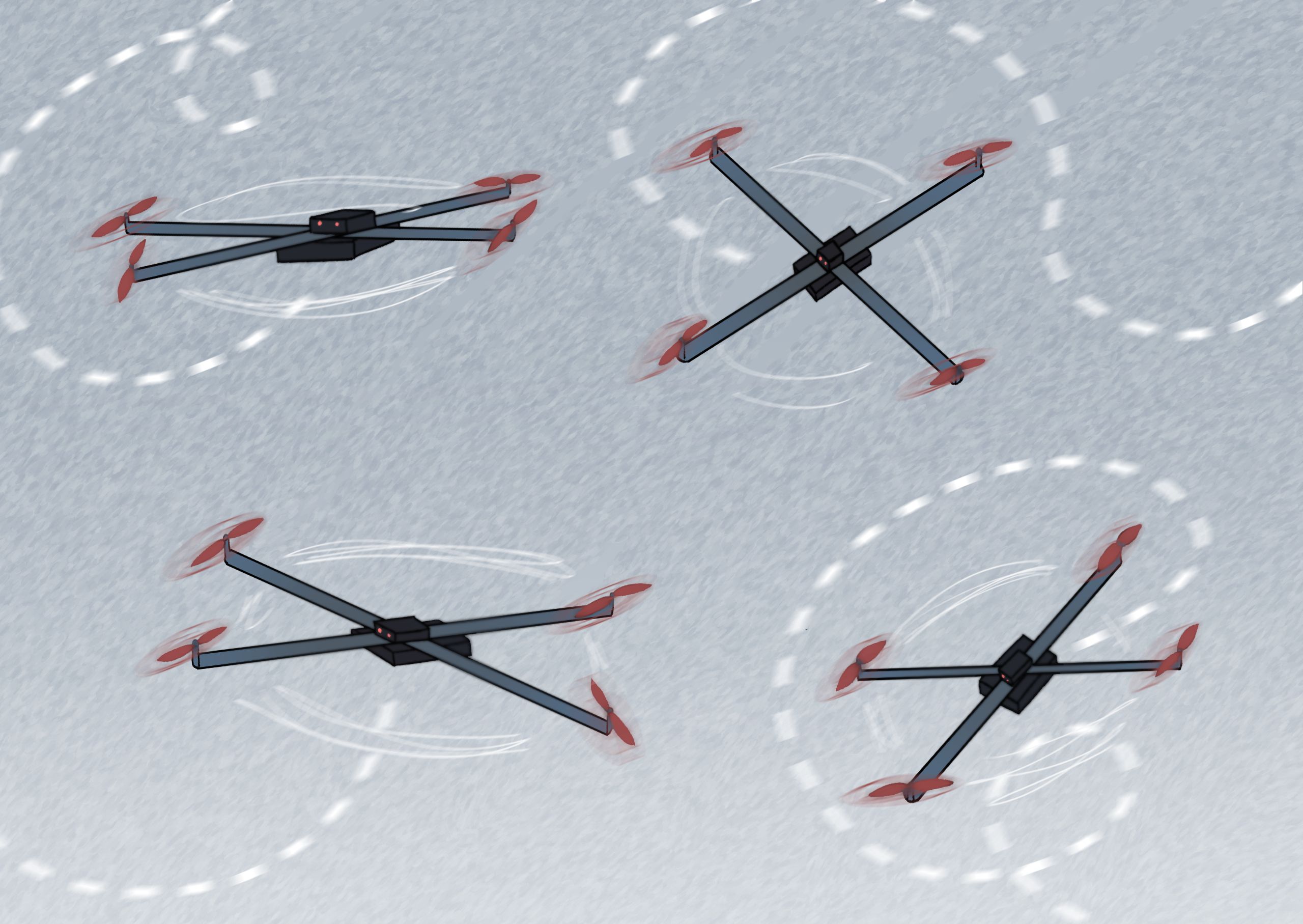
On Mondays and Wednesdays (Jake was excited to announce) Brooklyn Constructo-Bots would be visiting, from 10:30-noon, to teach the kids how to build a drone, by hand. “By the end of the week, your child will be able to say: ‘I have built a drone, by hand,'” Jake had written in the promo email. The parents were ecstatic. No one could get into a Brooklyn Constructo-Bots class without being on a one-year waiting list, and passing an entry exam. According to Jake’s email, each drone would have a small camera, and the kids would amass tons of footage and upload a finished, edited video which would be embedded on The Arbor School’s website, with soaring rock and roll music in the background, and a slideshow with Jake and the kids and the entire Brooklyn Constructo-Bots team. “It’s really great because they take a scaffolded approach to instruction.” (Jake took every opportunity to mention scaffolding in the context of education.) “Just tons of scaffolding everywhere,” he added.
A parent’s email: “Can we make sure all the drones are flown to the same altitude? Within reason, of course. I know, I’m in full Mama-bear mode, here. I just don’t want my son to be outmaneuvered in the air — and I know I am being a pain and this sounds crazy — but he once had a negative experience with a Japanese fighting kite, on Long Island. He wasn’t flying the Japanese fighting kite. A man was. I think he was a veteran. He flew his Japanese fighting kite into my son’s regular kite, which was shaped like a toucan, slicing off its wing, and sending it spiraling to the ground. We think he did it on purpose. Regardless, Caspian is touchy about air combat, now, and while I am happy he’ll be building a drone, by hand, I don’t want him to feel like his drone is less-than, and therefore susceptible, if that makes sense? Maybe just the instructors can fly them?” “Oh, don’t worry. There is so much scaffolding everywhere that the kids won’t be able to fly too high without crashing into it.”
Celine lost control of her scooter, and tumbled harmlessly onto the polished hardwood floor. She just lay there, laughing, and Jake was frozen for a moment, a stunned smile on his face, before checking on her. “I’m okay, Jake! More speed!” Celine grabbed the jump rope while situating herself on the scooter. “Hey, Ja-a-ake” she continued, with a whine (but an endearing one, an endearing one), “are you gonna do the train with me in camp, this summer?” “You’re going?” He had not seen any new registrations, recently, certainly none for Celine. “Ye e-ss. My mom says I’m going in Week One — Week One, yay! I wanna do the train. I wanna do the super-speed! Oh, also, I wanna build a drone.”
The last few weeks of after-school were easy, besides a slight mishap in Karate class, where Bromley Clayborne sustained an injury (bloody nose) during a board-breaking demonstration — “Brom Bloody, but Okay” read the subject line — but the long weekend before the start of Summer Camp killed Jake. The whole time, a kind of creaky wooden screw twisted the fabric of his psyche, causing restlessness and an uncomfortable mental twang. He had trouble reconciling the fake with the real. Jake had given up on the camp, and had pushed it to the back of his mind, but somehow here it was: Week One. He had created a bubble, of sorts, with his registration forms, and spreadsheets, and mail merges; in no way would he deliver the youth enrichment he had articulated so fluently over email.
At 8:15 AM, the Week One families waited at The Arbor School’s security desk, which was a folding table. The security guard, who had just unwrapped a small apple that he’d covered in aluminum foil, was surprised to find that Jake had not arrived. “Uhhh. Uhp. Jake isn’t here, yet. Just hold on and get signed in, and I’m sure he’ll be here.” The parents chuffed in exasperation, their dreams of completing a quick drop-off dashed, as they struggled to maintain a holding pattern for their kids in the lobby.
There, among the crowd, stood Celine, holding her father’s hand, a jump rope dangling from her half-zipped backpack, which had ears and was shaped like a frog’s face, grinning. Celine’s face, on the contrary, displayed her signature intensity. She could tell something was wrong.
“Hey, what’s this?” Winona Brownsford, mother of Tuba Brownsford, stood there in her high-performance leggings and gazed at a large, butcher-papered bulletin board at the foot of the stairwell. A small note was posted beneath a “SUMMER CAMP” banner:
“Dear Arbor School Camper Families: There is no camp, so you will have to play with your own kids, this summer. -Mr. Sandros.”
Upon reading this, Winona Brownsford’s pores began to excrete a sweat of indignation, which was quickly wicked away by her activewear.
“Mr. Sandros? Who’s Mr. Sandros?” asked Jesse Bulch Flagenmeyer.
“I’m Mr. Sandros!” Jake announced with his “Hey!” voice, his stentorian thunderclap, standing in the building entranceway, looking at the parents huddled around the bulletin. It had begun to rain. Jake had nothing with him, and his thinning hair, drenched, made him look like a kind of baptismal infant. “I’m not gonna be here long; I just wanted to say sorry — I, I wanted to say sorry to Celine.“ Celine looked at him, smiling, and waved. “Celine, you’re cool, but I can no longer provide you with super-speed. I apologize. Maybe your dad can play ‘Train’ with you. Anyway, have a good summer.” He turned and walked out. “Ja-a-ake!” called Celine. The door moved very slowly against its hydraulic closing mechanism, providing the parents and children with a diminishing view of the sidewalk, darkened by rain. Soon, a large dump truck swooshed across the nearby expressway with a flatulent blare of exhaust.
THE END