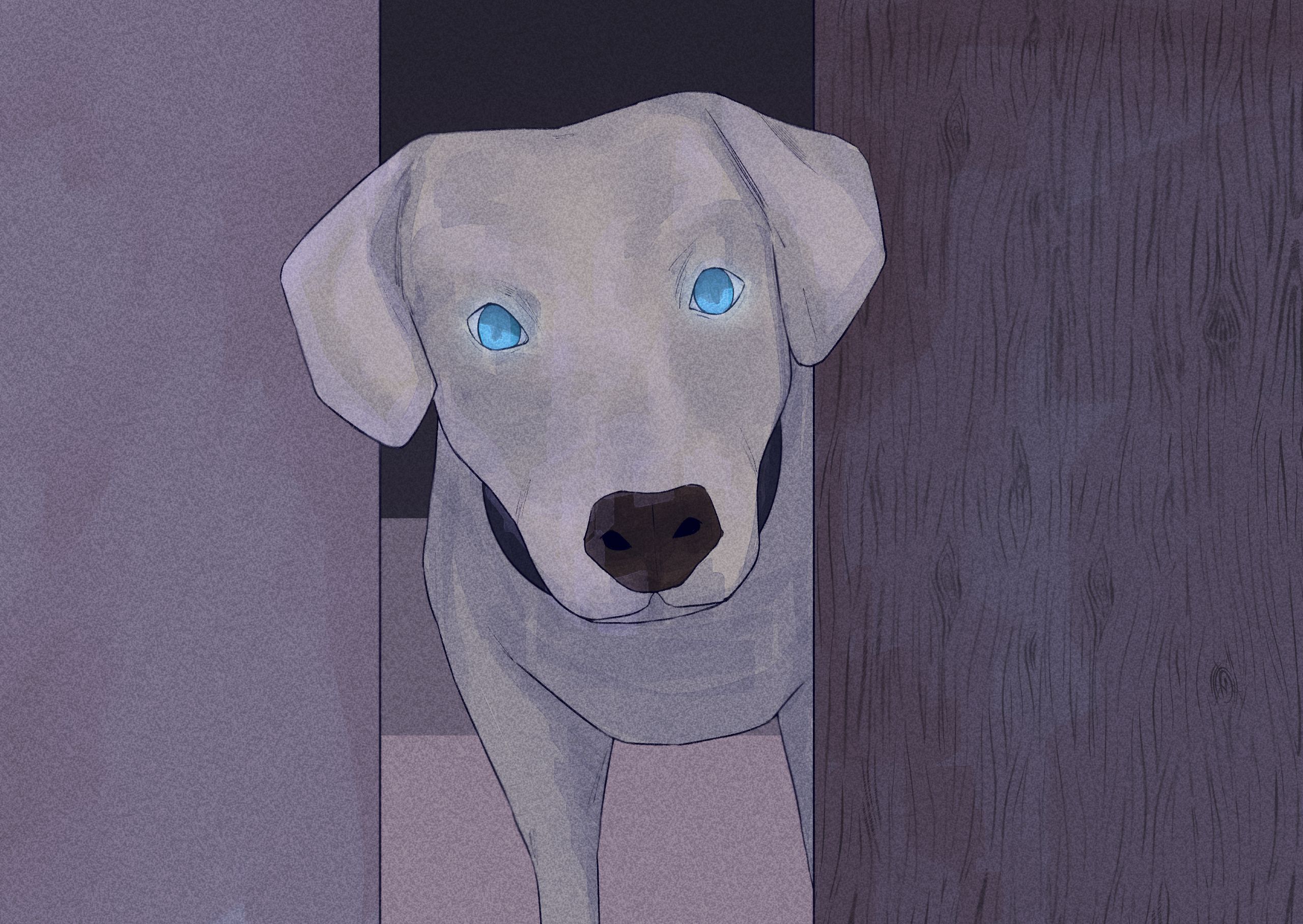
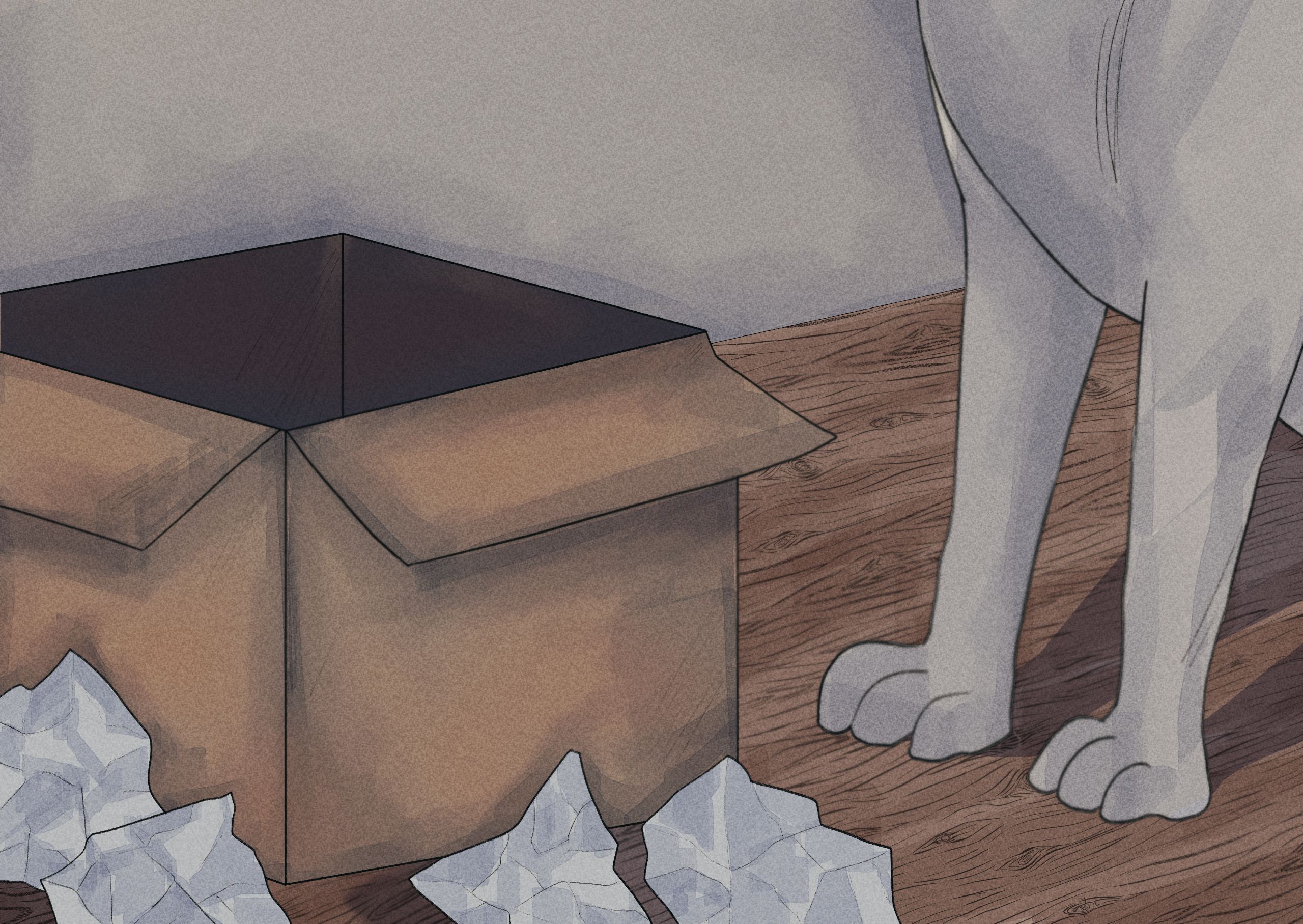
Barnhardt didn’t think much of the packaging. And the dog? It sat beside the box and the raveled paper, eyes glowing blue in the dusk light. Its tongue hung out and swayed while it panted without sound. Barnhardt snapped his fingers and slapped the table, but the dog did not take a break from its charade.
Barnhardt’s phone rang.
“Shall I answer it?” the phone assistant said.
“Don’t answer it,” he said.
“Answering,” said the phone assistant.
“Hi Dad! Happy Birthday!”
“Happy birthday Dad!”
Group call.
“Thanks girls.”
“You sound like a happy birthday boy!”
“Birthday boy! What do you think of him, birthday boy?”
“Yeah, what do you think?”
“Isn’t he adorable?”
“He’s the cutest, isn’t he Dad?”
“How’d you know?”
“Know what, Dad?”
“Yeah, know what?”
“I unwrapped it.”
They laughed. “Oh Dad,” one of them said. “Sensors.”
“Yeah Dad, hello? Sensors.”
“The package. It has sensors. You know that. Mandy and I received messages when you opened your present.”
Barnhardt felt dim. “How do I turn it off?”
“Turn it off?”
“Turn what off?”
“The dog.”
Again they laughed, like he had an endless stream of jokes. “Daaad, you can’t turn him off. He’s your pet now.”
“Your new best friend.”
“Yeah, with Shelby gone.”
“Long gone. Like, how long ago?”
“We know how you loved him and miss him.”
“We thought this’d be perfect for you.”
You’re projecting Barnhardt wanted to say. It was a concept he’d recently come to, the practice of assuming a person feels the same way you do about something. Projecting, he now understood, was a local problem. In fact, the source of most of the world’s problems.
“Can’t wait to hear what you name him.”
“Yeah, can’t wait. He’s going to be so great.”
“Happy birthday Dad.”
“Yeah, happy birthday!”
“Bye!”
“Bye!”
“Call ended,” the phone assistant said.
“Bye,” said Barnhardt.
The dog sat next to the box. Barnhardt picked up the warranty pamphlet and tossed it back into the box. “Not a dog. Carbon fiber plates arranged in the shape of a dog.”
Same as its tongue, the dog’s ears flopped like the real thing. Unprompted, it began to sniff around the chair and the legs of the kitchen table. It moved like a dog. But not a sound came from the thousands of actuators inside.
Barnhardt pushed the box into the corridor and shut the door. The dog had space to sprawl, but it loped to the wall and sat down. Barnhardt left it there.
That night a scraping, like a chair moving across the floor, woke him. He clicked on the light. The dog stood in the bathroom doorway, rubbing its hips against the jamb as if it had hair.
“Stop that.”
It gave no hint it heard him.
“Stop it!”
The dog plodded across the room, circled once, twice, and lay down. Then it began licking the bottoms of its paws, in a way familiar to Barnhardt.
On the third day, the dog sat near Barnhardt’s feet while he drank tea and on his phone searched for the manufacturer’s app. He found hundreds of apps to control all kinds of automaton pets. Not one for his.
The phone rang.
“Shall I answer—”
“Don’t answer,” he croaked. “Don’t answer it.”
“Answering,” his phone’s voice assistant said.
“Hi Dad!”
“Hi Dad!”
“Hi girls.”
“So?”
“Yeah, so?”
“What’s his name?”
“Yeah, what’s his name?”
“No name yet.”
“What?”
“It’s been, like, days Dad.”
“Yeah, more than two days already.”
“Like three or five.”
“Has it?”
“Hasn’t it?”
“I don’t think it cares.”
“Well, he needs a name.”
“I’m sure it doesn’t know if I’m talking to it or not.”
“Oh come on Dad, you have to name him.”
“You have to, he’s yours.”
“Morgan’s right. You have to. What are you going to name him?”
“I have a list, by the way. Juniper, I love that name. Or Jupiter.”
“Morgan, no way, you know it has to be two syllables. Has to be.”
“What, how come?”
“So it sounds right when you yell it. Duh.”
“JU pit ER. I don’t know, that sounds pretty good. JU pit ERR.”
“Dad, don’t do it, don’t listen to her. Two syllables. Keep it to two.”
“Mandy it’s not yours, Dad gets to decide. He can name it whatever he wants.”
“Well, he can’t call it it.”
“True, you can’t call it it.”
“I like Juniper, Dad.”
“Why doesn’t it have an app?”
“He’s his own thing.”
“Yeah, you can’t just remote control him.”
“He’s a real dog, Dad. You couldn’t run Shelby with an app.”
“And there’s some Shelby in him, so that makes him even more real.”
“What?”
“He’s part Shelby.”
“Yeah, we gave them DNA from Shelby.”
“We got it from the doggy license place.”
“And they put that in him, in your new dog.”
“They use it to, oh, what do they call it?”
“Yeah, what do they call it?”
“To inform your new dog with your old one.”
“That cost extra Dad. It didn’t come standard.”
“Is it smarter than the old one?”
“He’s a new dog, Dad. You have to teach him new tricks.”
“Yeah, can’t teach an old one, right?”
When the call ended, he scrolled through more apps. But after a minute he stopped. They were right.
“Used to be loads of new dives posted up here every day.” Barnhardt motioned at the few wilted cue cards tacked to the cork board. He turned to the woman at the high desk. “Hardly anything’s changed in months.”
She raised her gaze from her monitor. “At its best I’m not sure this was ever close to a guild hall,” she said. “If it was back then, it’s more museum now.”
“If this here’s a museum, there’s no better in town, thanks to you. How’d your dad end up with one of the good ones?”
She chuckled. “You’re too nice.”
“You’re the only person who says that.”
“He trained me fine, I guess.”
“That can’t be it.”
“Maybe he got lucky. He was sometimes lucky.”
“How long’s it been, Alice?”
“Well, let’s see.” She moved away from the blue light of her screen. “Coming up nineteen months since he passed.”
“Hard to believe. Time speeds up for antiques like me.”
“You got a ways to go before you’re antique, Mr. B.”
“Well, thank you. What you doing up there anyway?”
“You don’t wanna know. Not booking dives, that’s for sure.”
Barnhardt turned back to the board, lit by daylight from the other side of the dusty front window. “Yet they expect you to achieve something that brings value.”
“They?”
“The world. My daughters. The people I chase for a job. But they don’t really give you a shot.”
“Have a coffee, will ya,” Alice said. “Made it this morning.”
The coffee pot on the little table beside the desk was half full. The handwritten sign that had been up for years read first cup $1, refills free. Alice came around and poured a cup and handed it to Barnhardt.
“This one’s a refill,” she said, and went back to her desk.
The coffee was bitter, but it warmed him up. “Sorry,” he said. “Shouldn’t be unloading on you.”
“It’s all right. Tough times for everyone.”
“I get that way now, sometimes. I’m not half what I was since Sylvia left.”
“I know.”
“She would have loved if I talked this much when she was alive.”
“Now’s not the time for regrets.”
“Diving became more important after she was gone. Then the work dried up. That’s some kind of irony.”
“We got irony enough,” Alice said. “Ports up and down the coast never been more unforgiving. Sure, less cargo comes in, but lots of exports. Mostly people sailing to Asia. Still can’t figure that out.”
“The rich, leaving for a try at a better life.”
“Fine for them. Too bad for us when one of those boats of people goes down, the living rarely pay to haul ’em up.”
“Got us fighting for the scraps. The wrecks, the non-living cargo. That’s about all they pay money for.”
“Something will come around for you, Mr. B.”
“Too old, too error prone, the hiring agents tell me. Too expensive compared to the goddamn automatons.”
“Hiring agents,” Alice said. “Can’t pick out a diver in a crowd of mules.”
“My last few jobs, I dived to fix the screwups. Or to salvage the automata themselves. When a current yanked them into a tangle of their own gas lines. Or after a sensor went on the fritz and they’d plasma torch their own limbs off.”
“Somehow you’re the problem.”
Barnhardt sighed. “Guess I am now. Came by, I don’t know. For leftovers of the good old days. Should have known better.”
“It was good to see you, Mr. B.”
Barnhardt thanked Alice for the coffee and waited at the bus stop down the block. He slipped into the crowd that got on the bus through the rear door, squeezed into a seat. He tasted no satisfaction hating the automatons, not the ones that botched their jobs. For it was clear he muddled up his life, no one else. He shrunk with remorse over the way he spoke to Alice. He wouldn’t have done that in the past. He was sharp, once, had total command, both on land and underwater. The world didn’t make more sense then, but at least then he could make sense of the world. A piece of it, anyway.
He got home late. The dog was curled up at the foot of the bed. Barnhardt climbed in and, as he had with his old dog, he jabbed his feet at it. His toes mashed into its side and pain shot through his foot. But the dog didn’t budge. “Goddammit,” he said, and he squirmed under the blanket to the other side of the bed. In the morning, the dog hadn’t moved.
Barnhardt got up and showered. While he shaved at the sink, the dog nudged open the door and came in the bathroom.
“Out,” Barnhardt said. “Out. OUT!”
The dog stayed put. Barnhardt grabbed an old hairbrush of Sylvia’s. “Back, back,” he hollered, waving the brush at the dog. “Get out you stupid bastard!”
The dog bent around unnaturally and walked out.
Barnhardt followed. “You’re letting out all the steam.” He peeked at the photo of Sylvia hung outside the bathroom, the wallpaper behind peeled away years ago. The dog wandered toward the bed. “How’re you stupider than the idiot you replaced? Goddam microchip dog.”
He drove a long way that day to meet a man about a job. On the way home he stopped for gas. His SUV was older than his daughters, and soon there wouldn’t be any more stations to fill it. The girls wanted him to upgrade, but they all knew that wasn’t realistic.
As he filled the tank part way he thought of the dog, alone in his apartment with its mechanical body and digital thoughts. When he got home, he ran his hands along its back and neck, its hind legs, along its underside.
He went to the manufacturer’s website and found the model of his dog. Christ the thing was expensive. “Would have killed them to get me something useful.”
The company offered software upgrades, including ones that enhanced speed and endurance, and it sold an add-on called host mode for dog owners who needed help entertaining guests. Even had an option to swap in different DNA if the owner preferred, to give the dog traits of another creature. All for more money, lots more.
Finally, he found what he was looking for.
“So you’re solar powered.” Barnhardt led the dog into the closet and closed the door. At first it didn’t move. Then he heard it brushing up against the old wetsuits hanging in there, and one of his regulators crashed to the floor. The dog started to bark. It sounded like Shelby. It didn’t stop until he opened the door.
The next day Barnhardt went out looking for work. When he returned in the evening, the dog was barking. On the door he found a message. Dog won’t shut up. The building super’s scrawl in blue ink. If this happens again you’re out.
The dog stopped as soon as he unlocked the door. It peered at him then it went and sniffed the floor under the hotplate.
“Stupid bastard,” Barnhardt said, and wondered how he might recycle it. He dialed his daughters, then hung up before the first ring.
After that, Barnhardt never left home without the dog. When he drove, he would open the passenger door and it would stand there clueless. He’d nudge its rear with his foot until it climbed in, more primate than dog. Barnhardt found those movements disquieting.
At first, he tried to make it sit on the floor. It resisted, as though programed to know seats were more comfortable, to know its resistance irked him. He gave in. It burned him every time.
After he got behind the wheel, the dog sometimes stepped on his lap and peered out his window. “Dammit that hurts,” he’d say, and push it to the far side of the seat, where it would turn and turn in one spot. Barnhardt would press on its hips and say things like “Sit! Down!” or “Jesus, you want a written invitation?” At last, it would curl up and look at him.
“You want to know what the big deal is?” Barnhardt would say. “I’ll tell ya what the big deal is. One day.”
Once when Barnhardt stopped at a convenience store with a person at the till, the dog jumped out before he closed the door.
“Where do you think you’re going?”
The dog stood by, ready but uninterested in what he said. It followed him inside and stopped near the counter while Barnhardt gathered teabags, crackers, and a packet of mints. The clerk rang up the items and Barnhardt tapped his cash card.
“Declined,” the clerk said.
“My other card’s at home.”
“For sure.”
Barnhardt slid the mints across the counter. “Try now.”
“OK this time.” The clerk put the tea and crackers in a bag. “Want a treat for him?”
“But—” The clerk was looking at the dog. “Yeah, thanks.”
The clerk put a candy bar on the counter. Barnhardt ate it on the way home, each bite worse than the last.
“Da-aad.”
“Hi Dad.”
He’d answered on purpose and regretted it.
“How are you?”
“Yeah, how are you?”
“We saw you got the latest update.”
“We’re glad you’re showing such an interest.”
“Such an interest in looking after your birthday present.”
“You saw I what?”
“Got the update.”
“The update. For the dog.”
“For your dog. Your birthday present.”
“From us!”
“I didn’t get it anything.”
“Well, you updated it.”
“Over the Internet.”
“We got the notification Dad.”
“The update was for—one sec.”
“It was for mapping.”
“Yeah, the notification said the latest software update was for mapping.”
“New maps, Dad.”
“If you say so.”
“That’s what the notification says.”
“You know, for directions.”
“Your dog can give you directions.”
“I don’t need it to tell me what to do.”
“Not like that.”
“No, you can ask it for directions. Just like your phone. Or car.”
“Well not your car.”
“No, not your car.”
“So, it’s not like some big upgrade.”
“Not an upgrade at all.”
“Only an update.”
“Right, probably some new maps.”
“Yeah, more detailed or new views.”
“We get the notifications.”
“Both of us.”
“We’re on the account.”
“Since we bought him for you.”
“Yeah, him. You named him, right?”
“Right?”
“What else can we call him, otherwise?”
“Yeah, otherwise?”
“We can’t say oh IT got updated.”
“That’s not right.”
“Yeah, we have to say, like, Alonso got updated.”
“Oh, I like that name, Alonso. Alonso got updated.”
“Not two syllables though.”
“Whatever.”
“Dad, if you don’t name him, I might start calling him Alonso or, like, Shelby.”
“We might have to.”
“Or Shelby Two.”
“Right, Shelby Two.”
“That’s not funny.”
“It sort of is.”
“We’re just kidding, but I agree, it is funny.”
“Anyway, have to run.”
“Me, too, have to run, Dad.”
“OK then—”
“Bye.”
Barnhardt jabbed his finger at the screen to hang up. The dog sat, waiting. “How could anyone love talking with people as much as they do?”
“I’m still here Dad.”
He clenched the phone, reddened with a feeling that he could only do wrong. “Hey—”
“It’s OK—”
“Couldn’t hear you for a sec.”
“Ha!” But it wasn’t a laugh of amusement. “Anyway, I have to go, but my point—I was going to say, Morgan and I got you the dog for a reason. I hope you get something out of it.”
Maybe his daughters loved things. Maybe they loved things they could talk to, so they could listen to themselves. Maybe to them he was a thing.
He never loved Sylvia as a thing. He loved her as a person.
He said goodbye before he hung up. Then he went to the bathroom and fetched Sylvia’s old brush, a few strands of her hair still in it. He dropped it into a zipper bag and sealed it.
Barnhardt had only a hunch the site foreman was a man he respected, one who might give him a job. The trip would burn a lot of gas. That was the compromise. Getting there fast to beat the competition and with enough gas for the drive home. He went, his body tense as he balanced speed and mileage, the dog motionless beside him.
With distance, the road dwindled to two lanes. Thus like the last barbule of a feather did the system of human production and finance reach out from the city to that forgotten part of the world and touch the ocean. That meager connection had been all the companies and governments needed while they stripped the waters of fish and extracted minerals from under the ocean floor. More than a decade had passed since scrappers dismantled most of the giant steel latticework constructed for such processes. Chunks of it still hid under the surface, a hazard to boats. The rest poked out of the water and reached back to shore like broken stalks of bulrushes.
Barnhardt parked. Two unmanned cranes were reaching into the bowels of a ship, pulling out steel containers and lowering them onto the pier. Further out, two vessels sat at anchor, one listing. The water was black, overrun with bacteria, but Barnhardt imagined the beauty beneath, the light and the world receding above.
A foreman stood beside a truck talking with men in work clothes. Steam puffed from their huddle into the early winter air. Barnhardt got out of his SUV and the foreman walked over.
“Barnard is it?” the foreman asked.
“Barnhardt.”
“Right. How you doing?”
“Hungry.”
“Ain’t we all.”
“What happened?”
“No one’s saying too much. I suspect they tried to bring the second one in on their own. No auto pilot.”
“What got lost?”
“Judgin’ by those involved, I’d say pharmaceuticals.”
“That usually counts for a lot.”
“Yup.”
“What kind of help do you need?”
“Not a lot. None actually, I’m sorry to say. Automaton is on it. New model, too. Real precious goods I guess.”
The dive automaton looked like an old-time playground climber come alive, making its way toward the water. Without hesitating it climbed over the edge of the pier, its cables slithering behind.
“They’re getting snazzier,” said Barnhardt.
“Sure are.”
“Last one I saw was an older model. Watched it cut the pinchers off its partner’s arm.”
“That used to happen, didn’t it?”
“Like it was part of the job.”
“They don’t think a bit, do they?”
“Or care,” Barnhardt said.
The automaton disappeared into the water.
“Surprised you got one of those,” the foreman said.
Barnhardt turned round to his truck. The dog was staring at them through the window. “It was a gift.”
“Well, wish I had something for you.”
“It’s alright.”
“I did hear of a small spill in Fournier.”
“Fournier?”
“Yeah, south of here.”
“Been there. Thought they barred access years ago.”
“Nothing’s a hundred percent. They put a little landing a ways more out, when they mothballed the mine. Gets used once in a while.”
“What’s going on there today?”
“Barge went sideways on the way in. Malaysian or Thai, not sure. You know the story. Thought they knew the sea better’n they did.”
“What went under?”
“Dunno. Not a whole lot, I don’t think. But based on the chatter it was worth something.”
“I’m geared up.”
“That’s a head start.”
“Further out, huh?”
“Maybe a click or click and a half past the number eighteen. Small access road. Never got decommissioned. Never kept up either, but a road’s a road.”
Barnhardt didn’t reply.
“OK then,” the foreman said, “gotta get back at it.” He walked away, and as his co-workers welcomed his return their voices rose and broke into laughter.
Barnhardt drove away without a wave goodbye.
On that distant coast, craggy mountains stabbed into the water, interlocking with dark fingers of ocean reaching inland. Forgotten explorers named one of those fingers Fournier Channel. Barnhardt dived it back during the last throes of the boom, when the mountains buzzed with smalltime logging operators cutting what the conglomerates had left behind and the water frothed with boats and barges hauling away all they could.
The clanging and chugging of industry halted long ago. A single recovery job at the gravesite of industry that Fournier had become wouldn’t pay as much as it used to. Not enough to upgrade the dog. But it would cover rent a couple months and let him start saving for the upgrade.
“What do you think of that? Turn my new best friend into the only friend I ever had.” The dog did not acknowledge him. “See, that right there. You’re not helping your cause one bit.”
Barnhardt scanned the road and glanced in the mirrors. He had no hope for the money or the upgrade unless he got to Fournier before every other diver. If he did, as a bonus he might spare a minute or two underwater for himself. Divers considered Fournier an anomaly, and those who paid attention occasionally got rewarded. On his last visit years ago, a pair of starfish clung to the pilings of a boat launch. One time he spotted an anemone, waving in the current as though it lived in a forest of them.
Against instinct he pressed harder on the gas pedal.
The road curved along the base of a bare mountain on one side, a churning river on the other. The scenery blurred. Barnhardt thought he recognized a highway service sign. Then came a massive pine tree butted up to the shoulder of the road, dead but standing like a totem. He’d seen it before—except with a broken crown. This one soared intact, a showpiece of what once was. On he went, not slowing. Past a minor junction. Too close to be the one he wanted.
Kilometers ticked by. Nothing ignited his memories. No more turnoffs either.
He slowed the SUV. Gravel at the road’s edge crackled, then quieted. The dog stayed snuggled on the seat. Barnhardt took out his phone. No service.
“How do I get to Fournier Channel?” he said.
Nothing.
“Are you on? Hey, doggo. Speak.” He looked up for anyone suddenly nearby, watching him talk to himself. “Can you talk?”
Silence.
“Hey Shelby.”
The top of the dog’s head glowed blue.
“Can you hear me?”
The light in its head pulsed. “Yes, I can hear you,” said a woman’s lilting voice. The dog was inert, seemingly oblivious. “Can I help you?”
“How do I get to Fournier Channel?” Barnhardt said, as though to a child.
“Are you driving or walking?”
“What?”
“Are you driving or walking?”
“Driving, goddammit. Driving.”
“Pardon me?“
“Driving.”
“Make a U-turn here.”
Barnhardt turned the SUV around.
“Drive for 650 meters,” the voice said.
He got the vehicle up to 60 kilometers an hour.
“Turn left.”
“There’s no way—”
The entry to a narrow track appeared. “Well, I’ll be… ” Could the woman, he wondered, pick up the admiration in his voice? What about the shame? He braked and turned in.
“Continue for 200 meters.”
Weeds and naked cottonwood saplings growing on the crown of the road brushed along the underside of the vehicle. Barnhardt kept the SUV moving slow and steady. A fork in the road came into view.
“Veer right and continue for 300 meters.”
“No that’s too far,” Barnhardt said, but he kept going. The road began to climb. It became narrower and more overgrown as it skirted along the steep mountainside to his right. Out his side window, the slope dropped away into a cold wilderness of pine and grey alder, dozens, then a hundred, meters below. The SUV chugged toward the next rise in the road. “Better head back to sea level from there.”
It didn’t.
“This can’t be right. We’re at least half a click in.” Boughs rattled against the doors and undercarriage. “Now what?” he called over the scratching and banging.
The dog didn’t respond.
Barnhardt stopped the SUV. The engine rumbled in the hush of the wilderness.
“How much further?”
No answer. The light had gone out.
“How much further, I said.”
The dog raised its head off the seat, but its light stayed off.
“What the Christ? How much further? Shelby! You there?”
The dog stared at him.
“Goddammit.”
He checked the mirrors. Saplings encroaching from both sides hid the edges of the road. He put the SUV in reverse and backed into the mountainside. He crept the vehicle forward, turning the wheel sharply, feeling for where the road gave way to the slope and then the valley floor. Why could he hear trucks of other divers coming up the highway? He backed up again, pushing the rear bumper into the rockface, gaining a few degrees needed to turn the vehicle around, to head back down the road and into range for the stupid dog to pick up a signal.
He put the SUV in drive and moved ahead, but the front fender pushed over one sapling and another and kept going, dipping lower. Out the windshield, the horizon of distant woods tilted. The truck detached from the Earth, its weight floating off. Gravity transferred its grip to the tops of Barnhardt’s legs and head. The world spun a whirl of sky, stones, leaves, and branches, accompanied by a cycle of silence, mashing metal, glass, and wood.
The SUV stopped on its side. The engine hissed and went silent. Barnhardt’s head rested on rocks where the driver’s side window used to be. His dive mask was crushed under the door pillar and one of his air tanks teetered against the headrest. His dive pole for prodding hulls and cargo was jammed into the dash near the radio. He tried to move, but the other end was embedded in his inner thigh. He hammered on it with his fist until it bent and slid loose of the dash. He pulled the other end out of his leg. Blood welled from the hole it left.
He punched out the remnants of the windshield and dragged himself around the steering wheel and out the front window. He dug the heel of his good leg into the cold ground, churning up shallow furrows of gravel until he got clear of the truck. He propped his head against a wide tree.
The dog appeared.
Barnhardt laughed with half a breath. “Go. Go on. Go get help.”
The dog approached and stood before him.
“You understand? Go on.”
The top of the dog’s head glowed.
“Go on, you stupid bastard.”
It sat on its haunches.
“Son of a bitch.”
He dug in his heel again and got his shoulders against the tree. His pantleg was split open, the hole in his leg pouring blood. He couldn’t move his arms. He pushed once more with his heel, looked past his wound at his boots. He saw Sylvia’s approving grin when he had paid for them. The cash had come from a tip for a job well done.
“Interesting, Dad,” Morgan or Mandy had said, when he showed them the new boots.
“Yeah interesting.”
He was mad his daughters displaced Sylvia in his thoughts. But he smiled at the fact Mandy and Morgan never did like those boots, right from the start.
Beyond the needled branches above him, the clouds, dark and beautiful and harmless, roved across a silver winter sky. His body was numbing but in his heart he grieved. Behind those clouds were stars and oceans of space, but his life had been about cutting a piece of metal in the right place, filling a gas tank, filling a form, buying a pair of boots.
A freelance survey crew scouring old sites for mineable ore found Barnhardt a few weeks later. He was under the tree, surrounded by a halo of the season’s first snowfall. The dog sat nearby, under a gauze of snow.
For a short time, until the next news cycle, everyone who heard or read the story called the dog a loyal friend. They forgot about the whole thing by the time the automaton from the medical examiner’s department generated its report. It had found tooth marks around Barnhardt’s wound and on his exposed femoral artery. They matched perfectly with the dog’s teeth.
He didn’t feel a thing, the report stated.
But if in the intervening years—before the magnetic gates storing the digital records returned to their neutral state, erasing all trace—some person or persons, not his daughters, read the report, they couldn’t be certain if by he the examiner meant Barnhardt or the dog.