
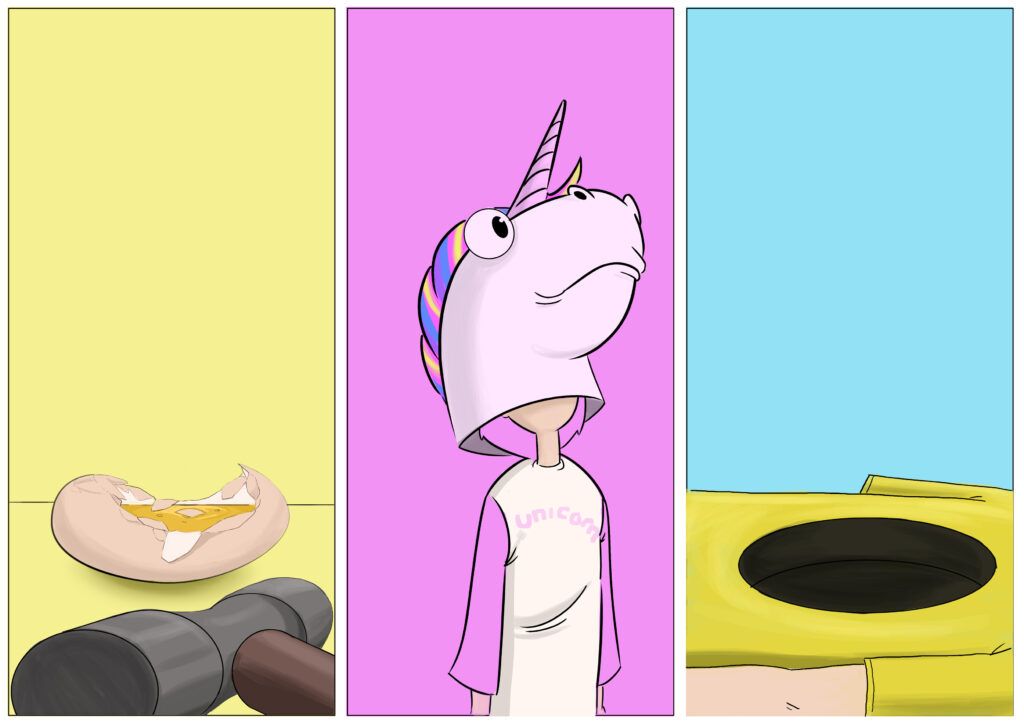
Dante, or why not just call him Axel, awoke as usual because the dreams (he said) had been hammers again. His torso, such a sloppy and hollow feeling, was (to hear him tell it) a cracked eggshell. Outside, while he walked to the café, no one on the sidewalk saw that he was a broken eggshell. No one saw that his/their head had lost its hammers. Anyway, everyone stared at their smartphones.
One child, though, a little girl in unicorn clothes (but she was really a unicorn in a little girl costume—he knew the species all too well), glanced at him as if she hurt how he hurt. Her mother pulled her along the sidewalk. He wanted to reach into his eggshell and, his hands rummaging through the draining yolk, pull out his heart and give to the girl: an offering, a thank you. Epiphany: he must aspire to girlhood, perhaps even to unicornism.
Inside the café, he tasted how too much hopelessness had been brewed into the coffee. Undrinkable. The coffee isn’t even bitter. On the other side of the counter, the barista lowered her enviable proboscis to the brew, and the look on her face confirmed his diagnosis: total resignation. She tossed her green hat and green apron to the ground, dropped her nametag into the trash, and strolled out the door, leaving him completely alone. He decided to read. The newspaper was a redundancy from yesterday. The word spite, only the word spite, printed over and over: spite, spite, on every headline and column. All Spite.
It was time, finally, to process this eggshell status. How long could he cycle through this closed circuit? Sometimes, he’s surprised that he woke up at all. I’m not dead again, he’d mutter to his memories. The memories were slinking back to him like scavengers, as if beckoned by morning light, morning consciousness.
His futile coffee: what now? He scrolled through photos on his phone. He suspected that in all the photos of him and his person, his person’s face, will have vanished. He was right, because this happens every day, and in the photos, every day, his own face ages acceleratingly hour by hour.
He walked outside, though he had not decided to, and he stepped off the sidewalk onto the grass, without any discernible volition. A woman he knew from a nearby shop saw him, and he watched her approach him. Oh, jaunt and smile, hair and boots. He knew what came next. She kissed his cheek and tried to put candy in his mouth, or benzos. But his so-called personal space was sealed as if with sandpaper. He could not feel the woman’s lips on him. Gratified or something, the woman hummed her way back to her shop. He stood on the grass. For a minute, he eyed the trio of hooligans provoking each other from their inertia on a bench. The woman smiled at him from the shop’s window. For ages, he said to no one. Such people made him feel guilty. What now? And why?
Something, he felt, had happened in his life; his life had been something, but he couldn’t bear to interrupt this limbo with a story. A brief jolt of energy: rise like a ghost from this body, he told himself, and race into the afterlife that is the real world, before there’s nothing left of you but shell shards and the ceaseless falling of hammers. But what’s the point? What now?
A horse paused beside the grass. She’s a certified horse therapist, her handler explained. He pondered equine salvation. You interested, the handler asked him.
Everyone told him to consult The Orifice. Coworkers, parents, even the gentle gas station attendant—the folks that filled his busier days concurred. That’s what they had done, and they looked so invigorated. He wasn’t sure how to find The Orifice, though, and he suspected that The Orifice sometimes misled them, sometimes made them need antibiotics. Indeed, there was even talk of a False Orifice.
Decayed fingers began to poke through the grass. Soon, entire arms had emerged from the soil. The withered and green limbs, whose odor was so arousing, sought voraciously, and they found. Greedy, rotten hands began to grab at his ankles. He was surprised, because he wouldn’t have thought the pull of the dead to be so strong. Ah, naiveté.
Soon, he was laughing in hysterics. Of course! The downward pull into the earth hurt. He laughed nonetheless. He laughed until he cried. Once his eyes dried and he caught his breath, he sighed. I’m sorry, he said, but I can’t. It wasn’t easy to yank himself free from so many corpse hands. The word allure glowed in his mind. He scuppered all temptation, stepped from grass to sidewalk, and went on his way.
He thought about a song lyric, or was it a story, where someone talked about loneliness as a companion. No, perhaps goneness would be a better word than loneliness. The problem here is the missing that seeps into the abundance all around us. Again, the hungry memories nipping at him. The faceless photos of his person, and the years that our phones witness more accurately than our eyes. He decided to study the full mileage of the sidewalk.
What time was it? So another year had passed. Wait: he checked his watch again—two. Perhaps he could wake up tomorrow as skin, sinew, and bone rather than shell, residual yolk. This has gone on too long. (But it feels like no time has passed). It was unavoidable, though: his heart was beating in a cracked eggshell, only the eggshell had grown, so his pulse delivered deeper echoes. Again, he considered goneness versus loneliness: don’t we all finally recognize each other, with tenderness and alarm, within this sound? (Where are you, unicorn girl?)
He had never thought a heart could be so loud. But it wasn’t the heart that was loud. It was the heart’s obstinacy, the mindless persistence of drumming on when the ending had already passed. Or was it always about to happen again? What was the sound but the noise of absence? Mutely, a person in an astronaut suit, then a horse-drawn carriage, moved in and out of fog yellowed by streetlights. An entire city, very tall and glassy, very populous, surrounded him, but its living sounds vanished into the loudness of what was gone.
The sidewalk, however, seemed to lengthen the farther onward, in both miles and years, he followed the concrete.