
Vodka tonics, Seal’s “Kiss from a Rose” on repeat, microwave dinners, questionable dalliances…I was built for life as a widower. So built for it I sank into its comforts before my wife had a chance to die from the kidney complications that had plagued her since birth. To hell with convention, I thought at the time. Why wait for the inevitable? Sixteen years Delilah and I were married; I remained faithful for fifteen of them, right up until our neighbour’s annual Christmas party. Delilah, exhausted from her latest round of dialysis, gave me her blessing to go alone.
The night as I remember it: a deluge of vodka tonics, a scrum of sympathetic hugs, condolences fired at me in drunken salvos—
“So sorry to hear about your wife, Tristan.”
“Is Delilah taking visitors? I’d love to say goodbye.”
“Delilah, Delilah, she made the best soufflés…”
Then her. Her. Waist tilted over the balcony’s guardrail, shoulder blades protruding like wings. I stumbled outside, her red dress my beacon. When I reached her, she hitched her painted eyebrows, placed a hand on my wrist, and asked if I was okay; if I needed to lie down; if I needed a glass of water.
“I need you to tell me your name,” I said.
She told me her name, and I repeated it—“Jodi.”
Jodi, Jodi, Jodi.
Fifteen years my junior, Jodi, but already grooves of wisdom at the corners of her eyes—and what a pair of eyes they were. Arctic blue, rusted around the irises, a yellowish smudge near her left tear duct. They didn’t seem to blink as frequently as most people’s eyes, carnivorous focus their default mode.
Delilah never learned of my affair…my son, however, was not so fortunate. Found out in the worst way possible, Owen—the way that makes you buy a lock for your bedroom door. How long he stood there watching Jodi bite his mother’s pillow only he could say. Immersed in our business, Jodi and I didn’t notice him until he slammed the door and marched away.
Six weeks later, Delilah passed away; and three weeks after that, I asked Jodi to marry me. Triple-dollar sign restaurant, diamond ring, down on one knee—I did it right, everything right, and she said yes.
The next day, still hungover from our celebratory drinks, I made myself a vodka tonic before I shared the news with Owen. I found him in the den, perched on my armchair, a book butterflied across his thighs. His feet rested on the Ottoman, paddling the air the way Delilah’s used to whenever she read. The sandals he wore had once been hers; not long after her funeral, he had begun to strap them on, for reasons I never asked about.
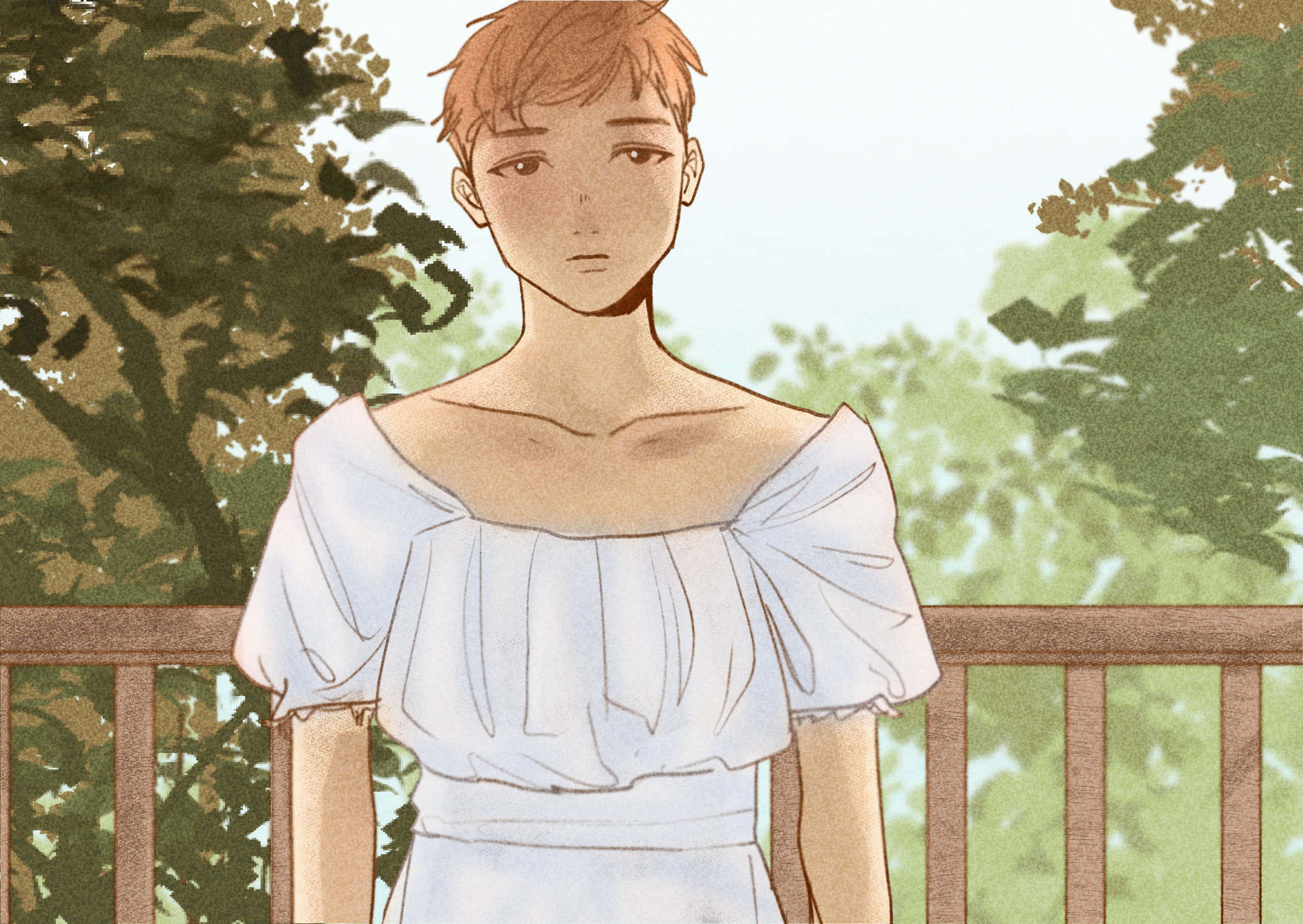
Though his artistic bent came from me, Owen took after his mother when it came to his looks. Red hair, cinnamon eyes, long limbs, tiny ears, freckles everywhere. Even the way he gnawed his lip while he read—all Delilah. Nearly fourteen years old, he had just started to grow, and he currently stood a little over five feet tall, the same height Delilah had been.
I sat on the Ottoman, and Owen stopped paddling his feet. In the corner of the room, Mr. Mustard, Jodi’s geriatric pug, snorted in his sleep.
I laid a hand on my son’s knee. “Owen,” I said.
Owen cricked his neck and brought his book closer to his face.
“Owen, I need to tell you something. Something important.”
Gaze riveted to his book, he said, “Then tell me.”
“Alright,” I said. “Well—Jodi and I made a big decision last night. A big, big decision. To get married, Owen, is what we decided. We decided to get married. I proposed, and she said yes. Owen, are you listening?”
The top of Owen’s book tipped down toward his lap. His feet stopped paddling, and his eyes flickered over mine.
“I know you’re not fond of her, Owen. I understand that, I get that, but you have to realize what a light she’s been for me these past few months. What a blessing.”
Owen’s eyes flickered again. He said, “What are these pieces about, Dad?”
“I’m sorry?”
Owen waved the book at me. I grabbed it and scanned the cover—Dance of the Stringless Puppet: a Collection of Poems by Tristan Mayorwood. The self-published anthology had taken me five years to write. Melodramatic, riddled with mixed metaphors, and filled with clunky line breaks and cringey biographical details, the book had been read by few and appreciated by none, save for Delilah, who said it had heart.
“I don’t get the poems,” Owen said. “Like the one with the naked clown—what’s his deal? Is he supposed to be you?” His feet began to paddle atop the Ottoman again. The grin on his face: toothy, taut. In the corner of the room, Mr. Mustard opened his eyes and huffed at something only his cataract-frosted eyes could see.
I shut the book, ran a finger along the spine, said, “Where did you find this, Owen?” I tried to keep my expression loose, relaxed, but inside me, my heart cudgelled. I took a sip of my vodka tonic to slow it, soften it. “Actually, it doesn’t matter. The book doesn’t matter. Jodi is what matters. Let’s talk about Jodi.”
Owen’s eyes flickered for a third time.
“She wants to be a part of this family, Owen. She wants—”
“To be my new mommy?”
“No. Owen—”
“Or maybe she wants to get in on Mom’s death insurance payout. Maybe she—”
“Owen, you can’t say that! You simply can’t say stuff like that!”
Owen wove his fingers together behind his head and leaned back in Delilah’s chair. He nodded at the book in my hand. “Has she read your work yet?”
I stood, ice cubes clinking in my glass. Mr. Mustard huffed again. “I swear, Owen, I’ve had it, had it, with your angsty bullshit.” I cricked my neck and stalked out of the den and into the hallway, Dance of the Stringless Puppet entrenched in my armpit.
Mr. Mustard followed, claws clicking against the floor.
Later that night, Owen knocked on my bedroom door—a loud knock that made Jodi jump in bed beside me. She set her ouzo down on Delilah’s old nightstand, tightened her robe, and sat up taller against the headboard. Scotch in hand, I went over to the door and unlocked it. Before I could open it though, Owen let himself in. Not only was he still in Delilah’s sandals, he now also wore her pink windbreaker. On his face was the same tooth-laden grin he had given me earlier, only wider now, glossier—a beam almost. He clomped past me. When he reached my dresser, he dragged a finger across the top so that a vein split the dust that had collected there. Delilah had not only been the primary breadwinner of the house—her corporate income exponentially greater than the sums I made strumming flamenco classics for tourists downtown—but the cleaner of it as well. “Jodi,” Owen said, “I would like to speak with my dad. Privately, please.”
I fished an ice cube from my glass and placed it on my tongue. “Jodi can hear whatever it is you have to say, Owen.”
Jodi straightened her back against the headboard. “I’d prefer not to intrude.”
I flapped my hand at her. “No, no—Owen has to learn to be open with you. And that learning can start tonight.”
The grin on Owen’s face shrank, but only slightly. “Please,” he said to Jodi, “may I sit?”
Jodi’s eyes spasmed in my direction. “Of course. Of course you may sit.” She scooted to make room on the bed. Owen scrunched back the sleeves of Delilah’s windbreaker and sat beside her. His gaze went to the nightstand, where Jodi’s ouzo rested next to a photograph of him taken right after he was born, his infant self cocooned in a hospital blanket and cradled against his mother’s chest.
After a second or two of staring, he brought his attention back to me.
“I have a proposition,” he said.
“A proposition?”
“A proposition.”
I chewed the remains of my ice cube. “Okay,” I said. “Let’s hear.”
Owen licked his teeth. “I think you’ll like it, Dad—it’s a bonding exercise. We haven’t bonded much lately, and I miss it; our bonding. Don’t you miss our bonding, Dad?”
I refilled my glass with the Dewar’s on my nightstand, then extracted a Valium from the container that sat beside my lamp. The prescription was meant to last a few months, but Jodi and I had almost gutted the container within the span of a couple weeks. Down my throat the pill went, propelled by a swallow of scotch. “Sure. Sure, I miss bonding. What do you have in mind?”
“I want us to compete in a poetry contest,” Owen said. “Jodi can be the judge.”
The cudgelling from earlier in the day returned. “I don’t think that’s a good idea, Owen.”
Jodi’s brow rippled skyward. “I think it’s a great idea. An excellent, excellent idea. What a fantastic way for a father and son to bond.”
“Jodi,” I said, “I haven’t written in years. I can’t just pick it up like that.”
Jodi smiled, dimples darkening. “Honey, you’re a published poet—don’t be so modest.” She patted Owen’s hand. “I’d be happy to judge, Owen.”
“Self-published, Jodi,” I said. “I’m a self-published poet.”
Owen eased his hand away from Jodi’s. “I have a second part to my proposition.”
“Great,” I said. “More.”
Owen looked at his photo again. “I’d like to place a wager.”
“A wager? Owen, you have no money.”
“No, no, not with money.” Owen reached down and adjusted the strap of Delilah’s sandal. When he looked up again, he had the same deadpan expression his mother would wear whenever she was about to tell a joke. “You said you wanted me to accept Jodi as a member of this family. If you win, I’ll do that—to a degree, I’ll do that. I’ll go to the wedding; I’ll eat the microwave dinners with you; and I’ll even converse while we eat. I’ll do those things.”
I smirked and set my glass down on the dresser. “And let me guess, Owen—we call off the marriage if you win? Is that it?”
“No,” Owen said. His fingers squirmed into the pockets of his windbreaker. “What happens, if I win, Dad, is you quit drinking.” He jabbed his chin at the scotch on my nightstand. “You quit with all that, forever.”

An hour or so after Owen went to bed, Jodi called to me from the bathroom, “What it all really comes down to is priorities, Tristan.” The toilet flushed, and Jodi returned to the bedroom, arms braided over her chest. Her naked body was luminous in the gloom. She stalked over to the bed, where I sat with my back propped against a tower of pillows, flossing.
Oral-B wedged between my molars, I said to Jodi, “It’s not about the booze; it’s about my son having a power trip. He’s become a little shit since Delilah passed.”
Jodi groaned and rubbed her eyes. “Why won’t you just admit you’re scared?”
“Because I’m not.”
“Honey, I can literally smell your fear—it’s miasmic.”
I squeezed my elbows against my ribs to close off my armpits. “Jo, Owen will learn to tolerate you whether we do this poetry thing or not.”
Jodi lay on the covers beside me, said, “Do you know what I heard him say on the phone to his friend today?” Her fingers raked through the fur near my collarbone. “Your son called me a guppy-mouthed harlot. A guppy-mouthed harlot, Tristan.” Lower and lower Jodi’s fingers raked.
“He doesn’t trust you yet, Jodi. He just needs time.”
Then Jodi’s hand alighted on my pelvis, and the floss came out of my mouth.
“Time to give Judge Jodi a kiss,” she said.
What a light; what a blessing.
The morning after Owen’s proposition, I found him in the kitchen, roosting on a stool at the far end of the marble island. A glass of orange juice and a bowl of milk sat in front of him. Next to the bowl, a cereal box lay open on its side, bereft of its innards. How long Owen had gone without cereal, I couldn’t say—I hadn’t gone grocery shopping for at least a week, though, content with the microwave dinners that packed the deep freezer.
Owen must’ve had a dig through the shed, because to go along with Delilah’s sandals and windbreaker today, he now wore her straw gardening hat. Banded around the crown was an ear of dried maize, a blue jay feather, and a plastic sunflower.
I positioned myself opposite Owen and said, “Jodi and I talked last night; and I’ve decided to accept your terms. But there needs to be one more condition: if I win, Owen, I don’t want you wearing your mother’s clothes anymore.” I pressed my palms against the edge of the island. “I never want to see her clothes on you again. Ever.”
Owen swished the milk in his mouth, then he swallowed, picked up his orange juice, and swished some of that. In the pear tree outside the kitchen window, a chickadee chirped. My son rotated in his stool to watch it. For a long while he did this. Then fingered the rim of his glass and bobbed his chin—up, down, up again.
“Ten days,” he said. “Ten days from now we recite our poems for Jodi.”
He reached across the island, and we shook hands.
The state of affairs in the home office that evening, five hours into my writing session: a blank Word doc on my laptop, a pulpy screwdriver in my hand, an ashtray with eleven butts in it beside my other hand, Mr. Mustard asleep at my feet. In front of me, the Word doc’s text cursor winked at the top of the page, taunting me. At times throughout the writing session, I had felt a familiar electricity buzz through me, but whenever my fingers connected with the keyboard, the charge fizzled, and my hands went limp—which was why I now held my screwdriver so tightly: to remind myself I still had power within me.
With my free hand, I lit another cigarette. Then I reached down and patted Mr. Mustard’s belly. But he didn’t move—didn’t even open his eyes. I scratched his ear and still no response. As a Hail Mary, I held the screwdriver under his nose. “Want a lick, Mr. Mustard?” I said.
Maybe it was the sound of his name that did it, but his eyelids finally peeled away from his bulbous eyes. He sniffed at the screwdriver, sneezed twice, then plunked his head back down. I sat up and finished my screwdriver. Downstairs, in the living room, Delilah’s old grandfather clock clanged seven times.
Three days later, Jodi, Owen, and I had lunch together. Well, not together, per se—we just happened to all be consuming meals in the kitchen at the same time, Owen drinking a bowl of milk (even though I had bought him more cereal shortly after we shook hands, he refused to ingest anything but Avalon 2%), Jodi and I gorging on microwaved stroganoff. In addition to the sandals, windbreaker, and gardening hat, Owen now sported Delilah’s blue nail polish and lilac eyeshadow, as well as her silver anklet and satin capris. Sunlight coppered the room around us. Outside, the pear tree shimmied in the breeze.
Jodi bit a strip of beef off her fork and asked Owen how his poem was going.
“Great,” Owen said. “Already finished.”
Jodi whistled. “Speedy Gonzales,” she said.
“And you, honey?” Jodi said to me. “How’s your poem going?”
“Phenomenally,” I said. “Nearly done.” I had yet to write a single word.
“What a pair of superstars you two are!” Jodi said.
Owen said nothing, just drank his milk.
I took a sip of my White Russian and let it sit in my mouth. Not even 6 PM, and I already had a warmth in my chest, a tingling in my fingers and lips. Before Delilah’s diagnosis, I had reserved my drinks for weekends, or late at night, after Owen and Delilah had gone to sleep. But that all changed once Delilah moved into the palliative ward. Earlier and earlier I began to indulge, Owen’s presence in the house alone not enough to guilt me away from the bottle.
Jodi didn’t mind if I drank all day long. “Do what makes you happy, Tristan,” she liked to say. “Happiness is what’s most important.”
Four days before the competition, Jodi asked me what would happen if neither of us won—“Like, what happens if I can’t decide whose poem I like better?” she said. “What if it’s a draw?” We sat at a high table at the Drunken Peanut, a novelty establishment where patrons were encouraged to sweep the shells of their complimentary peanuts onto the floor. Free drinks were offered to women who volunteered to hang their bras from the rafters, and every time a table ordered shots their server had the owner’s blessing to down one with them.
“You have to pick a winner,” I said, “and the winner has to be me. Could you imagine what a shit show it would be if Owen won? It’s gotta be me, Jodi—or it explodes. Everything explodes. I’ll make my poem as good as I can, though, so at least the judgement seems fair.”
“Why bother to write a poem at all then?” Jodi said. “Why not just plagiarize?”
I had considered this, back when Owen first mentioned the contest, but the thought had made me nauseous—even cheaters had their boundaries.
“No,” I said to Jodi. “I want to write the poem. I can do that much for Owen.”
Jodi studied the beer in her glass. “If he were to win, I’d do it with you, you know…or at least, I’d give it a try.”
“Give what a try?” I said.
“Quitting. Haven’t you ever wondered what it would be like to quit?”
I downed the last of my vodka tonic. “I’ve wondered,” I said. “But wondering is easy. Anyone can wonder, Jodi.”
The next morning, I tried to write again, this time in the living room, hoping a change in environment would stimulate my mind. An hour in and still no words, but I persisted regardless, hands going back and forth between my cigarettes and my laptop…back and forth, back and forth, until suddenly a warmth cascaded over my body; a warmth different than booze warmth—not emanating from within but blanketing me. It even felt heavy like a blanket. Next to me on the couch, Mr. Mustard must have felt it too, because he now began to pant, bulbous eyes fixed to the grandfather clock in the corner of the room. I reached for my vodka tonic and took a big swallow. By the time the glass left my lips, the warmth was gone.
The day before the contest, I passed by Owen’s bedroom on my way out of the house to meet Jodi for a celebratory drink.Earlier, in the home office, an electric surge had finally channelled its way from my brain to my fingers, then into my laptop’s keyboard. Word after word, line after line, stanza after stanza—I wrote nonstop until a full poem shone before me. Three pages long and free of mixed metaphors, it was my finest piece to date—a lyrical masterpiece written from the perspective of the pear tree outside the kitchen window, detailing the life events it had witnessed through the glass over the years. After a quick read-through and a few edits, I had texted Jodi to share the good news, and she suggested we meet at the Drunken Peanut, where I was now headed.
Owen was downstairs in the laundry room, ironing Delilah’s clothes, but he had left his door just ajar enough that I could see the laptop on his desk. Beckoned by the gleaming aluminum, I detoured into his room, which despite Delilah’s absence, was as clean as it had ever been, the bed made, the hardwood vacuumed and free of clothes, the dresser devoid of the dust that coated mine. I slunk to his computer and slowly opened it. An older model, it didn’t require a fingerprint to log in, only a password—a password I knew, Delilah having been the one to pick it out for him, afraid he’d succumb to porn addiction if she wasn’t able to monitor things.
Ilovemymom, I now typed, and voila, I was in.
He must’ve been doing last-minute edits, because Microsoft Word was already open, his poem right there on the screen.
I began to read—and as I read, my palms started to sweat. His poem was better than mine; better in every way. Where mine was overwrought, his was subtle; where mine stomped, his danced; where mine spoke plainly, his rooted itself in the unspoken, revealing its essence in the spaces between the words, rather than the words themselves. Where my poem was bad, his was good—and if Jodi were to pick my poem over his, he would know right away the contest was rigged…and that couldn’t happen, or everything would explode.
So to prevent this explosion, I picked up the laptop, raised it over my head, and hurled it. It smacked against the hardwood, and the screen went dark. A few seconds of quiet, absolute quiet—then a clicking sound behind me made me whip around. But it was just Mr. Mustard ambling down the hall. The dog eyed me from the doorway, tongue out, tail curled behind him like a cinnamon bun.
“Shoo,” I said to him. “Vamoose.”
And Mr. Mustard vamoosed.
After Owen discovered his laptop, he didn’t cry; he didn’t yell; he didn’t run away. No—he came down to the home office, where I lay supinated on the floor, a tumbler of vodka held against my belly, no tonic to dilute it. Standing in the doorway, he unzipped his windbreaker, took off Delilah’s hat, and asked me to please wait for him out on the back deck. “I’ll meet you in a minute,” he said. “All you need to do is wait.”
“Yes,” I said. “Of course.”
How could I ever say no to him again?
Before I got up, I placed my vodka on the floor and texted Jodi to tell her I wouldn’t be going to the bar; that I needed some time with Owen. Then I set my phone on the floor, next to the vodka, and headed to the deck, where I sat on a mildewed lawn chair. Sunlight nipped at my eyes, but I didn’t raise my hand to shield them. I didn’t even squint; I just let the damn things burn. Around me, chickadees chimed and dragonflies whirred, and in the back alley a pair of squirrels chittered as they corkscrewed up a telephone pole.
I don’t know how long I waited for Owen on that lawn chair—could’ve been twenty minutes; could’ve been an hour. But eventually the glass door slid open. I swayed to my feet to face my son. Instead of Delilah’s sandals, windbreaker, gardening hat, anklet, and capris, he now wore her wedding gown. The taffeta was too big for him, but somehow he looked just as beautiful as Delilah had the day she glided down the aisle.
Owen drifted across the deck toward me. In one hand he held a bowl of milk, and in the other he held Mr. Mustard. When less than a metre separated us, he halted and extended both dog and bowl toward me. His arm quivered under Mr. Mustard’s weight so I took the dog first, then the bowl. Owen sat on the lawn chair, and I sat beside him on the deck. I laid Mr. Mustard between us. Owen nodded at the bowl of milk. I drank from it until my mouth was coated with its sweetness, then I handed it back to him, and he drank too.
For a long time, we sat and drank milk together—and when the milk was finished, we continued to sit.