
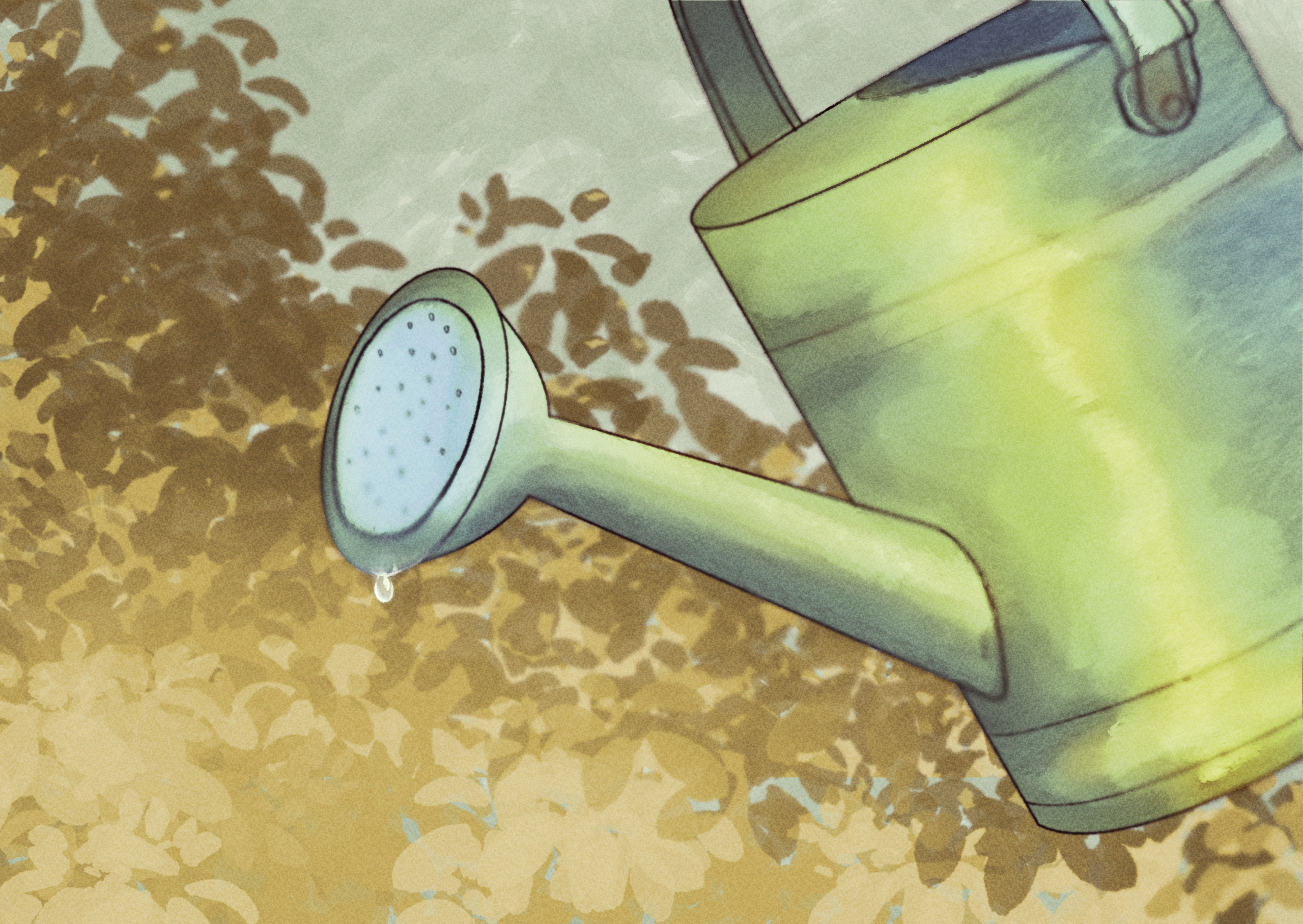
The roses were the first to go. The proud blossoms did their shriveling slowly at first, barely noticeable, then seemed to gain momentum as if accepting their fate, eager to get it over with. The grass yellowed steadily, without drama, the way a man goes gray, before quietly deteriorating into dust. The oak held on admirably – for dear life, as they say – until it too was overcome and surrendered its leaves pathetically, not honorably like every other Autumn.
I’m in the kitchen’s doorway, cuddling a mug of two-day-old, thrice-warmed coffee as the sun creeps a moment higher into the brilliantly blue, cloudless sky. A fly cautiously circles a yellowed pest strip hanging nearby. It alights onto the glue. Tomorrow will be one year since the funeral, one year since my father went upstairs to his bed, one year since it last rained. The fly buzzes helplessly. We all make choices.
The back door neighbor’s back door swings open. Marion launches herself across the yard, unlatches the chain link gate separating the properties and pushes through it. She’s a block of a person, a square, arms forced out to the side as if avoiding her body, wardrobed in her trademark camo and shiny black boots. She started wearing the camo when the drought officially became a crisis, but she’s always had that military vibe, even back in high school. She takes the four steps of the back stoop in two strides, comes to parade rest a few inches on the other side of the screen door.
“Hey,” she says.
“Hi Marion.”
“Just wondering if you were still here.”
“Where else would I be?” I say, nodding toward the second floor.
“How’s he doing?” She mimics my nod upward, and without waiting for a response: “You know you’ve got some serious fissures in your foundation. Your stem walls, right there at ground level. When the soil gets this dry everything settles, unevenly. Haphazardly. Not always. But in your case.” She jerks a thumb over her shoulder. “I can see it from my house.”
I have noticed new cracks zigzagging from doorway corners. And the window in the stairway won’t close properly. When it’s quiet, sometimes you can hear it. The sound of things out of place.
“Anyway. I’m checking on people.”
From a kit bag strapped across her body Marion produces a wrinkled sheet of lined yellow paper, with three columns written in blue ink. Names. Some are preceded by a checkmark. Others crossed out completely. Two are circled, one multiple times.
“How’s your water?”
“Same as everybody else’s, I suppose.”
Marion seems skeptical. But then she always seems skeptical. She leans to her left, surveying the kitchen behind me. Her field jacket hikes slightly – a glimpse of a holstered sidearm; this is a new development. Her eyes widen. I turn to look at what she sees. On the round kitchen table sits a small, potted succulent.
“Tell me you’re not watering that motherfucker.”
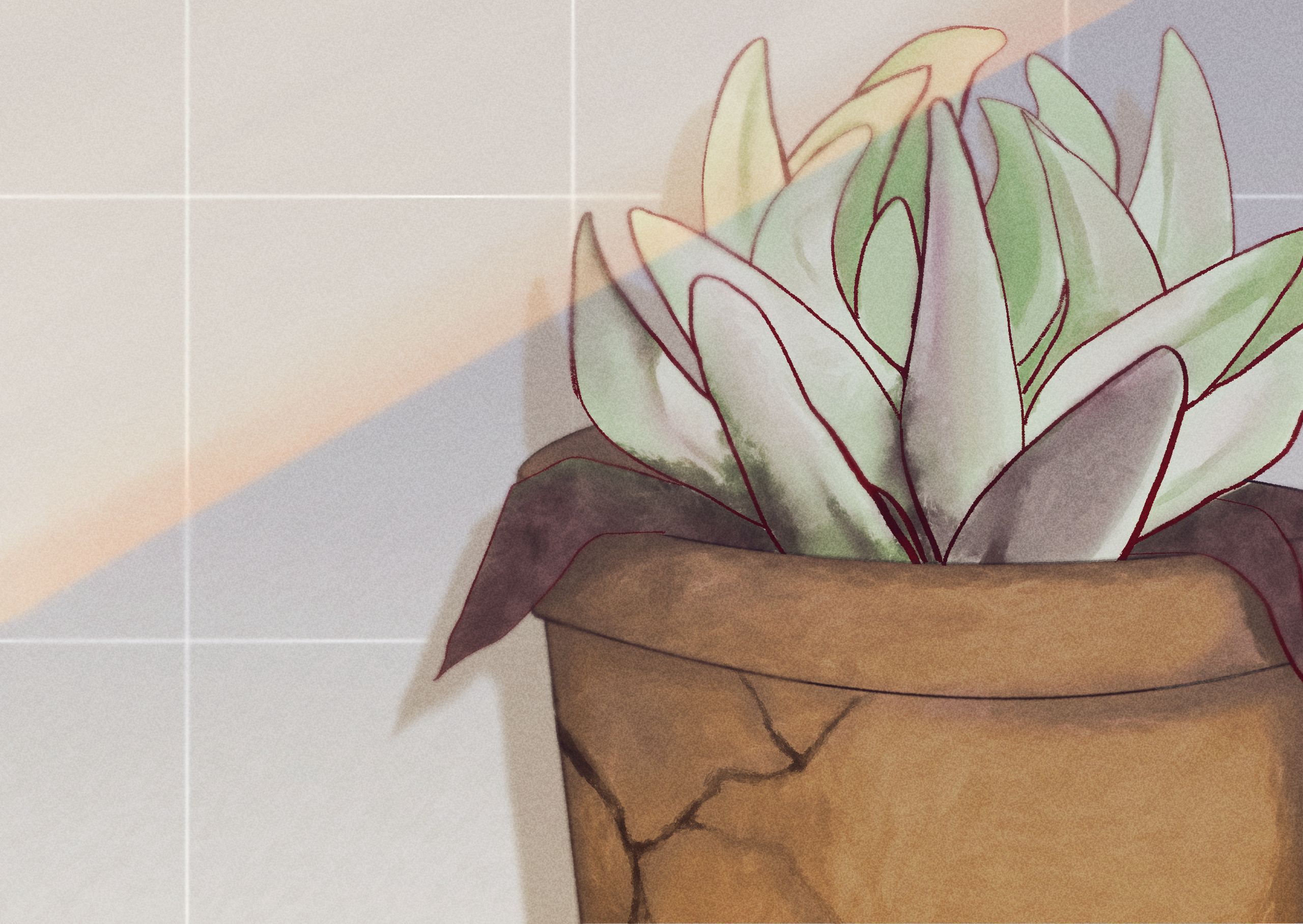
I had, in fact, watered the motherfucker a couple days ago. Against ordinance, yes. But it was a mere sprinkle. Just enough to moisten the dirt. Succulents don’t require much in the way of water. They don’t require much in the way of anything, really. An ideal companion in that way.
“Uh, no,” I say, intentionally non-responsive, but not technically dishonest.
“Look,” she says, “this is hard on everyone. But if we don’t stick together, we all suffer.”
I can’t help but wonder how sticking together would reduce suffering in this situation. You either had water or you didn’t. It wasn’t a question of morale. And wouldn’t it be true that fewer people would make a scarce resource go farther? Nevertheless, I nod.
Marion touches her kit bag. “Do you need a printout of the latest ordinances? A couple new ones since last week.”
“I think I’m good.”
She appears to be contemplating further action. I can’t figure out how she took on this role. Was it official, like a government assignment? Or just a concerned citizen. We’ve seen what concerned citizens can do.
“Okay then,” she says, though not entirely satisfied. She hands me a small card, with a phone number scrawled in black marker. “Let me know if there’s anything I can do.” She clomps down the steps, resets her kit bag and skulks toward the side of the house, perhaps in search of rogue moisture. I give the screen door a shove and it flings wide, earning a moan from the dry spring. I send the remaining coffee arcing from my cup into the dusty yard, where it lands with a satisfying patter. Marion pulls up short, cocks her head. Before the door can slam closed, I catch it with a foot, then ease it into its jamb.
I pin Marion’s phone number on top of the other three Marion’s phone numbers on the small bulletin board next to the phone, with the While You Were Out pad and the pen dangling from a length of red yarn. Just below the scrap with my old Chicago number. The phone, in once-stylish avocado green, clings to the kitchen wall next to the door, its twelve-foot cord sagging to the floor. Mother had insisted on the long cord so she could walk around the kitchen and gossip (no one ever called.) It’s harsh bell slices through the heavy air. I pick up the receiver mid-ring.
“Hello?”
“Hellooo,” the voice trills, “it’s Ann Marie.”
Ann Marie. It takes a moment to place the name. Ann Marie, three doors down, brown split-level on the cul-de-sac. Middle-aged, long wavy hair, suspiciously well-kempt, as if regularly showered. Husband works for the Metropolitan Water District, oversees emergency water allocation. He ordered the water cut off to the Fritz’s house up the street a week ago. They had neglected to update their occupancy status when their son checked back into rehab.
“How’s your dad?”
“Not dead yet.”
She chortles softly. “Sorry,” she says, “I’m sorry. I didn’t mean to laugh. It just reminded me of a funny skit I saw once in a movie. I’m sorry.”
“Monty Python.”
“What?”
“Monty Python and the Holy Grail. It is funny. The bubonic plague.”
“Yes. That’s the one,” she says.
…
(This is a talent of mine: an uncanny ability to paint a conversation into an awkward corner, with no easy exit.)
…
“Anyhoo, just checking to see if there’s anything you need. Anything I can do.”
Just checking to see if I’ll still be collecting two water rations. Disguised as wholesome, bumpkin charm, people around here are purely transactional. Had I always known that? Or maybe you have to leave a place to get that kind of perspective.
“Nope. We’re fine. Thanks for calling.”
“You too,” she says, clearly anxious to get off the phone.
I return the handset to the cradle. From upstairs, the first muffled strains of unintelligible voices crackle from the short wave. I set the mug in the sink, quietly, and ease down the hall to the front room.
A long couch squats under the filthy front window, ocher and burgundy brocade with elaborately carved arms and legs. It’s a holdover from grandmother’s house. After she died, there was no money left so the family carted off the furniture, what little was still usable. My father hated it, precisely because of where it came from. “It smells like her,” he said, under his breath, as if this was explanation enough. Mother adored it, loved “taking her coffee” on it, for a few moments a diva. She also loved napping on it, throughout the day, pretty much every day, sometimes even at night, curled up under her favorite crocheted throw. I remember peeking in at her from the hallway, careful to remain unseen.
It helps to get a little cross breeze in the morning, before the heat kicks in, so I open the front door. Next to one of the frayed wicker porch chairs squats a medium-sized cardboard box, with a few pieces of mail and a magazine lying on top. Yesterday’s mail. I move it all to the coffee table in front of the couch.
An official-looking envelope is addressed to me, as is the box. The magazine is this month’s Southern Living, addressed to Mother. (I had tried to cancel the subscription for months, unsuccessfully.) I’d always been curious about her fascination with the magazine and its precious home stylings, recipes that would never be followed, cleaning and organizing tips. Perched on her couch, she pored over it every month, ashing her cigarette in an empty coffee cup. The rest of the mail is junk, addressed to either my father, or Occupant. The official envelope holds my final severance check. I had drawn things out as long as I could – vacation days, sick days, short-term disability – until HR had no choice. The severance had been surprisingly generous – they liked me at work, I was good at my job – but this was it, there would be no more money coming in. I was, or would soon be, officially broke. With some scissors I slice the tape sealing the box. Contents: a faded Bears jersey, two ironic action figures (one Sigmund Freud and the other Jesus); a random assortment of pens (ball point and fountain); a collection of notebooks containing my writing; three paperbacks. The novels aren’t mine; I hate Sci-Fi. So, who did they belong to? A brief flash of jealousy quickly decays into concession. You can’t leave for a year and expect no consequences. There’s a note: Hey – This is the last of it. J. I turn the small square of paper over. There is nothing on the other side. I survey the little heap of reclaimed possessions. The last of it. What’s left.
I had moved away right after high school, to the most distant in-state college that would take me. Freshman year, I volunteered for the skeleton crew to stay over holidays and keep an eye on the dorms. At the end of each school year, I rolled right into a summer job with the facilities department, which paid in room and board. The rental car was packed and ready to go within hours of completing my last final. After putting it off for weeks, I finally called home to announce that I was moving to Chicago. No, they didn’t need to come up for graduation, I’d be skipping it (true.) No, I wouldn’t be coming home first, there was a job and they wanted me there immediately (not true.) I don’t think I took a breath until I saw the hazy skyline in the distance.
Mother could never understand why I would want to live in Chicago. Why anyone would. It was filthy. Rats everywhere. And dangerous. All those Blacks. And the gays. You’d have to be crazy. She vowed that she would never visit as long as I lived there. I was counting on that. Whenever she wanted to talk she’d call every five minutes until I picked up. I could picture her pacing the curled kitchen floor, hear her sucking on a cigarette between sentences. Sometimes the calls were cordial. Other times there were tears which led to vague insults which became shouted threats until she’d abruptly hang up. Then, as if nothing had happened, she’d send clips from the real estate section of the local paper, beautiful Victorians in the historic district, as if this would lure me back: some romantic notion of life in a storybook small town. But nothing could bring me back. Not the pleas, not the real estate clippings, not the threats. Not for eight years. Then Mother came up with the thing that would do the trick: she died.
Janice had moved in a few months before. She asked if I wanted her to go along to the funeral. She said she could take a couple days off work, and it would be a fun road trip. See where I grew up. Not a chance, is what I thought. Maybe another time, is what I said. The plan was to fulfill my obligation and return the next day.
The small house was crowded, something it had never been throughout my childhood – but who doesn’t love a funeral? It had rained for a solid week (an observation everyone felt compelled to make) but this morning the sun had swept into a cloudless blue sky, returning like a prodigal, turning the air steamy and thick. The church ladies were lined up on the couch, sipping weak coffee, waiting for the proper amount of time to pass so they could leave without offense. There was the kid from high school, Billy something, the one who had given me the nickname “whiskers” on account of the thin white scars on my cheeks. (Gotta hand it to him, much as I hated it, it was a solid nickname. It stuck.) The rest were here because that’s what you did in towns like this: you mind your own business, and you show up at a neighbor’s funeral.
With so many people milling about it was easy to avoid my father. I stole looks at him from across the room, watched him stare despondently at the floor while someone prattled on about his wife, how much she’d be missed – Just tragic She’s in a better place She lives on in our hearts – all the shit people say at a funeral. I was more gracious in accepting the guests’ hackneyed sentiments, nodding and squinty smiling,though I had to force myself not to check my watch. I regretted Janice not being there; she could work a crowd. (Not to mention the laughs to be had on the drive back.)
As the afternoon dragged on, the mourning-appropriate smile I had tacked to my face contorted into more of a wince. It was hot. The air was heavy. I stole back to the kitchen, which was, as expected, empty; it was always stifling at this time of day when the sun was out. I opened the back door, hoping for a breeze. I sensed movement behind me (something I got good at, growing up) and turned to see my father enter the kitchen. Without acknowledging me standing ten feet in front of him he walked to the cupboard next to the sink, opened the door and retrieved an almost-empty bottle of Wild Turkey from the back of a top shelf. He poured what little remained into a juice glass and drank it down. I had never seen him take a drink. Not once. But the bottle was empty. Maybe it was these past eight years, maybe the harsh sunlight, or the weight of the occasion, or all of it, but he looked very old. I considered pity, but it didn’t take. Voices swelled from the front room and quickly returned to a respectful murmur.
This old man. I watched him turn the empty glass in his hand, studying it like some relic. He set the glass down on the counter with a shaky hand, turned to face me. His tie was loose around his neck and his shirt was dark with sweat, steel blue eyes red-rimmed. He swallowed hard, like he was preparing to speak. What could he possibly have to say to me? Motes of dust loitered in the heavy air, waiting. He listed a little to the right. His knees buckled, he gripped the edge of the counter, struggling to hold himself upright. His arms quivered until they gave out and he crumpled to the floor and rolled onto his back. “Goddam it,” he whispered, staring at the ceiling. Billy of the nickname and the pastor helped haul him upstairs and into his bed. The church ladies leapt into action, shooing everyone out and leaving the place cleaner than it had been maybe ever. I stayed upstairs, sitting on the top step with sweat dripping off my nose, waiting until the coast was clear.
The doctor ruled out heart attack, prescribed bed rest. That night I called Janice to tell her I would be staying longer than planned. “Just a few days.” She said she could come down, the train would get her there tomorrow, for moral support at least. No…no. I need to deal with it. She hung up without saying goodbye. I fell asleep on the couch.
Just a few days became a week. Then two, then three. Then another day would simply materialize, like a zombie come to take the place of the one I had just killed. Months of zombie days passed. Calls to Chicago went to the answering machine. References to the lack of rain gradually migrated from the weather report to the news, first as a curiosity, then a looming threat, then a full-fledged disaster.
One of the harshest restrictions to be imposed was regarding the watering of household pets. Severe penalties were levied upon anyone giving water to a “non-essential” animal. People scrambled to register their pets as service animals, until that exemption was repealed. Public sentiment favored the humane treatment of animals, but as the drought dragged on, support began to wane. As rationing deepened, restrictions became more draconian, enforcement more ruthless. Concerned citizens took matters into their own hands, forming roving posses and euthanizing (their word) Fidos and Muffins and Spots left and right. They shot dogs, cats, ferrets, anything that might drink.
The roses died. The grass died. The honorable oak. The house creaked and cracked. Marion began making her rounds. Upstairs, my father developed a cough that often escalated into a fit that caused him to lose consciousness. Standing bedside, I’d watch him black out and wonder if this was it, if this could finally be it. One could hope. (Which came with small wisps of guilt.) But those cold blue eyes would flicker, and then slowly open, and then a small smile would creep onto the old man’s face. Not dead yet.
And here we are.
I gather the jersey, the pens, the notebooks and the action figures back into the box. The books and junk mail go into the trash can. I open the hall closet and hoist the box up to the shelf above the coats, trying to squeeze it next to an old banker’s box which teeters and falls, spilling file folders, tattered manilla envelopes, sheafs of loose papers. Peeking out of the mess is a thin red folder labelled simply Lucille. Inside is a life insurance policy: $100,000, in Mother’s name. An agent’s business card is paperclipped to it.
The agent is no longer employed by the agency, but maybe I can help you. The young woman who answers the phone puts me on hold. This money would come in handy, needless to say. Enough for a caregiver for the old man until he was back on his feet, groceries, utilities. Enough to get me out of here. The woman comes back on the line: The policy is, she hesitates, pending. “Pending what?” My voice becomes sharp, “Resurrection?” She says someone would get back to me.
An hour later they come back with this: the accident wasn’t an accident. That’s how the man who calls puts it, literally: The accident wasn’t an accident. “The fuck does that mean?” He launches into how sorry he is and how hard this must be and someone probably should request an official report from the coroner and then he starts really hemming and hawing, something about middle of the day and about clear skies and about dry roads and then the words indications that the vehicle had accelerated into the bridge abutment. “Okay…” is all I can come up with. The man harrumphs softly and then continues with some official-sounding language about a two-year suicide clause, which means death of the insured by suicide within the first two years of taking out the policy voids the agreement. It’s written into all our policies and unfortunately, well… yeah, it hadn’t been quite two years. “So…” I say, as it all comes together. I hold myself upright with an arm braced against the wall with the avocado phone and its stupid cord and as the man says are you there the line goes dead because I had hung up.
I mean, who hasn’t, right? Considered the bridge abutment ending. The abruptness of that final instant. The absolute clarity. Tell me you haven’t, even for the most fleeting of moments, imagined yanking the wheel and stomping on the gas. If not for yourself, for someone you love. And do you think for a minute that dear Mother didn’t know exactly when two years would be up?
At this moment, sitting in the kitchen, the last thing I would have predicted would be laughter. But that’s what happens. It hauls itself up from my lungs and bursts out of me in a snort, followed by rounds of hearty, belly-level guffaws, sucking breaths in between. Gasping for air. Eyes watering. My laugh fills the room.
But not for long. Being a joyless laugh, it plays itself out quickly, like an unexpected squall. I wipe my face with my hands.
Oh, Mother.
I lean my elbows on the kitchen table and look out at the dead backyard. Where I used to set up the sprinkler to run through in the heat of the day, by myself, because kids I knew from school weren’t allowed to come to my house. The garage where I’d hide whenever Mother started yelling with that voice. That sunny Saturday when I was twelve and she forced my head under the water and with her whole scrawny body shoved my face into the plastic floor of the wading pool and my cheap plastic sunglasses splintered and sliced my cheeks open and I thought for sure I was going to drown – while he just stood there, watching from the kitchen doorway. The table rocks slightly when I stand. It’s never been level.
The steps creak under my weight. A tentative breeze sneaks in through the window that won’t close anymore, nudging the sagging lace curtains. The house itself has had enough.
His room reeks of soiled linens and uneaten eggs. It’s dim; the sun peeks around the edges of the blinds that have been drawn since the funeral. Voices crackle out of the short wave, spitting drought conspiracies. One arm across his gut, the other tucked behind his head. One leg bent at the knee, the other lying flat. Repose.
When I was a kid, I suffered from sentimentality. Mother mocked me for this weakness, relentlessly; told me to get over it. I suppose I have. This was no sentimental undertaking. I did the right thing. I came back. Kept Janice away from all of it. I gave myself a year. Which is to say, as it turns out, I gave my father a year. Because the thing is, you can’t identify a disaster if it doesn’t manifest all at once. The frog, as the saying goes, doesn’t realize it’s being boiled. A drought doesn’t begin as a drought. It begins with a string of beautiful, sunny days. By the time you start to put together what’s going on, it’s already happening. And then, all you can really do is try to save yourself. Eventually, it would rain. It had to. That’s the way the world works, right? It would rain, and then, because of the drought, because the ground had turned hard as rock and all the plants that would absorb the water had died and everything had become impermeable, it would flood. And you’d have to decide which was worse.
I have the advantage of surprise; he doesn’t even acknowledge my presence anymore when I bring in food and take out empties. I pick up a pillow from the floor next to the bed and press it against his face with a single motion, no hesitation, but also no urgency. I put my entire weight behind it. Despite his weakened state, he resists impressively. He lands a couple of shots, one square on the nose which stuns me. But it isn’t enough. I push harder, apply a knee for good measure. I hold the pillow in place far longer than necessary.
There.
Halfway down the stairs I consider making a fresh pot of coffee, despite the fact that it would put me over my allotment for the week. I smile at the idea of a water official standing on the porch, Marion whispering into the man’s hair-tufted ear about the succulent in the kitchen and the crumbling stem walls; Ann Marie standing at the curb with her husband, clutching her pearls. Maybe Marion was right. Maybe adversity did bring people together.
Stepping over the scattered contents of the banker’s box, I move to close the front door and find Budzo, the Fritz’s dog from up the street, collapsed on the porch. His chest heaves and his tongue lolls out of his mouth. Somehow, he had survived. From the looks of him, just barely. I had always wanted a dog. Something to take care of. Unconditional love and all that. Mother nixed the idea; You’ll get attached and then it’ll die and break your heart.
In the kitchen, I find a bowl and fill it with water. When I return to the porch, Marion is standing at the curb, jacket unzipped, side arm in hand. I set the bowl down next to the dog, careful not to spill. He looks at me but doesn’t move. “Go ahead,” I say. “Go ahead, boy.”
There is activity on the street. Folks have left their houses, doors wide open, they’re milling about in their yards and on sidewalks. Necks crane, eyes lift to the sky. Clouds have appeared. And not those cute, puffy, imagination clouds. These are clouds with some heft, with some meteorological significance. These clouds mean business.
A beautiful sound is created when a drop of water lands in water. One of nature’s wonderful and mysterious onomatopoeic utterances. A single drop strikes the surface of the water in the bowl: plop. This is followed by a second, and then another. Marion looks up, blinks. Wet circles splat on the porch deck and quickly fade, the moisture lapped up by the dry planks. More come, hurrying now, countless drops slapping against the wood, darkening the surface. Sounds like applause.
#