Duncan grieves.
As people get older, the frequency of funerals they attend increases to an emotionally unbearable degree. Inoculation to the grief that death causes used to be predictable. First experiences might be a grandparent. Then a friend. If you were unlucky enough, you’d have to make the agonizing choice between a variety of the tiniest caskets for one of your kids. Since it was the poorest of people losing the sweetest of babies, the choice typically came as a consequence of finance. The smallest children could be buried from cuttings of the youngest pine trees, taking up the least green space for an already dwindling world.
Trees are different now. Trees from when the world still had grandparents are a memory to most. Those trees don’t exist today. Flowers now smell slightly sour.
Duncan reminisces.
Statisticians end environmentalists spent most of the 2040s on media platforms arguing over various flawed futures. The most exciting of these masturbatory displays was when a Professor of Environmental Science from UC Berkeley told Frank Greenbaum, a representative from the CDC,
You aren’t even educated enough to predict the impact of human respiration on the rising CO2 levels, even if the population climbs to 11 billion.
The anchor on WKT Network News chimes in on what she thinks is a dead lapel mic.
Oh fuck off, Greg, everyone knows you’re contributing to the overpopulation problem with your fucking grad student.
Surprisingly, Rachel Flannery of WKT News only moves to a different timeslot, but she covers one of UC Berkeley’s more dramatic calls for removal with a delightful spin on the ensuing protests:
“The F*cking Problem: Populous and Power.”
As Duncan leaves graduate school, the population is rapidly approaching 11 billion. His work in Botany hasn’t yielded anything he thinks would actually interest anyone. He pioneered a genetic line of Magnolia trees that produces non-toxic coatings for their seeds. Duncan thinks this might get into Nature and yield a reasonable post-doctoral position, but he is ready to teach at a State School. He isn’t thrilled about the revisions he’ll have to do, or additional experiments he’ll be asked to perform to satisfy a reviewer who thinks he’s missing one crucial bit of data that won’t make a god damn difference but one panel on a figure that won’t make it into the main body. To Duncan, reviewer comments after his paper has been accepted are a bit like unsolicited advice from strangers on the train: he’s only listening because he has nowhere else to go.
This won’t do much for the trees themselves, but we could use the technique to protect other seeds for better agricultural yields. Hell, Norman Borlaug helped mass-produce wheat for the hungry, maybe I can at least make the world smell nice.
Duncan’s wife has other hopes. Freya wants her seeds to grow at an accelerated rate like toxic weeds.
I bet your seeds don’t even taste like anything. They pass right through your animals, Duncan! You created the academic and nutritional equivalent of celery.
Freya was right. Duncan’s seeds give no nutritional value, as his animal studies had shown. The seeds lasted long enough to pass through a rat’s digestive system and come out the other side embedded in its own compost. His animals didn’t gain weight, certainly didn’t lose weight from the otherwise toxic alkaloids that would have leached into their bloodstream had it not been for his manipulations.
That was enough for him. That was all he wanted: a new way to protect his seeds so that some wild animal wouldn’t eat them and needlessly die, taking with it what could have been a beautiful tree of his youth. His work was nostalgia and ego wrapped into a diploma tube or rolled into a fly swatting device if anyone were to keep the print version.
Freya didn’t want her seeds to last at all. She wanted them to explode with the life that was burning within everyone on the already overcrowded planet.
Fuck all these people. They can poison the atmosphere with their breath and opinions. It’ll all be fuel for my plants, anyway. And they’re much nicer to look at. I want trees to block my road, not these people that won’t even read our papers.
Freya’s dissertation was all about what she coined “PLanti-aging.” Because I’m fucking hip, Duncan.
Honey, people haven’t been ‘hip’ since the 1980s.
Freya generated a line of magnolia trees with accelerated growth in the seed stage and extended lifespans. Freya considered herself the more serious botanist, because she avoided animal studies and validations at all costs. Freya’s paper therefore never made it to Nature or Science. The higher impact journals always had an unspoken requirement, one that begged the question from anyone in the life sciences “yes but how will this affect humans.” Freya found this narcissistic and annoying on a good day. Disgusting was more accurate. Freya focused on growing trees. That was enough for her.
It’s typical of two labmates to work on such fine details of an already niche area. That was academia, as Duncan and Freya saw it. How one detail changed, in one specific context, to maybe publish for a total of 60 readers, if you were lucky. Statistically, it was more likely to be 5.
Frank Greenbaum loves statistics.
After he fails to stifle his smile on live television, dying of euphoria at Greg Runnels’ newly exposed infidelity scandal, he walks off the sound stage to his green room where he collapses onto a faux leather couch in full spasms of laughter. Frank hardly had time to be offended for being called stupid before Rachel Flannery let fly such a devastating and unsuspecting blow to his opposing pundit’s credibility. He has just enough time to wipe his eyes and sanitize his hands before he answers a knock at the door. Greenbaum’s assistant hands him briefings on two recently published papers before being escorted out to a black government vehicle.
Frank sees a solution. The end of it all, possibly. The end of suffering, certainly. As the nondescript sedan exits an alley and merges into traffic, Frank emails staff scientists on his team an outline of the next 18 months as he hopes to accomplish what he envisions. He doesn’t know that it will only take 6.
You can call me Freya, Mr. Greenbaum. It’s a pleasure to meet you!
What a relief. I was afraid you were going to insist I call you “DOCTOR.”
Freya shivers in the room where she and her husband meet the director of the CDC’s environmental research center. It’s been two months since Duncan and Freya’s papers have been published. They performed each other’s hooding ceremony on stage for their graduation and kissed to the raucous applause of an auditorium filled with fellow graduate students and advisors. Freya whispered “my favorite hero” for no one else to hear as they hugged. Duncan whispered back “my favorite mad scientist.”
It’s a pleasure to meet you, Duncan.
Duncan greets Frank and notices sweat pooling in his armpit as Frank extends his immaculate and sterile hand. There wasn’t a bump. No hairs. No scars. Frank’s skin was the texture of the polished boots that hid beneath his starched slacks. As they sit down across a conference table, Duncan wants badly to know the amount of lotion it must take to achieve such a uniform landscape of tan skin. Could he call it Olive? Duncan has never quite understood what that term means when it comes to skin. From the handshake he can smell hints of aloe and cherry blossom. Duncan is sure he should be paying attention, but he sits a moment and reflects on the bright red flowers that colored his walks to junior high school.
I’m sorry. Are you suggesting a form of euthanasia?
Duncan remembers where he is.
Yes.
Silence lingers in the room.
You’re saying you combined our research… for some death tincture?
Duncan fumbles, after Freya.
We didn’t do anything like that?
Frank explains.
You’re both wonderful scientists who produced exceptional papers. We just used them in combination for a… tincture, as Freya put it. The world population is rapidly approaching one we cannot afford. Last week an influenza variant swept through North Carolina and became nearly as disastrous an epidemic as smallpox. Suicide is becoming the number one killer of the middle-aged and geriatric, and people are leaving the workforce now at 50. They spend all their time fucking and fighting and expelling toxic human fumes. The amount of oxygen has dropped a few percentage points, yet we all sit here breathing heavily with me sweating through a cotton-polyester blend like it’s 90 degrees. People don’t want to be here.
Duncan breathes slowly, in rebellion.
Duncan, your technique to manipulate the seeds’ coating ensured that Freya’s genetic line wasn’t exposed to patients’
PATIENTS
stomach acid too quickly before sprouting. We found that with the higher volume of stomach acid in humans, your coating degrades slowly enough that the alkaloids released by the seeds into the bloodstream act as a sort of
anesthetic…
Exactly. That in combination with a painkiller constipates the patient so that the seed can stay in someone’s system just long enough before they begin “Blooming.” Caskets will become a thing of the past! Once the patient is buried and creating new green space, their death seems noble to others and a relief to the planet.
Duncan remembers this moment, but months later still can’t comprehend Freya’s excitement. He thought her cynicism of hating people was dramatic for the sake of entertainment. She smiled through the briefing, verged on ecstatic at the idea of patenting the system and reaping the profits. Duncan hardly blinked. All he could do was debate on why the government couldn’t have used Imodium or some other anti-diarrheal.
Frank laughs.
Consider it a perk, Duncan. We can’t reasonably force people to take these pills. But promise them drugs and virtuous fame and you’ll be surprised at how many people wouldn’t mind a premature exodus.
Duncan laments. The ensuing months after the briefing yield eager suicidals, awash with pride. Donating a quarter to charity is arbitrary when you could just stop being part of the problem and start “BloomingTM.” The amount of people that fly to the Amazon for a morose form of mass ecological revitalization simultaneously make their carbon output from the jet fumes seem like nothing more than an exaggerated fart in the atmosphere. Riverbeds long exposed from drilling and harvesting now hardly see the sun.
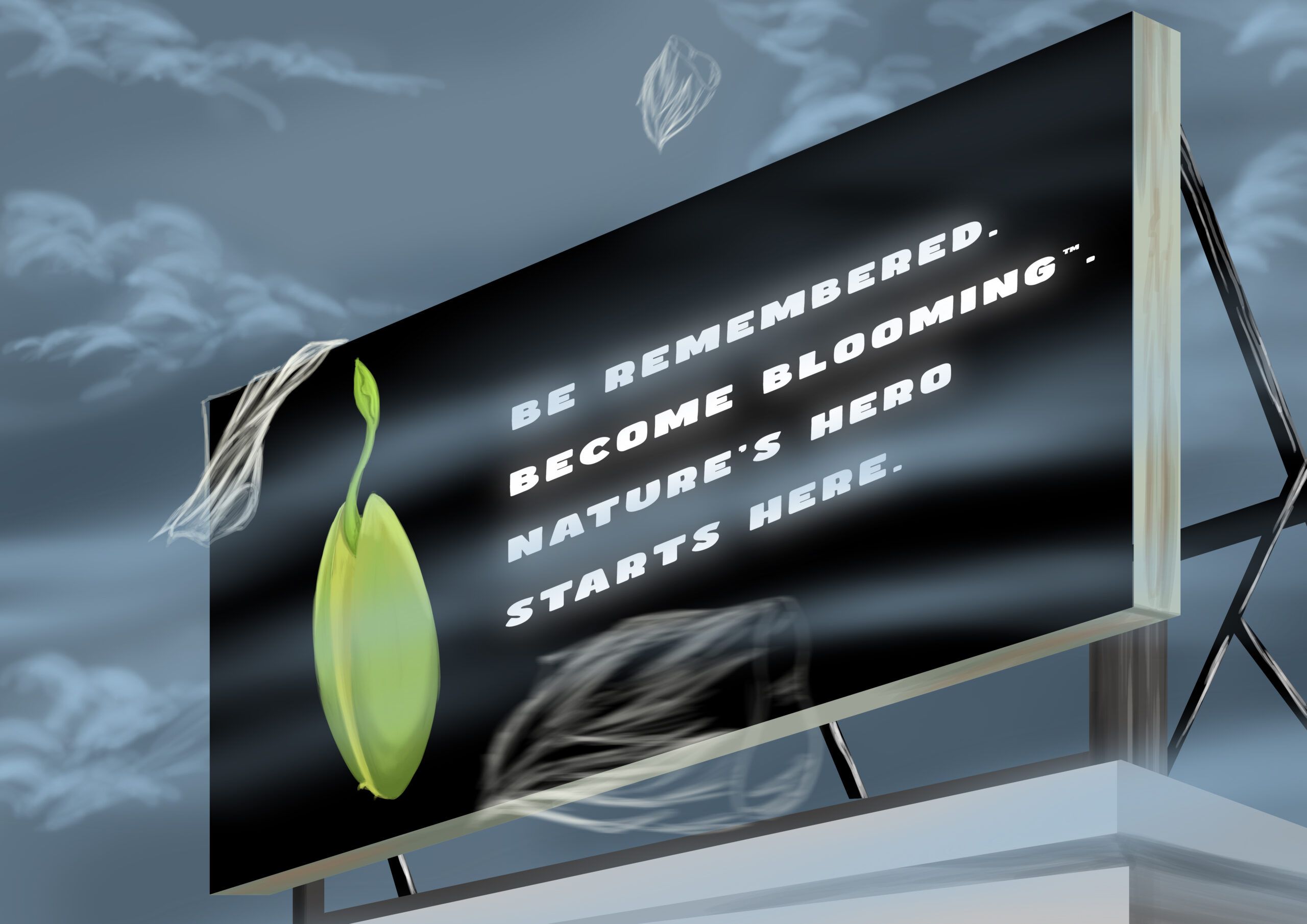
Trees sprout through concrete slabs in empty office spaces; their “FOR LEASE” signs are comparative measurements of how beautiful flowers can be, in juxtaposition to cardboard covered in mold from the microenvironmental humidity being generated in what used to be an H&R Block. Freya finds it beautiful. She updates Duncan daily on the metrics: population; atmospheric oxygen; the money they are saving.
You know there’s talk of giving us the Nobel Prize.
Freya buys a house in Sweden for convenience. In protest of the couple and their contribution to the overpopulation issue, a group identified as The Humanists perform a demonstration of BloomingTM along the fence line of the couple’s estate. By the time the couple arrive in Stockholm, their backyard is bordered by magnolia trees. In the early hours of their first morning in the new home, Freya drinks her coffee in the back yard seated in an Adirondack chair and breathes in the aroma of milk past its expiration date, drifting from the flowers in undulating breezes. Duncan knows the flowers’ smell is because of their unique fertilizer.
When he was younger, Duncan would climb into magnolia trees in his aunt’s backyard. The sap that coated his face and dangling arms in the summer heat served as glue between him and his favorite hiding spot. Duncan would lay on tree limbs the size of telephone poles falling in and out of dreams, surrounded by waxy green leaves and the perfume of the white flowers. His parents sat and drank wine in the sun below him, lulling him to sleep with their conversations.
Duncan now has nightmares.
He dreams of his parents towering over the earth as he lays on their extended limbs and smells their rancid flowers sprouting from fingernail beds. Vines creep out of his Father’s mouth to wrap Duncan’s ankles. His Mother bends at her trunk and displays new blooms to distract Duncan from the saplings that are enclosing his ribcage just before he hyperventilates and wakes to Freya rolling off his chest. Scanning for any source of light, he sweats next to her as she breathes undisturbed and unbothered. Shadows dance across his face from flowers making shadows in the moonlight outside their window.
Freya throws a party the night before the Nobel ceremony. It’s counterintuitive to Duncan as he watches his colleagues become raging animals. Duncan has seen cocaine a total of 3 times in his life, each at a party populated by botanist nerds. This is their way of fighting the mundane. As Freya’s pupils dilate, Duncan watches his wife, half of the laureate duo, cross the room. She’s beautiful and chaotic. He watches her wave at friends from grad school, her rapid speech giving him a chance to see her smile. She approaches as Duncan sulks behind his third cocktail. His glass and his wife both sweat and exchange places on his lips.
Why aren’t you having fun?
Oh, this cake that Frank made is so disappointing.
FUCK YOU I’M NOT A BAKER!
Duncan hesitates. Before he sets the mangled slice down, Freya grabs it off the floral plate and in a second, it’s gone.
Jesus! How much salt did he put in this?
Duncan stares.
As Freya’s pupils constrict, her stomach gurgles loud enough for heads to turn. She steps back and doubles over holding hands across her mouth, anticipating vomit.
Fuck I didn’t think my cake was that bad. Someone get a trash can!
Duncan holds Freya as Freya holds a metal rim and waits for relief. As she wretches, Duncan watches the blood vessels around her eyes burst. The pressure darkens her eye sockets. Freya looks like she’s been beaten. The breath squealing out of her smells sour as the people watching flare their nostrils and step away. The first thing to come is blood.
Duncan panics.
Stimulants.
Freya’s scream is muffled as she wretches again. She looks like she’s about to howl with her mouth stretched so far open. Freya falls before Duncan can catch her. She rolls and arches her back as people begin to shout. Freya’s dress rips as she slams her lower lumbar into the panels and kicks the rug out from beneath her, knocking the trash can over with her spasming head. As blood spills out onto her hair, the sprouts erupt out of her mouth. Freya’s head slows to a rock, waving the plant back and forth.
Guests run.
Duncan stays.
Freya’s dress darkens, producing spots of blood in uniform rings that tent from her body as new blooms form. Roots extend from the fresh wound in her lower back and follow her flexed thigh. Freya’s femur bows just before breaking through her hamstring muscles.
Duncan kisses Freya.
I made a mistake.
Duncan takes his cocktail from the blood and sap-soaked floor and walks out to sit in Freya’s lawn furniture in the middle of the back yard.
The sun makes orange and purple light on the horizon.
Birds wake and sing in distant trees.
Duncan reaches into his pocket and retrieves the last of the pills that did not go into his slice of cake. He swallows and closes his eyes. His deep exhale matches the rhythm of the tainted breeze.
Duncan waits to bloom.