

Translation from the Bulgarian: Izidora Angel
Jim says the boy was quiet and meek. While the other children spent all day running wild by the river or through the sunflower fields over the village, the boy lingered around his uncle Charlie’s house. Charlie had recently returned from the city, bringing with him all sorts of useless trinkets, including a large, shiny pocket watch. Every now and then, Charlie would take the watch out of his vest pocket—not so much to check the time, but to tease his nephew. The boy’s eyes would practically pop out with curiosity. Jim says that once, Charlie let the boy hold the watch for a few seconds. The boy pressed the button beneath the loop, attached to the vest by a long chain. When the lid flipped open, revealing the pure white dial with its thin golden hands, the boy let out such a loud, ecstatic cry that the uncle snatched the watch back, snapped the lid shut, and tucked it into his pocket, leaving the boy both stunned and enchanted. Jim says the boy immediately begged his uncle to let him see the watch one more time, but Charlie simply said, “That’s enough for today,” got up from the bench, and went inside.
In the following days, the boy remained steadfastly by his uncle’s doorstep, secretly hoping he’d be allowed to see the watch again. But each time Charlie appeared at the door, he either pretended not to hear the boy’s pleas or told him outright to leave him alone. Jim says longing and caution seemed to wrestle in the boy’s eyes. For weeks, the boy didn’t dare say anything other than, “Uncle Charlie, please, let me see the watch for just a minute! I promise I won’t break it.”This, according to Jim, was very strange, because by then Charlie should have already chased the boy away for good. But it seemed the uncle took some hidden pleasure in seeing the child wait for him like a beggar each day. He was careful not to crush his nephew’s hopes entirely. From time to time, he’d ask if the boy had been good—if he’d helped his mother in the kitchen or his father at the sawmill. And when the boy eagerly replied, “Yes, yes, I was good, Uncle Charlie!”, Charlie would quickly extinguish his hope with a curt, “Good, good,” and go about his business, leaving the boy crushed.
Jim says this went on for nearly a month until, one day, the boy’s mother appeared on her brother’s doorstep. When Charlie answered the door, she asked him directly, “Charles, what is this watch that my son talks about all day and night? What’s going on?”
Meanwhile, the boy sat silently on a nearby bench, completely still, though Jim says his eyes betrayed that, inwardly, he was trembling with excitement.
“What watch?” Charlie replied.
“Charles!” The woman narrowed her eyes at him.
“You’re bothering me at this hour over some watch? What’s the matter with all of you in this village? From the moment I got back from the city, I can’t get rid of pests.”
“Charles, just let the boy see that watch of yours! He said he only wants to open it and look at it for one minute, that’s all.”
“Ooh, he said so, did he now?!” Charlie turned to the boy and taunted him: “Is that right, boy? You want me to show you the watch, and you think that just because you said so, you and your mother can go knocking on people’s doors, bothering them over nothing at all hours?” He turned back to his sister and added, “What your son needs is a good whipping. That’s what he needs, if you ask me.” With that, he slammed the door in her face. She turned helplessly to her son and said, “There, you wanted me to ask him—I asked him. Now, will you leave me alone?”
But the child sat pitifully on the bench, and Jim says he never saw sadder eyes in his entire life.
Charlie kept tormenting his young nephew for a while longer until, one evening, the boy’s father appeared at his doorstep in wide blue overalls, a tattered straw hat, and covered head to toe in sawdust. Just a few steps behind him, with his hands in his pockets and his gaze fixed on his bare feet, was the poor little fella. Jim says the father knocked on the door for quite a long time before Charlie finally appeared, chewing and smacking his lips as he opened it:
“What the hell are you banging about at this hour?”
“Hey Charlie, I’m so sorry to bother you! You know I would never do this unless it was important.”
“Tell me what you want!” Charlie interrupted him, still chewing.
“Listen, I came here to talk to you. For over a month now, that son of mine hasn’t stopped going on about some pocket watch you showed him. He can’t sleep at night, and now his mother is beginning to lose her mind too. So that’s why I came—to have a chat and see what kind of watch this is, and whether there’s a way for the boy to see it for just a little while. Then we can all go our separate ways. What do you say?”
“Don’t you people have anything better to do than to interrupt my dinner over some damn watch? I thought it was just your hooligan son over there who’d lost it, but now it’s clear your whole family has gone mad.”
“Charlie, Charlie, wait!” the father said, trying to calm him. “Relax, relax!”
“Relax?! Get the hell out of here, the both of you!” Charlie continued to spray crumbs and spit onto his brother-in-law.
“Charlie, calm down! We’re all grown-ups—let’s not argue over nonsense.” And as he wiped the crumbs and spit from his face, he continued in an even gentler tone: “Listen, why don’t you just tell me how much that watch of yours is worth, and we can try to strike a deal? What do you say?”
Charlie stepped slightly backward, as if weighing the offer, but after glancing darkly at the boy, he said, “You’re all completely insane.” Then he turned around, stepped back into his house, and slammed the door behind him.
Jim says the boy didn’t get upset as he had expected. Instead, he just sat motionless on the bench in a strange daze, as though his thoughts were somewhere far away. The father took him by the hand and slowly led him down the road toward their home.
Jim says that over the next few weeks, he saw people coming in and out of the boy’s house, all leaving with pensive expressions, as if in deep confusion. Jim says that half of these visitors were fortune tellers and healers from the neighboring villages, while the other half were doctors from the city. Gradually, it became clear that the reason for all these visits was the child, who had stopped eating and had refused to speak for almost a week. Some villagers spoke of curses, others of black magic, but Jim says it was nothing of the sort—just a severe chill, not in the body, but in the brain, and the boy had barely escaped death. Both young and old tried to peek through the gaps in the tightly drawn curtains of the little run-down house. And though the father and mother left every morning—he for the sawmill, she for the shop—no one dared to ask how the boy was doing.
After another week, new kinds of visitors began to appear at the front door, one by one. Jim says these were relatives of the family, arriving from various parts of the district. Each of them crossed the threshold—some with a basket, some with a bag, some with a large bottle—and each of them left empty-handed, wearing the same grim expression as the fortune tellers and doctors before them. This strange procession lasted two days. On the third day, the mother finally stepped outside, sat on the wooden bench by the fence, and as she removed the large black shawl from her head, her hair was as white as snow.
Another whole month passed, with the father working at the sawmill from dawn till dusk every day, and the mother appearing at the shop only once a day for a brief moment. But Jim says there was no sign of the boy—no news, no trace. The villagers not only didn’t dare to ask about the child, but Jim also says that when the father or mother passed by, people would turn their heads away with a strange sense of shame.
Just when everything had settled down and people had almost forgotten the family’s troubles, a long and piercing wail echoed over the village one night—like the howl of an animal. Jim says it was so loud that dogs all over the village started barking. Windows lit up, and half-asleep people stepped onto their doorsteps to see what was happening, while the terrible howl not only did not stop—it seemed to grow stronger and stronger.
Groups of villagers gathered, wandering the streets with lanterns, trying to find the source of the wailing. It wasn’t long before they reached Charlie’s house, where the boy knelt just steps from the door, screaming at the windows: “Tiiiiick-tooooock! Tiiiiick-tooooock!” On the doorstep, across from him, Charlie stood frozen in horror, while the boy, in some kind of wild trance, kept shouting louder and louder in front of the astonished villagers: “Tiiiiick-tooooock! Tiiiiick-tooooock!” Jim says the boy’s infernal cries didn’t cease until his father suddenly emerged from the crowd, grabbed him, and attempted to calm him down. Little by little, the child quieted, then fell completely silent, as the people around them stood as if hypnotized. Finally, the father led the boy away through the narrow passage formed by the crowd. Jim says he had never in his entire life seen a face as horrified as Charlie’s that night—standing on his doorstep in his pajamas, holding a lantern in front of the gathered villagers, who, without saying a word, slowly began to disperse, leaving him alone, lantern in hand, like some kind of ghost.
Jim says that the next day, the father did not go to the sawmill, and the mother did not leave their home. The villagers couldn’t stop marveling at the previous night’s strange occurrence. But gradually, each found some explanation for what they’d seen and heard, and by the end of the day, the general excitement slowly subsided. And just when the whole village had sunk into pitch black darkness and deep sleep, at the same time of night, like clockwork, the same earth-shaking cry echoed: “Tiiiiick-tooooock! Tiiiiick-tooooock!” And Jim says that this time, it took the villagers only minutes to gather in front of Charlie’s house, where they found him pacing with a lantern around the boy, shouting angrily in his face. But the boy, still kneeling with his hands raised as if in prayer, seemed not to see or hear him, only letting out an increasingly piercing howl that made the hairs on the necks of those gathered stand on end.
Jim says, on the third day, early in the morning, Charlie finally mustered the courage to knock on the door of the boy’s parents. He banged on it for quite a long time before the mother finally opened. Before she could say anything, Charlie began: “What gives you, your husband, and that sniveling brat of yours the right to harass me and the whole village? Who do you think you are, and do you for one second think this will just slip by without any consequences? I’m marching straight to the constable’s office, and then we’ll see who’s going to be screaming at people’s doors all night.”
Jim says the woman said nothing, only stepped back and quietly closed the door in front of the angry and powerless Charlie, who, seeing that curious villagers had started to gather around again, ran up the street toward the constable’s office. About an hour later, he returned to the parents’ door, this time accompanied by the constable himself. After the constable knocked discreetly, the father appeared and listened carefully to his inquiries. But just as the mother had done an hour earlier, he silently stepped back and closed the door on the astonished constable and the now-furious Charlie. The constable knocked a second time, this time more insistently. The door opened again, and this time the father invited the constable inside, asking Charlie to stay outside. After a few minutes, the constable reappeared, adjusted his cap, and said firmly, “Go home, Charlie!”
The following night, people had already begun gathering in front of Charlie’s house, anticipating another appearance from the boy and his spine-chilling screams. Charlie himself timidly cracked the door several times to check if the boy had once again knelt at his doorstep, but he was met only with the curious gazes of his fellow villagers. Only Jim claims to have seen how, earlier that same night, a large car had stopped in front of the boy’s house. Two burly men carefully helped him into the vehicle; the mother and father followed, each carrying a large bag, before the car drove slowly up the road and out of the village.
When the boy failed to appear, people gradually dispersed. But Jim says the surprise came the next evening, when villagers began to gather again one by one in front of Charlie’s house. This time, some brought food, others pulled out bottles of wine, and soon a general celebration began on the lawn. Of course, it wasn’t long before Charlie appeared on the doorstep, in his pajamas and holding a lantern, shouting at the villagers to go away, threatening to complain to the constable. But not only did no one pay attention to him, some even jokingly invited him to join them.
Jim says that, night after night, the merrymaking in front of Charlie’s house expanded as people from neighboring villages began joining in. Traveling musicians, wandering caravans, and merchants with stalls added to the revelry until the chaos grew so intense that—according to Jim—the entire village resembled a drunken, unruly beehive. The constable and sheriff stood utterly powerless against the crowds, despite Charlie’s daily complaints.
Several weeks passed, and while the village fell into a drunken bacchanal every night, there was no sign of the boy or his parents. The house appeared uninhabited, and the sawmill was left unattended. Jim says that soon everyone in the village had forgotten about the family. Everyone, that is, except Charlie. One night, in the middle of one of the revelry, Charlie unexpectedly appeared with a lantern in hand, pacing around the empty space in front of the doorsteps, shouting into the void: “Boy, go away! Do you hear me? Leave me alone! Tomorrow, I’ll go to the constable. Your father will skin you alive! Go away, boy! Do you hear me?”
Jim says that from a distance, it all looked like some strange ritual, with Charlie singing his mad song and the crowd joining in. As the first rays of dawn appeared, people gradually dispersed, leaving poor Charlie exhausted and silent on the bench, the lantern still glowing in his hand, quietly repeating in a hoarse voice, “Go away, boy! Do you hear me? Go away!”
Every night, the carnival grew more intense, until one evening, Charlie appeared at the door, sat on the grass, and, taking his watch from the left pocket of his vest, quietly said to the void before him, “Here! Here’s the watch! Look, here under the bezel, you press this button and… hop! What do you think? Here, take it! See, the smaller hand shows the hours, the larger one—the minutes, and this thin one—the seconds. Tick-tock, tick-tock! Just like that!”
Jim says that he had never in his entire life seen such compassion as he saw that night on the faces of the suddenly silent crowd.
The following night, the field in front of Charlie’s house was completely empty. There was no sign of the drunken revelry, traveling caravans, or noisy merchants. Only Charlie quietly opened the door, sat on the grass in front of his doorstep, and began speaking:
“The merchants in the town are all swindlers and thieves, but I managed to bargain for this watch for almost half the price. I told that scoundrel: ‘Listen, do you see this money? It’s up to you to decide whether to take it or not. But when I return to my village, my nephew will have a new watch, and the only question is whether it will be from your shop or the one across the street.’ The old scoundrel tried to wriggle and make excuses, but when he saw me walking away, he shoved the watch into my hand and grabbed the money. But look, look at the chain—it feels as soft as velvet on the palm!”
Jim says that Charlie was crying as he spoke to the void before him, and he continued to talk with tears in his eyes until sunrise, when he finally went home.
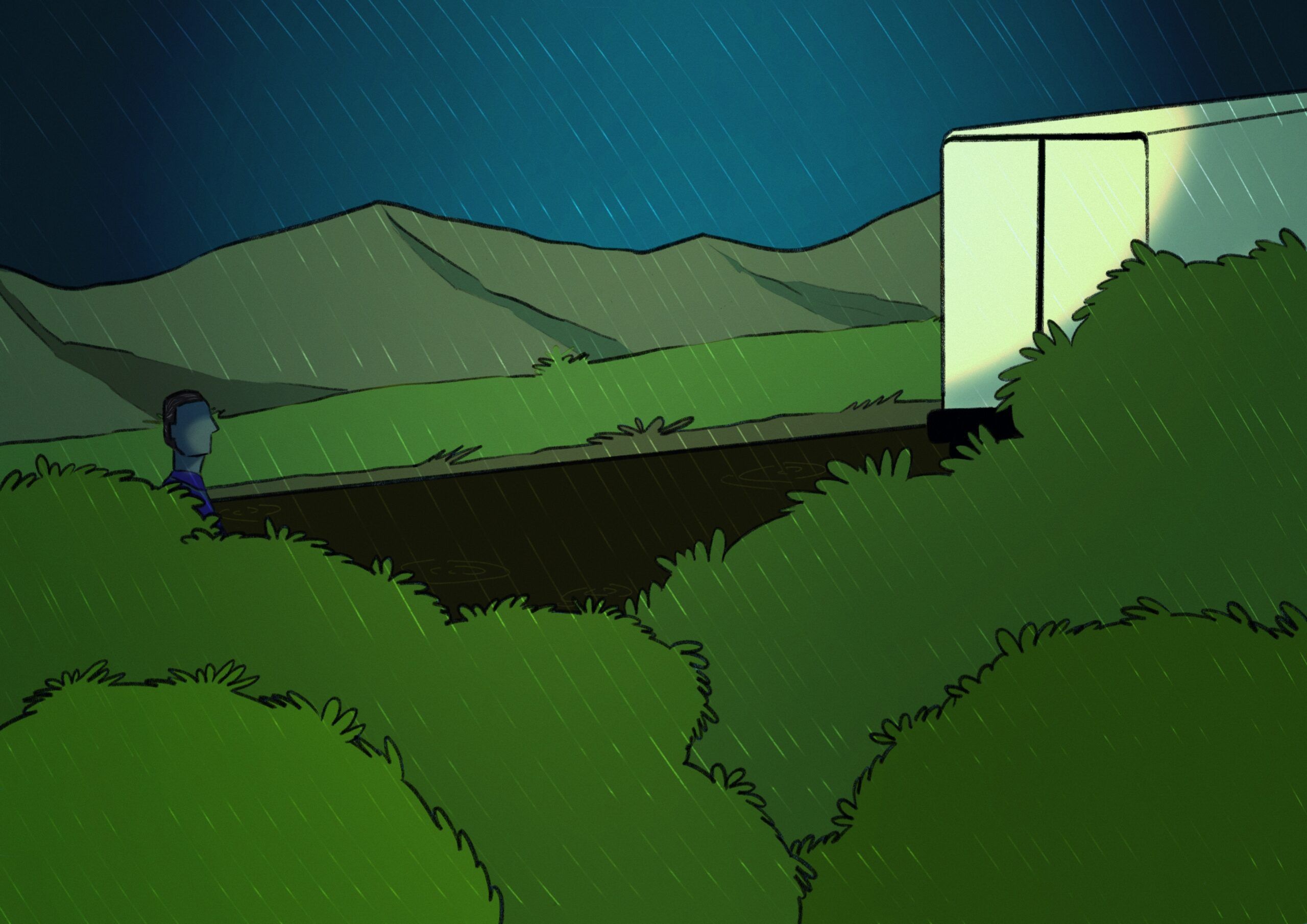
And so, every night for an entire month, Charlie went out, sat in front of his doorstep, and uttered words the villagers no longer understood. Then, one early rainy morning, just before dawn, the same large car that had taken the boy and his parents away passed by. Charlie quickly stood up and followed the car down the road. Jim says he watched from a distance, holding his breath, as the mother and father got out of the car, and the same two burly men helped the boy get out and slowly walk those few steps from the car to the front door. Then the car disappeared up the road, leaving Charlie all alone in the pouring rain, still muttering his incomprehensible words.
Jim says Charlie didn’t move from his spot until a few hours later, when the father appeared at the door in his wide blue overalls and worn straw hat. He looked at Charlie with a sad gaze and said, “Charlie, don’t stay out here in the rain! You’ll catch a cold! Go home and warm up!” Then he continued down the road toward the sawmill, leaving behind the stricken with grief Charlie, who didn’t budge from his spot.
Not long after, the mother appeared and gently said, “Charles, why are you sitting here in this pouring rain? Go home or you’ll catch a cold! Come on, go home!” And she continued up the road toward the shop, leaving Charlie still motionless, his head lowered.
After a few hours, the rain finally stopped, the heavy clouds dispersed, and Jim says that he had never seen such a bright sun in his entire life. And just as the sun’s rays illuminated the whole village—from the river to the sunflower fields—the door of the house opened, and the boy appeared. He slowly walked to the bench in front of the fence and sat down. Jim says that only then did Charlie’s tears and ramblings finally stopped, and for the next hour, uncle and nephew sat across from each other: the boy—quiet and calm on the bench, the uncle—kneeling a few steps away, with his hands raised as if in prayer. Then, at one point, Charlie quietly said:
“Show me the watch!” At first, the boy didn’t respond, but after a while, Charlie quietly repeated: “Please, show me the watch! I promise I won’t break it.”
The boy lowered his head, as if deep in thought, then looked up at his uncle and gestured toward him:
“Come, Uncle Charlie, sit here next to me.” Charlie slowly stood up with unbelieving eyes, took a few clumsy steps, and sat heavily on the bench next to his nephew. “Give me your head, uncle! Like this.”
Charlie slowly leaned toward his nephew and rested his tired head on his shoulder.
“There, there! Calm down, calm down!”
“Please, show me the watch!”
“Calm down, calm down!”